Probability & Statistics: Pascal, Bayes, Gauss & Kolmogorov
Encyclopedia/1. The Cosmos & The Natural World/1. Mathematics & Formal Systems/07. Probability, Statistics & Stochastics • Curated by Admin Timeline.sg
The formalization of probability and statistics from the 17th century gambling problems to the modern axiomatic foundation and data science tools, encompassing key figures like Pascal, Bayes, Gauss, Fisher, and Kolmogorov.
Chronological Storyline (36 Milestones)
Jul 29, 1654 CE
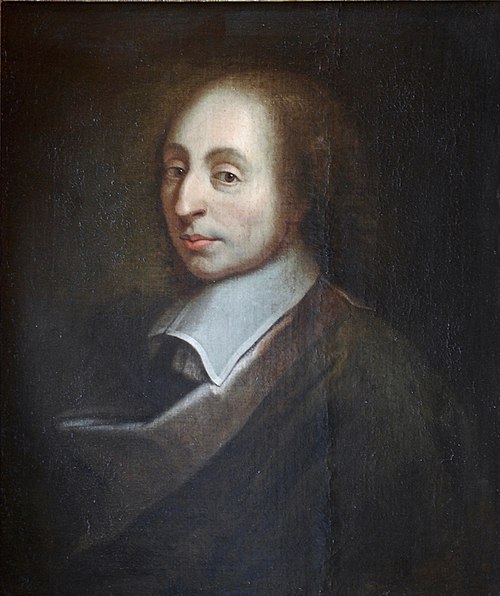
Pascal-Fermat Correspondence on Probability
Blaise Pascal and Pierre de Fermat exchange letters solving the problem of points, laying the foundation for probability theory. #probability #history
Pascal-Fermat Correspondence on Probability By unknown; a copy of the painting of François II Quesnel, which was made for Gérard Edelinck en 1691[réf. nécessaire]. - Own work, Public domain, https://commons.wikimedia.org/w/index.php?curid=12193020
1657 CE
Huygens Publishes 'De Ratiociniis in Ludo Aleae'
Christiaan Huygens publishes the first printed book on probability, introducing the concept of expected value. #probability #mathematics
Huygens Publishes 'De Ratiociniis in Ludo Aleae' By Caspar Netscher - http://ressources2.techno.free.fr/informatique/sites/inventions/inventions.html, Public domain, https://commons.wikimedia.org/w/index.php?curid=44047
1662 CE
Graunt Publishes 'Natural and Political Observations'
John Graunt analyzes London mortality data, founding demography and vital statistics. #statistics #demography
1713 CE
Bernoulli's 'Ars Conjectandi' Published Posthumously
Jacob Bernoulli's treatise includes the law of large numbers and foundational work in probability. #probability #law_of_large_numbers
Bernoulli's 'Ars Conjectandi' Published Posthumously By Jakob Bernoulli - http://nsm1.nsm.iup.edu/gsstoudt/history/images/arsconj.html, Public domain, https://commons.wikimedia.org/w/index.php?curid=4099411
1718 CE
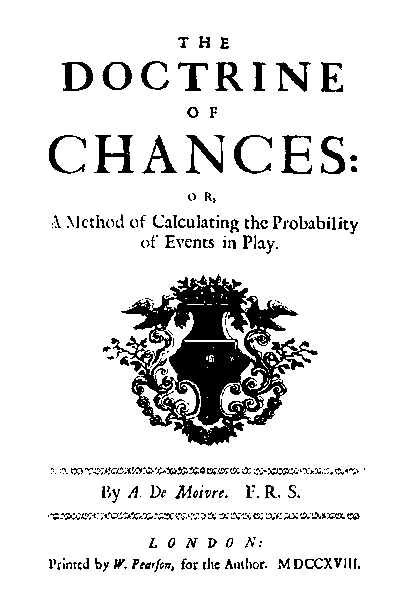
De Moivre's 'The Doctrine of Chances'
Abraham de Moivre publishes the first systematic account of probability theory, including the normal curve approximation. #probability #normal_distribution
De Moivre's 'The Doctrine of Chances' By Abraham de Moivre - http://www-groups.dcs.st-and.ac.uk/~history/Bookpages/DeMoivre10.gif, Public domain, https://commons.wikimedia.org/w/index.php?curid=3664582
1733 CE
De Moivre Discovers Normal Distribution
Abraham de Moivre derives the normal distribution as an approximation to the binomial, a precursor to the Central Limit Theorem. #statistics #normal_distribution
De Moivre Discovers Normal Distribution By Joseph Highmore - https://prints.royalsociety.org/products/portrait-of-abraham-de-moivre-1667-1754-rs-9548, Public domain, https://commons.wikimedia.org/w/index.php?curid=167394521
Dec 23, 1763 CE
Bayes' Theorem Presented to Royal Society
Richard Price presents Thomas Bayes' posthumous essay containing Bayes' theorem, now fundamental to inverse probability. #probability #bayesian
1774 CE
Laplace's Memoir on the Probability of Causes
Pierre-Simon Laplace publishes his first major work on probability, formalizing inverse probability and introducing the principle of indifference. #probability #inverse_probability
Laplace's Memoir on the Probability of Causes By James Posselwhite - www.britannica.com, Public domain, https://commons.wikimedia.org/w/index.php?curid=11128070
1805 CE
Legendre Publishes Method of Least Squares
Adrien-Marie Legendre develops the method of least squares for fitting curves to data, a cornerstone of statistical modeling. #statistics #least_squares
Legendre Publishes Method of Least Squares By Krishnavedala - File:Linear least squares2.png, CC0, https://commons.wikimedia.org/w/index.php?curid=70820642
1809 CE
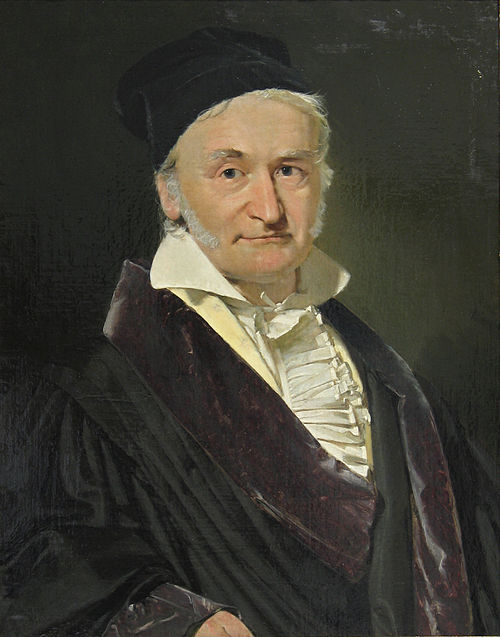
Gauss Justifies Least Squares with Normal Distribution
Carl Friedrich Gauss publishes 'Theoria Motus Corporum Coelestium', linking the normal distribution to the method of least squares. #statistics #normal_distribution
Gauss Justifies Least Squares with Normal Distribution By Christian Albrecht Jensen - http://archiv.bbaw.de/archiv/archivbestaende/abteilung-sammlungen/gesamtbestand-des-kunstbesitzes/gelehrtengemaelde/gelehrtengemalde-seiten/ZIMM-0001.html, Public domain, https://commons.wikimedia.org/w/index.php?curid=6886354
1812 CE
Laplace's 'Théorie Analytique des Probabilités'
Laplace publishes his comprehensive work synthesizing probability theory, including generating functions and the Central Limit Theorem. #probability #statistics
1835 CE
Quetelet Introduces the 'Average Man'
Adolphe Quetelet applies statistics to social science, introducing the concept of the 'average man' and using the normal distribution. #statistics #sociology
Quetelet Introduces the 'Average Man' By Joseph-Arnold Demannez - This image is available from the United States Library of Congress's Prints and Photographs division under the digital ID cph.3b11632.This tag does not indicate the copyright status of the attached work. A normal copyright tag is still required. See Commons:Licensing., Public domain, https://commons.wikimedia.org/w/index.php?curid=4080229
1855 CE
John Snow's Cholera Map and Statistical Analysis
John Snow uses map-based statistics to trace a cholera outbreak to a contaminated water pump, pioneering epidemiology. #statistics #epidemiology
John Snow's Cholera Map and Statistical Analysis By Unknown author - [1] Originally from en.wikipedia; description page is/was here., Public domain, https://commons.wikimedia.org/w/index.php?curid=403227
1866 CE
Mendel's Laws of Inheritance and Statistical Patterns
Gregor Mendel publishes his experiments on pea plants, using statistical analysis to formulate the laws of heredity. #statistics #genetics
Mendel's Laws of Inheritance and Statistical Patterns By Unknown author - http://0.tqn.com/d/biology/1/0/l/e/3244238.jpg, Public domain, https://commons.wikimedia.org/w/index.php?curid=33347279
1877 CE
Galton Discovers Regression to the Mean
Francis Galton identifies regression toward the mean in data on heights, a key concept in statistics. #statistics #regression
Galton Discovers Regression to the Mean By w: Francis Galton - https://books.google.ru/books?id=vL0hq80XXqMC&pg=PA183. Transferred from en.wikipedia to Commons. by User:Chaosconst, Public domain, https://commons.wikimedia.org/w/index.php?curid=4796196
1888 CE
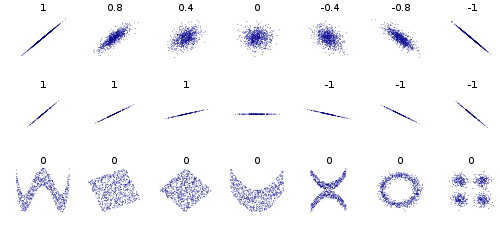
Galton Introduces the Correlation Coefficient
Francis Galton formalizes the concept of correlation to measure the strength of relationship between variables. #statistics #correlation
Galton Introduces the Correlation Coefficient By DenisBoigelot, original uploader was Imagecreator - Own work, original uploader was Imagecreator, CC0, https://commons.wikimedia.org/w/index.php?curid=15165296
1900 CE
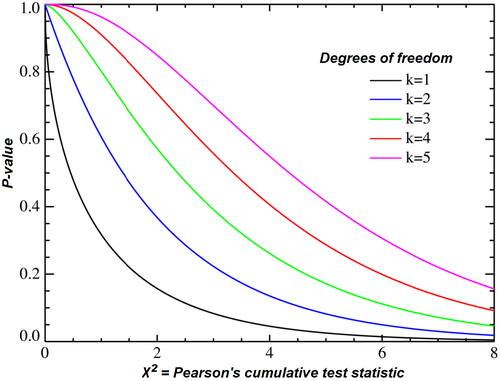
Pearson's Chi-Squared Test
Karl Pearson develops the chi-squared test for goodness of fit, a foundational hypothesis test. #statistics #hypothesis_testing
Pearson's Chi-Squared Test By Mikael Häggström - File:Chi-square distributionCDF.png, Public domain, https://commons.wikimedia.org/w/index.php?curid=10633630
1908 CE
Student's t-Distribution Published
William Sealy Gosset, under the pseudonym 'Student', publishes the t-distribution for small sample inference. #statistics #t_distribution
Student's t-Distribution Published By Skbkekas - Own work, CC BY 3.0, https://commons.wikimedia.org/w/index.php?curid=9546828
1922 CE
Fisher Introduces Maximum Likelihood Estimation
Ronald A. Fisher introduces the method of maximum likelihood as a general approach for parameter estimation. #statistics #maximum_likelihood
1925 CE
Fisher's 'Statistical Methods for Research Workers'
Fisher publishes a seminal book that standardizes statistical methods and introduces analysis of variance (ANOVA). #statistics #ANOVA
Fisher's 'Statistical Methods for Research Workers' By R. A. Fisher - https://archive.org/details/statisticalmethoe2fish/page/n7/mode/2up, Public domain, https://commons.wikimedia.org/w/index.php?curid=183805761
1928 CE
Neyman and Pearson Formalize Hypothesis Testing
Jerzy Neyman and Egon Pearson develop the theory of hypothesis testing, including type I and type II errors. #statistics #hypothesis_testing
1933 CE
Kolmogorov Publishes Axioms of Probability
Andrey Kolmogorov establishes the modern axiomatic foundation of probability theory in his book 'Foundations of the Theory of Probability'. #probability #axioms
Kolmogorov Publishes Axioms of Probability By Ainali - Own work, CC BY-SA 3.0, https://commons.wikimedia.org/w/index.php?curid=3141713
1935 CE
Fisher's 'Design of Experiments'
Ronald Fisher publishes 'The Design of Experiments', introducing randomization and the analysis of variance. #statistics #experimental_design
1936 CE
Mahalanobis Introduces Distance Measure
Prasanta Chandra Mahalanobis develops the Mahalanobis distance, a statistical measure for multivariate analysis. #statistics #multivariate
1946 CE
Wald Develops Sequential Analysis
Abraham Wald introduces sequential analysis, a method for statistical inference where sample size is not fixed. #statistics #sequential_analysis
1948 CE
Shannon Publishes 'A Mathematical Theory of Communication'
Claude Shannon founds information theory, defining entropy and mutual information, with deep links to statistics. #information_theory #statistics
Shannon Publishes 'A Mathematical Theory of Communication' By Claude E. Shannon and Warren Weaver - https://archive.org/details/in.ernet.dli.2015.503815/page/n5/mode/2up, Public domain, https://commons.wikimedia.org/w/index.php?curid=171159167
1953 CE
Metropolis Algorithm and Monte Carlo Methods
Nicholas Metropolis et al. publish the Metropolis algorithm, a Markov chain Monte Carlo method for sampling from complex distributions. #statistics #MCMC
Metropolis Algorithm and Monte Carlo Methods By Jaewook Lee Woosuk Sung Joo-Ho Choi - Metamodel for Efficient Estimation of Capacity-Fade Uncertainty in Li-Ion Batteries for Electric Vehicles June 2015Energies 8(6):5538-5554 DOI:10.3390/en8065538, CC BY 4.0, https://commons.wikimedia.org/w/index.php?curid=130401255
1960 CE
Kalman Filter Developed
Rudolf E. Kálmán publishes the Kalman filter, a recursive algorithm for estimating the state of a dynamic system from noisy measurements. #statistics #signal_processing
Kalman Filter Developed By Petteri Aimonen - Own work, CC0, https://commons.wikimedia.org/w/index.php?curid=17475883
1966 CE
Bayesian Statistics Revival Begins
Works by Lindley, Savage, and Edwards revitalize Bayesian statistics, applying subjective probability and decision theory. #bayesian #statistics
1970 CE
Efron Introduces the Bootstrap
Bradley Efron proposes the bootstrap method, a resampling technique for estimating sampling distributions. #statistics #bootstrap )
1974 CE
Akaike Information Criterion (AIC) Published
Hirotugu Akaike develops the AIC, a model selection criterion based on information theory. #statistics #model_selection
1984 CE
Geman and Geman's Gibbs Sampler
Stuart Geman and Donald Geman introduce the Gibbs sampling algorithm for Bayesian image restoration. #statistics #MCMC
1990 CE
Gelfand and Smith Popularize MCMC
Alan Gelfand and Adrian Smith demonstrate the power of Gibbs sampling for Bayesian computation, sparking widespread use. #statistics #Bayesian
1993 CE
MCMC Methods Revolutionize Bayesian Statistics
Advances in Markov chain Monte Carlo make Bayesian inference computationally feasible for complex models. #statistics #MCMC
1996 CE
Lasso Regression Proposed by Tibshirani
Robert Tibshirani introduces the lasso (least absolute shrinkage and selection operator) for regression shrinkage and variable selection. #statistics #machine_learning )
2001 CE
Breiman Publishes Random Forests
Leo Breiman develops random forests, an ensemble learning method based on bootstrapping and decision trees. #statistics #machine_learning