300 BCE
Euclid's Proof of Infinitude of Primes
Euclid's 'Elements' includes a proof that there are infinitely many prime numbers, a foundational result in number theory. #mathematics #history
This timeline traces the major case studies, experimental breakthroughs, and paradigm shifts in prime number theory and distribution, from ancient Greek proofs to modern computational discoveries.
Euclid's 'Elements' includes a proof that there are infinitely many prime numbers, a foundational result in number theory. #mathematics #history
Eratosthenes of Cyrene devises an algorithm to find all prime numbers up to a given limit, known as the Sieve of Eratosthenes. #mathematics #algorithm

Sunzi Suanjing describes a method for solving simultaneous congruences, now known as the Chinese remainder theorem, a key tool in prime factorization. #mathematics #China

Pierre de Fermat states that if p is a prime and a is not divisible by p, then a^{p-1} ≡ 1 mod p, a fundamental tool in primality testing. #mathematics #primes
Marin Mersenne publishes 'Cogitata Physica-Mathematica', discussing numbers of the form 2^p - 1, later known as Mersenne primes, which are central to prime searches. #mathematics #primes
Pierre de Fermat conjectures that numbers of the form 2^{2^n}+1 are prime; later disproved for n=5, but they remain a key concept in number theory. #mathematics #primes
Leonhard Euler introduces the product formula linking the Riemann zeta function to primes, providing a new approach to prime distribution. #mathematics #zeta
Christian Goldbach proposes in a letter to Euler that every even integer greater than 2 can be expressed as the sum of two primes, an unsolved problem. #mathematics #primes

At age 15, Carl Friedrich Gauss conjectures that the prime-counting function π(x) is asymptotically x/ln(x), later known as the Prime Number Theorem. #mathematics #history
Adrien-Marie Legendre publishes 'Essai sur la Théorie des Nombres', stating that π(x) ≈ x/(ln(x)-1.08366), and later conjecturing there is always a prime between n^2 and (n+1)^2. #mathematics #primes
Gauss's monumental work systematically develops number theory, including quadratic reciprocity and foundational results on primes. #mathematics #history

Sophie Germain shows that for Fermat's Last Theorem, primes of the form 2p+1 (Sophie Germain primes) are significant, advancing prime theory. #mathematics #women
Peter Gustav Lejeune Dirichlet proves that any arithmetic progression a, a+d, a+2d,... with gcd(a,d)=1 contains infinitely many primes. #mathematics #primes
Pafnuty Chebyshev proves bounds for π(x) showing that π(x) is between 0.92 x/ln(x) and 1.11 x/ln(x) for sufficiently large x. #mathematics #primes

Bernhard Riemann's paper 'On the Number of Primes Less Than a Given Magnitude' introduces the Riemann zeta function and the hypothesis about its zeros, a central unsolved problem. #mathematics #primes

Édouard Lucas develops a test for Mersenne primes, later refined by Derrick Lehmer; it remains the most efficient test for large primes. #mathematics #primes

Jacques Hadamard and Charles de la Vallée-Poussin independently prove the Prime Number Theorem, showing π(x) ~ x/ln(x). #mathematics #history
Leonard Eugene Dickson proposes a general conjecture on prime k-tuples, which includes the twin prime conjecture as a special case. #mathematics #primes
Robert Carmichael finds composite numbers that satisfy Fermat's little theorem, known as Carmichael numbers, highlighting limitations of simple primality tests. #mathematics #primes
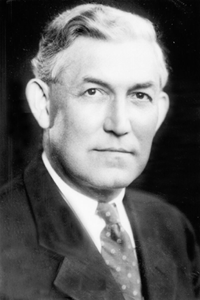
Srinivasa Ramanujan publishes work on the prime-counting function and the Ramanujan prime, advancing the understanding of prime distribution. #mathematics #India

John Edensor Littlewood proves that the difference π(x) - li(x) changes sign infinitely often, overturning earlier beliefs. #mathematics #primes
Viggo Brun shows that the sum of reciprocals of twin primes converges, a milestone in the study of prime gaps. #mathematics #primes

G. H. Hardy and John Littlewood develop the circle method and formulate conjectures about prime k-tuples, deeply influencing analytic number theory. #mathematics #primes
Derrick Henry Lehmer devises a deterministic primality test based on Lucas sequences, a precursor to modern primality tests. #mathematics #primes
Harald Cramér proposes that prime gaps are O(log^2 p), a heuristic law for the distribution of prime gaps. #mathematics #primes
Paul Erdős and Mark Kac prove that the number of prime factors of a large integer has a normal distribution, a landmark in probabilistic number theory. #mathematics #primes
Using the SWAC computer, Derrick Lehmer and Raphael Robinson discover Mersenne prime M521, the first prime found with a computer. #mathematics #computing
C. B. Haselgrove disproves Polya's conjecture that most numbers have an odd number of prime factors, using a computer search. #mathematics #primes

Stanislaw Ulam discovers the Ulam spiral, a graphical representation that reveals unexpected diagonal patterns in prime distribution. #mathematics #primes

Jingrun Chen proves that every sufficiently large even number is the sum of a prime and a product of at most two primes, a major step toward Goldbach. #mathematics #China
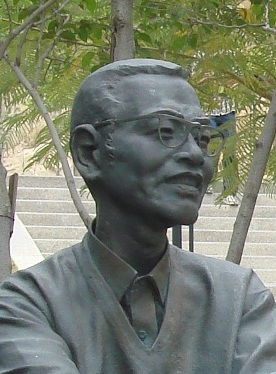
Gary Miller and Michael Rabin develop a probabilistic primality test based on Fermat's theorem and strong pseudoprimes, widely used today. #mathematics #algorithms
Robert Baillie, Carl Pomerance, and Samuel Wagstaff devise a combined test (Lucas and Fermat) that has no known counterexamples. #mathematics #primes
Leonard Adleman, Carl Pomerance, and Robert Rumely introduce a deterministic primality test using cyclotomic fields, practical for moderate numbers. #mathematics #primes
Shafi Goldwasser and Joe Kilian develop an algorithm to prove primality using elliptic curves, offering an efficient certificate-based method. #mathematics #cryptography
George Woltman launches GIMPS, a distributed computing project to find Mersenne primes, discovering the largest known primes. #mathematics #computing

Manindra Agrawal, Neeraj Kayal, and Nitin Saxena announce the first deterministic polynomial-time primality test, a landmark in computational number theory. #mathematics #algorithms
Ben Green and Terence Tao prove that the primes contain arbitrarily long arithmetic progressions, a stunning result in additive combinatorics. #mathematics #primes
Yitang Zhang proves that there are infinitely many prime pairs with gap less than 70 million, a breakthrough in the twin prime problem. #mathematics #primes
Harald Helfgott proves the weak Goldbach conjecture: every odd number greater than 5 is the sum of three primes. #mathematics #primes
James Maynard and Terence Tao independently refine Zhang's result, showing infinitely many prime gaps no larger than 600 (later 246). #mathematics #primes
The Polymath 8b project, led by Terence Tao, reduces the proven bound for gaps to 6 (subject to a generalized Elliott-Halberstam conjecture). #mathematics #collaboration
GIMPS discovers M82589933, a Mersenne prime with 24,862,048 digits, the largest known prime as of 2023. #mathematics #computing