History of China, sourced from Wikipedia's "Timeline of Chinese history".
Chronological Storyline (250 Milestones)
7500 BCE
Pengtoushan
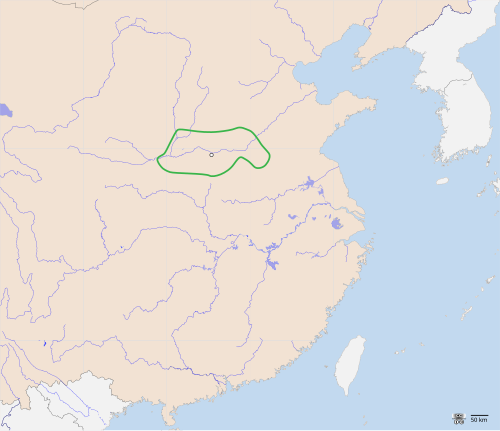
The Pengtoushan culture appeared. Source — Wikipedia, "Timeline of Chinese history" (Prehistory):
Area of the Pengtoushan culture (7000–5800 BC) in central China, based on Liu Li and Chen Xingcan (2012), The Archaeology of China: From the Late Paleolithic to the Early Bronze Age, Cambridge University Press, ISBN 978-0-521-64310-8, p124. By Kanguole - This file was derived from: Eastern China blank relief map.svg, CC BY-SA 4.0, https://commons.wikimedia.org/w/index.php?curid=42043115
6600 BCE
Jiahu symbols
The Jiahu symbols were first used at Jiahu. Source — Wikipedia, "Timeline of Chinese history" (Prehistory):
Tortoise shell with carved marks (Hebu 314), Henan Museum. Unearthed from the Jiahu site, Wuyang County, Henan province. Dated 8000–7000 years ago. By Kcx36 - Own work, CC BY-SA 4.0, https://commons.wikimedia.org/w/index.php?curid=137674719
6500 BCE
Cishan culture
The Cishan culture appeared. Source — Wikipedia, "Timeline of Chinese history" (Prehistory):
Area of the Cishan culture (6500–5000 BC) in northern China, based on Liu Li and Chen Xingcan (2012), The Archaeology of China: From the Late Paleolithic to the Early Bronze Age, Cambridge University Press, ISBN 978-0-521-64310-8, p124. By Kanguole - This file was derived from: Eastern China blank relief map.svg, CC BY-SA 4.0, https://commons.wikimedia.org/w/index.php?curid=41624046
3630 BCE
Sericulture
Silk processing was invented by the Yangshao culture. Source — Wikipedia, "Timeline of Chinese history" (Prehistory):
Area of the Yangshao culture (5000–3000 BC) in northern China, based on Liu Li and Chen Xingcan (2012), The Archaeology of China: From the Late Paleolithic to the Early Bronze Age, Cambridge University Press, ISBN 978-0-521-64310-8, p170. By Kanguole - This file was derived from: Eastern China blank relief map.svg, CC BY-SA 4.0, https://commons.wikimedia.org/w/index.php?curid=41246575
2570 BCE
Liangzhu culture
Silk was produced by the Liangzhu culture. Source — Wikipedia, "Timeline of Chinese history" (Antiquity):
Area of the Liangzhu culture (3400–2250 BC) in China, based on Liu Li and Chen Xingcan (2012), The Archaeology of China: From the Late Paleolithic to the Early Bronze Age, Cambridge University Press, ISBN 978-0-521-64310-8, p214. By Kanguole - This file was derived from: Eastern China blank relief map.svg, CC BY-SA 4.0, https://commons.wikimedia.org/w/index.php?curid=41323542
2500 BCE
Battle of Banquan
Battle of Banquan: The forces of the divine farmer Shennong were repelled by a force of tribes allied under the Yellow Emperor. Source — Wikipedia, "Timeline of Chinese history" (Antiquity):
Map of tribes and tribal unions in Ancient China, including tribes of Huang Di (Yellow Emperor), Yan Di (Flame Emperor) and Chiyou. By SY - Own work, CC BY-SA 4.0, https://commons.wikimedia.org/w/index.php?curid=60794173
2366 BCE
Emperor Zhi
Zhi became king. Source — Wikipedia, "Timeline of Chinese history" (Antiquity):
2200 BCE
Great Flood
Great Flood: Yu the Great completed a drainage system which ended the periodic and destructive flooding of the Yellow and Yangtze Rivers. (Reliable Archaeological discoveries depict that it happened around 1920BC. ) Source — Wikipedia, "Timeline of Chinese history" (22nd century BC):
King Yu (禹) as imagined by by Song Dynasty painter Ma Lin (馬麟). Hanging scroll, color on silk. Size 249 x 111.3 cm (height x width). Painting is located in the National Palace Museum, Taipei. (See: Page 93 of 故宮圖像選萃 (Gu gong tu xiang xuan cui) Masterpieces of Chinese Portrait Painting in the National Palace Museum. Taipei: National Palace Museum. 1971.) By Ma Lin - Digitized by NPM; image is directly from Shuge, Public domain, https://commons.wikimedia.org/w/index.php?curid=7102774
2117 BCE
Tai Kang
Tai Kang became king of the Xia dynasty. Source — Wikipedia, "Timeline of Chinese history" (22nd century BC):
此本《Recueil Historique des Principaux Traits de la Vie des Empereurs Chinois》(彩绘帝鉴图说)共两册,内含彩绘故事画95帧(有中文题签)。其中插图大致绘制于清早期,传入欧洲后添加了法文注释,并按照西方图书装订方法粘合成册。此套为法国国家图书馆藏本。 By 书格 - Own work, CC0, https://commons.wikimedia.org/w/index.php?curid=122799807
2075 BCE
Xiang of Xia
Xiang of Xia became king of the Xia dynasty. Source — Wikipedia, "Timeline of Chinese history" (21st century BC):
Xia Dynasty By w:en:User:Gurdjieff (Lamassu Design) - w:en:File:Xia dynasty.svg, CC BY-SA 3.0, https://commons.wikimedia.org/w/index.php?curid=15641604
2047 BCE
Xiang of Xia
Xiang was murdered and displaced as king on the orders of the warlord Han Zhuo. His pregnant wife fled the capital Shangqiu. Source — Wikipedia, "Timeline of Chinese history" (21st century BC):
Historic City of Shangqiu By Windmemories - Own work, CC BY-SA 4.0, https://commons.wikimedia.org/w/index.php?curid=121106616
2007 BCE
Shangqiu
The people of Shangqiu welcomed an army loyal to Shao into the city. Han committed suicide. Source — Wikipedia, "Timeline of Chinese history" (21st century BC):
Historic City of Shangqiu By Windmemories - Own work, CC BY-SA 4.0, https://commons.wikimedia.org/w/index.php?curid=121106616
1831 BCE
Bu Jiang
Bu abdicated in favor of his younger brother Jiong of Xia. Source — Wikipedia, "Timeline of Chinese history" (19th century BC):
Xia Dynasty pottery zun By Gary Lee Todd - Luoyang Museum, CC BY-SA 4.0, https://commons.wikimedia.org/w/index.php?curid=15992904
1831 BCE
Mount Tai earthquake
Mount Tai earthquake: An earthquake occurred at Mount Tai. Source — Wikipedia, "Timeline of Chinese history" (19th century BC):
Location within China. By LupinBot at English Wikipedia - Transferred from en.wikipedia to Commons., CC BY-SA 3.0, https://commons.wikimedia.org/w/index.php?curid=3200481
1810 BCE
Jiong of Xia
Jiong was succeeded by his son Jin of Xia. Source — Wikipedia, "Timeline of Chinese history" (19th century BC):
This “扃-seal.svg” vector image is depicting the character 扃 (4-stroke traditional Kangxi radical 063 戶 + 5 strokes) in the Shuowen seal script style. See also Wiktionary: en, fr, ja, zh. By Digital file creation, see the contributor names shown in the “User” column of the “File history” section below. - Available sources for this ancient Chinese character: Sinica Database Chinese Etymology. Multi-function Chinese Character Database. Chinese Text Project. Chinese Linguipedia. For this picture, see S08700 image on 扃's page in hanziyuan.net's data., Public domain, https://commons.wikimedia.org/w/index.php?curid=46543395
1789 BCE
Jin of Xia
Jin was succeeded by his cousin, Bu's son Kong Jia. Source — Wikipedia, "Timeline of Chinese history" (18th century BC):
Xia Dynasty pottery zun By Gary Lee Todd - Luoyang Museum, CC BY-SA 4.0, https://commons.wikimedia.org/w/index.php?curid=15992904
1758 BCE
Kong Jia
Kong was succeeded by his son Gao of Xia. Source — Wikipedia, "Timeline of Chinese history" (18th century BC):
孔甲(夏商合傳) By Unknown author - This image has been extracted from another file, Public domain, https://commons.wikimedia.org/w/index.php?curid=119515530
1747 BCE
Gao of Xia
Gao was succeeded by his son Fa of Xia. Source — Wikipedia, "Timeline of Chinese history" (18th century BC):
This “皋-seal-S07537.svg” vector image is depicting the character 皋 in the Shuowen seal script style. See also Wiktionary: en, fr, ja, zh. By Digital file creation, see the contributor names shown in the “User” column of the “File history” section below. - Available sources for this ancient Chinese character: Sinica Database Chinese Etymology. Multi-function Chinese Character Database. Chinese Text Project. Chinese Linguipedia., Public domain, https://commons.wikimedia.org/w/index.php?curid=162238132
1728 BCE
Fa of Xia
Fa was succeeded by his son Jie of Xia. Source — Wikipedia, "Timeline of Chinese history" (18th century BC):
This “發-seal.svg” vector image is depicting the character 發 in the Shuowen seal script style. It can be drawn with 1 2 pen strokes. See also Wiktionary: en, fr, ja, zh. By Digital file creation, see the contributor names shown in the “User” column of the “File history” section below. - Available sources for this ancient Chinese character: Sinica Database Chinese Etymology. Multi-function Chinese Character Database. Chinese Text Project. Chinese Linguipedia. For this picture, see 27.767C image on 發's page in xiaoxue.iis.sinica.edu.tw's data., Public domain, https://commons.wikimedia.org/w/index.php?curid=77313100
1675 BCE
Jie of Xia
Jie was succeeded by Tang of Shang, marking the beginning of the Shang dynasty. Source — Wikipedia, "Timeline of Chinese history" (17th century BC):
Clean version of File:Xiajie.jpg. Jie (桀), last ruler of Xia-dynasty sitting on two women and wearing a halberd on his shoulder. Rubbing of relief from the Wu-family Shrines, Jiaxiang, Shandong, China, around 150 CE. By User:Shibo77 - File:Xiajie.jpg, Public domain, https://commons.wikimedia.org/w/index.php?curid=16274020
1600 BCE
Battle of Mingtiao
Battle of Mingtiao: the Shang clan (later Shang dynasty) overthrow the corrupt and last emperor of the Xia dynasty Source — Wikipedia, "Timeline of Chinese history" (16th century BC):
"The Beginnings of Ancient China, 1900–1300 B.C.", two maps displaying the extent of the Xia ("Hsia") and Shang dynasties as understood in the 1930s. Historical routes and coastlines of the Yellow and Yangtze rivers noted. For a guide to typography, symbols, etc., see "HCAC Scripts Symbols & Abbreviations.jpg". By Albert Herrmann & Georg Westermann - Historical and Commercial Atlas of China, Map 4, p. 9., Public domain, https://commons.wikimedia.org/w/index.php?curid=172011613
1500 BCE
Erligang culture
The Erligang culture appeared. Source — Wikipedia, "Timeline of Chinese history" (15th century BC):
Area of the Erligang culture (1500–1300 BC) in northern China, based on Liu Li and Chen Xingcan (2012), The Archaeology of China: From the Late Paleolithic to the Early Bronze Age, Cambridge University Press, ISBN 978-0-521-64310-8, p279. By Kanguole - This file was derived from: Eastern China blank relief map.svg, CC BY-SA 3.0, https://commons.wikimedia.org/w/index.php?curid=40692455
1290 BCE
Pan Geng
Pan Geng became king of the Shang dynasty. Source — Wikipedia, "Timeline of Chinese history" (13th century BC):
欽定書經圖說 By 孫家鼐 - https://kokusho.nijl.ac.jp/biblio/100265589/407?ln=ja, Public domain, https://commons.wikimedia.org/w/index.php?curid=173674090
1250 BCE
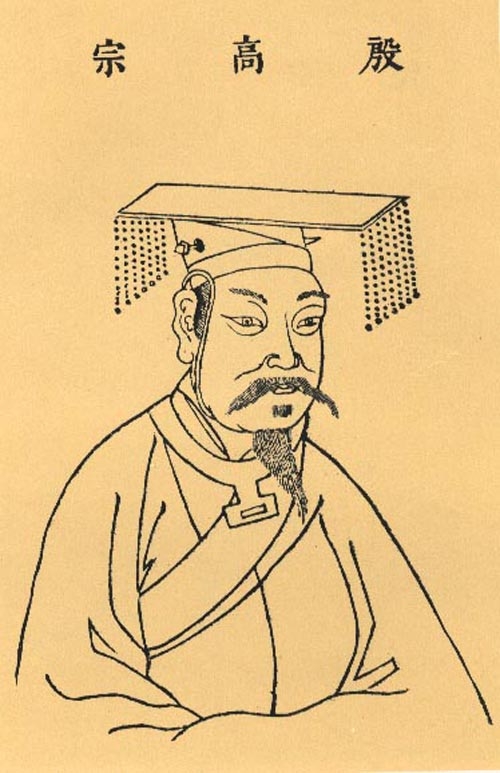
Wu Ding
Wu Ding became king of the Shang dynasty. Source — Wikipedia, "Timeline of Chinese history" (13th century BC):
Buting By Wang Qiji of the Ming Dynasty, Wanli engraved "Three Talents Picture Club" - http://www.zhlhh.com/ReadRoom/aazhlsyy/person.aspx?PersonName=%E6%AD%A6%E4%B8%81&PersonNianDai=xsxz, Public domain, https://commons.wikimedia.org/w/index.php?curid=122102114
1200 BCE
Wu Ding
Wu's wife, the general and high priestess Fu Hao, died and was buried at the tomb of Fu Hao in Yinxu. Source — Wikipedia, "Timeline of Chinese history" (12th century BC):
Buting By Wang Qiji of the Ming Dynasty, Wanli engraved "Three Talents Picture Club" - http://www.zhlhh.com/ReadRoom/aazhlsyy/person.aspx?PersonName=%E6%AD%A6%E4%B8%81&PersonNianDai=xsxz, Public domain, https://commons.wikimedia.org/w/index.php?curid=122102114
1192 BCE
Wu Ding
Wu died. He was succeeded by his son Zu Geng of Shang. Source — Wikipedia, "Timeline of Chinese history" (12th century BC):
Buting By Wang Qiji of the Ming Dynasty, Wanli engraved "Three Talents Picture Club" - http://www.zhlhh.com/ReadRoom/aazhlsyy/person.aspx?PersonName=%E6%AD%A6%E4%B8%81&PersonNianDai=xsxz, Public domain, https://commons.wikimedia.org/w/index.php?curid=122102114
1170 BCE
Geng Ding
Geng Ding became king of the Shang dynasty. Source — Wikipedia, "Timeline of Chinese history" (12th century BC):
Map of Shang Dynasty from Bamboo Annals By Lamassu Design Gurdjieff (talk) - Image by Author, CC BY-SA 3.0, https://commons.wikimedia.org/w/index.php?curid=10381870
1147 BCE
Geng Ding
Geng was succeeded by his son Wu Yi of Shang. Source — Wikipedia, "Timeline of Chinese history" (12th century BC):
Di Jiantu said that French export paintings in the 18th century By 张居正 (Zhang Juzheng) - https://new.shuge.org/view/di_jian_tu_shuo/#to-tab-1-4, Public domain, https://commons.wikimedia.org/w/index.php?curid=122855870
1112 BCE
Wu Yi of Shang
Wu was killed by lightning while out hunting. He was succeeded by his son Wen Ding. Source — Wikipedia, "Timeline of Chinese history" (12th century BC):
Di Jiantu said that French export paintings in the 18th century By 张居正 (Zhang Juzheng) - https://new.shuge.org/view/di_jian_tu_shuo/#to-tab-1-4, Public domain, https://commons.wikimedia.org/w/index.php?curid=122855870
1100 BCE
Wen Ding
Wen was succeeded by his son Di Yi. Source — Wikipedia, "Timeline of Chinese history" (12th century BC):
Bronzeware script is a style which engraved on the bronzeware. It is popular during 1100 BC. to 500 BC. in China. It is engraved on "Si Si Bi Qi You"(四祀邲其卣) a kind bronzen pot c. 1000 BC. By Unknown author - http://guoxue.zynews.com/XianFeng/2010/13605.html 北京故宫博物院藏, Public domain, https://commons.wikimedia.org/w/index.php?curid=11754943
1076 BCE
Di Yi
Di died. Source — Wikipedia, "Timeline of Chinese history" (11th century BC):
Bronzeware script is a style which engraved on the bronzeware. It is popular during 1100 BC. to 500 BC. in China. It is engraved on "Si Si Bi Qi You"(四祀邲其卣) a kind bronzen pot c. 1000 BC. By Unknown author - http://guoxue.zynews.com/XianFeng/2010/13605.html 北京故宫博物院藏, Public domain, https://commons.wikimedia.org/w/index.php?curid=11754943
1075 BCE
Di Yi
Di was succeeded as king of the Shang dynasty by his son King Zhou of Shang. Source — Wikipedia, "Timeline of Chinese history" (11th century BC):
Bronzeware script is a style which engraved on the bronzeware. It is popular during 1100 BC. to 500 BC. in China. It is engraved on "Si Si Bi Qi You"(四祀邲其卣) a kind bronzen pot c. 1000 BC. By Unknown author - http://guoxue.zynews.com/XianFeng/2010/13605.html 北京故宫博物院藏, Public domain, https://commons.wikimedia.org/w/index.php?curid=11754943
1050 BCE
King Wen of Zhou
King Wen of Zhou died. Source — Wikipedia, "Timeline of Chinese history" (11th century BC):
周文王像,明人绘 By Unknown author - 中国历史博物馆保管部, ed. (2003) 中国历代名人画像谱 1, 福州: 海峡文艺出版社, p. 17 ISBN: 7806407855. http://www.wanshengwang.org/show.aspx?id=8840&cid=111, Public domain, https://commons.wikimedia.org/w/index.php?curid=153875145
1047 BCE
King Zhou of Shang
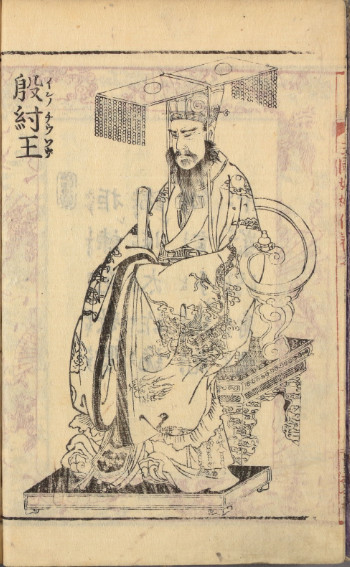
Zhou took Daji as his concubine. Source — Wikipedia, "Timeline of Chinese history" (11th century BC):
King Yin, from the picture book Three Kingdoms Youfuden. By 高井 伴寛、蹄斎 北馬 (Hiroshi Takai, Hossai Hokuma) - 絵本三国妖婦伝. 上,中,下編 / 高井伴寛 作; 蹄斎北馬 画 (Picture book 3 Kingdoms Youfuden. Part 1, 2, 2 / Written by: Tomohiro Takai; Painted by: Hokuma Teisai), Public domain, https://commons.wikimedia.org/w/index.php?curid=52609256
1046 BCE
Battle of Muye
Battle of Muye: The forces of the predynastic Zhou, led by King Wu of Zhou and aided by Shang dynasty defectors, dealt a bloody defeat to Shang forces at Muye, near Yinxu. Source — Wikipedia, "Timeline of Chinese history" (11th century BC):
Battle of Muye, the battle during which Zhou overthrew Shang dynasty. By SY - Own work, CC BY-SA 4.0, https://commons.wikimedia.org/w/index.php?curid=62649514
1043 BCE
King Wu of Zhou
Wu died. Source — Wikipedia, "Timeline of Chinese history" (11th century BC):
King Wu of Zhou By Ma Lin - Digitized by NPM; image is directly from Shuge, Public domain, https://commons.wikimedia.org/w/index.php?curid=7102798
1042 BCE
King Wu of Zhou
Wu was succeeded by his son King Cheng of Zhou. Source — Wikipedia, "Timeline of Chinese history" (11th century BC):
King Wu of Zhou By Ma Lin - Digitized by NPM; image is directly from Shuge, Public domain, https://commons.wikimedia.org/w/index.php?curid=7102798
1034 BCE
Chinese bronze inscriptions
Chinese bronze inscriptions came into use. Source — Wikipedia, "Timeline of Chinese history" (11th century BC):
Chinese bronze inscriptions By Unknown author, Public domain, https://commons.wikimedia.org/w/index.php?curid=148608421
1021 BCE
King Cheng of Zhou
Cheng died. Source — Wikipedia, "Timeline of Chinese history" (11th century BC):
周成王像,清人绘 By Unknown author - 中国历史博物馆保管部, ed. (2003) 中国历代名人画像谱 1, 福州: 海峡文艺出版社, p. 19 ISBN: 7806407855. http://www.bbshuaxia.cn/xia/2010-09-08/1017.html, Public domain, https://commons.wikimedia.org/w/index.php?curid=22912047
1020 BCE
King Cheng of Zhou
Cheng was succeeded by his son King Kang of Zhou. Source — Wikipedia, "Timeline of Chinese history" (11th century BC):
周成王像,清人绘 By Unknown author - 中国历史博物馆保管部, ed. (2003) 中国历代名人画像谱 1, 福州: 海峡文艺出版社, p. 19 ISBN: 7806407855. http://www.bbshuaxia.cn/xia/2010-09-08/1017.html, Public domain, https://commons.wikimedia.org/w/index.php?curid=22912047
1000 BCE
Classic of Poetry
The Classic of Poetry was compiled. Source — Wikipedia, "Timeline of Chinese history" (10th century BC):
Wooden-clapper bell (木鐸 mùduó) used as a symbol of Confucianism. The symbolism is drawn upon the Analects of Confucius, 3.24, where it is said: 天將以夫子爲木鐸, "Heaven will instruct the master like a wooden-clapper bell (to awaken everyone to the Way)". An analogy is made between the master (in the phrase, Confucius himself) who resonates with the order of Heaven which inspires him, and the bell, as if Heaven were the clapper and the master were the bell. The wooden-clapper bell is also an actual instrument that was used to gather people by ancient Chinese administrations, is used for ritual, and by analogy it means the purpose of Confucianism, that is to preach and educate people to the right values. By Aethelwolf Emsworth. - Own reproduction of a drawing made by Picnic11219 for Chinese Wikipedia., Public domain, https://commons.wikimedia.org/w/index.php?curid=65689742
996 BCE
King Kang of Zhou
Kang died. Source — Wikipedia, "Timeline of Chinese history" (10th century BC):
周康王画像,清人绘 By Unknown author - http://www.21unet.com/index.php?m=content&c=index&a=show&catid=148&id= 中国历史博物馆保管部, ed. (2003) 中国历代名人画像谱 1, 福州: 海峡文艺出版社, p. 20 ISBN: 7806407855., Public domain, https://commons.wikimedia.org/w/index.php?curid=22903550
976 BCE
King Mu of Zhou
King Mu of Zhou became king of the Zhou dynasty. Source — Wikipedia, "Timeline of Chinese history" (10th century BC):
此本《Recueil Historique des Principaux Traits de la Vie des Empereurs Chinois》(彩绘帝鉴图说)共两册,内含彩绘故事画95帧(有中文题签)。其中插图大致绘制于清早期,传入欧洲后添加了法文注释,并按照西方图书装订方法粘合成册。此套为法国国家图书馆藏本。 By 书格 - Own work, CC0, https://commons.wikimedia.org/w/index.php?curid=122801710
964 BCE
King Mu of Zhou
Mu led an unsuccessful expedition against the Quanrong. Source — Wikipedia, "Timeline of Chinese history" (10th century BC):
此本《Recueil Historique des Principaux Traits de la Vie des Empereurs Chinois》(彩绘帝鉴图说)共两册,内含彩绘故事画95帧(有中文题签)。其中插图大致绘制于清早期,传入欧洲后添加了法文注释,并按照西方图书装订方法粘合成册。此套为法国国家图书馆藏本。 By 书格 - Own work, CC0, https://commons.wikimedia.org/w/index.php?curid=122801710
922 BCE
King Mu of Zhou
Mu died. He was succeeded by his son King Gong of Zhou. Source — Wikipedia, "Timeline of Chinese history" (10th century BC):
此本《Recueil Historique des Principaux Traits de la Vie des Empereurs Chinois》(彩绘帝鉴图说)共两册,内含彩绘故事画95帧(有中文题签)。其中插图大致绘制于清早期,传入欧洲后添加了法文注释,并按照西方图书装订方法粘合成册。此套为法国国家图书馆藏本。 By 书格 - Own work, CC0, https://commons.wikimedia.org/w/index.php?curid=122801710
900 BCE
King Gong of Zhou
Gong died. Source — Wikipedia, "Timeline of Chinese history" (9th century BC):
Reign of King Gong, Western Zhou dynasty. Unearthed 1976 in the 1st hoard. Now located in the Baoji Bronze Ware Museum. By Unknown author - 幽灵巴尼, 2014-03-08 15:03:24, Own work, CC BY-SA 3.0, https://commons.wikimedia.org/w/index.php?curid=31500010
899 BCE
King Gong of Zhou
Gong's son Ji Jian, King Yi of Zhou became king of the Zhou dynasty. Source — Wikipedia, "Timeline of Chinese history" (9th century BC):
Reign of King Gong, Western Zhou dynasty. Unearthed 1976 in the 1st hoard. Now located in the Baoji Bronze Ware Museum. By Unknown author - 幽灵巴尼, 2014-03-08 15:03:24, Own work, CC BY-SA 3.0, https://commons.wikimedia.org/w/index.php?curid=31500010
892 BCE
King Yi of Zhou
Ji Jian died. Source — Wikipedia, "Timeline of Chinese history" (9th century BC):
三年兴壶 西周(约前1046—前771年)懿王三年 陕西扶风法门镇庄白村出土 宝鸡周原博物院藏 此器为国家一级文物。扶风县法门镇庄白村一号窖藏共出三年兴壶两件,大小、纹饰、铭文完全相同,此为其中之一。兴壶通体饰波状环带纹,波纹上下间以三角,口、眉。盖口沿和圈足饰窃曲纹,盖顶饰蟠鸟纹盖铭十二行六十字,大意为:周王三年九日丁已丑日,周王举行飨礼,天子命虢叔召兴,给兴赏赐。兴国为答谢天子之赐,铸造了这对壶,以记录天子的恩德。 Bronze Pot of the Third Year by Xing 3rd Years of King Yi Era, Western Zhou Dynasty Unearthed from Zhuanghai Hamlet, Famen Town, Fufeng County, Shaanxi Province Baoji Zhouyuan Museum By Kcx36 - Own work, CC BY-SA 4.0, https://commons.wikimedia.org/w/index.php?curid=137677330
891 BCE
King Yi of Zhou
Ji Jian's uncle, Mu's son King Xiao of Zhou became king of the Zhou dynasty. Source — Wikipedia, "Timeline of Chinese history" (9th century BC):
三年兴壶 西周(约前1046—前771年)懿王三年 陕西扶风法门镇庄白村出土 宝鸡周原博物院藏 此器为国家一级文物。扶风县法门镇庄白村一号窖藏共出三年兴壶两件,大小、纹饰、铭文完全相同,此为其中之一。兴壶通体饰波状环带纹,波纹上下间以三角,口、眉。盖口沿和圈足饰窃曲纹,盖顶饰蟠鸟纹盖铭十二行六十字,大意为:周王三年九日丁已丑日,周王举行飨礼,天子命虢叔召兴,给兴赏赐。兴国为答谢天子之赐,铸造了这对壶,以记录天子的恩德。 Bronze Pot of the Third Year by Xing 3rd Years of King Yi Era, Western Zhou Dynasty Unearthed from Zhuanghai Hamlet, Famen Town, Fufeng County, Shaanxi Province Baoji Zhouyuan Museum By Kcx36 - Own work, CC BY-SA 4.0, https://commons.wikimedia.org/w/index.php?curid=137677330
886 BCE
King Xiao of Zhou
Xiao died. Source — Wikipedia, "Timeline of Chinese history" (9th century BC):
885 BCE
King Yi of Zhou
Ji Jian's son Ji Xie, King Yi of Zhou became king of the Zhou dynasty. Source — Wikipedia, "Timeline of Chinese history" (9th century BC):
三年兴壶 西周(约前1046—前771年)懿王三年 陕西扶风法门镇庄白村出土 宝鸡周原博物院藏 此器为国家一级文物。扶风县法门镇庄白村一号窖藏共出三年兴壶两件,大小、纹饰、铭文完全相同,此为其中之一。兴壶通体饰波状环带纹,波纹上下间以三角,口、眉。盖口沿和圈足饰窃曲纹,盖顶饰蟠鸟纹盖铭十二行六十字,大意为:周王三年九日丁已丑日,周王举行飨礼,天子命虢叔召兴,给兴赏赐。兴国为答谢天子之赐,铸造了这对壶,以记录天子的恩德。 Bronze Pot of the Third Year by Xing 3rd Years of King Yi Era, Western Zhou Dynasty Unearthed from Zhuanghai Hamlet, Famen Town, Fufeng County, Shaanxi Province Baoji Zhouyuan Museum By Kcx36 - Own work, CC BY-SA 4.0, https://commons.wikimedia.org/w/index.php?curid=137677330
878 BCE
King Yi of Zhou
Ji Xie died. Source — Wikipedia, "Timeline of Chinese history" (9th century BC):
877 BCE
King Yi of Zhou
Ji Xie's son King Li of Zhou became king of the Zhou dynasty. Source — Wikipedia, "Timeline of Chinese history" (9th century BC):
胡簋,又称㝬簋。1978年5月陕西扶风出土,铭12行124字。高59cm,长43cm。是目前存世商周青铜簋中最大的一件。 By 幽灵巴尼 - Own work, CC BY-SA 3.0, https://commons.wikimedia.org/w/index.php?curid=30431137
842 BCE
King Li of Zhou
A popular revolt forced Li into exile near Linfen. Source — Wikipedia, "Timeline of Chinese history" (9th century BC):
胡簋,又称㝬簋。1978年5月陕西扶风出土,铭12行124字。高59cm,长43cm。是目前存世商周青铜簋中最大的一件。 By 幽灵巴尼 - Own work, CC BY-SA 3.0, https://commons.wikimedia.org/w/index.php?curid=30431137
841 BCE
Gonghe Regency
The Gonghe Regency came into power. Source — Wikipedia, "Timeline of Chinese history" (9th century BC):
聖君賢臣全身像冊 宣王 By Unknown author - https://digitalarchive.npm.gov.tw/Integrate/IIIFViewer?id=17964&dep=P&imageName=476143^^^979968895, Public domain, https://commons.wikimedia.org/w/index.php?curid=185403230
828 BCE
King Li of Zhou
Li died. Source — Wikipedia, "Timeline of Chinese history" (9th century BC):
胡簋,又称㝬簋。1978年5月陕西扶风出土,铭12行124字。高59cm,长43cm。是目前存世商周青铜簋中最大的一件。 By 幽灵巴尼 - Own work, CC BY-SA 3.0, https://commons.wikimedia.org/w/index.php?curid=30431137
827 BCE
King Li of Zhou
Li's son King Xuan of Zhou became king of the Zhou dynasty. Source — Wikipedia, "Timeline of Chinese history" (9th century BC):
胡簋,又称㝬簋。1978年5月陕西扶风出土,铭12行124字。高59cm,长43cm。是目前存世商周青铜簋中最大的一件。 By 幽灵巴尼 - Own work, CC BY-SA 3.0, https://commons.wikimedia.org/w/index.php?curid=30431137
782 BCE
King Xuan of Zhou
Xuan died. Source — Wikipedia, "Timeline of Chinese history" (8th century BC):
聖君賢臣全身像冊 宣王 By Unknown author - https://digitalarchive.npm.gov.tw/Integrate/IIIFViewer?id=17964&dep=P&imageName=476143^^^979968895, Public domain, https://commons.wikimedia.org/w/index.php?curid=185403230
781 BCE
King Xuan of Zhou
Xuan's son King You of Zhou became king of the Zhou dynasty. Source — Wikipedia, "Timeline of Chinese history" (8th century BC):
聖君賢臣全身像冊 宣王 By Unknown author - https://digitalarchive.npm.gov.tw/Integrate/IIIFViewer?id=17964&dep=P&imageName=476143^^^979968895, Public domain, https://commons.wikimedia.org/w/index.php?curid=185403230
779 BCE
King You of Zhou
You took Bao Si as his concubine. Source — Wikipedia, "Timeline of Chinese history" (8th century BC):
King You of Zhou By Unknown author - https://baike.sogou.com/v8347.htm, CC BY-SA 4.0, https://commons.wikimedia.org/w/index.php?curid=116674542
771 BCE
Marquess of Shen
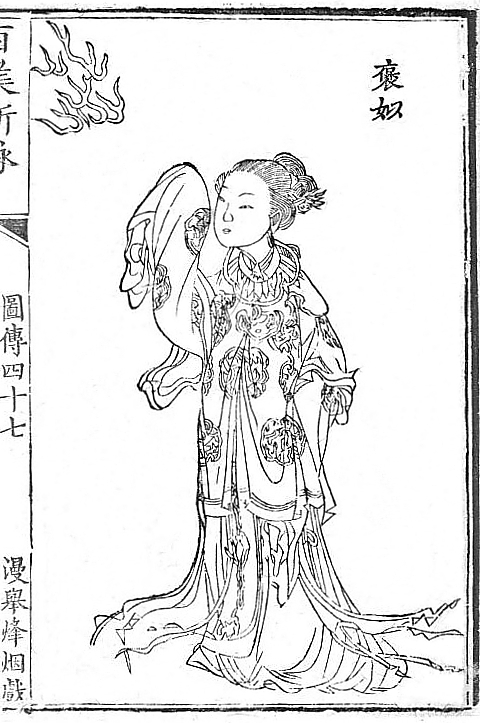
The Marquess of Shen, whose daughter had been replaced by Bao Si as queen, led an attack on Haojing in alliance with the Quanrong. You and Bao's son Bofu were killed. Source — Wikipedia, "Timeline of Chinese history" (8th century BC):
Bao Si, from the 18th century work Hundred Poems of Beautiful Women (Bai Mei Xin Yong Tu Zhuan 百美新詠圖傳) by Yan Xiyuan (颜希源). Woodblock print of drawing by Wang Hui 王翙 By Wang Hui 王翙 (1736-1795) - Bai Mei Xin Yong Tu Zhuan 百美新詠圖傳, Public domain, https://commons.wikimedia.org/w/index.php?curid=41606402
770 BCE
King You of Zhou
You's son King Ping of Zhou became king of the Zhou dynasty. Source — Wikipedia, "Timeline of Chinese history" (8th century BC):
King You of Zhou By Unknown author - https://baike.sogou.com/v8347.htm, CC BY-SA 4.0, https://commons.wikimedia.org/w/index.php?curid=116674542
720 BCE
King Ping of Zhou
Ping died. Source — Wikipedia, "Timeline of Chinese history" (8th century BC):
King Ping of Zhou By 冯梦龙、蔡元放 - 《东周列国志》(绣像本), CC BY-SA 4.0, https://commons.wikimedia.org/w/index.php?curid=116674615
719 BCE
King Ping of Zhou
Ping's grandson King Huan of Zhou became king of the Zhou dynasty. Source — Wikipedia, "Timeline of Chinese history" (8th century BC):
King Ping of Zhou By 冯梦龙、蔡元放 - 《东周列国志》(绣像本), CC BY-SA 4.0, https://commons.wikimedia.org/w/index.php?curid=116674615
707 BCE
Battle of Xuge
Battle of Xuge: Huan, in coalition with the Zhou vassal states Chen, Cai and Wey, led a punitive expedition against Zheng. The coalition was defeated and Huan was wounded. Source — Wikipedia, "Timeline of Chinese history" (8th century BC):
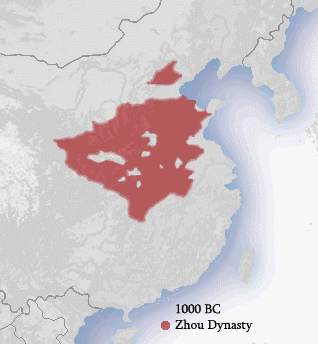
The approximate territory of the Zhou dynasty in China. Drawn by Ian Kiu. Derived from China_map.png by Nat. By Territories_of_Dynasties_in_China.gif: Ian Kiu - Territories_of_Dynasties_in_China.gif: Albert Herrmann (1935). History and Commercial Atlas of China. Harvard University Press. from "The Chou Dynasty, 11th-9th Centuries B.C.", CC BY-SA 3.0, https://commons.wikimedia.org/w/index.php?curid=13309273
697 BCE
King Huan of Zhou
Huan died. Source — Wikipedia, "Timeline of Chinese history" (7th century BC):
696 BCE
King Huan of Zhou
Huan's son King Zhuang of Zhou became king of the Zhou dynasty. Source — Wikipedia, "Timeline of Chinese history" (7th century BC):
The approximate territory of the Zhou dynasty in China. Drawn by Ian Kiu. Derived from China_map.png by Nat. By Territories_of_Dynasties_in_China.gif: Ian Kiu - Territories_of_Dynasties_in_China.gif: Albert Herrmann (1935). History and Commercial Atlas of China. Harvard University Press. from "The Chou Dynasty, 11th-9th Centuries B.C.", CC BY-SA 3.0, https://commons.wikimedia.org/w/index.php?curid=13309273
685 BCE
Duke Huan of Qi
Duke Huan of Qi became duke of Qi. Source — Wikipedia, "Timeline of Chinese history" (7th century BC):
Duke Huan of Qi and Guan Zhong depicted on Wu Family Shrines stone-relief. By Unknown author - https://www.dpm.org.cn/collection/impres/231853, Public domain, https://commons.wikimedia.org/w/index.php?curid=144383420
682 BCE
King Zhuang of Zhou
Zhuang died. Source — Wikipedia, "Timeline of Chinese history" (7th century BC):
681 BCE
King Zhuang of Zhou
Zhuang's son King Xi of Zhou became king of the Zhou dynasty. Source — Wikipedia, "Timeline of Chinese history" (7th century BC):
The approximate territory of the Zhou dynasty in China. Drawn by Ian Kiu. Derived from China_map.png by Nat. By Territories_of_Dynasties_in_China.gif: Ian Kiu - Territories_of_Dynasties_in_China.gif: Albert Herrmann (1935). History and Commercial Atlas of China. Harvard University Press. from "The Chou Dynasty, 11th-9th Centuries B.C.", CC BY-SA 3.0, https://commons.wikimedia.org/w/index.php?curid=13309273
677 BCE
King Xi of Zhou
Xi died. Source — Wikipedia, "Timeline of Chinese history" (7th century BC):
676 BCE
King Xi of Zhou
Xi's son King Hui of Zhou became king of the Zhou dynasty. Source — Wikipedia, "Timeline of Chinese history" (7th century BC):
The approximate territory of the Zhou dynasty in China. Drawn by Ian Kiu. Derived from China_map.png by Nat. By Territories_of_Dynasties_in_China.gif: Ian Kiu - Territories_of_Dynasties_in_China.gif: Albert Herrmann (1935). History and Commercial Atlas of China. Harvard University Press. from "The Chou Dynasty, 11th-9th Centuries B.C.", CC BY-SA 3.0, https://commons.wikimedia.org/w/index.php?curid=13309273
652 BCE
King Hui of Zhou
Hui died. Source — Wikipedia, "Timeline of Chinese history" (7th century BC):
645 BCE
Qi
The Qi chancellor Guan Zhong died. Source — Wikipedia, "Timeline of Chinese history" (7th century BC):
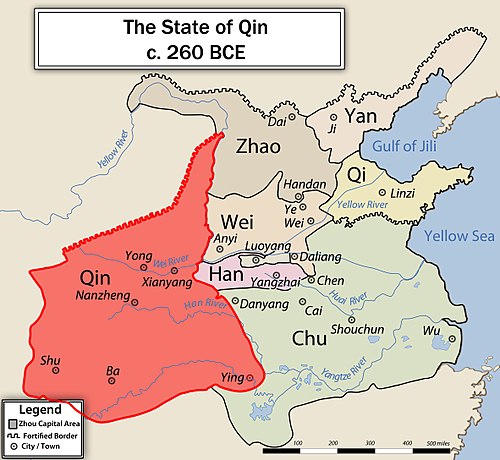
China Map, Qi State, 260BCE By Philg88 - Own work, CC BY-SA 3.0, https://commons.wikimedia.org/w/index.php?curid=11926165
632 BCE
Battle of Chengpu
Battle of Chengpu: Jin and its allies decisively defeated a coalition led by Chu. Source — Wikipedia, "Timeline of Chinese history" (7th century BC):
Map of Battle of Chengpu between Jin and Chu By SY - Own work, CC BY-SA 4.0, https://commons.wikimedia.org/w/index.php?curid=60838055
630 BCE
Sunshu Ao
Sunshu Ao was born. Source — Wikipedia, "Timeline of Chinese history" (7th century BC):
619 BCE
King Xiang of Zhou
Xiang died. Source — Wikipedia, "Timeline of Chinese history" (7th century BC):
618 BCE
King Xiang of Zhou
Xiang's son King Qing of Zhou became king of the Zhou dynasty. Source — Wikipedia, "Timeline of Chinese history" (7th century BC):
The approximate territory of the Zhou dynasty in China. Drawn by Ian Kiu. Derived from China_map.png by Nat. By Territories_of_Dynasties_in_China.gif: Ian Kiu - Territories_of_Dynasties_in_China.gif: Albert Herrmann (1935). History and Commercial Atlas of China. Harvard University Press. from "The Chou Dynasty, 11th-9th Centuries B.C.", CC BY-SA 3.0, https://commons.wikimedia.org/w/index.php?curid=13309273
613 BCE
King Qing of Zhou
Qing died. Source — Wikipedia, "Timeline of Chinese history" (7th century BC):
612 BCE
King Qing of Zhou
Qing's son King Kuang of Zhou became king of the Zhou dynasty. Source — Wikipedia, "Timeline of Chinese history" (7th century BC):
The approximate territory of the Zhou dynasty in China. Drawn by Ian Kiu. Derived from China_map.png by Nat. By Territories_of_Dynasties_in_China.gif: Ian Kiu - Territories_of_Dynasties_in_China.gif: Albert Herrmann (1935). History and Commercial Atlas of China. Harvard University Press. from "The Chou Dynasty, 11th-9th Centuries B.C.", CC BY-SA 3.0, https://commons.wikimedia.org/w/index.php?curid=13309273
607 BCE
King Kuang of Zhou
Kuang died. Source — Wikipedia, "Timeline of Chinese history" (7th century BC):
606 BCE
King Kuang of Zhou
Kuang's brother King Ding of Zhou became king of the Zhou dynasty. Source — Wikipedia, "Timeline of Chinese history" (7th century BC):
The approximate territory of the Zhou dynasty in China. Drawn by Ian Kiu. Derived from China_map.png by Nat. By Territories_of_Dynasties_in_China.gif: Ian Kiu - Territories_of_Dynasties_in_China.gif: Albert Herrmann (1935). History and Commercial Atlas of China. Harvard University Press. from "The Chou Dynasty, 11th-9th Centuries B.C.", CC BY-SA 3.0, https://commons.wikimedia.org/w/index.php?curid=13309273
600 BCE
Knife money
Knife money came into use. Source — Wikipedia, "Timeline of Chinese history" (6th century BC):
Yan State Coins (燕国刀币) in Capital Museum, Beijing, China By PENG Yanan (Neo-Jay) - Own work, CC BY-SA 3.0, https://commons.wikimedia.org/w/index.php?curid=1075362
595 BCE
Battle of Bi
Battle of Bi: Chu decisively defeated Jin at Bi, near modern Xingyang. Source — Wikipedia, "Timeline of Chinese history" (6th century BC):
Battle of Bi between State Jin and State Chu during the Spring and Autumn Period of Zhou Dynasty By SY - Own work, CC BY-SA 4.0, https://commons.wikimedia.org/w/index.php?curid=62701018
586 BCE
King Ding of Zhou
Ding died. Source — Wikipedia, "Timeline of Chinese history" (6th century BC):
585 BCE
King Ding of Zhou
Ding's son King Jian of Zhou became king of the Zhou dynasty. Source — Wikipedia, "Timeline of Chinese history" (6th century BC):
The approximate territory of the Zhou dynasty in China. Drawn by Ian Kiu. Derived from China_map.png by Nat. By Territories_of_Dynasties_in_China.gif: Ian Kiu - Territories_of_Dynasties_in_China.gif: Albert Herrmann (1935). History and Commercial Atlas of China. Harvard University Press. from "The Chou Dynasty, 11th-9th Centuries B.C.", CC BY-SA 3.0, https://commons.wikimedia.org/w/index.php?curid=13309273
575 BCE
Battle of Yanling
Battle of Yanling: A numerically superior Chu force was defeated by Jin in modern Yanling County. King Gong of Chu was injured. Source — Wikipedia, "Timeline of Chinese history" (6th century BC):
Battle of Yanling, in Simplified Chinese By 玖巧仔 - Own work, CC BY-SA 3.0, https://commons.wikimedia.org/w/index.php?curid=13907908
572 BCE
King Jian of Zhou
Jian died. Source — Wikipedia, "Timeline of Chinese history" (6th century BC):
571 BCE
King Jian of Zhou
Jian's son King Ling of Zhou became king of the Zhou dynasty. Source — Wikipedia, "Timeline of Chinese history" (6th century BC):
Zhou Lingwang: Shanyin Meixi Wang Family Genealogy II Page 3 (Library) - Chinese Text Project By Shanyin Meixi Wang Family Genealogy II Page 3 (Library) - Chinese Text Project (山阴梅溪王氏宗谱二 第3页 (图书馆) - 中国哲学书电子化计划) - https://ctext.org/library.pl?if=en&file=142150&page=3&remap=gb https://iiif.lib.harvard.edu/manifests/view/drs:25617610$76i, Public domain, https://commons.wikimedia.org/w/index.php?curid=121901300
551 BCE
Confucius
Confucius was born. Source — Wikipedia, "Timeline of Chinese history" (6th century BC):
The teaching Confucius. Portrait by Wu Daozi, 685-758, Tang Dynasty. By Wu Daozi, 685-758, Tang Dynasty. - https://i.pinimg.com/originals/77/95/19/7795198cc338e4642d2ce7ac965458b2.jpg, Public domain, https://commons.wikimedia.org/w/index.php?curid=857482
548 BCE
Go
The earliest surviving reference to Go appeared. Source — Wikipedia, "Timeline of Chinese history" (6th century BC):
My floor goban with a game in progress. By Goban1 - Own work, Public domain, https://commons.wikimedia.org/w/index.php?curid=15223468
545 BCE
King Ling of Zhou
Ling died. Source — Wikipedia, "Timeline of Chinese history" (6th century BC):
Zhou Lingwang: Shanyin Meixi Wang Family Genealogy II Page 3 (Library) - Chinese Text Project By Shanyin Meixi Wang Family Genealogy II Page 3 (Library) - Chinese Text Project (山阴梅溪王氏宗谱二 第3页 (图书馆) - 中国哲学书电子化计划) - https://ctext.org/library.pl?if=en&file=142150&page=3&remap=gb https://iiif.lib.harvard.edu/manifests/view/drs:25617610$76i, Public domain, https://commons.wikimedia.org/w/index.php?curid=121901300
544 BCE
King Ling of Zhou
Ling's son Ji Gui, King Jing of Zhou became king of the Zhou dynasty. Source — Wikipedia, "Timeline of Chinese history" (6th century BC):
Zhou Lingwang: Shanyin Meixi Wang Family Genealogy II Page 3 (Library) - Chinese Text Project By Shanyin Meixi Wang Family Genealogy II Page 3 (Library) - Chinese Text Project (山阴梅溪王氏宗谱二 第3页 (图书馆) - 中国哲学书电子化计划) - https://ctext.org/library.pl?if=en&file=142150&page=3&remap=gb https://iiif.lib.harvard.edu/manifests/view/drs:25617610$76i, Public domain, https://commons.wikimedia.org/w/index.php?curid=121901300
543 BCE
Zheng
The Zheng prime minister Zichan established the state's first written civil code. Source — Wikipedia, "Timeline of Chinese history" (6th century BC):
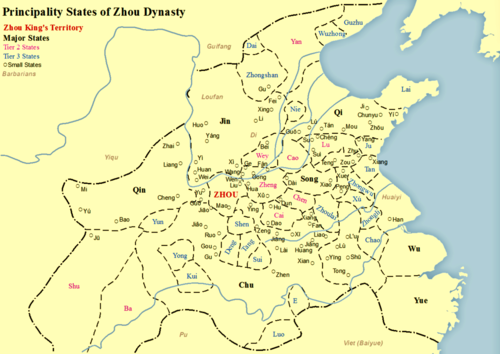
Map showing many of the ancient Chinese states (國, guo) at an indeterminate time under the Eastern Zhou dynasty with a nonsense "Principality State" label above. Borders are approximate and many locations are misplaced relative to the rivers and approximate coastline. Avoid use. By SY - Own work, CC BY-SA 4.0, https://commons.wikimedia.org/w/index.php?curid=60798682
520 BCE
King Jing of Zhou
Ji Gui died. He was succeeded by his son King Dao of Zhou. Source — Wikipedia, "Timeline of Chinese history" (6th century BC):
519 BCE
King Dao of Zhou
Dao's brother Ji Gai, King Jing of Zhou became king of the Zhou dynasty. Source — Wikipedia, "Timeline of Chinese history" (6th century BC):
The approximate territory of the Zhou dynasty in China. Drawn by Ian Kiu. Derived from China_map.png by Nat. By Territories_of_Dynasties_in_China.gif: Ian Kiu - Territories_of_Dynasties_in_China.gif: Albert Herrmann (1935). History and Commercial Atlas of China. Harvard University Press. from "The Chou Dynasty, 11th-9th Centuries B.C.", CC BY-SA 3.0, https://commons.wikimedia.org/w/index.php?curid=13309273
518 BCE
King Yuan of Zhou
Yuan's son King Zhending of Zhou became king of the Zhou dynasty. Source — Wikipedia, "Timeline of Chinese history" (5th century BC):
The approximate territory of the Zhou dynasty in China. Drawn by Ian Kiu. Derived from China_map.png by Nat. By Territories_of_Dynasties_in_China.gif: Ian Kiu - Territories_of_Dynasties_in_China.gif: Albert Herrmann (1935). History and Commercial Atlas of China. Harvard University Press. from "The Chou Dynasty, 11th-9th Centuries B.C.", CC BY-SA 3.0, https://commons.wikimedia.org/w/index.php?curid=13309273
515 BCE
Wu
The Wu king Liao was killed by the assassin Zhuan Zhu. Source — Wikipedia, "Timeline of Chinese history" (6th century BC):
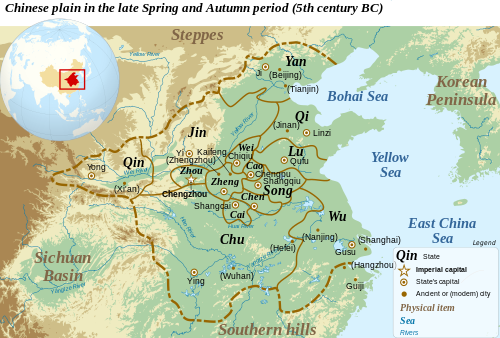
Map of the Chinese plain at the end of the Spring & Autumn period & the beginning of the War Kingdoms period (5th century B.C.E. / H.E.95th century) By Yug - Own work, *Background data: ETOPO1 + QGIS > then vectorized using Inkscape*Semantic data: some from Le Monde Chinois, Gernet, p58.or (en:) Gernet (1996) A History of Chinese Civilisation, Cambridge university press, p. 59, CC BY-SA 3.0, https://commons.wikimedia.org/w/index.php?curid=15585702
514 BCE
King Helü of Wu
King Helü of Wu became king of Wu. Source — Wikipedia, "Timeline of Chinese history" (6th century BC):
Map of the Chinese plain at the end of the Spring & Autumn period & the beginning of the War Kingdoms period (5th century B.C.E. / H.E.95th century) By Yug - Own work, *Background data: ETOPO1 + QGIS > then vectorized using Inkscape*Semantic data: some from Le Monde Chinois, Gernet, p58.or (en:) Gernet (1996) A History of Chinese Civilisation, Cambridge university press, p. 59, CC BY-SA 3.0, https://commons.wikimedia.org/w/index.php?curid=15585702
506 BCE
Battle of Boju
Battle of Boju: Wu decisively defeated a numerically superior Chu force at Boju. Source — Wikipedia, "Timeline of Chinese history" (6th century BC):
Map showing the Battle of Boju between Chu and Wu states By SY - Own work, CC BY-SA 4.0, https://commons.wikimedia.org/w/index.php?curid=60892648
500 BCE
Cast iron
Cast iron was first invented in China. Source — Wikipedia, "Timeline of Chinese history" (5th century BC):
The bat By Abob Bob - The bat, CC BY 2.0, https://commons.wikimedia.org/w/index.php?curid=46751171
486 BCE
Wu
The Wu king King Fuchai of Wu ordered the building of the Han Canal. Source — Wikipedia, "Timeline of Chinese history" (5th century BC):
Map of the Chinese plain at the end of the Spring & Autumn period & the beginning of the War Kingdoms period (5th century B.C.E. / H.E.95th century) By Yug - Own work, *Background data: ETOPO1 + QGIS > then vectorized using Inkscape*Semantic data: some from Le Monde Chinois, Gernet, p58.or (en:) Gernet (1996) A History of Chinese Civilisation, Cambridge university press, p. 59, CC BY-SA 3.0, https://commons.wikimedia.org/w/index.php?curid=15585702
484 BCE
Wu Zixu
Wu Zixu died. Source — Wikipedia, "Timeline of Chinese history" (5th century BC):
聖君賢臣全身像冊 伍員 By Unknown author - 聖君賢臣全身像冊, Public domain, https://commons.wikimedia.org/w/index.php?curid=154075177
482 BCE
Yue
The Yue king King Goujian of Yue captured the Wu capital in a surprise assault. Source — Wikipedia, "Timeline of Chinese history" (5th century BC):
Map of the Chinese plain, 5 century BC. Start of the Warring States Period This is a different version of Chinese plain 5c. BC-en.svg created by Yug with the state of Yue being added. By Yug - This is a different version of Chinese plain 5c. BC-en.svg created by Yug with the state of Yue being added., CC BY-SA 3.0, https://commons.wikimedia.org/w/index.php?curid=68330188
479 BCE
Confucius
The generally agreed upon date of Confucius' death. Source — Wikipedia, "Timeline of Chinese history" (5th century BC):
The teaching Confucius. Portrait by Wu Daozi, 685-758, Tang Dynasty. By Wu Daozi, 685-758, Tang Dynasty. - https://i.pinimg.com/originals/77/95/19/7795198cc338e4642d2ce7ac965458b2.jpg, Public domain, https://commons.wikimedia.org/w/index.php?curid=857482
477 BCE
King Jing of Zhou
Ji Gai died. Source — Wikipedia, "Timeline of Chinese history" (5th century BC):
476 BCE
King Jing of Zhou
Ji Gai's son King Yuan of Zhou became king of the Zhou dynasty. Source — Wikipedia, "Timeline of Chinese history" (5th century BC):
The approximate territory of the Zhou dynasty in China. Drawn by Ian Kiu. Derived from China_map.png by Nat. By Territories_of_Dynasties_in_China.gif: Ian Kiu - Territories_of_Dynasties_in_China.gif: Albert Herrmann (1935). History and Commercial Atlas of China. Harvard University Press. from "The Chou Dynasty, 11th-9th Centuries B.C.", CC BY-SA 3.0, https://commons.wikimedia.org/w/index.php?curid=13309273
473 BCE
Wu
Wu was annexed by Yue. Source — Wikipedia, "Timeline of Chinese history" (5th century BC):
Map of the Chinese plain at the end of the Spring & Autumn period & the beginning of the War Kingdoms period (5th century B.C.E. / H.E.95th century) By Yug - Own work, *Background data: ETOPO1 + QGIS > then vectorized using Inkscape*Semantic data: some from Le Monde Chinois, Gernet, p58.or (en:) Gernet (1996) A History of Chinese Civilisation, Cambridge university press, p. 59, CC BY-SA 3.0, https://commons.wikimedia.org/w/index.php?curid=15585702
470 BCE
Mozi
Mozi was born. Source — Wikipedia, "Timeline of Chinese history" (5th century BC):
Philosopher By Vjacheslav Rublevskiy - https://www.flickr.com/photos/193162016@N04/51221161306/, CC0, https://commons.wikimedia.org/w/index.php?curid=106219380
469 BCE
King Yuan of Zhou
Yuan died. Source — Wikipedia, "Timeline of Chinese history" (5th century BC):
465 BCE
King Goujian of Yue
Goujian died. Source — Wikipedia, "Timeline of Chinese history" (5th century BC):
绍兴越王台 By Gisling - Own work, CC BY-SA 3.0, https://commons.wikimedia.org/w/index.php?curid=17682953
441 BCE
King Zhending of Zhou
Zhending died. He was succeeded by his son King Ai of Zhou. Source — Wikipedia, "Timeline of Chinese history" (5th century BC):
440 BCE
King Kao of Zhou
Kao became king of the Zhou dynasty. Source — Wikipedia, "Timeline of Chinese history" (5th century BC):
The approximate territory of the Zhou dynasty in China. Drawn by Ian Kiu. Derived from China_map.png by Nat. By Territories_of_Dynasties_in_China.gif: Ian Kiu - Territories_of_Dynasties_in_China.gif: Albert Herrmann (1935). History and Commercial Atlas of China. Harvard University Press. from "The Chou Dynasty, 11th-9th Centuries B.C.", CC BY-SA 3.0, https://commons.wikimedia.org/w/index.php?curid=13309273
432 BCE
tomb of Marquis Yi of Zeng
The tomb of Marquis Yi of Zeng was constructed. Source — Wikipedia, "Timeline of Chinese history" (5th century BC):
Bianzhong - traditional chinese percussion instrument By The original uploader was Zzjgbc at Chinese Wikipedia. - Transferred from zh.wikipedia to Commons. From the Tomb of Marquis Yi of Zeng, dated 433 BC, during the interregnum between the Spring and Autumn Period and Warring States Period of ancient China., CC BY-SA 3.0, https://commons.wikimedia.org/w/index.php?curid=1681507
426 BCE
King Kao of Zhou
Kao died. Source — Wikipedia, "Timeline of Chinese history" (5th century BC):
425 BCE
King Kao of Zhou
Kao's son King Weilie of Zhou became king of the Zhou dynasty. Source — Wikipedia, "Timeline of Chinese history" (5th century BC):
The approximate territory of the Zhou dynasty in China. Drawn by Ian Kiu. Derived from China_map.png by Nat. By Territories_of_Dynasties_in_China.gif: Ian Kiu - Territories_of_Dynasties_in_China.gif: Albert Herrmann (1935). History and Commercial Atlas of China. Harvard University Press. from "The Chou Dynasty, 11th-9th Centuries B.C.", CC BY-SA 3.0, https://commons.wikimedia.org/w/index.php?curid=13309273
403 BCE
Partition of Jin
Partition of Jin: Weilie recognized the Jin nobles Marquess Wen of Wei, Marquess Lie of Zhao and Marquess Jing of Han as marquesses, granting de jure independence from Jin to the states of Wei, Zhao and Han. Source — Wikipedia, "Timeline of Chinese history" (5th century BC):
Map of the Chinese plain at the end of the Spring & Autumn period & the beginning of the War Kingdoms period (5th century B.C.E. / H.E.95th century) By Yug - Own work, *Background data: ETOPO1 + QGIS > then vectorized using Inkscape*Semantic data: some from Le Monde Chinois, Gernet, p58.or (en:) Gernet (1996) A History of Chinese Civilisation, Cambridge university press, p. 59, CC BY-SA 3.0, https://commons.wikimedia.org/w/index.php?curid=15585702
402 BCE
King Weilie of Zhou
Weilie died. Source — Wikipedia, "Timeline of Chinese history" (5th century BC):
401 BCE
King Weilie of Zhou
Weilie's son King An of Zhou became king of the Zhou dynasty. Source — Wikipedia, "Timeline of Chinese history" (5th century BC):
The approximate territory of the Zhou dynasty in China. Drawn by Ian Kiu. Derived from China_map.png by Nat. By Territories_of_Dynasties_in_China.gif: Ian Kiu - Territories_of_Dynasties_in_China.gif: Albert Herrmann (1935). History and Commercial Atlas of China. Harvard University Press. from "The Chou Dynasty, 11th-9th Centuries B.C.", CC BY-SA 3.0, https://commons.wikimedia.org/w/index.php?curid=13309273
400 BCE
Gan De
Gan De was born. Source — Wikipedia, "Timeline of Chinese history" (4th century BC):
389 BCE
Zuo Zhuan
The Zuo Zhuan was published. Source — Wikipedia, "Timeline of Chinese history" (4th century BC):
First page, Li Yuanyang edition of Zuo zhuan (16th century) By Chang Wei-tung - http://catalog.digitalarchives.tw/item/00/07/e8/cb.html, Public domain, https://commons.wikimedia.org/w/index.php?curid=39730234
386 BCE
Handan
The city of Handan was founded to serve as the Zhao capital. Source — Wikipedia, "Timeline of Chinese history" (4th century BC):
Handandao Historic District By H2v5o68z - Own work, CC0, https://commons.wikimedia.org/w/index.php?curid=165220499
381 BCE
Chu
The Chu prime minister Wu Qi was murdered by nobles at the funeral of its king King Dao of Chu. Source — Wikipedia, "Timeline of Chinese history" (4th century BC):
Warring States Period By Jiu Qiaozai - Own work 地形圖數據:ETOPO1 矢量底图数据:www.naturalearthdata.com 参考地图:zh:中国历史地图_(1980年)战国部分、zh:中国历史地图集战国部分 参考书籍:周振鹤主编《中国行政区划通史·总论、先秦卷》, CC BY-SA 3.0, https://commons.wikimedia.org/w/index.php?curid=20477957
376 BCE
King An of Zhou
An died. Source — Wikipedia, "Timeline of Chinese history" (4th century BC):
375 BCE
King An of Zhou
An's son King Lie of Zhou became king of the Zhou dynasty. Source — Wikipedia, "Timeline of Chinese history" (4th century BC):
The approximate territory of the Zhou dynasty in China. Drawn by Ian Kiu. Derived from China_map.png by Nat. By Territories_of_Dynasties_in_China.gif: Ian Kiu - Territories_of_Dynasties_in_China.gif: Albert Herrmann (1935). History and Commercial Atlas of China. Harvard University Press. from "The Chou Dynasty, 11th-9th Centuries B.C.", CC BY-SA 3.0, https://commons.wikimedia.org/w/index.php?curid=13309273
370 BCE
Zhuang Zhou
Zhuang Zhou was born. Source — Wikipedia, "Timeline of Chinese history" (4th century BC):
Xuanmen Ten Zi Tu Zhuang Zi By Hua Zili (華祖立) - http://m.yac8.com/news/12817_10.html, Public domain, https://commons.wikimedia.org/w/index.php?curid=77199503
369 BCE
King Lie of Zhou
Lie died. Source — Wikipedia, "Timeline of Chinese history" (4th century BC):
368 BCE
King Lie of Zhou
Lie's brother King Xian of Zhou became king of the Zhou dynasty. Source — Wikipedia, "Timeline of Chinese history" (4th century BC):
The approximate territory of the Zhou dynasty in China. Drawn by Ian Kiu. Derived from China_map.png by Nat. By Territories_of_Dynasties_in_China.gif: Ian Kiu - Territories_of_Dynasties_in_China.gif: Albert Herrmann (1935). History and Commercial Atlas of China. Harvard University Press. from "The Chou Dynasty, 11th-9th Centuries B.C.", CC BY-SA 3.0, https://commons.wikimedia.org/w/index.php?curid=13309273
361 BCE
Duke Xiao of Qin
Duke Xiao of Qin became duke of Qin. Source — Wikipedia, "Timeline of Chinese history" (4th century BC):
Portrait of His Grace James Duke of Chandos (1673–1744) By Michael Dahl - Berger Collection: Website; Archived webpage (work no longer in collection as of February 2011), Public domain, https://commons.wikimedia.org/w/index.php?curid=6436291
356 BCE
Duke Xiao of Qin
Xiao's adviser Shang Yang implemented a legal code in Qin based on the Canon of Laws which established punishment for complicity in a crime, established a system of military ranks, and implemented policies encouraging the cultivation of unsettled land. Source — Wikipedia, "Timeline of Chinese history" (4th century BC):
Statue of Shang Yang, an Ancient Chinese celebrity By Taken by Fanghong - Own work, CC BY 2.5, https://commons.wikimedia.org/w/index.php?curid=844037
354 BCE
Battle of Guiling
Battle of Guiling: Wei laid siege to the Zhao capital Handan. Source — Wikipedia, "Timeline of Chinese history" (4th century BC):
Map showing the Battle of Guiling in 353 BC and 352 BC between Qi and Wei states. By SY - Own work, CC BY-SA 4.0, https://commons.wikimedia.org/w/index.php?curid=60820837
353 BCE
Wei
Battle of Guiling: The Wei army fled Handan in response to reports of a Qi attack on their capital Daliang and were defeated by Qi forces at Guiling, in modern Changyuan County. Source — Wikipedia, "Timeline of Chinese history" (4th century BC):
Map of China proper in with the state of Wei highlighted, 260 BCE By Philg88 - Own work, CC BY-SA 3.0, https://commons.wikimedia.org/w/index.php?curid=11944658
342 BCE
Battle of Maling
Battle of Maling: Qi dealt Wei a bloody defeat. Source — Wikipedia, "Timeline of Chinese history" (4th century BC):
Map of the Battle of Maling between Qi and Wei By SY - Own work, CC BY-SA 4.0, https://commons.wikimedia.org/w/index.php?curid=60907242
338 BCE
Duke Xiao of Qin
Xiao died. He was succeeded by his son King Huiwen of Qin. Source — Wikipedia, "Timeline of Chinese history" (4th century BC):
321 BCE
King Xian of Zhou
Xian died. Source — Wikipedia, "Timeline of Chinese history" (4th century BC):
320 BCE
King Xian of Zhou
Xian's son King Shenjing of Zhou became king of the Zhou dynasty. Source — Wikipedia, "Timeline of Chinese history" (4th century BC):
The approximate territory of the Zhou dynasty in China. Drawn by Ian Kiu. Derived from China_map.png by Nat. By Territories_of_Dynasties_in_China.gif: Ian Kiu - Territories_of_Dynasties_in_China.gif: Albert Herrmann (1935). History and Commercial Atlas of China. Harvard University Press. from "The Chou Dynasty, 11th-9th Centuries B.C.", CC BY-SA 3.0, https://commons.wikimedia.org/w/index.php?curid=13309273
319 BCE
Confucianism
The Confucian Mencius became a Qi official. Source — Wikipedia, "Timeline of Chinese history" (4th century BC):
Wooden-clapper bell (木鐸 mùduó) used as a symbol of Confucianism. The symbolism is drawn upon the Analects of Confucius, 3.24, where it is said: 天將以夫子爲木鐸, "Heaven will instruct the master like a wooden-clapper bell (to awaken everyone to the Way)". An analogy is made between the master (in the phrase, Confucius himself) who resonates with the order of Heaven which inspires him, and the bell, as if Heaven were the clapper and the master were the bell. The wooden-clapper bell is also an actual instrument that was used to gather people by ancient Chinese administrations, is used for ritual, and by analogy it means the purpose of Confucianism, that is to preach and educate people to the right values. By Aethelwolf Emsworth. - Own reproduction of a drawing made by Picnic11219 for Chinese Wikipedia., Public domain, https://commons.wikimedia.org/w/index.php?curid=65689742
316 BCE
Sun Bin
Sun Bin died. Source — Wikipedia, "Timeline of Chinese history" (4th century BC):
Portrait of Sun Bin, painted by Ming people By Unknown author - 中国历史博物馆保管部, ed. (2003) 中国历代名人画像谱 1, 福州: 海峡文艺出版社, p. 93 ISBN: 7806407855. http://123.4hn.org/dao/a/zongmiao/chunqiuzhanguo/2011/0525/283.html, Public domain, https://commons.wikimedia.org/w/index.php?curid=20806544
315 BCE
King Shenjing of Zhou
Shenjing died. Source — Wikipedia, "Timeline of Chinese history" (4th century BC):
314 BCE
King Shenjing of Zhou
Shenjing's son King Nan of Zhou became king of the Zhou dynasty. Source — Wikipedia, "Timeline of Chinese history" (4th century BC):
The approximate territory of the Zhou dynasty in China. Drawn by Ian Kiu. Derived from China_map.png by Nat. By Territories_of_Dynasties_in_China.gif: Ian Kiu - Territories_of_Dynasties_in_China.gif: Albert Herrmann (1935). History and Commercial Atlas of China. Harvard University Press. from "The Chou Dynasty, 11th-9th Centuries B.C.", CC BY-SA 3.0, https://commons.wikimedia.org/w/index.php?curid=13309273
311 BCE
King Huiwen of Qin
Huiwen died. Source — Wikipedia, "Timeline of Chinese history" (4th century BC):
310 BCE
King Huiwen of Qin
Huiwen's son King Wu of Qin became king of Qin. Source — Wikipedia, "Timeline of Chinese history" (4th century BC):
China Map, Qin State, 260BCE By Philg88 - Own work, CC BY-SA 3.0, https://commons.wikimedia.org/w/index.php?curid=11936378
307 BCE
Zhou dynasty
The Zhou king King Wuling of Zhao ordered his cavalry to begin wearing clothes fashioned after those of the Donghu and Xiongnu peoples. Source — Wikipedia, "Timeline of Chinese history" (4th century BC):
The approximate territory of the Zhou dynasty in China. Drawn by Ian Kiu. Derived from China_map.png by Nat. By Territories_of_Dynasties_in_China.gif: Ian Kiu - Territories_of_Dynasties_in_China.gif: Albert Herrmann (1935). History and Commercial Atlas of China. Harvard University Press. from "The Chou Dynasty, 11th-9th Centuries B.C.", CC BY-SA 3.0, https://commons.wikimedia.org/w/index.php?curid=13309273
306 BCE
King Wu of Qin
Wu's brother King Zhaoxiang of Qin became king of Qin. Source — Wikipedia, "Timeline of Chinese history" (4th century BC):
Story of "Returning the whole jade annulus to Zhao" (完璧歸趙, 'wánbìguīzhào), From Wu Family Shrines, tracing from Jinshisuo (金石索) By ChenDaoIsHere - Own work, CC0, https://commons.wikimedia.org/w/index.php?curid=145013436
305 BCE
Zou Yan
Zou Yan was born. The Tsinghua Bamboo Slips were written. Source — Wikipedia, "Timeline of Chinese history" (4th century BC):
300 BCE
Erya
Erya was published. Source — Wikipedia, "Timeline of Chinese history" (3rd century BC):
Erya Zhushu (爾雅注疏) exhibit in the Chinese Dictionary Museum, on the grounds of Huangcheng Xiangfu By Underbar dk - Own work, CC BY-SA 4.0, https://commons.wikimedia.org/w/index.php?curid=35358011
293 BCE
Battle of Yique
Battle of Yique: Qin dealt a bloody defeat to a Wei-Han alliance. Source — Wikipedia, "Timeline of Chinese history" (3rd century BC):
China Map, Qin State, 260BCE By Philg88 - Own work, CC BY-SA 3.0, https://commons.wikimedia.org/w/index.php?curid=11936378
278 BCE
Qin
Qin conquered the Chu capital Ying. Source — Wikipedia, "Timeline of Chinese history" (3rd century BC):
China Map, Qin State, 260BCE By Philg88 - Own work, CC BY-SA 3.0, https://commons.wikimedia.org/w/index.php?curid=11936378
Apr 1, 262 BCE
Battle of Changping
Battle of Changping: Zhao intercepted a Qin invasion of the commandery of Shangdang . Source — Wikipedia, "Timeline of Chinese history" (3rd century BC):
Map of Battle of Changping between Qin and Zhao states By SY - Own work, CC BY-SA 4.0, https://commons.wikimedia.org/w/index.php?curid=60821414
Jul 1, 260 BCE
Qin
Battle of Changping: Qin forces encircled the Zhao army, forcing its surrender. The Zhao general Zhao Kuo was killed in action. Source — Wikipedia, "Timeline of Chinese history" (3rd century BC):
China Map, Qin State, 260BCE By Philg88 - Own work, CC BY-SA 3.0, https://commons.wikimedia.org/w/index.php?curid=11936378
Feb 18, 259 BCE
Qin Shi Huang
Qin Shi Huang is born. Source — Wikipedia, "Timeline of Chinese history" (3rd century BC):
Qin Shi Huang in a 19th century portrait, with Korean colophons, in an album portraying famous historical figures. It's a copy of a 1609 Chinese portrait. By Unknown (18??–18??) - Portal, Jane (Ed.). The first emperor: China's Terracotta Army. Cambridge, Massachusetts: Harvard University Press, 2007 ISBN 978-0-674-02697-7 Invalid ISBN (p.29), Public domain, https://commons.wikimedia.org/w/index.php?curid=164928091
256 BCE
King Nan of Zhou
Nan submitted to Zhaoxiang and took the title Duke of West Zhou. Source — Wikipedia, "Timeline of Chinese history" (3rd century BC):
Story of "Returning the whole jade annulus to Zhao" (完璧歸趙, 'wánbìguīzhào), From Wu Family Shrines, tracing from Jinshisuo (金石索) By ChenDaoIsHere - Own work, CC0, https://commons.wikimedia.org/w/index.php?curid=145013436
251 BCE
King Zhaoxiang of Qin
Zhaoxiang died. Source — Wikipedia, "Timeline of Chinese history" (3rd century BC):
Story of "Returning the whole jade annulus to Zhao" (完璧歸趙, 'wánbìguīzhào), From Wu Family Shrines, tracing from Jinshisuo (金石索) By ChenDaoIsHere - Own work, CC0, https://commons.wikimedia.org/w/index.php?curid=145013436
250 BCE
Chu
The first drawings of the repeating crossbow appeared in Chu records. Source — Wikipedia, "Timeline of Chinese history" (3rd century BC):
Warring States Period By Jiu Qiaozai - Own work 地形圖數據:ETOPO1 矢量底图数据:www.naturalearthdata.com 参考地图:zh:中国历史地图_(1980年)战国部分、zh:中国历史地图集战国部分 参考书籍:周振鹤主编《中国行政区划通史·总论、先秦卷》, CC BY-SA 3.0, https://commons.wikimedia.org/w/index.php?curid=20477957
May 7, 247 BCE
King Zhuangxiang of Qin
Zhuangxiang died. He was succeeded by his son Qin Shi Huang. Source — Wikipedia, "Timeline of Chinese history" (3rd century BC):
Qin Shi Huang in a 19th century portrait, with Korean colophons, in an album portraying famous historical figures. It's a copy of a 1609 Chinese portrait. By Unknown (18??–18??) - Portal, Jane (Ed.). The first emperor: China's Terracotta Army. Cambridge, Massachusetts: Harvard University Press, 2007 ISBN 978-0-674-02697-7 Invalid ISBN (p.29), Public domain, https://commons.wikimedia.org/w/index.php?curid=164928091
246 BCE
Zhengguo Canal
The Zhengguo Canal was completed by Zheng Guo of Qin. Source — Wikipedia, "Timeline of Chinese history" (3rd century BC):
This is a sketch map of the Zhengguo Canal irrigation system. By Weirivermap.png: Kmusser derivative work: Felis domestica (talk) - This file was derived from: Weirivermap.png, CC BY-SA 3.0, https://commons.wikimedia.org/w/index.php?curid=10257367
230 BCE
Qin's wars of unification
Qin's wars of unification: Qin invaded Han. Source — Wikipedia, "Timeline of Chinese history" (3rd century BC):
Qin's wars of unification Describe the Strength of 6 states before the wars and the year and the process of unification. Compare the annual change in the territory. By Benedetta blair - Own work, CC BY-SA 4.0, https://commons.wikimedia.org/w/index.php?curid=45623632
227 BCE
Jing Ke
Jing Ke failed in an assassination attempt on Qin Shi Huang. Source — Wikipedia, "Timeline of Chinese history" (3rd century BC):
Jin Ke's assassination attempt on Qin Shi Huang. Jin Ke (right) is held by one of Qin Shi Huang's physicians ( background). The dagger used in the assassination attempt is seen stuck in the pillar. Qin Shi Huang (left) is trying to escape. Qin Wuyang, Qin Wuyang, the follower of Jin Ke, kneels (central). A box with the general Fan Wuqi's head (front central). Rubbing detail from Stone Chamber 1 on the 1st stone wall of the Wu Family Shrine in Shandong Province, China, dated 2nd century AD during the Eastern Han Dynasty. By ReijiYamashina777 - Own work, CC BY-SA 4.0, https://commons.wikimedia.org/w/index.php?curid=131470789
225 BCE
Qin
Qin conquered Wei. Source — Wikipedia, "Timeline of Chinese history" (3rd century BC):
China Map, Qin State, 260BCE By Philg88 - Own work, CC BY-SA 3.0, https://commons.wikimedia.org/w/index.php?curid=11936378
223 BCE
Qin
Qin conquered Chu. Source — Wikipedia, "Timeline of Chinese history" (3rd century BC):
China Map, Qin State, 260BCE By Philg88 - Own work, CC BY-SA 3.0, https://commons.wikimedia.org/w/index.php?curid=11936378
222 BCE
Qin
Qin conquered Yan. Source — Wikipedia, "Timeline of Chinese history" (3rd century BC):
China Map, Qin State, 260BCE By Philg88 - Own work, CC BY-SA 3.0, https://commons.wikimedia.org/w/index.php?curid=11936378
221 BCE
Qin
Qin conquered Qi. Source — Wikipedia, "Timeline of Chinese history" (3rd century BC):
China Map, Qin State, 260BCE By Philg88 - Own work, CC BY-SA 3.0, https://commons.wikimedia.org/w/index.php?curid=11936378
220 BCE
Qin Shi Huang
Qin Shi Huang took the title Qin Shi Huang, first emperor of China. Source — Wikipedia, "Timeline of Chinese history" (3rd century BC):
Qin Shi Huang in a 19th century portrait, with Korean colophons, in an album portraying famous historical figures. It's a copy of a 1609 Chinese portrait. By Unknown (18??–18??) - Portal, Jane (Ed.). The first emperor: China's Terracotta Army. Cambridge, Massachusetts: Harvard University Press, 2007 ISBN 978-0-674-02697-7 Invalid ISBN (p.29), Public domain, https://commons.wikimedia.org/w/index.php?curid=164928091
214 BCE
Lingqu Canal
The Lingqu Canal was built. Source — Wikipedia, "Timeline of Chinese history" (3rd century BC):
Lingqu Canal By Farm - Own work, CC BY 3.0, https://commons.wikimedia.org/w/index.php?curid=6907371
213 BCE
Burning of books and burying of scholars
Burning of books and burying of scholars: All copies of the Classic of Poetry, the Book of Documents and works of the Hundred Schools of Thought were ordered burned. Source — Wikipedia, "Timeline of Chinese history" (3rd century BC):
Map of the Qin Dynasty (in c. 210 BCE) — in China. ::*The first unifying Imperial dynasty of China. ::*The coloured territories show the approximate extent of Qin political control at the death of Emperor Qin Shi Huang in 210 BC. By Itsmine - Self-published work by Itsmine, CC BY-SA 3.0, https://commons.wikimedia.org/w/index.php?curid=1389340
Sep 10, 210 BCE
Qin Shi Huang
Qin Shi Huang died from mercury pills made by his alchemists and court physicians; ironically these pills were meant to make Qin Shi Huang immortal. Source — Wikipedia, "Timeline of Chinese history" (3rd century BC):
Qin Shi Huang in a 19th century portrait, with Korean colophons, in an album portraying famous historical figures. It's a copy of a 1609 Chinese portrait. By Unknown (18??–18??) - Portal, Jane (Ed.). The first emperor: China's Terracotta Army. Cambridge, Massachusetts: Harvard University Press, 2007 ISBN 978-0-674-02697-7 Invalid ISBN (p.29), Public domain, https://commons.wikimedia.org/w/index.php?curid=164928091
209 BCE
Xiongnu
The Xiongnu chanyu Modu Chanyu established the Xiongnu Empire on the Eurasian Steppe. Source — Wikipedia, "Timeline of Chinese history" (3rd century BC):
Recontruction of Xiongnu chief warrior, 2nd century BCE-1st century CE By Davide Mauro - This image has been extracted from another file, CC BY-SA 4.0, https://commons.wikimedia.org/w/index.php?curid=143460466
208 BCE
Li Si
Li was executed on charges of treason. Zhao Gao, who had framed him, was appointed chancellor in his stead. Source — Wikipedia, "Timeline of Chinese history" (3rd century BC):
statue of Zhuge Liang and Liu Bei, with the words “鱼水君臣” written on the pedestal, in reference to the quote "君臣魚水" from Records of the Three Kingdoms. By ping lin - https://web.archive.org/web/20161022103105/http://www.panoramio.com/photo/69586444, CC BY 3.0, https://commons.wikimedia.org/w/index.php?curid=138858778
207 BCE
Battle of Julu
Battle of Julu: Chu forces led by the warlord Xiang Yu defeated a numerically superior Qin force, killing a large fraction of the Qin army. Source — Wikipedia, "Timeline of Chinese history" (3rd century BC):
巨鹿之戰_邢台博物館 By Vitsuha - Own work, CC0, https://commons.wikimedia.org/w/index.php?curid=170999727
206 BCE
Feast at Hong Gate
Feast at Hong Gate: Gaozu fled a banquet after it became clear that Xiang had invited him there to be killed. Source — Wikipedia, "Timeline of Chinese history" (3rd century BC):
Western Han Dynasty mural depicting the Hongmen Banquet, discovered in Northwest 61th Tomb now in the Luoyang Ancient Tombs Museum. One of the earliest excavated depictions of the event. 鸿门宴图, 河南洛阳老城西北61号墓,现藏于洛阳古墓博物馆 By ChenDaoIsHere - Own work, Public domain, https://commons.wikimedia.org/w/index.php?curid=117303712
205 BCE
Battle of Jingxing
Battle of Jingxing: Han forces dealt a decisive defeat to a numerically superior Zhao army at Jingxing Pass. Source — Wikipedia, "Timeline of Chinese history" (3rd century BC):
Map of Han Dynasty in 2 CE. Modification of Image:Han Dynasty Plain map.PNG Darkest blue represents the commanderies and principalities of the Han Empire. Light blue represents the Tarim Basin protectorate. By DannamEmpire - Own work using: Based on: Map, p. 63, Mapping History: World History (London: Cartographica, 2007), by Dr. Ian Barnes. ISBN 978-1-84573-323-0, CC BY 4.0, https://commons.wikimedia.org/w/index.php?curid=162847450
204 BCE
Qin dynasty
The Qin general Zhao Tuo established the state of Nanyue. Source — Wikipedia, "Timeline of Chinese history" (3rd century BC):
Commandaries and population centers of the Qin dynasty (221–206 BC) By Ian Remsen - Modern natural borders from Natural Earth Albers used for the map projection, via svgis λ 0 = 110 {\displaystyle \lambda _{0}=110} φ 0 = 30 {\displaystyle \varphi _{0}=30} φ 1 = 25 {\displaystyle \varphi _{1}=25} φ 2 = 37 {\displaystyle \varphi _{2}=37} Political borders, location of the Great Wall, and adjustments to reflect ancient borders from Li, Feng (2013) Early China: A Social and Cultural History, New Approaches to Asian History, 12, Cambridge University Press, p. 246 DOI: 10.1017/CBO9781139034395. ISBN: 978-0-521-89552-1. Square represents the Qin capital at Xianyang Dotted open circles represent population centers whose precise locations are unclear, CC0, https://commons.wikimedia.org/w/index.php?curid=158113722
202 BCE
Battle of Gaixia
Battle of Gaixia: Gaozu's Han forces destroyed the Western Chu army led by Xiang in modern Suzhou. Source — Wikipedia, "Timeline of Chinese history" (3rd century BC):
汉高祖(前256一前195) 明人绘 By Unknown author - http://earlyworldhistory.blogspot.com/2012/03/liu-bang.html, Public domain, https://commons.wikimedia.org/w/index.php?curid=70464970
200 BCE
Battle of Baideng
Battle of Baideng: The Xiongnu encircled and besieged a superior Han force. Source — Wikipedia, "Timeline of Chinese history" (2nd century BC):
Map of Han Dynasty in 2 CE. Modification of Image:Han Dynasty Plain map.PNG Darkest blue represents the commanderies and principalities of the Han Empire. Light blue represents the Tarim Basin protectorate. By DannamEmpire - Own work using: Based on: Map, p. 63, Mapping History: World History (London: Cartographica, 2007), by Dr. Ian Barnes. ISBN 978-1-84573-323-0, CC BY 4.0, https://commons.wikimedia.org/w/index.php?curid=162847450
Jun 1, 195 BCE
Emperor Gaozu of Han
Gaozu died. He was succeeded by his son Emperor Hui of Han. Source — Wikipedia, "Timeline of Chinese history" (2nd century BC):
汉高祖(前256一前195) 明人绘 By Unknown author - http://earlyworldhistory.blogspot.com/2012/03/liu-bang.html, Public domain, https://commons.wikimedia.org/w/index.php?curid=70464970
193 BCE
Han dynasty
The Han chancellor Xiao He died. Source — Wikipedia, "Timeline of Chinese history" (2nd century BC):
Map of Han Dynasty in 2 CE. Modification of Image:Han Dynasty Plain map.PNG Darkest blue represents the commanderies and principalities of the Han Empire. Light blue represents the Tarim Basin protectorate. By DannamEmpire - Own work using: Based on: Map, p. 63, Mapping History: World History (London: Cartographica, 2007), by Dr. Ian Barnes. ISBN 978-1-84573-323-0, CC BY 4.0, https://commons.wikimedia.org/w/index.php?curid=162847450
190 BCE
Chang'an
Chang'an became the eastern terminus of the Silk Road to Europe. Source — Wikipedia, "Timeline of Chinese history" (2nd century BC):
188 BCE
Emperor Hui of Han
Hui died. He was succeeded by his son Emperor Qianshao of Han. Source — Wikipedia, "Timeline of Chinese history" (2nd century BC):
186 BCE
Zhang Liang
Zhang Liang died. Source — Wikipedia, "Timeline of Chinese history" (2nd century BC):
184 BCE
Emperor Qianshao of Han
Qianshao was deposed and killed on the orders of the empress dowager Empress Lü Zhi. He was succeeded by his brother Emperor Houshao of Han. Source — Wikipedia, "Timeline of Chinese history" (2nd century BC):
180 BCE
Lü Clan Disturbance
Lü Clan Disturbance: Houshao was deposed by imperial officials led by Chen Ping and Zhou Bo. He was succeeded by his uncle, Gaozu's son Emperor Wen of Han. Source — Wikipedia, "Timeline of Chinese history" (2nd century BC):
汉高祖(前256一前195) 明人绘 By Unknown author - http://earlyworldhistory.blogspot.com/2012/03/liu-bang.html, Public domain, https://commons.wikimedia.org/w/index.php?curid=70464970
168 BCE
Mawongdui Silk Texts
The Mawongdui Silk Texts were buried at Mawongdui. Source — Wikipedia, "Timeline of Chinese history" (2nd century BC):
157 BCE
Emperor Wen of Han
Wen died. He was succeeded by his son Emperor Jing of Han. Source — Wikipedia, "Timeline of Chinese history" (2nd century BC):
Mar 9, 141 BCE
Emperor Jing of Han
Jing died. He was succeeded by his son Emperor Wu of Han. Source — Wikipedia, "Timeline of Chinese history" (2nd century BC):
140 BCE
Emperor Wu of Han
Wu adopted Confucianism. Source — Wikipedia, "Timeline of Chinese history" (2nd century BC):
Wooden-clapper bell (木鐸 mùduó) used as a symbol of Confucianism. The symbolism is drawn upon the Analects of Confucius, 3.24, where it is said: 天將以夫子爲木鐸, "Heaven will instruct the master like a wooden-clapper bell (to awaken everyone to the Way)". An analogy is made between the master (in the phrase, Confucius himself) who resonates with the order of Heaven which inspires him, and the bell, as if Heaven were the clapper and the master were the bell. The wooden-clapper bell is also an actual instrument that was used to gather people by ancient Chinese administrations, is used for ritual, and by analogy it means the purpose of Confucianism, that is to preach and educate people to the right values. By Aethelwolf Emsworth. - Own reproduction of a drawing made by Picnic11219 for Chinese Wikipedia., Public domain, https://commons.wikimedia.org/w/index.php?curid=65689742
139 BCE
Eight Immortals of Huainan
The Eight Immortals of Huainan published the Huainanzi. Source — Wikipedia, "Timeline of Chinese history" (2nd century BC):
135 BCE
Han campaigns against Minyue
Han campaigns against Minyue: The Han dynasty invaded Minyue after a plea for assistance from its vassal state Nanyue. Source — Wikipedia, "Timeline of Chinese history" (2nd century BC):
Map of Han Dynasty in 2 CE. Modification of Image:Han Dynasty Plain map.PNG Darkest blue represents the commanderies and principalities of the Han Empire. Light blue represents the Tarim Basin protectorate. By DannamEmpire - Own work using: Based on: Map, p. 63, Mapping History: World History (London: Cartographica, 2007), by Dr. Ian Barnes. ISBN 978-1-84573-323-0, CC BY 4.0, https://commons.wikimedia.org/w/index.php?curid=162847450
Jun 1, 133 BCE
Battle of Mayi
Battle of Mayi: A Han deception failed to lure the Xiongnu into an ambush at Mayi. Source — Wikipedia, "Timeline of Chinese history" (2nd century BC):
Map of Han Dynasty in 2 CE. Modification of Image:Han Dynasty Plain map.PNG Darkest blue represents the commanderies and principalities of the Han Empire. Light blue represents the Tarim Basin protectorate. By DannamEmpire - Own work using: Based on: Map, p. 63, Mapping History: World History (London: Cartographica, 2007), by Dr. Ian Barnes. ISBN 978-1-84573-323-0, CC BY 4.0, https://commons.wikimedia.org/w/index.php?curid=162847450
125 BCE
Zhang Qian
Zhang Qian returned to the Han court to report on his travels to the kingdoms of Dayuan, Kangju, the Greco-Bactrian and Indo-Greek Kingdoms, Parthia and Mesopotamia. Source — Wikipedia, "Timeline of Chinese history" (2nd century BC):
Map of Han Dynasty in 2 CE. Modification of Image:Han Dynasty Plain map.PNG Darkest blue represents the commanderies and principalities of the Han Empire. Light blue represents the Tarim Basin protectorate. By DannamEmpire - Own work using: Based on: Map, p. 63, Mapping History: World History (London: Cartographica, 2007), by Dr. Ian Barnes. ISBN 978-1-84573-323-0, CC BY 4.0, https://commons.wikimedia.org/w/index.php?curid=162847450
Jan 1, 119 BCE
Battle of Mobei
Battle of Mobei: A Han expedition into the Orkhon Valley began which would deal a decisive and bloody defeat to the Xiongnu. Source — Wikipedia, "Timeline of Chinese history" (2nd century BC):
Map of Han Dynasty in 2 CE. Modification of Image:Han Dynasty Plain map.PNG Darkest blue represents the commanderies and principalities of the Han Empire. Light blue represents the Tarim Basin protectorate. By DannamEmpire - Own work using: Based on: Map, p. 63, Mapping History: World History (London: Cartographica, 2007), by Dr. Ian Barnes. ISBN 978-1-84573-323-0, CC BY 4.0, https://commons.wikimedia.org/w/index.php?curid=162847450
111 BCE
Minyue
Han campaigns against Minyue: The Minyue rump state of Dongyue was invaded and annexed by the Han dynasty. Source — Wikipedia, "Timeline of Chinese history" (2nd century BC):
Map of Han Dynasty in 2 CE. Modification of Image:Han Dynasty Plain map.PNG Darkest blue represents the commanderies and principalities of the Han Empire. Light blue represents the Tarim Basin protectorate. By DannamEmpire - Own work using: Based on: Map, p. 63, Mapping History: World History (London: Cartographica, 2007), by Dr. Ian Barnes. ISBN 978-1-84573-323-0, CC BY 4.0, https://commons.wikimedia.org/w/index.php?curid=162847450
109 BCE
Han campaigns against Dian
Han campaigns against Dian: The Han dynasty invaded and annexed the Dian Kingdom. Source — Wikipedia, "Timeline of Chinese history" (2nd century BC):
Map of Han Dynasty in 2 CE. Modification of Image:Han Dynasty Plain map.PNG Darkest blue represents the commanderies and principalities of the Han Empire. Light blue represents the Tarim Basin protectorate. By DannamEmpire - Own work using: Based on: Map, p. 63, Mapping History: World History (London: Cartographica, 2007), by Dr. Ian Barnes. ISBN 978-1-84573-323-0, CC BY 4.0, https://commons.wikimedia.org/w/index.php?curid=162847450
Dec 1, 108 BCE
Battle of Loulan
Battle of Loulan: Han forces attacked the Loulan Kingdom at Lop Nur. Source — Wikipedia, "Timeline of Chinese history" (2nd century BC):
Map of Han Dynasty in 2 CE. Modification of Image:Han Dynasty Plain map.PNG Darkest blue represents the commanderies and principalities of the Han Empire. Light blue represents the Tarim Basin protectorate. By DannamEmpire - Own work using: Based on: Map, p. 63, Mapping History: World History (London: Cartographica, 2007), by Dr. Ian Barnes. ISBN 978-1-84573-323-0, CC BY 4.0, https://commons.wikimedia.org/w/index.php?curid=162847450
102 BCE
Han dynasty
Han forces laid siege to Kokand. Source — Wikipedia, "Timeline of Chinese history" (2nd century BC):
Map of Han Dynasty in 2 CE. Modification of Image:Han Dynasty Plain map.PNG Darkest blue represents the commanderies and principalities of the Han Empire. Light blue represents the Tarim Basin protectorate. By DannamEmpire - Own work using: Based on: Map, p. 63, Mapping History: World History (London: Cartographica, 2007), by Dr. Ian Barnes. ISBN 978-1-84573-323-0, CC BY 4.0, https://commons.wikimedia.org/w/index.php?curid=162847450
100 BCE
Steel was first used in China.
Steel was first used in China. Source — Wikipedia, "Timeline of Chinese history" (1st century BC):
91 BCE
Sima Qian
Sima Qian completed the Records of the Grand Historian. Source — Wikipedia, "Timeline of Chinese history" (1st century BC):
Mar 29, 87 BCE
Emperor Wu of Han
Wu died. He was succeeded by his young son Emperor Zhao of Han, with Huo Guang, Jin Midi and Shangguang Jie acting as regents. Source — Wikipedia, "Timeline of Chinese history" (1st century BC):
86 BCE
Jin Midi
Jin died. Source — Wikipedia, "Timeline of Chinese history" (1st century BC):
80 BCE
Dao County
H. sapiens appears in modern Dao County, Hunan. Source — Wikipedia, "Timeline of Chinese history" (Prehistory):
74 BCE
Emperor Zhao of Han
Zhao died. Source — Wikipedia, "Timeline of Chinese history" (1st century BC):
Dec 1, 67 BCE
Battle of Jushi
Battle of Jushi: Han forces defeated the people of the Gushi culture, at that time subject to the Xiongnu, at Jiaohe in modern Turpan. Source — Wikipedia, "Timeline of Chinese history" (1st century BC):
Map of Han Dynasty in 2 CE. Modification of Image:Han Dynasty Plain map.PNG Darkest blue represents the commanderies and principalities of the Han Empire. Light blue represents the Tarim Basin protectorate. By DannamEmpire - Own work using: Based on: Map, p. 63, Mapping History: World History (London: Cartographica, 2007), by Dr. Ian Barnes. ISBN 978-1-84573-323-0, CC BY 4.0, https://commons.wikimedia.org/w/index.php?curid=162847450
60 BCE
Protectorate of the Western Regions
The Protectorate of the Western Regions was established. Source — Wikipedia, "Timeline of Chinese history" (1st century BC):
49 BCE
Emperor Xuan of Han
Xuan died. Source — Wikipedia, "Timeline of Chinese history" (1st century BC):
48 BCE
Emperor Xuan of Han
Xuan's son Emperor Yuan of Han became emperor of the Han dynasty. Source — Wikipedia, "Timeline of Chinese history" (1st century BC):
Heirloom Seal of the Realm was the symbol of legitimacy for emperors during Imperial China. The words, "Having received the Mandate from Heaven, may (the emperor) lead a long and prosperous life." (受命於天, 既壽永昌) were written by Prime Minister Li Si. By Original: Li Si (李斯) Vector: Lệ Xuân - Own workBased on: «传统国学之传国玉玺上的传奇“鸟”字都写了啥?», Public domain, https://commons.wikimedia.org/w/index.php?curid=101819500
40 BCE
The earliest surviving Chinese record of
The earliest surviving Chinese record of the treadle-operated tilt hammer appeared. Source — Wikipedia, "Timeline of Chinese history" (1st century BC):
37 BCE
Jing Fang
Jing Fang died. Source — Wikipedia, "Timeline of Chinese history" (1st century BC):
Dec 1, 36 BCE
Battle of Zhizhi
Battle of Zhizhi: A Han force breached and destroyed a fortress occupied by the Xiongnu chanyu Zhizhi Chanyu at Taraz, killing him. Source — Wikipedia, "Timeline of Chinese history" (1st century BC):
Map of Han Dynasty in 2 CE. Modification of Image:Han Dynasty Plain map.PNG Darkest blue represents the commanderies and principalities of the Han Empire. Light blue represents the Tarim Basin protectorate. By DannamEmpire - Own work using: Based on: Map, p. 63, Mapping History: World History (London: Cartographica, 2007), by Dr. Ian Barnes. ISBN 978-1-84573-323-0, CC BY 4.0, https://commons.wikimedia.org/w/index.php?curid=162847450
33 BCE
Emperor Yuan of Han
Yuan died. He was succeeded by his son Emperor Cheng of Han. Source — Wikipedia, "Timeline of Chinese history" (1st century BC):
30 BCE
The earliest surviving mention of the
The earliest surviving mention of the wheelbarrow appeared. Source — Wikipedia, "Timeline of Chinese history" (1st century BC):
20 BCE
Pottery
Pottery was used in Xianren Cave. Source — Wikipedia, "Timeline of Chinese history" (Prehistory):
18 BCE
Liu Xiang
Liu Xiang compiled the Biographies of Exemplary Women. Source — Wikipedia, "Timeline of Chinese history" (1st century BC):
8 BCE
Zengpiyan
The Zengpiyan culture appeared. Source — Wikipedia, "Timeline of Chinese history" (Prehistory):
7 BCE
Emperor Cheng of Han
Cheng died. He was succeeded by his nephew Emperor Ai of Han. Source — Wikipedia, "Timeline of Chinese history" (1st century BC):
7 BCE
Peiligang culture
The Peiligang culture appeared. Source — Wikipedia, "Timeline of Chinese history" (Prehistory):
6 BCE
Dogs were first domesticated in China.
Dogs were first domesticated in China. Source — Wikipedia, "Timeline of Chinese history" (Prehistory):
4 BCE
Banpo
Symbols were carved into pottery at Banpo. Source — Wikipedia, "Timeline of Chinese history" (Prehistory):
1 BCE
Emperor Ai of Han
Ai died. Source — Wikipedia, "Timeline of Chinese history" (1st century BC):
1 CE
rudder
The first model of a stern-mounted rudder was produced. Source — Wikipedia, "Timeline of Chinese history" (1st century):
2 CE
Han dynasty
A census counted fifty-nine million people in the Han empire. Source — Wikipedia, "Timeline of Chinese history" (1st century):
Map of Han Dynasty in 2 CE. Modification of Image:Han Dynasty Plain map.PNG Darkest blue represents the commanderies and principalities of the Han Empire. Light blue represents the Tarim Basin protectorate. By DannamEmpire - Own work using: Based on: Map, p. 63, Mapping History: World History (London: Cartographica, 2007), by Dr. Ian Barnes. ISBN 978-1-84573-323-0, CC BY 4.0, https://commons.wikimedia.org/w/index.php?curid=162847450
3 CE
Emperor Ping of Han
Ping established a national school system. Ban Biao, first author of the Book of Han, is born. Source — Wikipedia, "Timeline of Chinese history" (1st century):
Feb 3, 6 CE
Emperor Ping of Han
Ping died after being poisoned by Wang, who became acting emperor. Source — Wikipedia, "Timeline of Chinese history" (1st century):
Heirloom Seal of the Realm was the symbol of legitimacy for emperors during Imperial China. The words, "Having received the Mandate from Heaven, may (the emperor) lead a long and prosperous life." (受命於天, 既壽永昌) were written by Prime Minister Li Si. By Original: Li Si (李斯) Vector: Lệ Xuân - Own workBased on: «传统国学之传国玉玺上的传奇“鸟”字都写了啥?», Public domain, https://commons.wikimedia.org/w/index.php?curid=101819500
8 CE
Liu Xin
Liu Xin completed a star catalogue and calculated the length of the year. Source — Wikipedia, "Timeline of Chinese history" (1st century):
9 CE
Wang Mang
Wang declared himself emperor of the Xin dynasty. Source — Wikipedia, "Timeline of Chinese history" (1st century):
Heirloom Seal of the Realm was the symbol of legitimacy for emperors during Imperial China. The words, "Having received the Mandate from Heaven, may (the emperor) lead a long and prosperous life." (受命於天, 既壽永昌) were written by Prime Minister Li Si. By Original: Li Si (李斯) Vector: Lệ Xuân - Own workBased on: «传统国学之传国玉玺上的传奇“鸟”字都写了啥?», Public domain, https://commons.wikimedia.org/w/index.php?curid=101819500
10 CE
Wang Mang
Wang introduced an income tax of ten percent for professionals and skilled laborers. Source — Wikipedia, "Timeline of Chinese history" (1st century):
12 CE
Wang Mang
Wang abandoned the well-field system under pressure from the aristocracy. Source — Wikipedia, "Timeline of Chinese history" (1st century):
17 CE
Wang Mang
Wang imposed government monopolies on liquor, salt, iron, coinage, forestry, and fishing. Source — Wikipedia, "Timeline of Chinese history" (1st century):
18 CE
Yang Xiong
Yang Xiong dies. Source — Wikipedia, "Timeline of Chinese history" (1st century):
23 CE
Battle of Kunyang
Battle of Kunyang: Lülin forces broke the siege of Kunyang, in modern Ye County, by a vastly superior Xin army. Source — Wikipedia, "Timeline of Chinese history" (1st century):
25 CE
Red Eyebrows Rebellions
Red Eyebrows Rebellions: The Gengshi Emperor was executed. Source — Wikipedia, "Timeline of Chinese history" (1st century):
27 CE
Han dynasty
Red Eyebrows Rebellions: The Red Eyebrows surrendered to the Han dynasty. Source — Wikipedia, "Timeline of Chinese history" (1st century):
Map of Han Dynasty in 2 CE. Modification of Image:Han Dynasty Plain map.PNG Darkest blue represents the commanderies and principalities of the Han Empire. Light blue represents the Tarim Basin protectorate. By DannamEmpire - Own work using: Based on: Map, p. 63, Mapping History: World History (London: Cartographica, 2007), by Dr. Ian Barnes. ISBN 978-1-84573-323-0, CC BY 4.0, https://commons.wikimedia.org/w/index.php?curid=162847450
31 CE
Du Shi
Du Shi invented waterwheel-powered bellows for smelting cast iron. Source — Wikipedia, "Timeline of Chinese history" (1st century):
32 CE
Ban Gu
Ban Gu, co-author of the Book of Han, is born. Source — Wikipedia, "Timeline of Chinese history" (1st century):
33 CE
Yangtze River
A blockade of the Yangtze River by the rebel Gongsun Shu was broken by Han castle ships. Source — Wikipedia, "Timeline of Chinese history" (1st century):
Map of Han Dynasty in 2 CE. Modification of Image:Han Dynasty Plain map.PNG Darkest blue represents the commanderies and principalities of the Han Empire. Light blue represents the Tarim Basin protectorate. By DannamEmpire - Own work using: Based on: Map, p. 63, Mapping History: World History (London: Cartographica, 2007), by Dr. Ian Barnes. ISBN 978-1-84573-323-0, CC BY 4.0, https://commons.wikimedia.org/w/index.php?curid=162847450
43 CE
Second Chinese domination of Vietnam
Second Chinese domination of Vietnam: Vietnam fell into Han control. Source — Wikipedia, "Timeline of Chinese history" (1st century):
Map of Han Dynasty in 2 CE. Modification of Image:Han Dynasty Plain map.PNG Darkest blue represents the commanderies and principalities of the Han Empire. Light blue represents the Tarim Basin protectorate. By DannamEmpire - Own work using: Based on: Map, p. 63, Mapping History: World History (London: Cartographica, 2007), by Dr. Ian Barnes. ISBN 978-1-84573-323-0, CC BY 4.0, https://commons.wikimedia.org/w/index.php?curid=162847450
45 CE
Ban Zhao
Ban Zhao, China's first female historian, is born. Source — Wikipedia, "Timeline of Chinese history" (1st century):
52 CE
Yuejue Shu
The Yuejue Shu was written. Source — Wikipedia, "Timeline of Chinese history" (1st century):
Mar 29, 57 CE
Emperor Guangwu of Han
Guangwu died. He was succeeded by his son Emperor Ming of Han. Source — Wikipedia, "Timeline of Chinese history" (1st century):
58 CE
Han dynasty
The Han chancellor Deng Yu died. Source — Wikipedia, "Timeline of Chinese history" (1st century):
Map of Han Dynasty in 2 CE. Modification of Image:Han Dynasty Plain map.PNG Darkest blue represents the commanderies and principalities of the Han Empire. Light blue represents the Tarim Basin protectorate. By DannamEmpire - Own work using: Based on: Map, p. 63, Mapping History: World History (London: Cartographica, 2007), by Dr. Ian Barnes. ISBN 978-1-84573-323-0, CC BY 4.0, https://commons.wikimedia.org/w/index.php?curid=162847450
65 CE
Emperor Ming of Han
Ming's half brother Liu Ying converted to Buddhism. Source — Wikipedia, "Timeline of Chinese history" (1st century):
68 CE
Buddhism
The Buddhist White Horse Temple was established in Luoyang. Source — Wikipedia, "Timeline of Chinese history" (1st century):
Feb 1, 73 CE
Battle of Yiwulu
Battle of Yiwulu: A punitive Han expedition against the Xiongnu captured territory in the area of modern Hami City. Source — Wikipedia, "Timeline of Chinese history" (1st century):
Map of Han Dynasty in 2 CE. Modification of Image:Han Dynasty Plain map.PNG Darkest blue represents the commanderies and principalities of the Han Empire. Light blue represents the Tarim Basin protectorate. By DannamEmpire - Own work using: Based on: Map, p. 63, Mapping History: World History (London: Cartographica, 2007), by Dr. Ian Barnes. ISBN 978-1-84573-323-0, CC BY 4.0, https://commons.wikimedia.org/w/index.php?curid=162847450
75 CE
Emperor Ming of Han
Ming died. He was succeeded by his son Emperor Zhang of Han. Source — Wikipedia, "Timeline of Chinese history" (1st century):
83 CE
Wang Chong
Wang Chong correctly theorized the nature of the water cycle. Source — Wikipedia, "Timeline of Chinese history" (1st century):
87 CE
Yuan An
Yuan An was appointed situ. Source — Wikipedia, "Timeline of Chinese history" (1st century):
88 CE
Emperor Zhang of Han
Zhang died. He was succeeded by his son Emperor He of Han. Source — Wikipedia, "Timeline of Chinese history" (1st century):
Jun 1, 89 CE
Battle of the Altai Mountains
Battle of the Altai Mountains: Han and allied forces defeated the army of the Northern Chanyu and accepted the surrender of two hundred thousand Xiongnu soldiers in the Altai Mountains. Source — Wikipedia, "Timeline of Chinese history" (1st century):
Map of Han Dynasty in 2 CE. Modification of Image:Han Dynasty Plain map.PNG Darkest blue represents the commanderies and principalities of the Han Empire. Light blue represents the Tarim Basin protectorate. By DannamEmpire - Own work using: Based on: Map, p. 63, Mapping History: World History (London: Cartographica, 2007), by Dr. Ian Barnes. ISBN 978-1-84573-323-0, CC BY 4.0, https://commons.wikimedia.org/w/index.php?curid=162847450
97 CE
Han dynasty
The Han general Ban Chao sent the envoy Gan Ying to the outskirts of the Roman Empire. Source — Wikipedia, "Timeline of Chinese history" (1st century):
Map of Han Dynasty in 2 CE. Modification of Image:Han Dynasty Plain map.PNG Darkest blue represents the commanderies and principalities of the Han Empire. Light blue represents the Tarim Basin protectorate. By DannamEmpire - Own work using: Based on: Map, p. 63, Mapping History: World History (London: Cartographica, 2007), by Dr. Ian Barnes. ISBN 978-1-84573-323-0, CC BY 4.0, https://commons.wikimedia.org/w/index.php?curid=162847450
100 CE
Xu Shen
Xu Shen completed the Shuowen Jiezi. Source — Wikipedia, "Timeline of Chinese history" (1st century):
105 CE
Cai Lun
Cai Lun invents papermaking. Source — Wikipedia, "Timeline of Chinese history" (2nd century):
106 CE
Emperor Shang of Han
Shang died. Source — Wikipedia, "Timeline of Chinese history" (2nd century):