Encyclopedia/2. Technology & The Built World/2. Engineering & Applied Sciences • Curated by Admin Timeline.sg
This timeline traces the evolution of port and maritime freight infrastructure from ancient harbors to modern automated mega-ports, highlighting key innovations and global developments that enabled global trade.
Chronological Storyline (36 Milestones)
2400 BCE
Lothal Dockyard (Indus Valley)
The world's earliest known dockyard, built at Lothal (modern Gujarat, India) by the Indus Valley Civilization. It featured a 214-meter long basin connected to the Gulf of Khambhat via a channel, demonstrating advanced maritime engineering. #ancient #maritime #history
Lothal Dockyard (Indus Valley) By Abhilashdvbk - Own work, CC BY-SA 3.0, https://commons.wikimedia.org/w/index.php?curid=20997257
1250 BCE
Egyptian Port of Perunefer
The port of Perunefer near Memphis served as a major naval and trading hub for Ancient Egypt, facilitating expeditions to Punt and Mediterranean trade. #ancient #egypt #ports
1200 BCE
Phoenician Port of Byblos
Byblos in modern Lebanon was a key Phoenician port exporting papyrus, cedar, and other goods across the Mediterranean. Its natural harbor and quays exemplify early port infrastructure. #ancient #phoenician #ports
Phoenician Port of Byblos By Orient at de.wikipedia - Selbst fotografiert. Transfered from de.wikipedia, CC BY-SA 2.0 de, https://commons.wikimedia.org/w/index.php?curid=3266681
300 BCE
Port of Piraeus (Athens)
The fortified port of Piraeus became the main harbor of Athens, connected to the city by the Long Walls. It featured ship sheds, docks, and commercial facilities, symbolizing classical maritime power. #ancient #greece #ports
Port of Piraeus (Athens) By Pitichinaccio - Own work, CC BY 3.0, https://commons.wikimedia.org/w/index.php?curid=11984336
112 CE
Roman Portus (Trajan's Harbor)
Emperor Trajan completed the hexagonal harbor basin at Portus near Rome, a massive engineering feat with warehouses, quays, and lighthouses. It became the principal port for Rome's grain supply. #ancient #rome #engineering
Roman Portus (Trajan's Harbor) By Ra Boe - selbst fotografiert SP-550 UZ, CC BY-SA 3.0, https://commons.wikimedia.org/w/index.php?curid=4864044
742 CE
Rise of Quanzhou Port (China)
During the Tang Dynasty, Quanzhou (Zayton) emerged as a major international port on the Maritime Silk Road, handling spices, silk, and porcelain. It later became the largest port in the world by the 13th century. #china #maritimesilkroad #history
Rise of Quanzhou Port (China) By Windmemories - Own work, CC BY-SA 4.0, https://commons.wikimedia.org/w/index.php?curid=128390435
1100 CE
Swahili Port Cities (Kilwa, Mombasa)
The Swahili coast city-states like Kilwa and Mombasa developed sophisticated stone-built harbors and traded gold, ivory, and slaves across the Indian Ocean. Their architecture reflects a fusion of African, Arab, and Persian influences. #africa #swahili #maritime
Swahili Port Cities (Kilwa, Mombasa) By Khalidsalewa - Own work, CC BY-SA 4.0, https://commons.wikimedia.org/w/index.php?curid=107865406
1204 CE
Venice Arsenal Expansion
The Venetian Arsenal expanded to become the largest industrial complex in pre-industrial Europe, specializing in shipbuilding and naval logistics. Its assembly-line methods and dry docks revolutionized maritime infrastructure. #venice #shipbuilding #innovation
Venice Arsenal Expansion By Didier Descouens - Own work, CC BY-SA 4.0, https://commons.wikimedia.org/w/index.php?curid=24209075
1405 CE
Zheng He's Treasure Fleet Voyages
Chinese admiral Zheng He commanded massive treasure ships from the port of Nanjing, visiting Southeast Asia, India, the Middle East, and Africa. These voyages demonstrated advanced Chinese maritime technology and port infrastructure. #china #exploration #maritime
Zheng He's Treasure Fleet Voyages By Marcin Konsek - Own work, CC BY-SA 4.0, https://commons.wikimedia.org/w/index.php?curid=51927875
May 20, 1498 CE
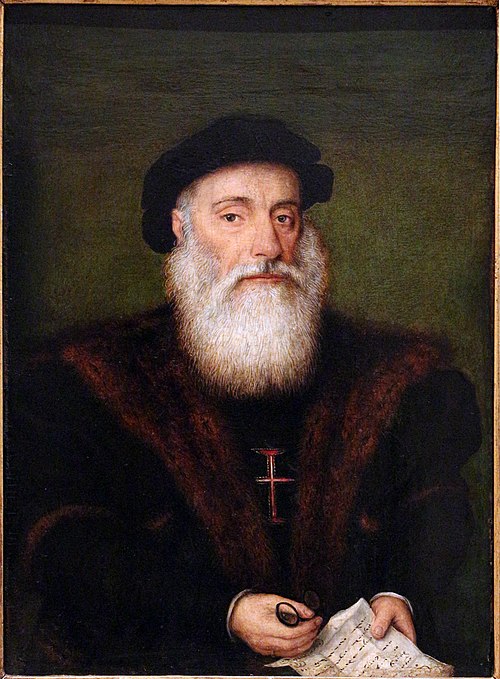
Vasco da Gama Reaches Calicut
Portuguese explorer Vasco da Gama arrived at Calicut (Kozhikode) on the Malabar Coast, opening a sea route to India. Calicut's port was a key hub in the Indian Ocean spice trade, leading to European colonial port development. #ageofexploration #india #ports
Vasco da Gama Reaches Calicut By Sailko - Own work, CC BY 3.0, https://commons.wikimedia.org/w/index.php?curid=61575307
Aug 24, 1511 CE
Portuguese Conquest of Malacca
The Portuguese captured the strategic port of Malacca, a thriving emporium controlling trade between the Indian Ocean and East Asia. They fortified the harbor and imposed trade monopolies, reshaping regional port hierarchies. #colonialism #southeastasia #maritime
Portuguese Conquest of Malacca By User Mysid on en.wikipedia - w:Flag of Malacca.svg, Public domain, https://commons.wikimedia.org/w/index.php?curid=1037511
1661 CE
Bombay Port Development Begins
The British East India Company began developing Bombay (Mumbai) into a major deep-water port after receiving it as a dowry. Docks, warehouses, and fortifications were built, laying the foundation for modern India's largest port. #india #colonial #ports
Bombay Port Development Begins By A.Savin - Own work, FAL, https://commons.wikimedia.org/w/index.php?curid=48487078
1717 CE
Liverpool Old Dock Opens
The world's first commercial enclosed wet dock, the Old Dock in Liverpool, England, opened. It allowed ships to unload and load in a controlled basin, greatly improving efficiency and safety. #industrialrevolution #ports #innovation
Aug 17, 1807 CE
Robert Fulton's Steamboat Clermont
Fulton's steamboat Clermont traveled from New York to Albany on the Hudson River, demonstrating steam navigation. Although not a port event, it spurred the construction of steamship berths and coaling stations globally. #steam #navigation #maritime
Robert Fulton's Steamboat Clermont By Detroit Publishing Co. - This image is available from the United States Library of Congress's Prints and Photographs division under the digital ID det.4a16094.This tag does not indicate the copyright status of the attached work. A normal copyright tag is still required. See Commons:Licensing., Public domain, https://commons.wikimedia.org/w/index.php?curid=9948737
1824 CE
First Floating Dry Dock
The first floating dry dock was built in the United States, allowing ship repairs without tidal basins. This innovation enabled maintenance of larger vessels and spread to major ports worldwide. #shipbuilding #engineering #innovation
First Floating Dry Dock By Unknown; DoD photo (according to its source) - http://www.defense.gov/, Public domain, https://commons.wikimedia.org/w/index.php?curid=19322445
Sep 15, 1830 CE
Liverpool and Manchester Railway Opens
The first inter-city railway connected the port of Liverpool to Manchester, enabling rapid freight movement between docks and inland factories. This port-rail integration set a model for intermodal transport. #railway #ports #logistics
Liverpool and Manchester Railway Opens By A.B. Clayton - Not necessary, PD by age., Public domain, https://commons.wikimedia.org/w/index.php?curid=2401054
Apr 25, 1859 CE
Suez Canal Construction Begins
The Suez Canal project, linking the Mediterranean and Red Sea, started under French engineer Ferdinand de Lesseps. The canal drastically shortened sea routes between Europe and Asia. #canal #engineering #maritime
Suez Canal Construction Begins By NASA - http://spaceflight.nasa.gov/gallery/images/station/crew-16/html/iss016e019375.html, Public domain, https://commons.wikimedia.org/w/index.php?curid=3832302
Nov 17, 1869 CE
Suez Canal Opens
The Suez Canal officially opened, revolutionizing global shipping by eliminating the need to circumnavigate Africa. Ports along the route, such as Port Said and Suez, expanded rapidly. #canal #globaltrade #history
1870 CE
First Suction Dredger
The invention of the suction dredger allowed efficient deepening of harbors and channels, enabling ports to accommodate larger vessels with deeper drafts. This was critical for port expansion worldwide. #dredging #engineering #ports
First Suction Dredger By Pearson Scott Foresman - This image has been extracted from another file, Public domain, https://commons.wikimedia.org/w/index.php?curid=6968356
1889 CE
Port of Seattle Founded
The Port of Seattle was established as a public port district, a model for U.S. port governance. It later became a major gateway for trade with Asia, especially after the Klondike Gold Rush. #usa #ports #pacific
Port of Seattle Founded By SounderBruce - Own work, CC BY-SA 4.0, https://commons.wikimedia.org/w/index.php?curid=122173805
Aug 15, 1914 CE
Panama Canal Opens
The Panama Canal officially opened, connecting the Atlantic and Pacific Oceans. It transformed global shipping routes, spurring infrastructure development in Caribbean and Central American ports. #canal #engineering #globaltrade
Panama Canal Opens By Thoroe - Own work Map created using: Generic Mapping Tools (GMT) with SRTM3 V2 data OpenStreetMap data File:CanalZone.gif File:Panama Canal Rough Diagram-non annotated.png Proposal for the expansion of the Panama Canal Panama Canal Profile Map, CC BY-SA 2.0, https://commons.wikimedia.org/w/index.php?curid=142105511
1930 CE
First Roll-on/Roll-off (Ro-Ro) Ferry
The first purpose-built Ro-Ro ferry, the 'Santa Maria', was introduced, allowing vehicles to drive on and off ships. This innovation later revolutionized short-sea shipping and port terminal design. #ferry #shipping #innovation
First Roll-on/Roll-off (Ro-Ro) Ferry By Wikideas1 - Own work made with w:QGIS and data from Inland waterways - https://geodata.bts.gov/datasets/2f8f522f630e4cf5b754ab9e4b64e37e_0/explore?location=37.310971%2C-94.556468%2C5.51 RoRo ports - https://geodata.bts.gov/datasets/ff5f787f987c4686b3a79d3dc5b3daa2_0/explore?location=36.663018%2C-95.658454%2C5.64 OpenStreetMaps - https://www.openstreetmap.org/#map=6/38.01/-95.84, CC0, https://commons.wikimedia.org/w/index.php?curid=157305031
Apr 26, 1956 CE
Containerization Begins with Ideal X
Malcolm McLean's converted tanker 'Ideal X' carried 58 containers from Newark to Houston, launching modern container shipping. This innovation standardized freight handling and transformed port infrastructure worldwide. #containerization #shipping #innovation
Containerization Begins with Ideal X By U.S. Navy - NARA Number 80022 from Record Group 80, General Records of the Department of the Navy, 1798-1947. The picture was researched by Dave Whittaker, Suffolk, VA, Public domain, https://commons.wikimedia.org/w/index.php?curid=953450
1965 CE
International Container Bureau Founded
The International Container Bureau (ICB) was established to standardize container dimensions, facilitating global intermodal transport. This led to the adoption of ISO container sizes. #containerization #standards #logistics
1970 CE
First Automated Container Terminal
The first automated container terminal opened at the Port of Rotterdam, using computer-controlled stacking cranes and guided vehicles. This set the stage for efficiency gains in port operations. #automation #ports #netherlands
First Automated Container Terminal By Port of Rotterdam - www.portofrotterdam.com, CC BY-SA 4.0, https://commons.wikimedia.org/w/index.php?curid=112946724
1980 CE
Rise of Mega-Ships (3000+ TEU)
The first post-Panamax container ships, exceeding the Panama Canal's original locks, were built. These 'mega-ships' drove the deepening and expansion of ports like Singapore, Hong Kong, and Rotterdam. #shipping #mega-ships #ports
Rise of Mega-Ships (3000+ TEU) By kees torn - MAERSK MC KINNEY MÖLLER & MARSEILLE MAERSK, CC BY-SA 2.0, https://commons.wikimedia.org/w/index.php?curid=82090447
1992 CE
Port Privatization Wave (e.g., UK)
The UK privatized major ports like Felixstowe and Southampton, leading to a global trend of private investment in port infrastructure. This increased efficiency but also raised concerns about labor and public access. #privatization #ports #economics
Port Privatization Wave (e.g., UK) By Geof Sheppard - Own work, CC BY-SA 4.0, https://commons.wikimedia.org/w/index.php?curid=61919591
2000 CE
Introduction of RFID in Ports
Radio-frequency identification (RFID) technology began to be used for tracking containers and assets within ports, improving inventory management and security. #supplychain #technology #ports
Introduction of RFID in Ports By Nicolas Eynaud - Own work, CC BY 4.0, https://commons.wikimedia.org/w/index.php?curid=163337716
2005 CE
Rubber-Tired Gantry Cranes Widespread
Rubber-tired gantry (RTG) cranes became standard in container terminals, allowing faster stacking and movement of containers. Their flexibility and efficiency boosted throughput. #cranes #containerization #ports
2008 CE
Port of Singapore Becomes World's Busiest
The Port of Singapore surpassed others to become the world's busiest container port, handling over 30 million TEUs. Its strategic location and advanced infrastructure exemplify modern hub ports. #singapore #ports #globaltrade
Port of Singapore Becomes World's Busiest By Aaaatu - Own work, CC BY-SA 4.0, https://commons.wikimedia.org/w/index.php?curid=147237520
2010 CE
Smart Port Initiatives (e.g., Hamburg)
The Port of Hamburg launched its 'SmartPort' initiative, using IoT sensors, big data, and AI to optimize traffic flow, berth allocation, and energy use. This model was adopted by many ports. #smartport #iot #digitalization
Smart Port Initiatives (e.g., Hamburg) By Matthias Süßen - Own work, CC BY-SA 4.0, https://commons.wikimedia.org/w/index.php?curid=110511860
Jun 26, 2014 CE
Expanded Panama Canal Opens
A third set of locks opened on the Panama Canal, allowing Neopanamax vessels (up to 14,000 TEU). This triggered port upgrades in the Americas to handle larger ships. #canal #expansion #shipping
Expanded Panama Canal Opens By Mariordo (Mario Roberto Durán Ortiz) - Own work, CC BY-SA 4.0, https://commons.wikimedia.org/w/index.php?curid=82643323
2017 CE
Automated Guided Vehicles (AGVs) in Terminals
Major terminals like Rotterdam's Maasvlakte 2 deployed fleets of AGVs for container movement, reducing labor costs and operational errors. Automation became a key trend. #automation #agv #ports
Automated Guided Vehicles (AGVs) in Terminals By MakoGomez90 - Own work, CC BY-SA 4.0, https://commons.wikimedia.org/w/index.php?curid=68173999
2019 CE
Green Port Initiatives (Emission Controls)
Ports like Los Angeles and Rotterdam implemented strict emission controls and shore power for ships, aiming to reduce carbon footprint. The IMO's 2020 sulfur cap further pushed green investments. #greenport #environment #shipping
Green Port Initiatives (Emission Controls) By Fabian Horst - Own work, CC BY-SA 4.0, https://commons.wikimedia.org/w/index.php?curid=82816054
Mar 23, 2021 CE
Ever Given Blocks Suez Canal
The container ship Ever Given ran aground in the Suez Canal, blocking traffic for six days. This event highlighted the vulnerability of global supply chains and the critical importance of port and canal infrastructure. #supplychain #suez #evergiven
Ever Given Blocks Suez Canal By S.J. de Waard - Own work, CC BY-SA 3.0, https://commons.wikimedia.org/w/index.php?curid=107989305
2023 CE
Autonomous Port Tugs and Drones
Several ports began trials of autonomous tugboats and inspection drones to enhance safety and efficiency. These technologies represent the next frontier in port automation. #autonomous #drones #ports