Pipa Silk Road Lute: Tunhuang Manuscripts to Modern Concertos
Encyclopedia/4. Arts & Literature/3. Music, Theatre & Performance/02. Traditional Asian Instrumental Music • Curated by Admin Timeline.sg
The pipa, a four-stringed pear-shaped lute, originated from Central Asia and was transmitted to China via the Silk Road during the Han Dynasty. Over two millennia, it evolved from a Silk Road folk instrument to a refined Tang court favorite, inspired Dunhuang cave art, produced masterpieces like 'Ambush from Ten Sides', and achieved modern symphonic concertos.
Chronological Storyline (43 Milestones)
200 BCE
Earliest depictions of pipa-like instruments in Central Asia
Terracotta figurines and murals in present-day Uzbekistan and Tajikistan show musicians playing a lute with a curved neck, a prototype of the pipa. #music #history
Earliest depictions of pipa-like instruments in Central Asia By Unknown author - This file was donated to Wikimedia Commons as part of a project by the Metropolitan Museum of Art. See the Image and Data Resources Open Access Policy, CC0, https://commons.wikimedia.org/w/index.php?curid=57858544
100 BCE
Han Dynasty silk road transmission of pipa to China
The pipa (then called 'hu pipa' or barbarian lute) enters China from Central Asia via the Silk Road during the Han Dynasty, gaining popularity in the northern regions. #silkroad #music
100 CE
Earliest Chinese textual reference to pipa
The 'Shuowen Jiezi' dictionary (c. 100 AD) defines 'pipa' as a hand-plucked string instrument, referencing its two techniques: 'pi' (forward pluck) and 'pa' (backward pluck). #literature #music
300 CE
Pipa appears in Dunhuang mural art
The Mogao Caves near Dunhuang (c. 4th century) feature murals of pipa-playing celestial beings (apsaras), notably the 'flying pipa' with the instrument held upside down. #art #buddhism
Pipa appears in Dunhuang mural art By 慕尼黑啤酒 - Own work, CC BY-SA 3.0, https://commons.wikimedia.org/w/index.php?curid=44245000
400 CE
Pipa becomes popular in Six Dynasties court music
During the Six Dynasties period, the pipa is adopted into Chinese court orchestras, with foreign musicians introducing new tunes and techniques. #music #history
550 CE
Earliest surviving pipa notation from Dunhuang manuscripts
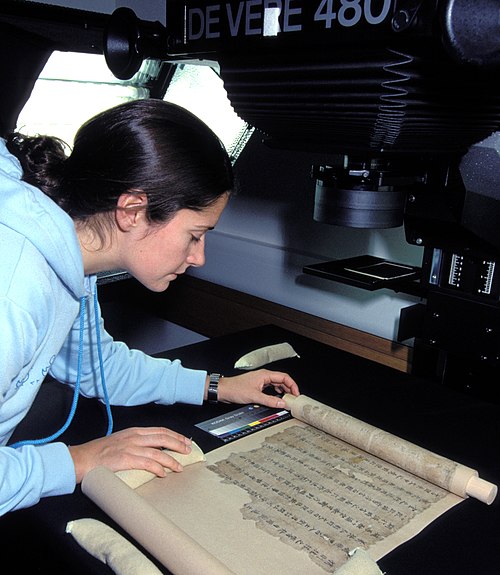
Dunhuang Cave 17 yields a Tang dynasty manuscript (c. 6th-10th century) with pipa tablature in the 'gongche' notation, the oldest known pipa score. #music #manuscript
Earliest surviving pipa notation from Dunhuang manuscripts By International Dunhuang Project - This file has been provided by the International Dunhuang Project from its digital collections, from original file IDP1_167.jpg., CC BY-SA 3.0, https://commons.wikimedia.org/w/index.php?curid=22115069
618 CE
Tang Dynasty golden age of pipa music
The Tang Dynasty (618–907) elevates the pipa to a central instrument in court banquet music (Yanyue), with famous players like Cao Gang and Pei Xingnu. #music #court
630 CE
Tang court pipa music transcribed in Japanese gagaku
Japanese envoys bring Tang pipa music to Japan, where it is preserved in gagaku court music notations, notably the 'Tōgaku' repertoire. #music #japan
700 CE
Famous pipa piece 'Rainbow Skirt and Feathered Coat'
A celebrated Tang-era pipa composition, 'Nishang Yuyi Qu' (Rainbow Skirt and Feathered Coat), is said to be inspired by the emperor's dream of a moon palace dance. #music #legend
750 CE
Dunhuang pipa scores deposited in Mogao Caves
Multiple pipa manuscripts, including pieces like 'Bodhisattva Man' and 'Qinghai Bo', are sealed in Dunhuang Cave 17, later rediscovered in the 20th century. #music #manuscript
900 CE
Sui-Tang pipa master Caobao develops new techniques
Pipa virtuoso Caobao (c. 9th-10th century) is credited with expanding the pipa's expressive range and standardizing finger techniques. #music #history
1000 CE
Song Dynasty pipa evolves into solo instrument
During the Song Dynasty, the pipa transitions from ensemble accompaniment to a solo instrument, with new schools of playing emerging in the south. #music #solo
1200 CE
Mongol Yuan Dynasty pipa in opera and storytelling
The pipa becomes a key instrument in Yuan dynasty zaju opera and tanci storytelling, often used to accompany narrative ballads. #opera #storytelling
1300 CE
Pipa spreads to neighboring countries: Korea, Vietnam
Tribute missions and trade bring the pipa to Korea (as 'bipa') and Vietnam (as 'đàn tỳ bà'), where it is adapted into local music traditions. #korea #vietnam #music
Pipa spreads to neighboring countries: Korea, Vietnam By Hoàng Thành Ân tự Trọng Khoa at Vietnamese Wikipedia - Transferred from vi.wikipedia to Commons., Public domain, https://commons.wikimedia.org/w/index.php?curid=39629062
1500 CE
Ming Dynasty pipa technique manual 'Youxiang Yipu'
Zhang Xiong's 'Youxiang Yipu' (c. 1528) is the earliest known printed pipa tablature collection, containing 18 pieces with fingering instructions. #music #manual
1550 CE
Classic pipa piece 'Ambush from Ten Sides' composed
The martial pipa masterpiece 'Shimian Maifu' (Ambush from Ten Sides) is believed to have originated in the Ming Dynasty, depicting the 202 BC Battle of Gaixia. #music #history
1600 CE
Pipa piece 'Flute and Drum at Sunset' appears
Another classic pipa piece 'Xiyang Xiao Gu' (Flute and Drum at Sunset) becomes popular, depicting a serene river scene. It later evolves into a modern orchestral work. #music #nature
Regional pipa schools flourish in Jiangsu and Zhejiang provinces, each with distinct repertoires, such as the Wuxi school's 'Hua' style and the Pinghu school's lyrical pieces. #music #schools
1818 CE
First comprehensive pipa score collection: 'Hua Qiupu Pipa Score'
The 'Hua Qiupu Pipa Score' (1818) by Hua Wenbin collects 10 major traditional pieces with detailed fingering, becoming a foundational text for modern pipa playing. #music #score
1895 CE
Li Fangyuan publishes 'Nanchang Old Pipa Score'
Pipa master Li Fangyuan's 'Nanchang Old Pipa Score' (1895) preserves 14 pieces from the Pinghu school, including the famous 'E Minor' pieces. #music #score
1920 CE
Liu Tianhua reforms pipa technique and notation
Liu Tianhua (1895–1932), a pioneer of modern Chinese music, reforms pipa technique, introducing bi-tonal fingerings and standardizing staff notation alongside traditional tablature. #music #reform
Liu Tianhua reforms pipa technique and notation By Unknown author - https://www.huain.com/attach/uploadfile/musician/images/2022/0520/20220520031932215_s.jpg, Public domain, https://commons.wikimedia.org/w/index.php?curid=165152700
1925 CE
First recording of pipa music on phonograph
The first commercial recordings of pipa solos are made in Shanghai, featuring pieces like 'Ambush from Ten Sides' performed by masters such as Wei Zhongle. #music #recording
1937 CE
Pipa piece 'A Moonlit Night on the Spring River' arranged
The pipa piece 'Chunjiang Huayue Ye' (A Moonlit Night on the Spring River) is arranged from the traditional 'Flute and Drum at Sunset', becoming a beloved standard. #music #moon
1954 CE
Pipa Concerto 'Yellow River' premiered
The 'Yellow River Pipa Concerto' (1954) by Liu Wenjin and others marks the first major pipa concerto with Western orchestra, blending socialist realism with traditional melodies. #concerto #music
1960 CE
Pipa master Wei Zhongle performs internationally
Wei Zhongle (1908–1997) tours the United States and Europe, introducing the pipa to global audiences and collaborating with Western composers. #music #tour
Pipa master Lin Shicheng composes 'Dance of the Yi People'
Lin Shicheng's 'Dance of the Yi People' (1963) becomes one of the most performed modern pipa pieces, showcasing ethnic yi folk tunes. #music #ethnic
1976 CE
Pipa used in film 'The Legend of Tianyun Mountain'
The pipa features prominently in the soundtrack of the Chinese film 'Tianyunshan Chuangi' (1976), introducing the instrument to wider media. #film #music
1977 CE
Pipa gains academic recognition in Chinese conservatories
The pipa is formally established as a major instrument in Chinese conservatories, with standardized curricula at the Central Conservatory of Music in Beijing. #education #music
1984 CE
Premiere of 'Pipa Concerto No. 2' by Wu Zuqiang
Wu Zuqiang's Pipa Concerto No. 2 (1984) blends Chinese folk melodies with Western symphonic techniques, commissioned by the Chinese Central Philharmonic. #concerto #music
1990 CE
Pipa appears in popular culture: 'The Butterfly Lovers' concerto
The pipa is used as a solo instrument in arrangements of the 'Butterfly Lovers' violin concerto, demonstrating its versatility in romantic themes. #music #pop
Pipa appears in popular culture: 'The Butterfly Lovers' concerto By Andrijko Z. - Own work, CC BY-SA 4.0, https://commons.wikimedia.org/w/index.php?curid=52827684
1995 CE
Pipa master Wu Man moves to United States
Wu Man, a graduate of the Central Conservatory, relocates to the US and becomes the foremost international pipa ambassador, commissioning dozens of new works. #musician #global
Pipa master Wu Man moves to United States By Michael Coghlan from Adelaide, Australia - Wu Man, CC BY-SA 2.0, https://commons.wikimedia.org/w/index.php?curid=34140563
2000 CE
Dunhuang pipa manuscript 'Bu Kong Juan Suo' performed
Musicologists reconstruct and perform 'Bu Kong Juan Suo' from a Tang Dunhuang manuscript, reviving a lost pipa piece for modern audiences. #reconstruction #manuscript
2003 CE
Pipa included in UNESCO's Intangible Cultural Heritage
Chinese guqin (not pipa) is inscribed, but pipa's status is recognized as part of China's intangible cultural heritage list. #unesco #culture
2006 CE
Pipa in film 'The House of Flying Daggers'
The film 'Shi Mian Mai Fu' (House of Flying Daggers) features a dramatic pipa performance of 'Ambush from Ten Sides', boosting the instrument's global fame. #film #music
2008 CE
Pipa performed at Beijing Olympics Opening Ceremony
Wu Man performs the pipa solo 'Jasmine Flower' during the Beijing 2008 Olympic Games opening ceremony, watched by billions worldwide. #olympics #music
Pipa performed at Beijing Olympics Opening Ceremony By wuqiang_beijing - https://web.archive.org/web/20161012030731/http://www.panoramio.com/photo/13569222, CC BY 3.0, https://commons.wikimedia.org/w/index.php?curid=49616537
2010 CE
Pipa concerto 'King Chu Doffs His Armour' premiered
Composer Zhou Long's pipa concerto 'King Chu Doffs His Armour' wins the 2011 Pulitzer Prize for Music, blending ancient themes with modern orchestration. #concerto #prize
2011 CE
Wu Man collaborates with Kronos Quartet
Wu Man and the Kronos Quartet release 'A Chinese Home' (2011), fusing pipa with contemporary string quartet. #collaboration #music
2014 CE
Pipa in video game music: 'Total War: Three Kingdoms'
The pipa is featured in the soundtrack of the video game 'Total War: Three Kingdoms' (2014), reaching new audiences. #gaming #music
2015 CE
Pipa master Lin Shicheng passes away
Lin Shicheng (1922–2015), a leading pipa performer and professor at the Central Conservatory, dies, leaving a legacy of teaching and composition. #obituary #music
2018 CE
First Pipa International Competition held
The first International Pipa Competition is held in Beijing, attracting participants from over 20 countries, signaling the instrument's global reach. #competition #music
2020 CE
Digital Dunhuang project releases pipa music reconstructions
The Dunhuang Academy and musicologists release digital reconstructions of Tang pipa pieces from cave manuscripts, available online. #digital #heritage
2022 CE
Pipa in K-pop: BTS's 'Idol' features pipa sample
Korean group BTS uses a pipa sample in their hit 'Idol', introducing the instrument to a massive K-pop audience. #kpop #music )
2023 CE
New pipa design innovations: electronic pipa developed
Luthiers in Shanghai develop an electronic pipa with MIDI capabilities, allowing compatibility with digital music production. #innovation #technology