Encyclopedia/5. Human Thought & Philosophy/1. Philosophy, Religion & Ethics/03. Epistemology, Logic & Philosophy of Science • Curated by Admin Timeline.sg
Falsifiability · Scientific realism · Ethics of technological development
Chronological Storyline (27 Milestones)
400 BCE
Nyaya school epistemology founded
The Nyaya school of Indian philosophy developed a rigorous system of logic and epistemology, defining valid means of knowledge (pramanas) including perception, inference, and testimony, which parallels later Western philosophy of science. Source — Wikipedia:
380 BCE
Mohist Canon's logic and empiricism
The Mohist Canon (Mo Jing) in China articulated principles of logic, inference, and empirical testing, advancing a philosophy of knowledge that valued observable consequences and practical verification. Source — Wikipedia:
Birth places of notable Chinese philosophers of the Hundred Schools of Thoughts in the Zhou dynasty. By SY - Own work, CC BY-SA 4.0, https://commons.wikimedia.org/w/index.php?curid=65898454
350 BCE
Aristotle's Posterior Analytics
Aristotle's Posterior Analytics laid the foundation for scientific demonstration, defining deductive reasoning and the structure of scientific explanation that influenced philosophy of science for over two millennia. · Wikipedia: https://en.wikipedia.org/wiki/Posterior_Analytics
300 BCE
Euclid's Elements and deductive method
Euclid's Elements established the axiomatic-deductive method as a model of scientific knowledge, demonstrating how complex truths can be derived from self-evident axioms. Source — Wikipedia:
Originally P.Oxy.29 (now P.Penn. Museum inv. E02748); a papyrus fragment of Euclid's Elements Book II, Proposition 5 dated 3rd-4th century CE. By University of Pennsylvania Museum of Archaeology and Anthropology - https://openn.library.upenn.edu/Data/0016/html/e2748.html, CC BY-SA 4.0, https://commons.wikimedia.org/w/index.php?curid=169166171
830 CE
House of Wisdom translation movement
Under Caliph al-Ma'mun, Baghdad's House of Wisdom translated and synthesized Greek, Persian, and Indian scientific and philosophical works, preserving and transforming the global scientific heritage. Source — Wikipedia:
Manuscript with depiction by Yahya ibn Vaseti found in the Maqama of Hariri located at the Bibliotheque Nationale de France. Image depicts a library with pupils in it. By Zereshk - Own work, Public domain, https://commons.wikimedia.org/w/index.php?curid=2809505
1021 CE
Ibn al-Haytham's scientific method
In his Book of Optics, Ibn al-Haytham insisted on systematic experimentation and doubt, combining empirical observation with mathematical reasoning in a manner anticipating the modern scientific method. Source — Wikipedia:
This picture is of the cover page of Ibn al-Haytham's "Book of Optics", 1572. By Ibn al-Haytham, Vitello, Friedrich Risner - University of Oklahoma History of Science Collections et BnF Gallica : http://gallica.bnf.fr/ark:/12148/bpt6k312873d.r=Haytham?rk=407727;2, Public domain, https://commons.wikimedia.org/w/index.php?curid=48189707
1030 CE
Al-Biruni's comparative scientific method
Al-Biruni developed rigorous comparative methods in his studies of India, applying systematic observation, measurement, and cross-cultural analysis to anthropology, astronomy, and geology. Source — Wikipedia:
USSR stamp, Abū Rayhān al-Bīrūnī, 6 copecks, 1973. By The original uploader was Romanm at Slovenian Wikipedia. - Originally from sl.wikipedia; description page is/was here., Public domain, https://commons.wikimedia.org/w/index.php?curid=2590841
1037 CE
Ibn Sina's Canon of Medicine
Ibn Sina's Canon of Medicine systematized medical knowledge through structured observation, classification, and logical inference, becoming a standard reference in Europe for centuries. Source — Wikipedia:
The Persian manuscript copy of The Canon of Medicine in Museum and Mausoleum of Avicenna, Hamedan, Iran. By Coffeetalkh - Own work, CC BY-SA 3.0, https://commons.wikimedia.org/w/index.php?curid=11906621
1190 CE
Ibn Rushd on reason and nature
Ibn Rushd (Averroes) argued that philosophical rational inquiry and religious revelation are compatible, and his commentaries on Aristotle shaped medieval European philosophy of nature and science. · Wikipedia: https://en.wikipedia.org/wiki/Averroes
Cappellone degli Spagnoli - Triumph of St. Thomas Aquinas By Sailko - Own work, CC BY 3.0, https://commons.wikimedia.org/w/index.php?curid=39974830
1265 CE
Roger Bacon on experimental science
Roger Bacon advocated for empirical verification and the use of mathematics in natural philosophy, arguing that knowledge must be tested by experience rather than authority alone. Source — Wikipedia:
Roger Bacon on experimental science By Unknown author, CC BY-SA 3.0, https://commons.wikimedia.org/w/index.php?curid=131754
1377 CE
Ibn Khaldun's philosophy of history
In the Muqaddimah, Ibn Khaldun developed a systematic philosophy of history and social science, analyzing causal patterns in human society with empirical rigor and methodological self-awareness. Source — Wikipedia:
The Muqaddimah of Ibn Khaldun By Riad Salih - Own work, CC BY 4.0, https://commons.wikimedia.org/w/index.php?curid=154963244
1620 CE
Bacon's Novum Organum published
Francis Bacon's Novum Organum proposed a new system of inductive reasoning and empirical method, rejecting Aristotelian deduction and laying the philosophical groundwork for modern science. Source — Wikipedia:
Title page for Novum organum scientiarum, 1645, by Francis Bacon (1561-1626). *EC.B1328.620ib, Houghton Library, Harvard University: Francis Bacon of Verulam / High Chancellor of England / New Organon (Beneath the galleon) “Many will travel and knowledge will be increased.” Leiden, Holland: at the shop of Wyngaerden and Moiardum, 1645. By Francis Bacon - Houghton Library, Public domain, https://commons.wikimedia.org/w/index.php?curid=34947014
1632 CE
Galileo's Dialogue on Two World Systems
Galileo Galilei's Dialogue comparing Copernican and Ptolemaic systems exemplified the use of empirical evidence and reasoned argument to challenge established authority in natural philosophy. Source — Wikipedia:
Frontispiece (by Stefan Della Bella) and title page of Galileo Galilei's Dialogue Concerning the Two Chief World Systems, published by Giovanni Battista Landini in 1632 in Florence. By Giovanni Battista Landini - http://moro.imss.fi.it/lettura/LetturaWEB.DLL?AZIONE=IMG&TESTO=E_U&PARAM=07-23-tit.jpg and http://moro.imss.fi.it/lettura/LetturaWEB.DLL?AZIONE=IMG&TESTO=E_U&PARAM=07-25-tit.jpg Transferred from en.wikipedia to Commons by User:Lijealso using CommonsHelper., Public domain, https://commons.wikimedia.org/w/index.php?curid=5289735
1637 CE
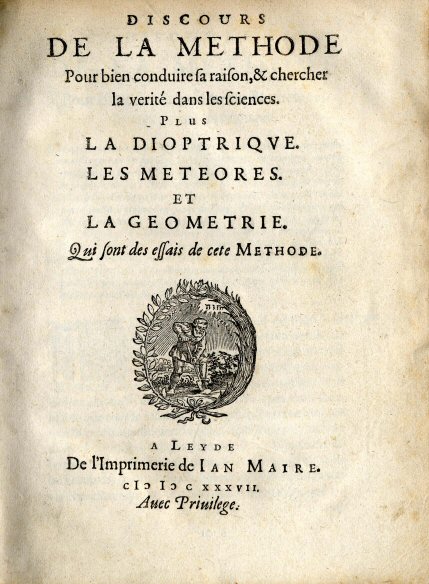
Descartes' Discourse on Method
René Descartes' Discourse on Method introduced systematic methodological doubt and rationalist principles for acquiring scientific knowledge, founding modern philosophy of method. Source — Wikipedia:
Title page of the first edition of René Descartes' Discourse on Method By Ian Maire - Leeds University Library, Public domain, https://commons.wikimedia.org/w/index.php?curid=1472528
1687 CE
Newton's Principia Mathematica
Isaac Newton's Principia established a unified mathematical-empirical framework for physical laws, demonstrating the power of combining inductive generalization with deductive proof. Source — Wikipedia:
Title page of the 1687 first edition of Philosophiae Naturalis Principia Mathematica, by Isaac Newton. PHILOSOPHIÆ NATURALIS PRINCIPIA MATHEMATICA. Autore IS. NEWTON, Trin. Coll. Cantab. Soc. Matheseos Professore Lucasiano, & Societatis Regalis Sodali. IMPRIMATUR. S. PEPYS, Reg. Soc. PRÆSES. Julii 5. 1686. LONDINI, Jussu Societatis Regiæ ac Typis Josephi Streater. Prostat apud plures Bibliopolas. Anno MDCLXXXVII. By The original uploader was Zhaladshar at English Wikisource. - Transferred from en.wikisource to Commons. (previous image from another copy) Internet Archive (current image from the Bern Dibner copy), Public domain, https://commons.wikimedia.org/w/index.php?curid=2681838Secret Life of Isaac Newton - Full Documentary
1739 CE
Hume's problem of induction
David Hume's Treatise of Human Nature identified the problem of induction, questioning the logical basis for inferring universal laws from finite observations, a central issue in philosophy of science. · Wikipedia: https://en.wikipedia.org/wiki/David_Hume
Hume's problem of induction By Allan Ramsay - National Galleries Scotland, Public domain, https://commons.wikimedia.org/w/index.php?curid=51564591
1833 CE
Whewell coins 'scientist' and inductive philosophy
William Whewell coined the term 'scientist' and developed a sophisticated philosophy of induction, emphasizing the creative role of hypotheses and the concept of consilience in science. Source — Wikipedia:
- Iconographic Collections By Unknown author - https://wellcomeimages.org/indexplus/obf_images/a5/02/27077d587356a560e4d77fdaf300.jpg Gallery: https://wellcomeimages.org/indexplus/image/L0014766.html Wellcome Collection gallery (2018-04-01): https://wellcomecollection.org/works/m4vcqgcv CC-BY-4.0, CC BY 4.0, https://commons.wikimedia.org/w/index.php?curid=35971492
1843 CE
Mill's System of Logic
John Stuart Mill's System of Logic formulated canons of inductive reasoning and methods of experimental inquiry that became foundational for the philosophy of scientific method. Source — Wikipedia:
Página de título de Un sistema de lógica deductivo e inductivo, de 1881. Obra del filosofo inglés John Stuart Mill (publicada por primera vez en 1863). Edición octava, editor: Harper & Brothers. Lugar de publicacion: Nueva York By Kelly - Universidad de Toronto - https://archive.org/details/systemoflogicrat00milluoft, Public domain, https://commons.wikimedia.org/w/index.php?curid=71782384
1890 CE
Peirce on pragmatism and inquiry
Charles Sanders Peirce developed pragmatism and a theory of inquiry that treated scientific knowledge as a self-correcting communal process, introducing ideas like fallibilism and abduction. · Wikipedia: https://en.wikipedia.org/wiki/Charles_Sanders_Peirce
Charles Sanders Peirce. Great philosopher, scientist, and mathematician. Served 30 years with the Coast and Geodetic Survey. By Charles_Sanders_Peirce_theb3558.jpg: NOAA Office of NOAA Corps Operations derivative work: Ori.livneh (talk) - Charles_Sanders_Peirce_theb3558.jpg, Public domain, https://commons.wikimedia.org/w/index.php?curid=10310713
1919 CE
Eddington eclipse tests relativity
Arthur Eddington's solar eclipse expedition tested Einstein's general relativity, becoming a celebrated case study in philosophy of science for questions of theory confirmation and crucial experiments. Source — Wikipedia:
Almost exactly 100 years ago, a remarkable event occurred: a total solar eclipse. This eclipse was special in more ways than one. Firstly, at just under seven minutes in duration, it was the longest such eclipse in over 500 years. Secondly, it was used by astronomers to explore the then-new theory of general relativity — with successful and groundbreaking results. Einstein published his general theory of relativity in 1915. The total solar eclipse of 1919 offered the perfect opportunity to test it experimentally, by exploring whether — and how — the immense gravity of the Sun bends and distorts incoming light from more distant stars, as predicted by Einstein’s theory. For a brief moment during the eclipse, the Moon would block the Sun’s light in the sky and make visible some of the stars that lie close to the line of sight of the Sun, not normally visible during the daytime. By measuring the positions of these stars during the eclipse and comparing them to their positions at night, when the sun is not in the field of view, it would be possible to determine whether their light rays bends while passing close to the Sun. Three astronomers — Arthur Eddington, Frank Watson Dyson, and Andrew Crommelin — played key roles in this 1919 experiment. Eddington and Crommelin travelled to locations at which the eclipse would be total — Eddington to the West African island of Príncipe, Crommelin to the Brazilian town of Sobral — while Dyson coordinated the attempt from England. Eddington and Crommelin imaged the eclipse using the technology of the time: photographic plates made of glass. Sadly, the original plates from the 1919 expedition (one of which was reproduced in Dyson’s original paper) have been lost — but, luckily, copies of one of the plates were made and sent to observatories around the world to allow scientists everywhere to see the evidence in support of relativity with their own eyes. One copy of a plate from Sobral went to Landessternwarte Heidelberg-Königstuhl, who recently scanned theirs as part of the Heidelberg Digitized Astronomical Plates (HDAP) project [1]. The image shown here is arguably the highest resolution image of the 1919 eclipse, and is the result of applying modern image processing techniques — including image restoration, noise reduction, and removal of artifacts — to that plate copy (un-annotated version here). It unveils stunning details in the solar corona, a giant prominence emerging from the upper right part of the Sun, and stars in the constellation of Taurus (The Bull) that were used to confirm general relativity’s predictions [2]. Notes [1] HDAP receives funding under grant No. 00.071.2005 of the Klaus Tschira Foundation. The original high-resolution scan before the digital restoration is provided here for historical purposes. [2] Dyson’s original paper concludes with the paradigm-changing graph on p.332 plotting the displacements of the stars during the eclipse against their distance from the solar disc’s centre. This shows a clear relation (solid line) — the stars closer to the solar disc are deflected more than those further away, and by roughly the amount predicted by general relativity (twice that predicted by Newtonian theory, which is represented by the dotted line). By ESO/Landessternwarte Heidelberg-Königstuhl/F. W. Dyson, A. S. Eddington, & C. Davidson - https://www.eso.org/public/images/potw1926a/, CC BY 4.0, https://commons.wikimedia.org/w/index.php?curid=80091497The eclipse photo that made Einstein famous
1934 CE
Popper's Logic of Scientific Discovery
Karl Popper proposed falsifiability as the demarcation criterion for science, arguing that scientific theories must be testable and potentially refutable, fundamentally reshaping philosophy of science. Source — Wikipedia:
1962 CE
Kuhn's Structure of Scientific Revolutions
Thomas Kuhn introduced the concept of paradigm shifts, arguing that science progresses through revolutionary changes in conceptual frameworks rather than steady accumulation of knowledge. Source — Wikipedia:
Thomas Kuhn: The Structure of Scientific Revolutions
1975 CE
Feyerabend's Against Method
Paul Feyerabend argued against any fixed scientific method, advocating methodological anarchism and claiming that science progresses through pluralism and adherence to no single rule. Source — Wikipedia:
Against Method Front cover By Unknown author - Scan of book cover, Public domain, https://commons.wikimedia.org/w/index.php?curid=131375271
1983 CE
Van Fraassen's constructive empiricism
Bas van Fraassen proposed constructive empiricism, arguing that the aim of science is empirical adequacy rather than truth, reigniting debates on scientific realism. · Wikipedia: https://en.wikipedia.org/wiki/Constructive_empiricism
This is a collage of prominent logical positivists. From left to right, top to bottom: Moritz Schlick, Otto Neurath, Hans Hahn, and A. J. Ayer. By User:Thiagovscoelho - Collage created from the following files on Wikimedia Commons, each of which is in the public domain or otherwise freely licensed: Moritz Schlick – Public domainPublic domainfalsefalse This work is in the public domain in its country of origin and other countries and areas where the copyright term is the author's life plus 70 years or fewer. You must also include a United States public domain tag to indicate why this work is in the public domain in the United States. Note that a few countries have copyright terms longer than 70 years: Mexico has 100 years, Jamaica has 95 years, Colombia has 80 years, and Guatemala and Samoa have 75 years. This image may not be in the public domain in these countries, which moreover do not implement the rule of the shorter term. Honduras has a general copyright term of 75 years, but it does implement the rule of the shorter term. Copyright may extend on works created by French who died for France in World War II (more information), Russians who served in the Eastern Front of World War II (known as the Great Patriotic War in Russia) and posthumously rehabilitated victims of Soviet repressions (more information). This file has been identified as being free of known restrictions under copyright law, including all related and neighboring rights. https://creativecommons.org/publicdomain/mark/1.0/PDMCreative Commons Public Domain Mark 1.0falsefalse Otto Neurath – Public domainPublic domainfalsefalse This work is in the public domain in its country of origin and other countries and areas where the copyright term is the author's life plus 70 years or fewer. You must also include a United States public domain tag to indicate why this work is in the public domain in the United States. Note that a few countries have copyright terms longer than 70 years: Mexico has 100 years, Jamaica has 95 years, Colombia has 80 years, and Guatemala and Samoa have 75 years. This image may not be in the public domain in these countries, which moreover do not implement the rule of the shorter term. Honduras has a general copyright term of 75 years, but it does implement the rule of the shorter term. Copyright may extend on works created by French who died for France in World War II (more information), Russians who served in the Eastern Front of World War II (known as the Great Patriotic War in Russia) and posthumously rehabilitated victims of Soviet repressions (more information). This file has been identified as being free of known restrictions under copyright law, including all related and neighboring rights. https://creativecommons.org/publicdomain/mark/1.0/PDMCreative Commons Public Domain Mark 1.0falsefalse Hans Hahn – This file is licensed under the Creative Commons Attribution-Share Alike 4.0 International license. You are free: to share – to copy, distribute and transmit the work to remix – to adapt the work Under the following conditions: attribution – You must give appropriate credit, provide a link to the license, and indicate if changes were made. You may do so in any reasonable manner, but not in any way that suggests the licensor endorses you or your use. share alike – If you remix, transform, or build upon the material, you must distribute your contributions under the same or compatible license as the original.https://creativecommons.org/licenses/by-sa/4.0CC BY-SA 4.0 Creative Commons Attribution-Share Alike 4.0 truetrue Alfred Jules Ayer – Public domainPublic domainfalsefalse This work is in the public domain in its country of origin and other countries and areas where the copyright term is the author's life plus 70 years or fewer. You must also include a United States public domain tag to indicate why this work is in the public domain in the United States. Note that a few countries have copyright terms longer than 70 years: Mexico has 100 years, Jamaica has 95 years, Colombia has 80 years, and Guatemala and Samoa have 75 years. This image may not be in the public domain in these countries, which moreover do not implement the rule of the shorter term. Honduras has a general copyright term of 75 years, but it does implement the rule of the shorter term. Copyright may extend on works created by French who died for France in World War II (more information), Russians who served in the Eastern Front of World War II (known as the Great Patriotic War in Russia) and posthumously rehabilitated victims of Soviet repressions (more information). This file has been identified as being free of known restrictions under copyright law, including all related and neighboring rights. https://creativecommons.org/publicdomain/mark/1.0/PDMCreative Commons Public Domain Mark 1.0falsefalse, Public domain, https://commons.wikimedia.org/w/index.php?curid=179096859
1999 CE
Jonas on ethics of technology
Hans Jonas's The Imperative of Responsibility argued that modern technological power demands a new ethics of responsibility for future generations and the biosphere. Source — Wikipedia:
Jonas on ethics of technology By Unknown author, CC BY-SA 4.0, https://commons.wikimedia.org/w/index.php?curid=179262836
2016 CE
AI ethics and machine learning accountability
The rapid development of machine learning prompted new philosophical work on algorithmic bias, transparency, and the ethics of autonomous systems, linking philosophy of science to technology assessment. · Wikipedia: https://en.wikipedia.org/wiki/Ethics_of_artificial_intelligence
2024 CE
AI safety and frontier model governance
Philosophers and scientists intensified debates on the alignment, governance, and existential risk of advanced AI, making the ethics of technological development a central concern in philosophy of science. · Wikipedia: https://en.wikipedia.org/wiki/Existential_risk_from_artificial_general_intelligence




![Almost exactly 100 years ago, a remarkable event occurred: a total solar eclipse. This eclipse was special in more ways than one. Firstly, at just under seven minutes in duration, it was the longest such eclipse in over 500 years. Secondly, it was used by astronomers to explore the then-new theory of general relativity — with successful and groundbreaking results. Einstein published his general theory of relativity in 1915. The total solar eclipse of 1919 offered the perfect opportunity to test it experimentally, by exploring whether — and how — the immense gravity of the Sun bends and distorts incoming light from more distant stars, as predicted by Einstein’s theory. For a brief moment during the eclipse, the Moon would block the Sun’s light in the sky and make visible some of the stars that lie close to the line of sight of the Sun, not normally visible during the daytime. By measuring the positions of these stars during the eclipse and comparing them to their positions at night, when the sun is not in the field of view, it would be possible to determine whether their light rays bends while passing close to the Sun. Three astronomers — Arthur Eddington, Frank Watson Dyson, and Andrew Crommelin — played key roles in this 1919 experiment. Eddington and Crommelin travelled to locations at which the eclipse would be total — Eddington to the West African island of Príncipe, Crommelin to the Brazilian town of Sobral — while Dyson coordinated the attempt from England. Eddington and Crommelin imaged the eclipse using the technology of the time: photographic plates made of glass. Sadly, the original plates from the 1919 expedition (one of which was reproduced in Dyson’s original paper) have been lost — but, luckily, copies of one of the plates were made and sent to observatories around the world to allow scientists everywhere to see the evidence in support of relativity with their own eyes. One copy of a plate from Sobral went to Landessternwarte Heidelberg-Königstuhl, who recently scanned theirs as part of the Heidelberg Digitized Astronomical Plates (HDAP) project [1]. The image shown here is arguably the highest resolution image of the 1919 eclipse, and is the result of applying modern image processing techniques — including image restoration, noise reduction, and removal of artifacts — to that plate copy (un-annotated version here). It unveils stunning details in the solar corona, a giant prominence emerging from the upper right part of the Sun, and stars in the constellation of Taurus (The Bull) that were used to confirm general relativity’s predictions [2]. Notes [1] HDAP receives funding under grant No. 00.071.2005 of the Klaus Tschira Foundation. The original high-resolution scan before the digital restoration is provided here for historical purposes. [2] Dyson’s original paper concludes with the paradigm-changing graph on p.332 plotting the displacements of the stars during the eclipse against their distance from the solar disc’s centre. This shows a clear relation (solid line) — the stars closer to the solar disc are deflected more than those further away, and by roughly the amount predicted by general relativity (twice that predicted by Newtonian theory, which is represented by the dotted line).](https://upload.wikimedia.org/wikipedia/commons/thumb/f/f8/Highest_resolution_image_of_the_1919_solar_eclipse.tif/lossy-page1-500px-Highest_resolution_image_of_the_1919_solar_eclipse.tif.jpg)


