Encyclopedia/1. The Cosmos & The Natural World/2. Physics & Chemistry/10. Foundational & General Physics • Curated by Admin Timeline.sg
This timeline traces the evolution of particle accelerators and CERN from early 20th-century inventions to modern discoveries like the Higgs boson, highlighting key technological breakthroughs and their impact on physics.
Chronological Storyline (51 Milestones)
1928 CE
Rolf Widerøe Proposes Linear Accelerator
Norwegian engineer Rolf Widerøe publishes the concept of a linear accelerator using alternating electric fields. This foundational idea leads to the development of modern linacs. #particlephysics #accelerator
Rolf Widerøe Proposes Linear Accelerator By Unbekannt - This image is from the collection of the ETH-Bibliothek and has been published on Wikimedia Commons as part of a cooperation with Wikimedia CH. Corrections and additional information are welcome., CC BY-SA 4.0, https://commons.wikimedia.org/w/index.php?curid=103245628
1929 CE
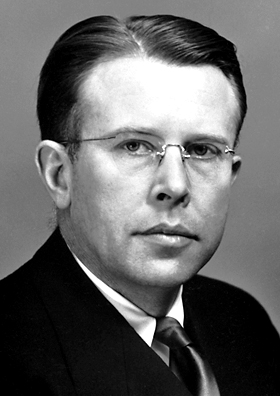
Ernest Lawrence Invents Cyclotron
American physicist Ernest Lawrence conceives the cyclotron, a circular accelerator that uses a magnetic field to spiral particles. The first working model is built in 1931, revolutionizing nuclear physics. #cyclotron #invention
Ernest Lawrence Invents Cyclotron By Nobel foundation - http://nobelprize.org/nobel_prizes/physics/laureates/1939/lawrence-bio.html, Public domain, https://commons.wikimedia.org/w/index.php?curid=6186577
1930 CE
Cockcroft-Walton Generator Built
John Cockcroft and Ernest Walton construct a voltage multiplier generator at Cambridge, achieving 800 kV. In 1932, they use it to split the lithium atom, confirming Einstein's E=mc². #nuclearphysics #accelerator
Cockcroft-Walton Generator Built By Kestrel - Own work, CC BY-SA 4.0, https://commons.wikimedia.org/w/index.php?curid=62252362
1931 CE
First Cyclotron Operational
Lawrence and his team build the first working cyclotron at UC Berkeley, accelerating hydrogen ions to 1 MeV. This marks the birth of circular particle accelerators. #cyclotron #milestone
First Cyclotron Operational By Unknown author, Public domain, https://commons.wikimedia.org/w/index.php?curid=130962
1940 CE
Van de Graaff Generator Developed
Robert Van de Graaff builds a high-voltage electrostatic generator capable of 5 MV. These generators are used as particle accelerators for nuclear research. #electrostatic #accelerator
Van de Graaff Generator Developed By Walber - Own work, CC BY-SA 4.0, https://commons.wikimedia.org/w/index.php?curid=48371643
1944 CE
Synchrotron Concept Proposed
Vladimir Veksler and Edwin McMillan independently propose the synchrotron, which uses a varying magnetic field to keep particles in a circular orbit as they gain energy. This enables higher energies. #synchrotron #concept
Synchrotron Concept Proposed By Albert J. Forman - Retrieved May 3, 2015 from Albert J. Forman "Engineering Research" in The Michigan Technic magazine, Univ. of Michigan, Ann Arbor, Michigan, Vol. 67, No. 7, April 1949 , p. 21 on Google Books, Public domain, https://commons.wikimedia.org/w/index.php?curid=39956068
1945 CE
First Betatron Built
Donald Kerst builds the first betatron at the University of Illinois, accelerating electrons to 2.3 MeV using induction. It is used for X-ray generation and nuclear studies. #betatron #accelerator
First Betatron Built By Unknown author - Retrieved January 2, 2015 from Electronics magazine, McGraw-Hill Publishing Co., New York, Vol. 15, No. 2, February 1942, p. 22 on http://www.americanradiohistory.com, Public domain, https://commons.wikimedia.org/w/index.php?curid=37638789
1947 CE
Synchrotron Radiation Discovered
Scientists at General Electric observe synchrotron radiation from a 70 MeV electron synchrotron. This electromagnetic radiation becomes a powerful tool for materials science and biology. #synchrotron #radiation
Synchrotron Radiation Discovered By Joao Paulo Bessa Brito - Own work, CC BY-SA 4.0, https://commons.wikimedia.org/w/index.php?curid=91170907
1952 CE
Cosmotron Begins Operation
Brookhaven National Laboratory's Cosmotron, the first proton synchrotron, reaches 3.3 GeV. It produces the first artificial mesons and advances particle physics. #synchrotron #proton
Cosmotron Begins Operation By Pearson Scott Foresman - This image has been extracted from another file, Public domain, https://commons.wikimedia.org/w/index.php?curid=5509550
Sep 29, 1954 CE
CERN Founded
The European Organization for Nuclear Research (CERN) is established by 12 European nations to foster collaborative particle physics research. Its first accelerator, the Synchrocyclotron, starts in 1957. #CERN #founding
CERN Founded By European Organization for Nuclear Research Organisation européenne pour la recherche nucléaire - https://cernandsocietyfoundation.cern https://cernandsocietyfoundation.cern/sites/default/files/Annual%20Reviews/CERN%20&%20Society%20Foundation%20Annual%20Report%202024.pdf https://design-guidelines.web.cern.ch/guidelines/badge-logo Own work based on: CERN logo.png:, Public domain, https://commons.wikimedia.org/w/index.php?curid=178595736
1955 CE
Bevatron Produces Antiprotons
The Bevatron at Lawrence Berkeley Lab accelerates protons to 6.2 GeV, leading to the discovery of the antiproton. This confirms the existence of antimatter. #antimatter #discovery
Bevatron Produces Antiprotons By Lawrence Berkeley National Laboratory - Left to Right: Dr. Donald Cooksey, Dr. Harold Fidler, Professor Ernest Orlando Lawrence, William Brobeck, and Professor Robert Thornton overlooking model of Bevatron in Building 51. Photo taken November 22, 1955, U.S. National Archives and Records Administration, Public domain, https://commons.wikimedia.org/w/index.php?curid=128286625
1959 CE
CERN Proton Synchrotron Starts
CERN's Proton Synchrotron (PS) becomes operational at 28 GeV, the world's highest energy accelerator at the time. It enables discoveries like the neutral pion and neutrino interactions. #CERN #synchrotron
CERN Proton Synchrotron Starts By Landua, Fabienne - https://cds.cern.ch/record/2813716?ln=en, CC BY 4.0, https://commons.wikimedia.org/w/index.php?curid=136265059
1960 CE
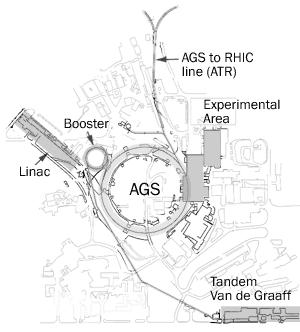
Alternating Gradient Synchrotron Built
Brookhaven's Alternating Gradient Synchrotron (AGS) reaches 33 GeV using strong focusing. It discovers the muon neutrino and the J/psi meson. #synchrotron #strongfocusing
Alternating Gradient Synchrotron Built By Brookhaven National Laboratory - Image courtesy of Brookhaven National Laboratory, Public domain, https://commons.wikimedia.org/w/index.php?curid=45001931
1962 CE
Muon Neutrino Discovered
Using the AGS at Brookhaven, physicists detect the muon neutrino, confirming the existence of a second neutrino type. This leads to the Standard Model's lepton families. #neutrino #discovery
Muon Neutrino Discovered By Argonne National Laboratory - Image courtesy of Argonne National Laboratory, Public domain, https://commons.wikimedia.org/w/index.php?curid=10949136
1964 CE
Higgs Mechanism Proposed
Peter Higgs and others propose the Higgs mechanism to explain mass generation via spontaneous symmetry breaking. The Higgs boson becomes a key target for future accelerators. #Higgs #theory
Higgs Mechanism Proposed By Cush - Own work using: PBS NOVA [1], Fermilab, Office of Science, United States Department of Energy, Particle Data Group, Public domain, https://commons.wikimedia.org/w/index.php?curid=4286964
1966 CE
SLAC Linear Accelerator Completed
The Stanford Linear Accelerator Center (SLAC) builds a 3.2 km linear accelerator reaching 20 GeV. It enables deep inelastic scattering experiments, revealing quarks inside protons. #linac #quarks
SLAC Linear Accelerator Completed By Dicklyon - Own work, CC BY-SA 4.0, https://commons.wikimedia.org/w/index.php?curid=50302350
1968 CE
Quarks Discovered at SLAC
Deep inelastic scattering experiments at SLAC provide evidence for point-like constituents inside protons, later identified as quarks. This revolutionizes particle physics. #quarks #discovery
Quarks Discovered at SLAC By Arpad Horvath - Own work, CC BY-SA 2.5, https://commons.wikimedia.org/w/index.php?curid=637353
1971 CE
CERN Intersecting Storage Rings
CERN's ISR, the first proton-proton collider, begins operation with 31.4 GeV beams. It studies high-energy collisions and discovers rising cross-sections. #collider #CERN
CERN Intersecting Storage Rings By Unknown author, CC BY-SA 3.0, https://commons.wikimedia.org/w/index.php?curid=91947286
1972 CE
Fermilab Main Ring Operational
Fermilab's Main Ring accelerates protons to 400 GeV, the highest energy at the time. It discovers the bottom quark in 1977. #Fermilab #accelerator
Fermilab Main Ring Operational By CramBetter.com - Own work, CC BY 4.0, https://commons.wikimedia.org/w/index.php?curid=64142737
1973 CE
Neutral Currents Discovered at CERN
The Gargamelle bubble chamber at CERN detects neutral current interactions of neutrinos, confirming the electroweak theory and predicting the Z boson. #electroweak #discovery
Neutral Currents Discovered at CERN By CERN - CERN Photo Archive: https://cds.cern.ch/record/917824?ln=en, CC BY 4.0, https://commons.wikimedia.org/w/index.php?curid=61879580
1974 CE
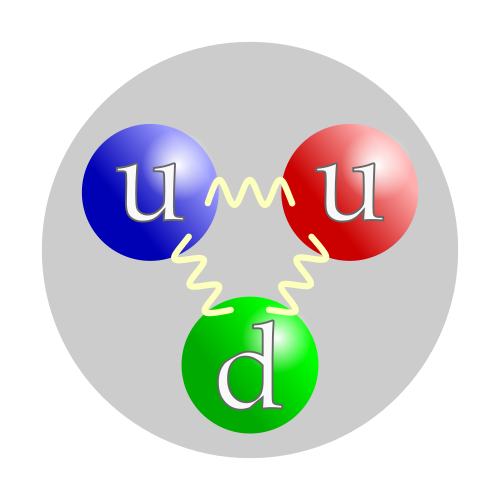
J/psi Meson Discovered
Independently at Brookhaven (AGS) and SLAC, the J/psi meson is discovered, providing evidence for the charm quark. This leads to the November Revolution in particle physics. #charm #discovery
J/psi Meson Discovered By https://commons.wikimedia.org/wiki/User:Harp - File:Quark_structure_pion.svg, CC BY-SA 4.0, https://commons.wikimedia.org/w/index.php?curid=46504895
1976 CE
CERN Super Proton Synchrotron
CERN's SPS becomes operational at 400 GeV. It later serves as a proton-antiproton collider, leading to the discovery of W and Z bosons in 1983. #SPS #CERN
CERN Super Proton Synchrotron By Gillis - Own work, CC BY 3.0, https://commons.wikimedia.org/w/index.php?curid=11296201
1977 CE
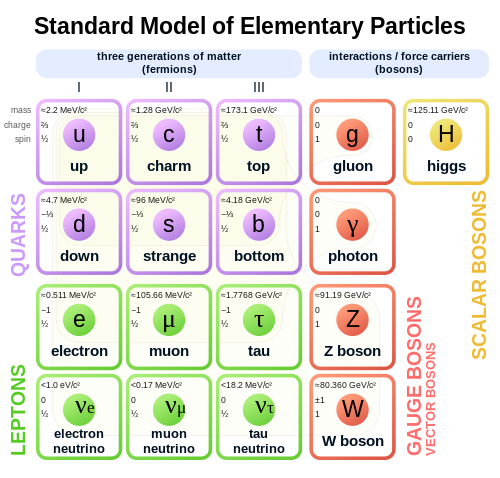
Bottom Quark Discovered
Fermilab's E288 experiment discovers the upsilon meson, revealing the bottom quark. This completes the third generation of quarks. #bottom #quark
Bottom Quark Discovered By user:MissMJ - File:Standard Model of Elementary Particles.svg, CC BY 3.0, https://commons.wikimedia.org/w/index.php?curid=24657344
1981 CE
CERN Proton-Antiproton Collider
CERN converts the SPS into a proton-antiproton collider, achieving 540 GeV center-of-mass energy. This enables the search for W and Z bosons. #collider #CERN
CERN Proton-Antiproton Collider By Luigi Di Lella, CC BY 4.0, https://commons.wikimedia.org/w/index.php?curid=61331006
1983 CE
W and Z Bosons Discovered
The UA1 and UA2 experiments at CERN discover the W and Z bosons, carriers of the weak force. This confirms the electroweak unification and earns a Nobel Prize. #weakforce #discovery
W and Z Bosons Discovered By Inductiveload - Own work, Public domain, https://commons.wikimedia.org/w/index.php?curid=2859203
1989 CE
LEP Collider Starts at CERN
The Large Electron-Positron (LEP) collider begins operation at 45 GeV per beam. It precisely measures the Z boson mass and tests the Standard Model. #LEP #CERN
LEP Collider Starts at CERN By Juhanson - Image taken by Juhanson during CERN 50 Years OpenDay, using Canon EOS 10D camera, CC BY-SA 3.0, https://commons.wikimedia.org/w/index.php?curid=197318
1995 CE
Top Quark Discovered at Fermilab
The CDF and DØ experiments at Fermilab's Tevatron discover the top quark, the heaviest known elementary particle. Its mass helps constrain the Higgs boson. #topquark #discovery
Top Quark Discovered at Fermilab By user:MissMJ - File:Standard Model of Elementary Particles.svg, CC BY 3.0, https://commons.wikimedia.org/w/index.php?curid=24657343
2000 CE
Tau Neutrino Discovered
The DONUT experiment at Fermilab detects the tau neutrino, the third neutrino flavor. This completes the lepton family of the Standard Model. #neutrino #discovery
Tau Neutrino Discovered By user:MissMJ - File:Standard Model of Elementary Particles.svg, CC BY 3.0, https://commons.wikimedia.org/w/index.php?curid=24692631
2001 CE
RHIC Collider Begins at Brookhaven
The Relativistic Heavy Ion Collider (RHIC) starts operations, colliding gold ions to study quark-gluon plasma. It discovers the perfect liquid behavior of the plasma. #RHIC #heavyion
RHIC Collider Begins at Brookhaven By Z22 - Own work, CC BY-SA 4.0, https://commons.wikimedia.org/w/index.php?curid=61541447
Sep 10, 2008 CE
LHC First Beam
CERN's Large Hadron Collider (LHC) circulates its first proton beams at 450 GeV. It is the world's most powerful accelerator, designed to explore the TeV scale. #LHC #CERN
LHC First Beam By Arpad Horvath - Drawn by Arpad Horvath with Inkscape., CC BY-SA 2.5, https://commons.wikimedia.org/w/index.php?curid=679693
Nov 23, 2009 CE
LHC First Collisions
The LHC achieves its first proton-proton collisions at 900 GeV center-of-mass energy, marking the start of physics operations. #LHC #collisions
Mar 30, 2010 CE
LHC Reaches 7 TeV
The LHC sets a world record by colliding protons at 7 TeV, surpassing the Tevatron. This begins the search for new physics beyond the Standard Model. #LHC #energyrecord
2011 CE
LHCb Discovers New Particles
The LHCb experiment at CERN observes several new hadrons, including exotic states like tetraquarks, advancing understanding of strong interactions. #LHCb #hadrons
Jul 4, 2012 CE
Higgs Boson Discovered
ATLAS and CMS experiments at the LHC announce the discovery of a Higgs-like particle at 125 GeV. This confirms the Higgs mechanism and completes the Standard Model. #Higgs #discovery
Higgs Boson Discovered By CERN for the ATLAS and CMS Collaborations - https://cds.cern.ch/record/1630222, CC BY-SA 3.0, https://commons.wikimedia.org/w/index.php?curid=29737816
Oct 8, 2013 CE
Nobel Prize for Higgs Boson
François Englert and Peter Higgs receive the Nobel Prize in Physics for the theoretical discovery of the Higgs mechanism. The discovery at CERN is recognized as a monumental achievement. #Nobel #Higgs
Nobel Prize for Higgs Boson By Design of the medal: The Nobel Foundation. Sculptor and engraver: Erik Lindberg (1902). - Source of this work Photographer: David Monniaux (2005, 2006, 2007) Edited by: hidro 21:17, 28 July 2008 (UTC) Design of the medal: The Nobel Foundation. Sculptor and engraver: Erik Lindberg (1902)., Cc-by-sa-3.0, https://en.wikipedia.org/w/index.php?curid=18622921
2015 CE
LHC Run 2 at 13 TeV
The LHC resumes collisions at 13 TeV, doubling its energy. This run aims to discover new particles and study the Higgs boson in detail. #LHC #Run2
2016 CE
Pentaquark Discovery Confirmed
The LHCb experiment confirms the existence of pentaquarks, exotic particles composed of five quarks. This opens a new frontier in hadron spectroscopy. #pentaquark #exotic
Pentaquark Discovery Confirmed By Headbomb - Own work, CC BY-SA 4.0, https://commons.wikimedia.org/w/index.php?curid=41591193
2017 CE
LHCb Observes Double Charm Baryon
LHCb discovers the Ξcc++ baryon, containing two charm quarks. It is the first doubly charmed baryon observed, testing quantum chromodynamics. #baryon #charm
2018 CE
LHC Run 2 Ends
The LHC completes Run 2, collecting over 150 fb^-1 of data. No clear signs of new physics beyond the Standard Model are found, but Higgs properties are measured precisely. #LHC #data
2019 CE
FCC Feasibility Study Launched
CERN launches a feasibility study for the Future Circular Collider (FCC), a 100 km ring to reach 100 TeV. It aims to succeed the LHC in the 2050s. #FCC #future
FCC Feasibility Study Launched By Pcharito - Own work, CC BY-SA 4.0, https://commons.wikimedia.org/w/index.php?curid=47521834
2020 CE
LHC Long Shutdown 2
The LHC enters a long shutdown for upgrades to increase luminosity. The High-Luminosity LHC (HL-LHC) project aims to collect 10 times more data. #HL-LHC #upgrade
2021 CE
Muon g-2 Anomaly at Fermilab
The Muon g-2 experiment at Fermilab confirms a discrepancy with the Standard Model, hinting at new physics. This motivates future accelerators like a muon collider. #muon #anomaly
Muon g-2 Anomaly at Fermilab By Reidar Hahn - https://vms.fnal.gov/asset/detail?recid=1950114, CC BY-SA 4.0, https://commons.wikimedia.org/w/index.php?curid=58326280
Jul 5, 2022 CE
LHC Run 3 Begins
The LHC starts Run 3 at 13.6 TeV, the highest collision energy ever. It aims to explore rare processes and search for dark matter. #LHC #Run3
2023 CE
CERN Council Approves Next Steps
CERN council approves the update of the European Strategy for Particle Physics, supporting the FCC and other initiatives. The LHC continues operations until 2041. #CERN #strategy
2024 CE
HL-LHC Installation Progress
Installation of new magnets and systems for the High-Luminosity LHC progresses. The upgrade will increase collision rates tenfold, enabling precision studies. #HL-LHC #upgrade
2025 CE
Muon Collider Proposal Gains Interest
Studies for a muon collider gain momentum as a potential compact, high-energy option. It could reach multi-TeV energies with less footprint than a proton collider. #muoncollider #future
2026 CE
CERN's Physics Beyond Colliders Program
CERN's Physics Beyond Colliders program explores fixed-target and beam-dump experiments. It searches for dark sector particles and precision measurements. #darkmatter #CERN
2027 CE
LHCb Upgrade II Planned
LHCb plans a major upgrade for Run 4 to handle higher luminosity. It will study CP violation and rare decays with unprecedented precision. #LHCb #upgrade
2028 CE
FCC Tunnel Design Finalized
The FCC feasibility study concludes with a preferred tunnel design. The 100 km ring could host an electron-positron collider before a proton collider. #FCC #design
2029 CE
Dark Matter Searches at LHC
LHC experiments continue to search for dark matter particles, such as weakly interacting massive particles (WIMPs), using missing energy signatures. #darkmatter #LHC
Dark Matter Searches at LHC By NASA / WMAP Science Team - http://map.gsfc.nasa.gov/media/121238/ilc_9yr_moll4096.png, Public domain, https://commons.wikimedia.org/w/index.php?curid=23285693
2030 CE
LHC Run 4 Expected Start
After Long Shutdown 3, the LHC begins Run 4 with the HL-LHC configuration. It will deliver high-luminosity collisions for precision Higgs and new physics searches. #HL-LHC #Run4