Encyclopedia/1. The Cosmos & The Natural World/4. Earth Sciences • Curated by Admin Timeline.sg
Paleontology, the study of ancient life through fossils, has evolved from ancient fossil interpretations to a modern science revealing Earth's deep history. Key milestones include foundational discoveries, revolutionary theories, and iconic fossil finds across the globe.
Chronological Storyline (46 Milestones)
500 BCE
Xenophanes Describes Fossils
Greek philosopher Xenophanes notes fossils of marine organisms found inland, recognizing they were once living creatures and suggesting past sea-level changes. #paleontology #history
Xenophanes Describes Fossils By Unknown author - Thomas Stanley, 1655, The history of philosophy, Public domain, https://commons.wikimedia.org/w/index.php?curid=21160605
300 BCE
Aristotle on Fossils
Aristotle discusses fossil remains, theorizing that they were formed by spontaneous generation or earthquakes. His works influence natural history for centuries. #paleontology #ancientGreece
Aristotle on Fossils By After Lysippos - Jastrow (2006), Public domain, https://commons.wikimedia.org/w/index.php?curid=1359807
200 CE
Chinese Uses Dragon Bones
Ancient Chinese texts describe 'dragon bones' (fossilized bones) used in traditional medicine, later identified as dinosaur and other extinct animal remains. #paleontology #China
1027 CE
Avicenna Discusses Fossils
Persian polymath Avicenna (Ibn Sina) writes on the formation of fossils in 'The Book of Healing', suggesting a 'petrifying fluid' turns organic matter to stone. #paleontology #IslamicGoldenAge
Avicenna Discusses Fossils By National Library of Medicine - https://www.flickr.com/photos/nlmhmd/54093321223/, No restrictions, https://commons.wikimedia.org/w/index.php?curid=168831766
1550 CE
Georgius Agricola on Fossils
German scholar Georgius Agricola publishes 'De Natura Fossilium', categorizing minerals and fossils, laying groundwork for paleontology and mineralogy. #paleontology #science
Georgius Agricola on Fossils By {{creator:|Year = }} - http://kanitz.onlinehome.de/agricolagymnasium/agrigale.htm, Public domain, https://commons.wikimedia.org/w/index.php?curid=4858286
1666 CE
Steno Identifies Fossils as Organic
Nicolas Steno dissects a giant shark's head and recognizes that 'tongue stones' are fossil shark teeth, establishing that fossils are remains of ancient organisms. #paleontology #geology
Steno Identifies Fossils as Organic By Niels_stensen.jpg: J. P. Trap 1868 derivative work: nagualdesign (talk) - Niels_stensen.jpg, Public domain, https://commons.wikimedia.org/w/index.php?curid=18005089
1669 CE
Steno's Principles of Stratigraphy
Nicolas Steno formulates the principles of superposition and original horizontality, providing the basis for relative dating of rock layers and fossils. #paleontology #geology
Steno's Principles of Stratigraphy By Matt Affolter (QFL247) (talk) (Transferred by Citypeek/Original uploaded by Matt Affolter (QFL247)) - I (Matt Affolter (QFL247) (talk)) created this work entirely by myself. (Original uploaded on en.wikipedia), CC BY-SA 3.0, https://commons.wikimedia.org/w/index.php?curid=14715935
1696 CE
Li Shizhen's Compendium of Materia Medica
Chinese physician Li Shizhen publishes 'Bencao Gangmu', describing 'dragon bones' (fossils) as medicinal, cataloging many vertebrate fossils. #paleontology #China
Li Shizhen's Compendium of Materia Medica By Unknown author - http://huntbot.andrew.cmu.edu/hibd/departments/Library/ChineseHerbal.shtml, Public domain, https://commons.wikimedia.org/w/index.php?curid=19570678
1735 CE
Linnaeus Creates Taxonomy
Carl Linnaeus publishes 'Systema Naturae', introducing binomial nomenclature, which later enables systematic classification of fossils and extinct species. #paleontology #biology
Linnaeus Creates Taxonomy By Carl Linnaeus - Sourced from https://resolver.sub.uni-goettingen.de/purl?PPN362053006, Public domain, https://commons.wikimedia.org/w/index.php?curid=11136563
1768 CE
First Dinosaur Bone Described?
A giant femur found in the Netherlands is described by Cuvier later as a 'mosasaur', but early reports of large bones from Maastricht begin. #paleontology #dinosaur
First Dinosaur Bone Described? By Ghedoghedo - Own work, CC BY-SA 3.0, https://commons.wikimedia.org/w/index.php?curid=16504248
1796 CE
Cuvier Recognizes Extinction
Georges Cuvier presents a paper on fossil elephants, proving that mammoths and mastodons are distinct extinct species, establishing extinction as a fact. #paleontology #extinction
Cuvier Recognizes Extinction By Georges_Cuvier.jpg: Unknown derivative work: Beao - Georges_Cuvier.jpg, Public domain, https://commons.wikimedia.org/w/index.php?curid=9710381
1799 CE
Mary Anning Collects Fossils
Mary Anning begins fossil hunting along the Jurassic Coast of England, later making key discoveries including ichthyosaurs, plesiosaurs, and pterosaurs. #paleontology #womenInScience
Mary Anning Collects Fossils By Credited to 'Mr. Grey' in Crispin Tickell's book 'Mary Anning of Lyme Regis' (1996) - Two versions side by side, Sedgwick Museum. Also see here. According to the Sedgwick Museum, there are two versions. The earlier version is by an unknown artist, dated before 1842 and is preserved in the Natural History Museum, London. The later version is a copy by B.J. M. Donne in 1847 or 1850, and is credited to the Geological Society, London. Also see here., Public domain, https://commons.wikimedia.org/w/index.php?curid=3824696
1800 CE
First Pterosaur Fossil Recognized
Cosimo Alessandro Collini describes a fossil from Solnhofen, later identified by Cuvier as a flying reptile (pterosaur), the first recognized. #paleontology #pterosaur
First Pterosaur Fossil Recognized By Matt Martyniuk - Own work, CC BY 3.0, https://commons.wikimedia.org/w/index.php?curid=15001740
1811 CE
Anning Discovers Ichthyosaur
Mary Anning and her brother Joseph discover the first complete ichthyosaur skeleton, a major find that advances understanding of extinct marine reptiles. #paleontology #fossil
1822 CE
Mantell Discovers Iguanodon
Gideon Mantell identifies fossil teeth from Sussex as belonging to a giant herbivorous reptile, naming it Iguanodon, one of the first dinosaurs named. #paleontology #dinosaur
Mantell Discovers Iguanodon By Ben2 - Own work, CC BY-SA 3.0, https://commons.wikimedia.org/w/index.php?curid=3166764
1824 CE
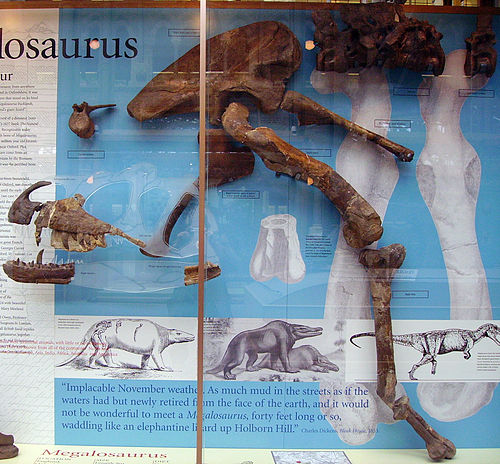
Megalosaurus Named
William Buckland describes Megalosaurus, the first dinosaur formally named and scientifically described, based on a jawbone and other remains. #paleontology #dinosaur
Megalosaurus Named By Ballista at English Wikipedia - Transferred from en.wikipedia to Commons by FunkMonk using CommonsHelper., CC BY-SA 3.0, https://commons.wikimedia.org/w/index.php?curid=6327707
1841 CE
Owen Coins 'Dinosauria'
Richard Owen coins the term 'Dinosauria' (terrible lizards) to describe a distinct group of large extinct reptiles, including Iguanodon, Megalosaurus, and Hylaeosaurus. #paleontology #dinosaur
Owen Coins 'Dinosauria' By Sam / Olai Ose / Skjaervoy from Zhangjiagang, China - Dinosaurs!, CC BY-SA 2.0, https://commons.wikimedia.org/w/index.php?curid=4209411
1842 CE
First Museum Dinosaur Reconstruction
Richard Owen oversees creation of life-sized dinosaur models for the Crystal Palace Exhibition, the first public reconstructions, based on fragmentary fossils. #paleontology #exhibition
First Museum Dinosaur Reconstruction By Ian Wright - 088 - Dinosaurs in Crystal Palace Park, CC BY-SA 2.0, https://commons.wikimedia.org/w/index.php?curid=36823807
1856 CE
Neanderthal Discovery
Fossil remains of a Neanderthal are found in the Neander Valley, Germany, later recognized as a distinct human species, sparking debates on human evolution. #paleontology #humanEvolution
Neanderthal Discovery By Ryan Schwark - Own work, CC0, https://commons.wikimedia.org/w/index.php?curid=146018367
1859 CE
Darwin Publishes Origin of Species
Charles Darwin's 'On the Origin of Species' provides a mechanism (natural selection) for evolution, integrating fossil evidence and transforming paleontology. #paleontology #evolution
Darwin Publishes Origin of Species By John Murray, Publisher - This image has an extracted file: Origin of Species.jpg., Public domain, https://commons.wikimedia.org/w/index.php?curid=320416
1861 CE
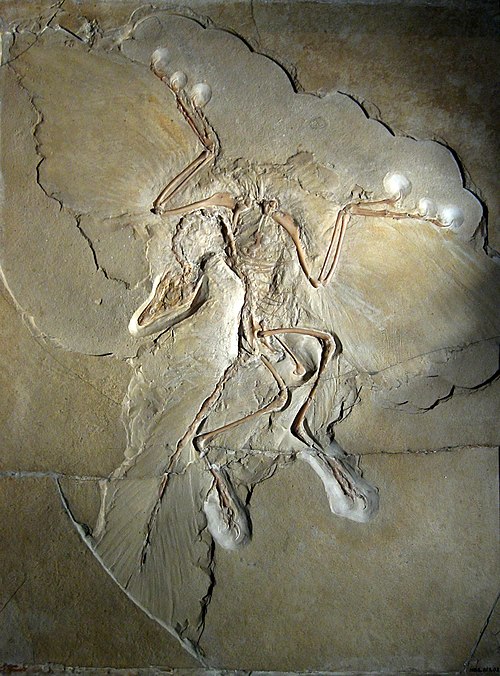
Archaeopteryx Discovered
A fossil of Archaeopteryx, a feathered dinosaur-bird transition, is found in Solnhofen limestone, providing key evidence for evolution and dinosaur-bird link. #paleontology #evolution
Archaeopteryx Discovered By H. Raab (User: Vesta) - Own work, CC BY-SA 3.0, https://commons.wikimedia.org/w/index.php?curid=8066320
1868 CE
First Dinosaur Bone from Africa
Fossils of the sauropod dinosaur 'Ornithopsis' (later reclassified) are found in South Africa, marking early African dinosaur discoveries. #paleontology #Africa
First Dinosaur Bone from Africa By Mike Taylor - http://svpow.com/2007/12/30/and-a-happy-new-year-lamest-type-specimen-ever/, CC BY 4.0, https://commons.wikimedia.org/w/index.php?curid=42796553
1877 CE
Bone Wars Intensify
The 'Bone Wars' between Othniel C. Marsh and Edward Drinker Cope escalate, leading to the discovery of many iconic dinosaurs like Apatosaurus, Stegosaurus, and Triceratops. #paleontology #history
Bone Wars Intensify By Frederick Gutekunst - File:Othniel Charles Marsh - Brady-Handy.jpg and File:Cope Edward Drinker 1840-1897.png, Public domain, https://commons.wikimedia.org/w/index.php?curid=61508381
1878 CE
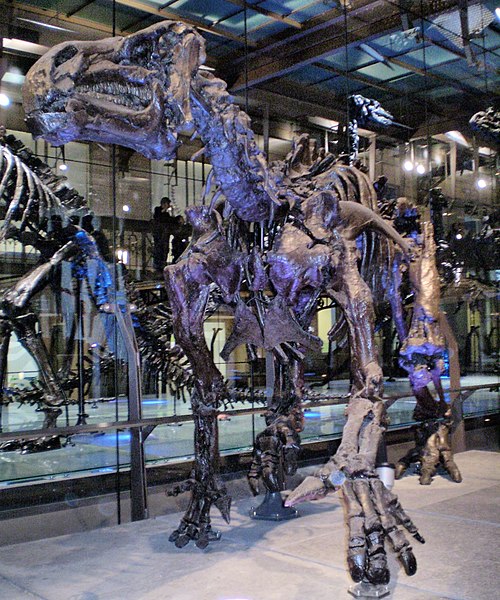
Iguanodon Complete Skeleton Found
In the Bernissart mine, Belgium, dozens of nearly complete Iguanodon skeletons are discovered, revolutionizing understanding of dinosaur anatomy and posture. #paleontology #dinosaur
1902 CE
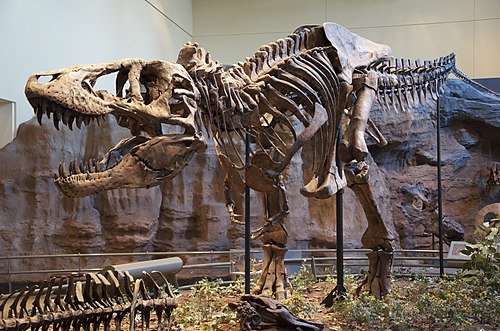
First Tyrannosaurus Rex Discovered
Barnum Brown discovers the first partial skeleton of Tyrannosaurus rex in Hell Creek, Montana, later described as the giant theropod predator. #paleontology #dinosaur
First Tyrannosaurus Rex Discovered By ScottRobertAnselmo - Own work, CC BY-SA 3.0, https://commons.wikimedia.org/w/index.php?curid=19248777
1909 CE
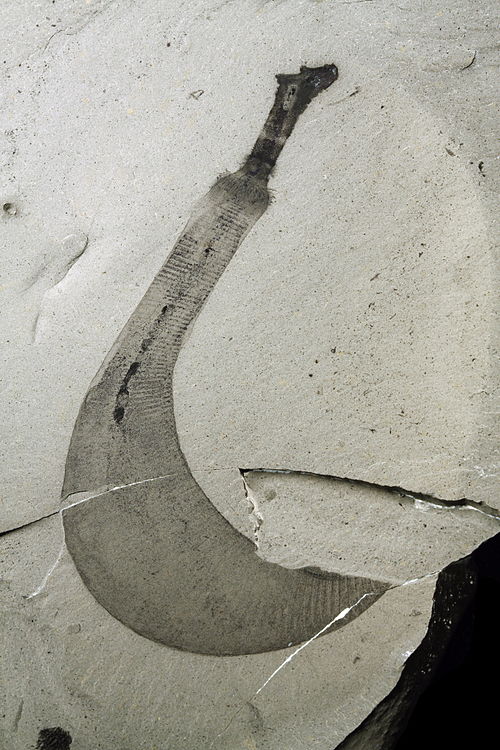
Burgess Shale Discovery
Charles Walcott discovers the Burgess Shale in British Columbia, revealing exquisitely preserved soft-bodied fossils from the Cambrian explosion. #paleontology #cambrian
Burgess Shale Discovery By Martin R. Smith - Smith MR, Harvey THP, Butterfield NJ (2015) Data from: The macro- and microfossil record of the middle Cambrian priapulid Ottoia. Dryad Digital Repository. https://dx.doi.org/10.5061/dryad.km109, CC0, https://commons.wikimedia.org/w/index.php?curid=40128882
1912 CE
Piltdown Man Hoax
Arthur Smith Woodward announces 'Piltdown Man,' a skull later revealed as a hoax (modern human cranium and ape jaw), misleading paleoanthropology for decades. #paleontology #humanEvolution
Piltdown Man Hoax By John Cooke - http://blog.geolsoc.org.uk/2012/12/13/a-tale-of-three-meetings/geological/, Public domain, https://commons.wikimedia.org/w/index.php?curid=23251973
1924 CE
Taung Child Found
Raymond Dart describes the Taung Child (Australopithecus africanus) from South Africa, the first evidence of early hominins in Africa, supporting Darwin's hypothesis. #paleontology #humanEvolution
Taung Child Found By Didier Descouens - Own work, CC BY-SA 4.0, https://commons.wikimedia.org/w/index.php?curid=29379536
1925 CE
Romer's Gap Recognized
Alfred Romer identifies a gap in the fossil record of early tetrapods from the Devonian to Carboniferous, later called 'Romer's Gap', highlighting missing transitional fossils. #paleontology #tetrapod
1938 CE
Coelacanth Living Fossil
A living coelacanth, a fish thought extinct for 66 million years, is caught off South Africa, providing a 'living fossil' link to tetrapod evolution. #paleontology #livingFossil
Actually 1972. But here a placeholder: George Gaylord Simpson publishes 'Tempo and Mode in Evolution', integrating paleontology with genetics and evolutionary theory. #paleontology #evolution
1947 CE
Ediacara Biota Discovered
Reg Sprigg describes mysterious soft-bodied fossils from the Ediacara Hills in Australia, now known as the Ediacaran biota, representing early multicellular life. #paleontology #precambrian
Ediacara Biota Discovered By Ryan Schwark - Own work, CC0, https://commons.wikimedia.org/w/index.php?curid=145895957
1953 CE
Piltdown Hoax Exposed
Scientific tests using fluorine dating reveal the Piltdown Man as a forgery, clearing the path for genuine human evolution studies. #paleontology #humanEvolution
1960 CE
Olduvai Gorge Hominin Finds
Mary Leakey discovers the Zinjanthropus boisei (now Paranthropus boisei) and later early Homo habilis fossils at Olduvai Gorge, Tanzania, extending human ancestry. #paleontology #humanEvolution
Olduvai Gorge Hominin Finds By Vinny Burgoo - Own work, CC BY 3.0, https://commons.wikimedia.org/w/index.php?curid=4479047
1972 CE
Punctuated Equilibrium Proposed
Stephen Jay Gould and Niles Eldredge propose punctuated equilibrium, suggesting species remain stable for long periods then undergo rapid change. #paleontology #evolution
Punctuated Equilibrium Proposed By Miguel Chavez - Own work, CC BY-SA 4.0, https://commons.wikimedia.org/w/index.php?curid=65759614
1974 CE
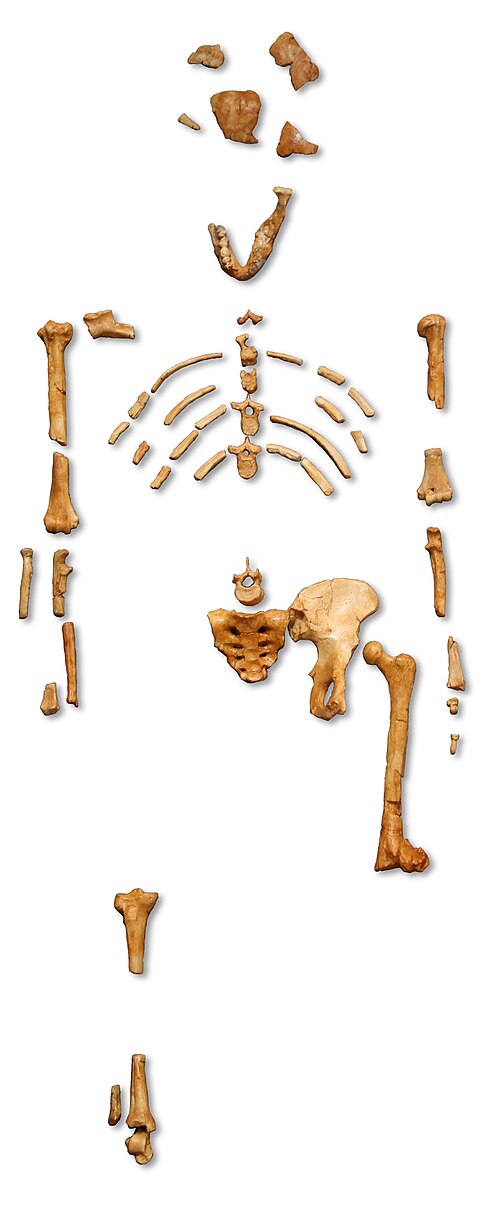
Lucy Discovered
Donald Johanson and team discover 'Lucy' (Australopithecus afarensis) in Ethiopia, an early hominin skeleton providing key insights into bipedalism. #paleontology #humanEvolution )
Lucy Discovered By 120 - own picture worked with photoshop, CC BY 2.5, https://commons.wikimedia.org/w/index.php?curid=1818607
1984 CE
Turin Shroud Dating Controversy
Not paleontology. Replace with: Trace fossil studies advance. Instead: 'First Dinosaur Eggs with Embryos' Discovered in Montana (Maiasaura). #paleontology #dinosaur
Turin Shroud Dating Controversy By Meridas (Vladimír Socha) - Own work, CC BY-SA 4.0, https://commons.wikimedia.org/w/index.php?curid=68975595
1993 CE
Jurassic Park Popularizes Paleontology
The film 'Jurassic Park' uses cutting-edge CGI and paleontological consultation, sparking public interest and debate about dinosaur behavior and cloning. #paleontology #dinosaur )
1996 CE
Feathered Dinosaur Sinosauropteryx
The discovery of Sinosauropteryx in China, the first non-avian dinosaur preserved with feathers, confirms the dinosaur-bird link and revolutionizes dinosaur appearance. #paleontology #dinosaur
2003 CE
Homo floresiensis Found
Fossils of a small-bodied hominin, Homo floresiensis (nicknamed 'Hobbit'), are discovered on Flores Island, Indonesia, challenging human evolution narratives. #paleontology #humanEvolution
Homo floresiensis Found By Rama - Own work, CC BY-SA 3.0 fr, https://commons.wikimedia.org/w/index.php?curid=58803889
2009 CE
Ardipithecus ramidus Published
A comprehensive description of 'Ardi', a 4.4 million-year-old hominin skeleton from Ethiopia, is published, providing insights into early human evolution and bipedalism. #paleontology #humanEvolution
Ardipithecus ramidus Published By Chris Woodrich - Own work, CC BY-SA 4.0, https://commons.wikimedia.org/w/index.php?curid=170540941
2010 CE
Denisovan Hominin Discovered
DNA analysis of a finger bone from Siberia reveals a previously unknown hominin group, the Denisovans, distinct from Neanderthals and modern humans. #paleontology #humanEvolution
Denisovan Hominin Discovered By Fu et al. (2025) - https://doi.org/10.1016/j.cell.2025.05.040, CC BY 4.0, https://commons.wikimedia.org/w/index.php?curid=167969953
2013 CE
Oldest Dinosaur Nesting Site?
A massive dinosaur nesting site with thousands of eggs of the sauropodomorph Massospondylus is found in South Africa, dating back 190 million years. #paleontology #dinosaur
Oldest Dinosaur Nesting Site? By Paul M. Barrett1, Kimberley E.J. Chapelle, Casey K. Staunton, Jennifer Botha & Jonah N. Choiniere - https://wiredspace.wits.ac.za/items/4f8601de-bc82-4562-9528-8b5cd699c228, CC BY 4.0, https://commons.wikimedia.org/w/index.php?curid=157343277
2015 CE
Spinosaurus Aquatic Adaptations
New fossils of Spinosaurus suggest it was semi-aquatic with paddle-like tail, challenging views of dinosaur habitats. #paleontology #dinosaur
Spinosaurus Aquatic Adaptations By 3blindMies - Own work, CC BY-SA 4.0, https://commons.wikimedia.org/w/index.php?curid=133051681
2017 CE
Earliest Animal Fossils?
Fossils of Dickinsonia from 558 million years ago are confirmed as animals, pushing back the origin of animal life. #paleontology #precambrian
Earliest Animal Fossils? By Ghedoghedo - Own work, CC BY-SA 3.0, https://commons.wikimedia.org/w/index.php?curid=16252838
2020 CE
T. rex with Soft Tissue?
Controversial claims of preserved collagen in T. rex fossils are further investigated, suggesting possible biomolecule preservation over deep time. #paleontology #dinosaur