Encyclopedia/1. The Cosmos & The Natural World/2. Physics & Chemistry/10. Foundational & General Physics • Curated by Admin Timeline.sg
This timeline covers major breakthroughs in organic chemistry from ancient times to the modern era, including the isolation of urea, structure elucidation of natural products, and the development of synthetic methods and theories that revolutionized the field.
Chronological Storyline (51 Milestones)
8000 BCE
Fermentation of Alcoholic Beverages
Early humans discover fermentation, converting sugars to ethanol using yeast. This is one of the first organic chemical processes used by mankind. #chemistry #history
Fermentation of Alcoholic Beverages By Tjhackmann - Own work, CC BY-SA 4.0, https://commons.wikimedia.org/w/index.php?curid=152132653
3000 BCE
Extraction of Natural Dyes
Ancient civilizations extract dyes like indigo and alizarin from plants. These natural products are organic compounds used for coloring textiles. #chemistry #history
Extraction of Natural Dyes By Madison60 - Own work, CC BY-SA 3.0, https://commons.wikimedia.org/w/index.php?curid=19010845
400 BCE
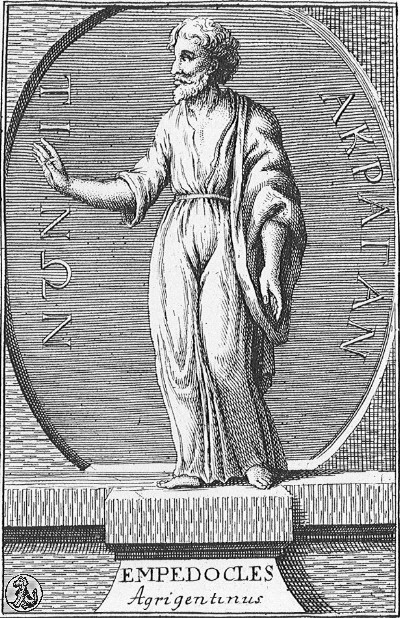
Empedocles' Four Elements Theory
Empedocles proposes that all matter is composed of four elements: earth, air, fire, and water. This early theory influences alchemical thought for centuries. #chemistry #philosophy
Empedocles' Four Elements Theory By Unknown author - http://www.phil-fak.uni-duesseldorf.de/philo/galerie/antike/empedok.html, Public domain, https://commons.wikimedia.org/w/index.php?curid=74149
300 CE
Zosimos of Panopolis and Alchemy
Zosimos writes the earliest known alchemical texts, describing processes like distillation and sublimation. His work lays groundwork for later organic chemistry. #chemistry #alchemy
Zosimos of Panopolis and Alchemy By Rvalette - Own work, CC BY-SA 4.0, https://commons.wikimedia.org/w/index.php?curid=35562978
800 CE
Jabir ibn Hayyan's Alchemical Works
Jabir ibn Hayyan (Geber) develops experimental methods including distillation and crystallization. He describes preparation of acetic acid from vinegar. #chemistry #alchemy
Jabir ibn Hayyan's Alchemical Works By Unknown author - https://cdn.britannica.com/10/132710-050-CECF006B/illustration-manuscript-Abu-Musa-Jabir-ibn-Hayyan.jpg, Public domain, https://commons.wikimedia.org/w/index.php?curid=166835469
1661 CE
Robert Boyle's The Sceptical Chymist
Boyle defines elements as irreducible substances and criticizes alchemical theories. His work shifts chemistry toward a scientific discipline. #chemistry #history
Robert Boyle's The Sceptical Chymist By Johann Kerseboom - https://digital.sciencehistory.org/works/3r074v879, Public domain, https://commons.wikimedia.org/w/index.php?curid=27091904
1769 CE
Scheele Discovers Tartaric Acid
Carl Wilhelm Scheele isolates tartaric acid from wine dregs. He also discovers many other organic acids, contributing to the isolation of natural products. #chemistry #organic
Scheele Discovers Tartaric Acid By Johann Gottfried Scheffner - https://www.portraitindex.de/documents/obj/33207871, PDM-owner, https://commons.wikimedia.org/w/index.php?curid=173735144
1773 CE
Rouelle Defines Organic Chemistry
Guillaume-François Rouelle distinguishes organic from inorganic chemistry, defining organic as substances from living organisms. This formalizes the field. #chemistry #history
Rouelle Defines Organic Chemistry By Unknown author - [1], Public domain, https://commons.wikimedia.org/w/index.php?curid=2586681
1784 CE
Lavoisier's Analysis of Organic Compounds
Antoine Lavoisier develops combustion analysis to determine carbon and hydrogen content. He shows that organic compounds contain carbon, hydrogen, and oxygen. #chemistry #analysis
Lavoisier's Analysis of Organic Compounds By Jacques-Louis David - Metropolitan Museum of Art: entry 436106 (accession number: 1977.10), Public domain, https://commons.wikimedia.org/w/index.php?curid=141652400
1806 CE
Berzelius Coins 'Organic Chemistry'
Jöns Jacob Berzelius introduces the term 'organic chemistry' for the study of compounds from living things. He also develops notation for chemical formulas. #chemistry #terminology
Berzelius Coins 'Organic Chemistry' By John Way [1] - https://www.meisterdrucke.com/fine-art-prints/Unknown-artist/1000178/Portrait-of-the-Swedish-Chemist-Jons-Jacob-Berzelius.html, Public domain, https://commons.wikimedia.org/w/index.php?curid=162866730
1828 CE
Wöhler Synthesizes Urea
Friedrich Wöhler accidentally synthesizes urea from ammonium cyanate, disproving vitalism. This is considered the birth of synthetic organic chemistry. #chemistry #synthesis
Wöhler Synthesizes Urea By Rudolph Hoffmann - Eigenes Foto einer Originallithographie der ÖNB (Wien), Public domain, https://commons.wikimedia.org/w/index.php?curid=16652576
1832 CE
Liebig and Wöhler Discover Benzoyl Radical
Justus von Liebig and Friedrich Wöhler identify the benzoyl radical (C6H5CO-), supporting the radical theory of organic chemistry. #chemistry #radicals
Liebig and Wöhler Discover Benzoyl Radical By Unknown author - http://ihm.nlm.nih.gov/images/B17480, Public domain, https://commons.wikimedia.org/w/index.php?curid=19141954
1834 CE
Dumas and Polarity Theory
Jean-Baptiste Dumas proposes the theory of substitution, showing that chlorine can replace hydrogen in organic compounds. This challenges the radical theory. #chemistry #theory
Dumas and Polarity Theory By Unknown author, Public domain, https://commons.wikimedia.org/w/index.php?curid=244598
1845 CE
Kolbe Synthesizes Acetic Acid
Hermann Kolbe synthesizes acetic acid from carbon disulfide, the first total synthesis of an organic compound from inorganic precursors. #chemistry #synthesis
Kolbe Synthesizes Acetic Acid By A. Brasch, Leipzig - [1], Public domain, https://commons.wikimedia.org/w/index.php?curid=16071392
1848 CE
Pasteur Discovers Molecular Chirality
Louis Pasteur separates tartaric acid enantiomers, discovering optical activity and molecular chirality. This lays the foundation for stereochemistry. #chemistry #stereochemistry
Pasteur Discovers Molecular Chirality By Paul Nadar - File:Louis Pasteur, foto av Paul Nadar.jpg, Public domain, https://commons.wikimedia.org/w/index.php?curid=28039885
1856 CE
Perkin Synthesizes Mauveine
William Henry Perkin accidentally synthesizes mauveine, the first synthetic dye. This sparks the synthetic dye industry and organic chemistry research. #chemistry #dyes
Perkin Synthesizes Mauveine By Unknown author - English Wikipedia. - Scanned photograph from F. J. Moore's book, A History of Chemistry (1918). - Popular Science Monthly Volume 69, Public domain, https://commons.wikimedia.org/w/index.php?curid=6343060
1858 CE
Kekulé and Couper Propose Tetravalent Carbon
August Kekulé and Archibald Scott Couper independently propose that carbon is tetravalent and can form chains. This is key to structural theory. #chemistry #theory
Kekulé and Couper Propose Tetravalent Carbon By Unknown author - https://www.gettyimages.ie/detail/news-photo/german-organic-chemist-friedrich-august-kekule-von-news-photo/72242781, Public domain, https://commons.wikimedia.org/w/index.php?curid=167877
1861 CE
Butlerov Introduces Chemical Structure
Alexander Butlerov uses the term 'chemical structure' and explains isomerism based on different bonding arrangements. He synthesizes sugars. #chemistry #structure
Butlerov Introduces Chemical Structure By Butlerov, A. M. 1828-1886 - Stat'i po mediumizmu. S vospominan'em ob A. M. Butlerove, N. R. Vagnera ; Spb. : A. N. Aksakov, 1889, Public domain, https://commons.wikimedia.org/w/index.php?curid=38189750
1865 CE
Kekulé Proposes Benzene Structure
August Kekulé suggests a cyclic structure for benzene with alternating double bonds. This explains benzene's stability and guides aromatic chemistry. #chemistry #aromatic
1874 CE
van't Hoff and Le Bel Propose Tetrahedral Carbon
Jacobus Henricus van 't Hoff and Joseph Le Bel independently propose that carbon bonds are arranged tetrahedrally, explaining optical isomerism. #chemistry #stereochemistry
van't Hoff and Le Bel Propose Tetrahedral Carbon By Nicola Perscheid - one or more third parties have made copyright claims against Wikimedia Commons in relation to the work from which this is sourced or a purely mechanical reproduction thereof. This may be due to recognition of the "sweat of the brow" doctrine, allowing works to be eligible for protection through skill and labour, and not purely by originality as is the case in the United States (where this website is hosted). These claims may or may not be valid in all jurisdictions. As such, use of this image in the jurisdiction of the claimant or other countries may be regarded as copyright infringement. Please see Commons:When to use the PD-Art tag for more information., Public domain, https://commons.wikimedia.org/w/index.php?curid=44101635
1884 CE
Fischer Elucidates Sugar Structure
Emil Fischer determines the structures of glucose and other sugars, developing the Fischer projection. He also synthesizes many sugars. #chemistry #carbohydrates
Fischer Elucidates Sugar Structure By Unknown author - https://wellcomeimages.org/indexplus/obf_images/29/85/3104172da6b66ab0d72a53a71f82.jpg Gallery: https://wellcomeimages.org/indexplus/image/V0027668.html Wellcome Collection gallery (2018-03-23): https://wellcomecollection.org/works/pbekk7qp CC-BY-4.0, CC BY 4.0, https://commons.wikimedia.org/w/index.php?curid=180238528
1890 CE
Baeyer Synthesizes Indigo
Adolf von Baeyer synthesizes indigo, a major natural dye. His work on indigo and other dyes earns him the Nobel Prize in 1905. #chemistry #dyes
Baeyer Synthesizes Indigo By Unknown author - This document belongs to the collections of the Bibliothèque interuniversitaire de santé. It was uploaded to Commons through a partnership with Wikimedia France., Licence Ouverte, https://commons.wikimedia.org/w/index.php?curid=180247881
1897 CE
Ehrlich Develops Salvarsan
Paul Ehrlich discovers arsphenamine (Salvarsan), the first effective treatment for syphilis. This is a milestone in medicinal chemistry and chemotherapy. #chemistry #medicine
Ehrlich Develops Salvarsan By Harris & Ewing - This image is available from the United States Library of Congress's Prints and Photographs division under the digital ID hec.04709.This tag does not indicate the copyright status of the attached work. A normal copyright tag is still required. See Commons:Licensing., Public domain, https://commons.wikimedia.org/w/index.php?curid=6060062
1900 CE
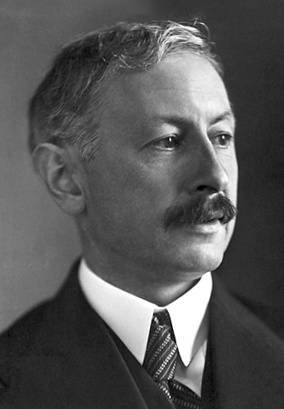
Grignard Reagents Discovered
Victor Grignard discovers organomagnesium compounds (Grignard reagents), which become essential for forming carbon-carbon bonds in synthesis. #chemistry #synthesis
Grignard Reagents Discovered By Fotograv. - Generalstabens Litografiska Anstalt Stockholm - Les Prix Nobel, p. 56 (2nd part of the book) and [1], Public domain, https://commons.wikimedia.org/w/index.php?curid=115004535
1901 CE
First Nobel Prize in Chemistry
Jacobus Henricus van 't Hoff wins the first Nobel Prize in Chemistry for his work on chemical dynamics and osmotic pressure in solutions. #chemistry #Nobel
1907 CE
Bakelite Invented
Leo Baekeland invents Bakelite, the first synthetic plastic. This thermosetting polymer marks the beginning of the plastics industry. #chemistry #polymers
Bakelite Invented By Unknown author - http://www.deutsches-kunststoff-museum.de/rund-um-kunststoff/erfinder/leo-hendrik-baekeland/, Public domain, https://commons.wikimedia.org/w/index.php?curid=29619343
1910 CE
Sorensen Introduces pH Scale
Søren Peder Lauritz Sørensen develops the pH scale to measure acidity. This concept is crucial for understanding organic reactions in solution. #chemistry #acidity
Sorensen Introduces pH Scale By Unknown author - Polytech Photos. Scientific photodatabase, Public domain, https://commons.wikimedia.org/w/index.php?curid=5975361
1912 CE
Wallach Isolates Terpenes
Otto Wallach wins the Nobel Prize for his work on alicyclic compounds, particularly terpenes. He establishes systematic methods for isolating natural products. #chemistry #natural products
Wallach Isolates Terpenes By Unknown (Mondadori Publishers) - http://www.gettyimages.co.uk/detail/news-photo/portrait-of-the-german-chemist-otto-wallach-1880s-news-photo/141551243, Public domain, https://commons.wikimedia.org/w/index.php?curid=41260474
1916 CE
Lewis Electron Dot Structures
Gilbert N. Lewis proposes electron dot structures to represent chemical bonding. This concept is fundamental for understanding organic molecular structure. #chemistry #bonding
1920 CE
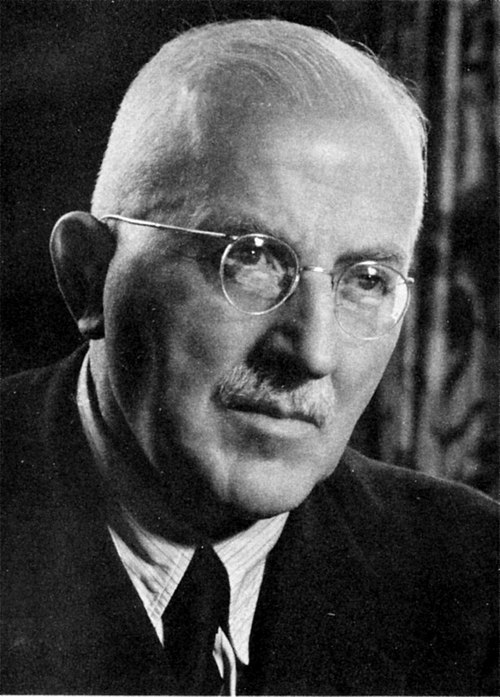
Staudinger Proposes Macromolecules
Hermann Staudinger suggests that polymers are long chains of repeating units (macromolecules). This revolutionizes polymer chemistry. #chemistry #polymers
Staudinger Proposes Macromolecules By Nobel Foundation - Les Prix Nobel en 1953, Public domain, https://commons.wikimedia.org/w/index.php?curid=18542861
1923 CE
Bronsted-Lowry Acid-Base Theory
Johannes Nicolaus Brønsted and Thomas Martin Lowry independently define acids as proton donors and bases as proton acceptors. This theory is widely used in organic chemistry. #chemistry #acids
1925 CE
Robinson Elucidates Alkaloid Structures
Robert Robinson determines the structures of many alkaloids like morphine and strychnine. He also develops syntheses and theories of organic reactions. #chemistry #alkaloids
Robinson Elucidates Alkaloid Structures By Unknown author - http://www.nobelprize.org/nobel_prizes/chemistry/laureates/1947/, Public domain, https://commons.wikimedia.org/w/index.php?curid=18334522
1931 CE
Hückel's Rule for Aromaticity
Erich Hückel proposes the 4n+2 π-electron rule for aromatic stability. This rule explains the special stability of benzene-like compounds. #chemistry #aromaticity
Hückel's Rule for Aromaticity By NEUROtiker - Own work, Public domain, https://commons.wikimedia.org/w/index.php?curid=1636078
1932 CE
Pauling's Resonance Theory
Linus Pauling introduces resonance theory to describe delocalized electrons in molecules like benzene. This concept is key to understanding molecular structure. #chemistry #theory
Pauling's Resonance Theory By Unknown author - Oregon State University [1], CC BY-SA 2.0, https://commons.wikimedia.org/w/index.php?curid=144490366
1937 CE
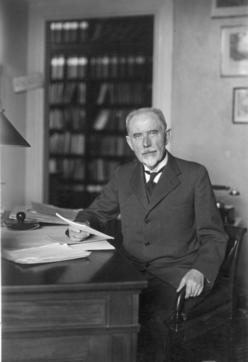
Karrer Synthesizes Vitamin A
Paul Karrer synthesizes vitamin A (retinol) and elucidates its structure. He also works on other vitamins, contributing to organic chemistry of natural products. #chemistry #vitamins
Karrer Synthesizes Vitamin A By Nobel Foundation - http://nobelprize.org/nobel_prizes/chemistry/laureates/1937/karrer-bio.html, Public domain, https://commons.wikimedia.org/w/index.php?curid=15365350
1939 CE
DDT Insecticidal Properties Discovered
Paul Hermann Müller discovers the insecticidal properties of DDT, a synthetic organic compound. DDT becomes widely used but later banned due to environmental concerns. #chemistry #pesticides
DDT Insecticidal Properties Discovered By Leyo - Own work, Public domain, https://commons.wikimedia.org/w/index.php?curid=9093502
1940 CE
Woodward Synthesizes Quinine
Robert Burns Woodward completes the first total synthesis of quinine, a complex natural product. This showcases the power of synthetic organic chemistry. #chemistry #synthesis
Woodward Synthesizes Quinine By Louis Fabian Bachrach Jr. (photographer), via The Nobel Foundation - http://www.nobelprize.org/nobel_prizes/chemistry/laureates/1965/, PD-Sweden, https://en.wikipedia.org/w/index.php?curid=34664939
1944 CE
Avery-MacLeod-McCarty Experiment
Oswald Avery, Colin MacLeod, and Maclyn McCarty demonstrate that DNA is the genetic material. This discovery links organic chemistry to molecular biology. #chemistry #DNA
Avery-MacLeod-McCarty Experiment By Bbkkk - self-made in the Naturkunste Museum in Berlin, CC BY-SA 4.0, https://commons.wikimedia.org/w/index.php?curid=3679283
1945 CE
Penicillin Structure Elucidated
Dorothy Crowfoot Hodgkin determines the structure of penicillin using X-ray crystallography. This enables the synthesis of penicillin derivatives. #chemistry #antibiotics
Penicillin Structure Elucidated By Unknown - http://www.nobelprize.org/nobel_prizes/chemistry/laureates/1964/, PD-Sweden, https://en.wikipedia.org/w/index.php?curid=34665020
1951 CE
Woodward Synthesizes Cholesterol
Robert Burns Woodward completes the total synthesis of cholesterol, a complex steroid. This demonstrates the feasibility of synthesizing complex natural products. #chemistry #synthesis
1953 CE
Miller-Urey Experiment
Stanley Miller and Harold Urey simulate early Earth conditions and produce amino acids from simple molecules. This supports the chemical origin of life. #chemistry #origin of life
Miller-Urey Experiment By GYassineMrabetTalk✉ This W3C-unspecified vector image was created with Inkscape . W3C-validity not checked. - Own work from Image:MUexperiment.png by Carny, CC BY-SA 3.0, https://commons.wikimedia.org/w/index.php?curid=3500500
1953 CE
Watson and Crick Propose DNA Structure
James Watson and Francis Crick propose the double helix structure of DNA, based on X-ray data. This revolutionizes biochemistry and organic chemistry. #chemistry #DNA
Watson and Crick Propose DNA Structure By Thomas Shafee - Own work, CC BY 4.0, https://commons.wikimedia.org/w/index.php?curid=40736969
1954 CE
Cram Develops Cyclophane Chemistry
Donald J. Cram synthesizes cyclophanes, molecules with unusual bonding. His work on host-guest chemistry later earns him a Nobel Prize. #chemistry #supramolecular
1960 CE
Merrifield Develops Solid-Phase Peptide Synthesis
Bruce Merrifield invents solid-phase peptide synthesis, allowing automated synthesis of peptides. This revolutionizes biochemistry and drug development. #chemistry #peptides
Merrifield Develops Solid-Phase Peptide Synthesis By Dann Kristoff - Own work, CC BY-SA 4.0, https://commons.wikimedia.org/w/index.php?curid=48220584
1963 CE
Woodward and Hoffmann Propose Orbital Symmetry Rules
Robert Burns Woodward and Roald Hoffmann develop the Woodward-Hoffmann rules for pericyclic reactions. These rules predict stereochemistry of concerted reactions. #chemistry #theory
Woodward and Hoffmann Propose Orbital Symmetry Rules By Ivogt - Own work, CC BY-SA 3.0, https://commons.wikimedia.org/w/index.php?curid=23034878
1965 CE
Corey Develops Retrosynthetic Analysis
Elias James Corey formalizes retrosynthetic analysis, a systematic method for planning organic syntheses. This becomes a cornerstone of synthetic chemistry. #chemistry #synthesis
Corey Develops Retrosynthetic Analysis By Creator: Trvthchem personal photo - Own work, CC0, https://commons.wikimedia.org/w/index.php?curid=28252482
1970 CE
Wittig Reaction Discovered
Georg Wittig discovers the Wittig reaction, which converts carbonyl compounds to alkenes using phosphonium ylides. This is a key reaction in organic synthesis. #chemistry #reaction
1974 CE
Olefin Metathesis Discovered
Yves Chauvin, Robert H. Grubbs, and Richard R. Schrock develop olefin metathesis, a powerful method for forming carbon-carbon double bonds. They win the 2005 Nobel Prize. #chemistry #catalysis
Olefin Metathesis Discovered By Ple210 - Own work, CC BY-SA 4.0, https://commons.wikimedia.org/w/index.php?curid=81966544
1984 CE
Fullerene Discovery
Harold Kroto, Robert Curl, and Richard Smalley discover buckminsterfullerene (C60), a new allotrope of carbon. This opens up nanotechnology and materials chemistry. #chemistry #nanotechnology
Fullerene Discovery By 痛 - Own work, CC BY-SA 4.0, https://commons.wikimedia.org/w/index.php?curid=118428240
1990 CE
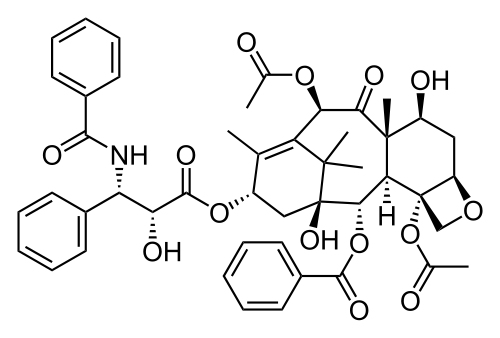
First Total Synthesis of Taxol
Robert A. Holton and others complete the first total synthesis of Taxol (paclitaxel), a complex anticancer natural product. This enables further drug development. #chemistry #synthesis
First Total Synthesis of Taxol By Calvero. - Selfmade with ChemDraw., Public domain, https://commons.wikimedia.org/w/index.php?curid=1703615
2001 CE
Click Chemistry Introduced
K. Barry Sharpless introduces click chemistry, a set of highly efficient and selective reactions. This concept revolutionizes bioconjugation and materials science. #chemistry #synthesis