Encyclopedia/1. The Cosmos & The Natural World/1. Mathematics & Formal Systems • Curated by Admin Timeline.sg
Optimization and operations research apply mathematical methods to improve decision-making in complex systems, from ancient logistics to modern algorithms. Key milestones include the simplex algorithm, linear programming, and network flow theory.
Chronological Storyline (44 Milestones)
300 BCE
Euclid's Elements
Euclid's Elements lays foundational geometry and number theory, later influencing optimization through geometric reasoning. #math #history
Euclid's Elements By University of Pennsylvania Museum of Archaeology and Anthropology - https://openn.library.upenn.edu/Data/0016/html/e2748.html, CC BY-SA 4.0, https://commons.wikimedia.org/w/index.php?curid=169166171
300 CE
Diophantus's Arithmetica
Diophantus writes Arithmetica, one of the earliest texts on algebraic equations, which later informs integer programming. #math #history
900 CE
Al-Khwarizmi's Algebra
Al-Khwarizmi's The Compendious Book on Calculation by Completion and Balancing establishes algebra, a cornerstone of optimization. #math #history
Al-Khwarizmi's Algebra By Zarateman - Own work, CC0, https://commons.wikimedia.org/w/index.php?curid=162213187
1614 CE
Napier's Logarithms
John Napier introduces logarithms, simplifying complex calculations and aiding later optimization algorithms. #math #history
Napier's Logarithms By Richard F. Lyon - made myself, alt version of Logarithm plots.svg with better text, CC BY-SA 3.0, https://commons.wikimedia.org/w/index.php?curid=13257335
1637 CE
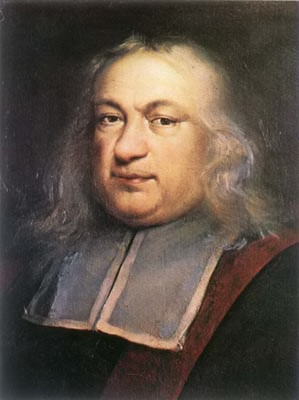
Fermat's Method of Maxima and Minima
Pierre de Fermat develops a method for finding maxima and minima, an early precursor to calculus-based optimization. #math #history
Fermat's Method of Maxima and Minima By Unknown author - https://web.archive.org/web/20191028044928/http://www-groups.dcs.st-and.ac.uk/~history/PictDisplay/Fermat.html, Public domain, https://commons.wikimedia.org/w/index.php?curid=36804
1687 CE
Newton's Principia Mathematica
Isaac Newton publishes Principia, introducing calculus and the concept of optimization in physical systems. #math #physics
Newton's Principia Mathematica By The original uploader was Zhaladshar at English Wikisource. - Transferred from en.wikisource to Commons. (previous image from another copy) Internet Archive (current image from the Bern Dibner copy), Public domain, https://commons.wikimedia.org/w/index.php?curid=2681838
1744 CE
Euler's Principle of Least Action
Leonhard Euler formulates the principle of least action, a variational principle that optimizes physical paths. #math #physics
1824 CE
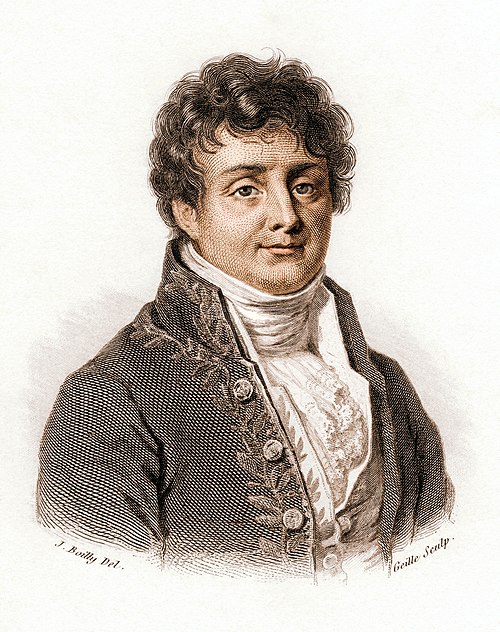
Fourier's Method for Linear Inequalities
Joseph Fourier proposes a method for solving systems of linear inequalities, a precursor to linear programming. #math #history
Fourier's Method for Linear Inequalities By Julien-Léopold Boilly - This file was derived from: Fourier2.jpg Restored by: Bammesk Original source: https://www.gettyimages.com.au/license/169251384 https://wellcomecollection.org/works/b4qh352u, Public domain, https://commons.wikimedia.org/w/index.php?curid=114366437
1909 CE
Minkowski's Convex Geometry
Hermann Minkowski develops convex geometry, providing theoretical foundations for linear programming. #math #history
Minkowski's Convex Geometry By Hermann Minkowski - scan from original book, Public domain, https://commons.wikimedia.org/w/index.php?curid=59559231
1939 CE
Kantorovich's Linear Programming
Leonid Kantorovich formulates linear programming for production planning, but his work remains largely unknown in the West. #math #history
Kantorovich's Linear Programming By Андрей Богданов (Andrei-bogdanoffyandex.ru) - [1], CC BY 3.0, https://commons.wikimedia.org/w/index.php?curid=11494406
1947 CE
Dantzig's Simplex Algorithm
George Dantzig invents the simplex algorithm, revolutionizing linear programming and operations research. #math #optimization
Dantzig's Simplex Algorithm By Lorepenoten - Own work, CC0, https://commons.wikimedia.org/w/index.php?curid=176109032
1948 CE
Von Neumann's Game Theory
John von Neumann publishes Theory of Games and Economic Behavior, linking game theory to optimization. #math #economics
1951 CE
Karush–Kuhn–Tucker Conditions
William Karush, Harold Kuhn, and Albert Tucker independently develop necessary conditions for constrained optimization. #math #optimization
1954 CE
Ford-Fulkerson Algorithm
Lester Ford and Delbert Fulkerson publish the Ford-Fulkerson algorithm for maximum flow in networks. #math #optimization
1956 CE
Bellman's Dynamic Programming
Richard Bellman introduces dynamic programming, a method for solving complex optimization problems. #math #optimization
Bellman's Dynamic Programming By User:Dcoetzee - http://en.wikipedia.org/wiki/File:Shortest_path_optimal_substructure.png, CC0, https://commons.wikimedia.org/w/index.php?curid=20557284
1957 CE
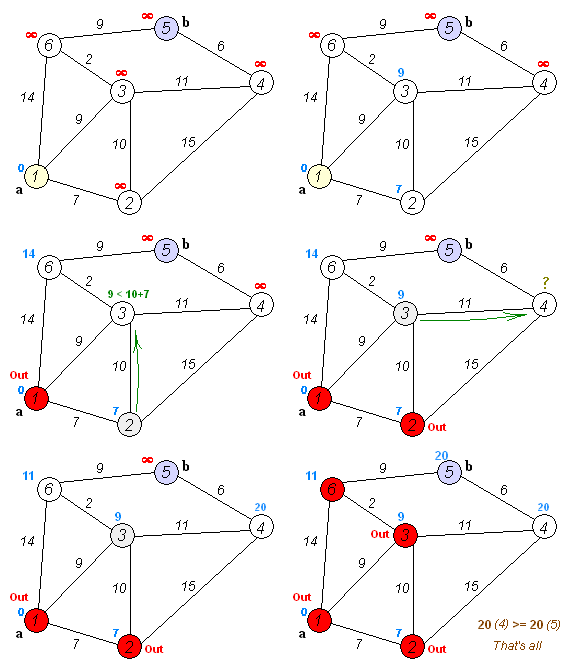
Dijkstra's Algorithm
Edsger Dijkstra develops Dijkstra's algorithm for shortest paths in graphs, a key network optimization tool. #math #computerscience
Dijkstra's Algorithm By Ibmua - Work by uploader., Public domain, https://commons.wikimedia.org/w/index.php?curid=6282617
1958 CE
Gomory's Cutting Plane Method
Ralph Gomory introduces cutting planes for integer programming, enabling optimization with integer variables. #math #optimization
Gomory's Cutting Plane Method By Sdo - own work, created using xfig and fig2dev., CC BY-SA 2.5, https://commons.wikimedia.org/w/index.php?curid=1101022
1960 CE
Rosenbrock's Function
Howard Rosenbrock proposes the Rosenbrock function, a classic test problem for optimization algorithms. #math #optimization
Rosenbrock's Function By Nschloe - Own work, CC BY-SA 4.0, https://commons.wikimedia.org/w/index.php?curid=114931732
1961 CE
Zoutendijk's Method of Feasible Directions
G. Zoutendijk develops the method of feasible directions for nonlinear constrained optimization. #math #optimization
1963 CE
Dantzig-Wolfe Decomposition
George Dantzig and Philip Wolfe introduce decomposition for large-scale linear programs. #math #optimization
1964 CE
Fletcher-Reeves Conjugate Gradient
Reeves and Fletcher publish the conjugate gradient method for unconstrained optimization. #math #optimization
Fletcher-Reeves Conjugate Gradient By Oleg Alexandrov - Own work, Public domain, https://commons.wikimedia.org/w/index.php?curid=2267598
1965 CE
Nelder-Mead Simplex Method
John Nelder and Roger Mead propose the Nelder-Mead simplex method for direct search optimization. #math #optimization
Nelder-Mead Simplex Method By Jade Yu Cheng Thomas Mailund - 10.1016/j.compbiolchem.2015.02.001, CC BY 4.0, https://commons.wikimedia.org/w/index.php?curid=122326033
1967 CE
Kruskal's Algorithm
Joseph Kruskal publishes Kruskal's algorithm for minimum spanning trees, a classic network optimization. #math #computerscience
Kruskal's Algorithm By Shiyu Ji - Own work, CC BY-SA 4.0, https://commons.wikimedia.org/w/index.php?curid=54420893
1970 CE
Branch and Bound for Integer Programming
A. H. Land and A. G. Doig develop branch and bound, a fundamental method for integer optimization. #math #optimization
1971 CE
Cook's Theorem on NP-Completeness
Stephen Cook proves NP-completeness, showing many optimization problems are computationally hard. #math #computerscience
1972 CE
Klee-Minty Cube Shows Simplex Exponential
Victor Klee and George Minty construct a polytope where the simplex algorithm takes exponential steps. #math #optimization
Klee-Minty Cube Shows Simplex Exponential By Sophie Huiberts - Own work, CC BY 4.0, https://commons.wikimedia.org/w/index.php?curid=81364401
1975 CE
Holland's Genetic Algorithms
John Holland introduces genetic algorithms, inspired by natural selection for optimization. #math #optimization
Holland's Genetic Algorithms By Pasimi - Own work, CC BY-SA 4.0, https://commons.wikimedia.org/w/index.php?curid=37611586
1979 CE
Khachiyan's Ellipsoid Method
Leonid Khachiyan proposes the ellipsoid method, the first polynomial-time algorithm for linear programming. #math #optimization
Khachiyan's Ellipsoid Method By User:Sdo - self-made using xfig (.fig source files can be obtained from me upon request), Public domain, https://commons.wikimedia.org/w/index.php?curid=748851
1984 CE
Karmarkar's Interior Point Method
Narendra Karmarkar introduces an interior point method for linear programming, competitive with simplex. #math #optimization
1985 CE
Kirkpatrick's Simulated Annealing
Scott Kirkpatrick et al. apply simulated annealing to combinatorial optimization. #math #optimization
Kirkpatrick's Simulated Annealing By Geodac - Own work, CC0, https://commons.wikimedia.org/w/index.php?curid=67988888
1986 CE
Rumelhart's Backpropagation
David Rumelhart popularizes backpropagation for training neural networks, enabling optimization in deep learning. #math #machinelearning
1987 CE
Tabu Search by Glover
Fred Glover introduces tabu search, a metaheuristic for combinatorial optimization. #math #optimization
1991 CE
Dorigo's Ant Colony Optimization
Marco Dorigo proposes ant colony optimization, inspired by ant foraging behavior. #math #optimization
Dorigo's Ant Colony Optimization By Mehmet Karatay - Own work, CC BY-SA 3.0, https://commons.wikimedia.org/w/index.php?curid=2179109
1993 CE
Storn and Price's Differential Evolution
Rainer Storn and Kenneth Price develop differential evolution, a population-based optimization algorithm. #math #optimization
1995 CE
Kennedy and Eberhart's Particle Swarm
James Kennedy and Russell Eberhart introduce particle swarm optimization, inspired by social behavior. #math #optimization
Kennedy and Eberhart's Particle Swarm By Ephramac - Own work, CC BY-SA 4.0, https://commons.wikimedia.org/w/index.php?curid=54975083
1997 CE
Vapnik's Support Vector Machines
Vladimir Vapnik develops support vector machines, which solve a convex optimization problem for classification. #math #machinelearning
2001 CE
Boyd's Convex Optimization Book
Stephen Boyd and Lieven Vandenberghe publish Convex Optimization, a standard reference. #math #optimization )
2004 CE
Candes' Compressed Sensing
Emmanuel Candès et al. introduce compressed sensing, using optimization for signal reconstruction. #math #signalprocessing