Encyclopedia/1. The Cosmos & The Natural World/2. Physics & Chemistry • Curated by Admin Timeline.sg
Optics and laser spectroscopy trace the evolution of light physics from ancient camera obscura to modern quantum optics, encompassing key milestones like Ibn al-Haytham's Book of Optics, Newton's prism experiments, the invention of the laser, and advances in spectroscopy.
Chronological Storyline (43 Milestones)
400 BCE
Mozi Describes Camera Obscura
Chinese philosopher Mozi records the principles of the camera obscura, noting how light travels in straight lines and forms an inverted image. #optics #history
Mozi Describes Camera Obscura By Vjacheslav Rublevskiy - https://www.flickr.com/photos/193162016@N04/51221161306/, CC0, https://commons.wikimedia.org/w/index.php?curid=106219380
300 BCE
Euclid's Optics
Greek mathematician Euclid writes 'Optics', treating vision as rays from the eye to objects, establishing geometric optics. #optics #ancient
Euclid's Optics By Euclid - Available in the BEIC digital library and uploaded in partnership with BEIC Foundation., Public domain, https://commons.wikimedia.org/w/index.php?curid=37857016
150 CE
Ptolemy's Optics
Claudius Ptolemy writes 'Optics', studying reflection and refraction, and tabulating angles of refraction for various media. #optics #ancient
Ptolemy's Optics By Justus van Gent / Pedro Berruguete - Public domainPublic domainfalsefalse This work is in the public domain in its country of origin and other countries and areas where the copyright term is the author's life plus 100 years or fewer. You must also include a United States public domain tag to indicate why this work is in the public domain in the United States. This file has been identified as being free of known restrictions under copyright law, including all related and neighboring rights. https://creativecommons.org/publicdomain/mark/1.0/PDMCreative Commons Public Domain Mark 1.0falsefalse, Public domain, https://commons.wikimedia.org/w/index.php?curid=16043714
1021 CE
Ibn al-Haytham's Book of Optics
Ibn al-Haytham (Alhazen) publishes 'Kitab al-Manazir' (Book of Optics), correctly explaining vision as light entering the eye, and using experiments with camera obscura. #optics #islamicgoldenage
Ibn al-Haytham's Book of Optics By Ibn al-Haytham, Vitello, Friedrich Risner - University of Oklahoma History of Science Collections et BnF Gallica : http://gallica.bnf.fr/ark:/12148/bpt6k312873d.r=Haytham?rk=407727;2, Public domain, https://commons.wikimedia.org/w/index.php?curid=48189707
1267 CE
Roger Bacon on Optics
English philosopher Roger Bacon writes 'Opus Majus', discussing lenses and the principles of refraction, building on Ibn al-Haytham's work. #optics #medieval
Roger Bacon on Optics By Unknown author, CC BY-SA 3.0, https://commons.wikimedia.org/w/index.php?curid=131754
1590 CE
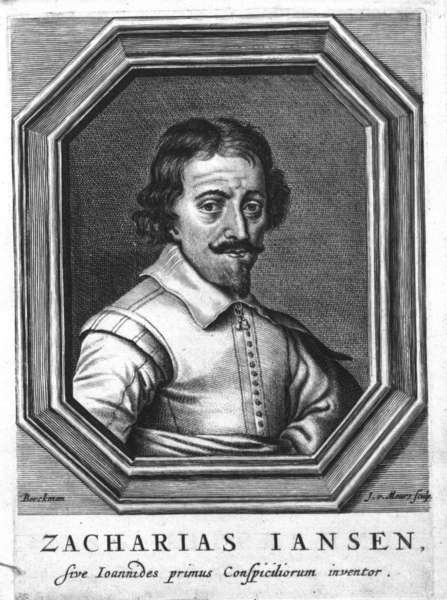
Zacharias Janssen Invents Compound Microscope
Dutch spectacle maker Zacharias Janssen is credited with inventing the compound microscope, using two convex lenses to magnify objects. #optics #microscope
Zacharias Janssen Invents Compound Microscope By Pierre Borel - Pierre Borel, De vero telescopii inventore, Public domain, https://commons.wikimedia.org/w/index.php?curid=3990766
1608 CE
Hans Lippershey Patents Telescope
Dutch lensmaker Hans Lippershey applies for a patent for a refracting telescope, leading to rapid astronomical discoveries. #optics #telescope
Hans Lippershey Patents Telescope By Pierre Borel - De vero telescopii inventore (See http://fermi.imss.fi.it/rd/bdv?/bdviewer/bid=000000300919), Public domain, https://commons.wikimedia.org/w/index.php?curid=3990839
1611 CE
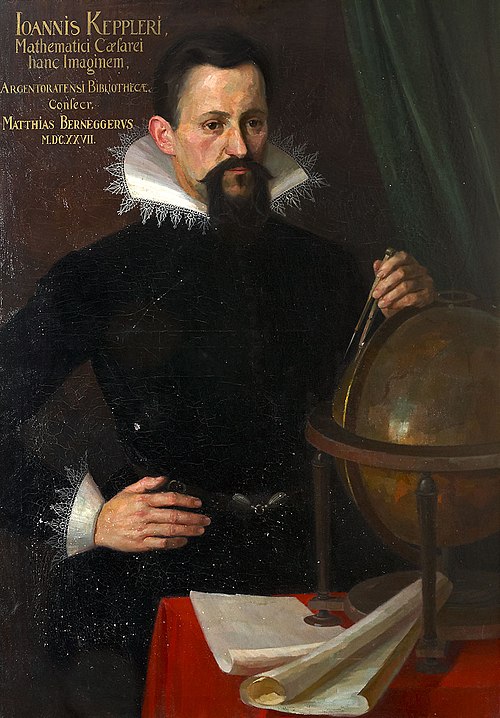
Johannes Kepler's Dioptrice
Johannes Kepler publishes 'Dioptrice', explaining the principles of refraction and the operation of telescopes and microscopes. #optics #science
Johannes Kepler's Dioptrice By August Köhler [1] - Kepler-Museum in Weil der Stadt, Public domain, https://commons.wikimedia.org/w/index.php?curid=9406242
1621 CE
Snell's Law of Refraction
Willebrord Snellius discovers the law of refraction (Snell's law), relating the angles of incidence and refraction to the indices of refraction. #optics #physics
Snell's Law of Refraction By Oleg Alexandrov — I just tweaked the original - Rotated and tweaked version of en:Image:Snells law.svg, same license, Public domain, https://commons.wikimedia.org/w/index.php?curid=3273668
1665 CE
Newton's Prism Experiments
Isaac Newton performs experiments with prisms, demonstrating that white light is composed of a spectrum of colors, laying foundation for spectroscopy. #optics #spectroscopy
1678 CE
Huygens' Wave Theory of Light
Christiaan Huygens proposes the wave theory of light, explaining reflection and refraction using wavefronts. #optics #physics
Huygens' Wave Theory of Light By Caspar Netscher - http://ressources2.techno.free.fr/informatique/sites/inventions/inventions.html, Public domain, https://commons.wikimedia.org/w/index.php?curid=44047
1704 CE
Newton's Opticks Published
Isaac Newton publishes 'Opticks', summarizing his experiments on light and color, and proposing the corpuscular theory of light. #optics #science
Newton's Opticks Published By Unknown author, Public domain, https://commons.wikimedia.org/w/index.php?curid=510265
1800 CE
Herschel Discovers Infrared Radiation
William Herschel discovers infrared radiation by measuring temperature beyond the red end of the visible spectrum. #optics #spectroscopy
Herschel Discovers Infrared Radiation By Unknown author, CC BY-SA 3.0, https://commons.wikimedia.org/w/index.php?curid=3484188
1801 CE
Young's Double-Slit Experiment
Thomas Young performs the double-slit experiment, demonstrating the wave nature of light through interference patterns. #optics #physics
Young's Double-Slit Experiment By Original: NekoJaNekoJa Vector: Johannes Kalliauer - Own work based on: Double-slit.PNG:, CC BY-SA 4.0, https://commons.wikimedia.org/w/index.php?curid=61496401
1802 CE
Wollaston Discovers Fraunhofer Lines
William Hyde Wollaston observes dark lines in the solar spectrum, later studied by Fraunhofer, leading to spectroscopy. #optics #spectroscopy
Wollaston Discovers Fraunhofer Lines By This derivative work : Eric Bajart Which is a derivative of: File:Spectrum of blue sky.png by Remember the dot Which is itself a derivative of: File:Spectrum of blue sky.gif by Deglr6328 (14 Oct 2006) - Spectrum of blue sky.png, CC BY-SA 4.0, https://commons.wikimedia.org/w/index.php?curid=10586771
1814 CE
Fraunhofer Maps Solar Spectrum
Joseph von Fraunhofer independently discovers and maps hundreds of dark lines in the solar spectrum, now known as Fraunhofer lines. #optics #spectroscopy
Fraunhofer Maps Solar Spectrum By Unknown author - Scanned from "Die großen Deutschen im Bilde" (1936) by Michael Schönitzer, Public domain, https://commons.wikimedia.org/w/index.php?curid=5017460
1859 CE
Kirchhoff and Bunsen Found Spectroscopy
Gustav Kirchhoff and Robert Bunsen develop spectroscopy, showing that each element emits and absorbs characteristic spectral lines. #spectroscopy #physics
1865 CE
Maxwell's Electromagnetic Theory of Light
James Clerk Maxwell publishes his theory of electromagnetism, showing that light is an electromagnetic wave. #optics #physics
Maxwell's Electromagnetic Theory of Light By Unknown author - https://www.researchgate.net/figure/James-Clerk-Maxwell-1831-1879_fig1_360164096, Public domain, https://commons.wikimedia.org/w/index.php?curid=129476608
1887 CE
Michelson-Morley Experiment
Albert Michelson and Edward Morley perform an experiment that fails to detect the luminiferous aether, leading to special relativity. #optics #physics
Michelson-Morley Experiment By Case Western Reserve University - http://www.cellularuniverse.org/AA2MM_Aether.htm, Public domain, https://commons.wikimedia.org/w/index.php?curid=48697725
1900 CE
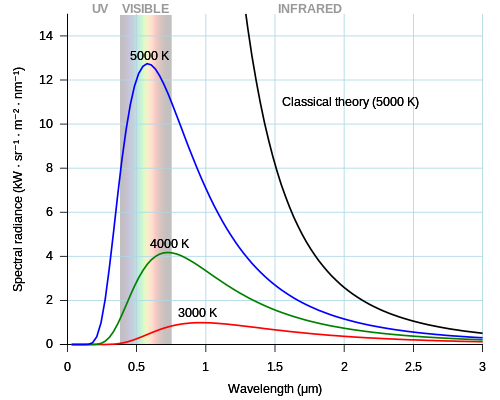
Planck's Quantum Hypothesis
Max Planck introduces the quantum of action (Planck's constant) to explain blackbody radiation, founding quantum theory. #quantum #optics
Planck's Quantum Hypothesis By Darth Kule - Own work, Public domain, https://commons.wikimedia.org/w/index.php?curid=10555337
1905 CE
Einstein's Photoelectric Effect
Albert Einstein explains the photoelectric effect by proposing light consists of quanta (photons), supporting particle nature of light. #optics #quantum
Einstein's Photoelectric Effect By Ponor - Own work, CC BY-SA 4.0, https://commons.wikimedia.org/w/index.php?curid=92684859
1913 CE
Bohr Model and Atomic Spectra
Niels Bohr proposes a model of the hydrogen atom with quantized energy levels, explaining spectral lines. #spectroscopy #quantum
Bohr Model and Atomic Spectra By JabberWok at English Wikipedia - Transferred from en.wikipedia to Commons., CC BY-SA 3.0, https://commons.wikimedia.org/w/index.php?curid=2639910
1917 CE
Einstein Predicts Stimulated Emission
Albert Einstein introduces the concept of stimulated emission, the theoretical basis for lasers. #laser #quantum
Einstein Predicts Stimulated Emission By 彭嘉傑 - Own work, CC BY 2.5, https://commons.wikimedia.org/w/index.php?curid=60733412
1924 CE
de Broglie's Wave-Particle Duality
Louis de Broglie proposes that particles have wave-like properties, extending wave-particle duality to matter. #quantum #optics
1928 CE
Raman Effect Discovered
C. V. Raman discovers the Raman effect, inelastic scattering of light, leading to Raman spectroscopy. #spectroscopy #optics
Raman Effect Discovered By KCVelaga - File:Electron-scattering.png by JabberWok, CC BY-SA 4.0, https://commons.wikimedia.org/w/index.php?curid=79274364
1931 CE
Zernike Invents Phase-Contrast Microscopy
Frits Zernike invents phase-contrast microscopy, allowing observation of transparent specimens without staining. #optics #microscopy
Zernike Invents Phase-Contrast Microscopy By GcG - Own work, Public domain, https://commons.wikimedia.org/w/index.php?curid=2263499
1947 CE
Dennis Gabor Invents Holography
Dennis Gabor develops the theory of holography, for which he later receives the Nobel Prize. #optics #holography
Dennis Gabor Invents Holography By Holo-Mouse.jpg: Georg-Johann Lay derivative work: Epzcaw (talk) - Holo-Mouse.jpg, Public domain, https://commons.wikimedia.org/w/index.php?curid=16456745
1953 CE
Townes Invents Maser
Charles Townes and colleagues build the first maser (microwave amplification by stimulated emission of radiation), precursor to the laser. #laser #physics
Townes Invents Maser By Dan Rubin - Retrieved February 18, 2015 from Shunaman, Fred "Revolutionary new oscillator-amplifier" in Radio-Electronic Engineering magazine, Ziff-Davis Publishing Co., New York, Vol. 26, No. 6, June 1955, cover on http://www.americanradiohistory.com, Public domain, https://commons.wikimedia.org/w/index.php?curid=38461589
May 16, 1960 CE
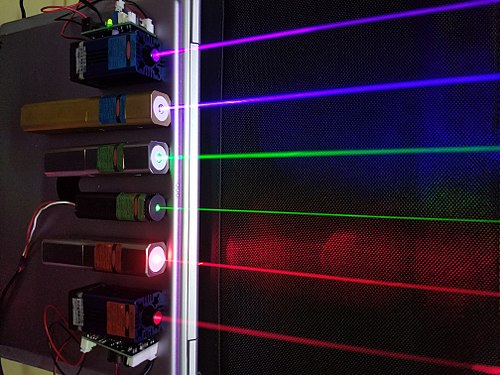
Maiman Demonstrates First Laser
Theodore Maiman operates the first working laser, a ruby laser emitting pulsed red light, revolutionizing optics and spectroscopy. #laser #optics
Maiman Demonstrates First Laser By Andrey Chernogorodov - Own work, CC BY 4.0, https://commons.wikimedia.org/w/index.php?curid=90481144
1961 CE
First Continuous-Wave Laser
Ali Javan, William Bennett, and Donald Herriott demonstrate the first continuous-wave helium-neon laser. #laser #optics
First Continuous-Wave Laser By Tommy Markstein - Own work (Original text: Tommy Markstein), CC BY-SA 3.0, https://commons.wikimedia.org/w/index.php?curid=24295060
1962 CE
Semiconductor Laser Invented
Robert Hall and colleagues invent the semiconductor (diode) laser, enabling compact and efficient laser sources. #laser #optics
Semiconductor Laser Invented By Unknown author - Jet Propulsion Laboratory website: http://technology.jpl.nasa.gov/gallery/index.cfm?page=imageDetail&ItemID=120&catId=8 (archive), Public domain, https://commons.wikimedia.org/w/index.php?curid=2359148
1964 CE
Nobel Prize for Maser-Laser Work
Charles Townes, Nikolay Basov, and Alexander Prokhorov receive the Nobel Prize for fundamental work on masers and lasers. #laser #physics
Nobel Prize for Maser-Laser Work By Unknown author - [1], Public domain, https://commons.wikimedia.org/w/index.php?curid=92738267
1966 CE
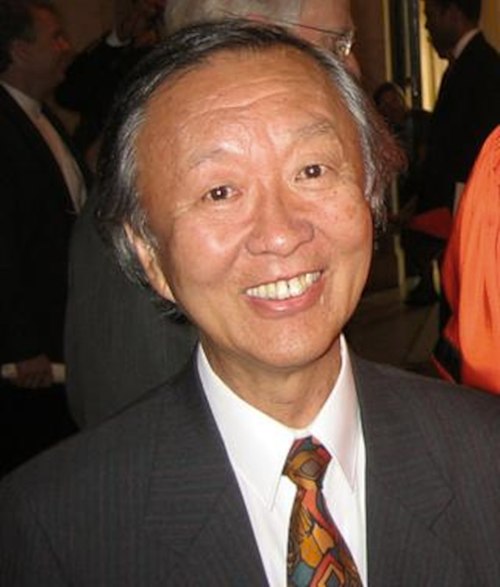
Kao Proposes Optical Fiber Communication
Charles K. Kao demonstrates that optical fibers can transmit light with low loss, laying foundation for fiber-optic communications. #optics #telecom
Kao Proposes Optical Fiber Communication By David Dobkin [1] - http://www.cs.princeton.edu/~dpd/DeanOfFaculty/person_FILES/Charles.Kao.html, CC BY-SA 3.0, https://commons.wikimedia.org/w/index.php?curid=8000542
1970 CE
First Room-Temperature Continuous-Wave Diode Laser
Izuo Hayashi and Morton Panish achieve continuous-wave operation of a semiconductor laser at room temperature, crucial for practical applications. #laser #optics
1971 CE
Gabor Receives Nobel for Holography
Dennis Gabor is awarded the Nobel Prize in Physics for his invention of holography. #optics #holography
Gabor Receives Nobel for Holography By Keystone - [1], Public domain, https://commons.wikimedia.org/w/index.php?curid=62245929
1977 CE
First Optical Fiber Telephone System
The first optical fiber telephone system is installed in Chicago, marking the beginning of fiber-optic communication. #optics #telecom
First Optical Fiber Telephone System By Alby (talk) - Own work (Original text: I (Alby (talk)) created this work entirely by myself.), Public domain, https://commons.wikimedia.org/w/index.php?curid=27148045
1981 CE
Nobel for Laser Spectroscopy
Nicolaas Bloembergen and Arthur Schawlow share the Nobel Prize for laser spectroscopy, and Kai Siegbahn for electron spectroscopy. #spectroscopy #laser
Nobel for Laser Spectroscopy By D-Kuru - Own work, CC BY-SA 3.0 at, https://commons.wikimedia.org/w/index.php?curid=7082370
1985 CE
Femtosecond Laser Pulses
Development of femtosecond laser pulses enables time-resolved spectroscopy on ultrafast timescales. #laser #spectroscopy
1995 CE
Bose-Einstein Condensate Created
Eric Cornell and Carl Wieman create the first Bose-Einstein condensate, using laser cooling and trapping. #quantum #optics
Bose-Einstein Condensate Created By Vectorized version by AG Caesar, original by DG85 - Inspired by a work from Wikipedia User DG85 https://commons.wikimedia.org/wiki/File:QuantumPhaseTransition.png, Public domain, https://commons.wikimedia.org/w/index.php?curid=67110336
2001 CE
Nobel for Bose-Einstein Condensation
Eric Cornell, Carl Wieman, and Wolfgang Ketterle receive the Nobel Prize for achieving Bose-Einstein condensation in dilute gases. #quantum #optics
2005 CE
Nobel for Optical Coherence Tomography
John Hall and Theodor Hänsch share the Nobel Prize for laser-based precision spectroscopy, including optical frequency comb technique. #spectroscopy #laser
Nobel for Optical Coherence Tomography By Rubber Duck (☮ • ✍) - Own work, Public domain, https://commons.wikimedia.org/w/index.php?curid=39652854
2012 CE
Nobel for Quantum Optics
Serge Haroche and David Wineland receive the Nobel Prize for measuring and manipulating individual quantum systems, advancing quantum optics. #quantum #optics
2018 CE
Nobel for Laser Physics
Arthur Ashkin wins half the Nobel Prize for optical tweezers, and Gérard Mourou and Donna Strickland for chirped pulse amplification. #laser #physics