WW2/Battles of WW2/Date-by-Date/Eastern Front • Curated by Admin Timeline.sg
Nazi Germany's massive surprise invasion of the Soviet Union, which shattered Red Army forces in huge encirclement battles before grinding to a halt at the gates of Moscow. (22 June – 5 December 1941)
Chronological Storyline (34 Milestones)
Jun 22, 1941 CE
Army Group North advances toward Leningrad
Field Marshal Wilhelm Ritter von Leeb's Army Group North strikes from East Prussia toward the Baltic states and Leningrad, meeting disorganized but stiffening Soviet resistance. · Wikipedia: https://en.wikipedia.org/wiki/Army_Group_North
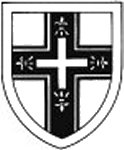
Insigne van de Heeresgruppe Nord (1941-1945) By Unknown author - https://www.axishistory.com/books/147-germany-heer/heeresgruppen/2618-heeresgruppe-nord, Public domain, https://commons.wikimedia.org/w/index.php?curid=86290446
Jun 22, 1941 CE
Army Group South drives into Ukraine
Field Marshal Gerd von Rundstedt's Army Group South advances toward Kiev and the Dnieper, facing the strongest Soviet concentration and making slower progress than other fronts. · Wikipedia: https://en.wikipedia.org/wiki/Army_Group_South
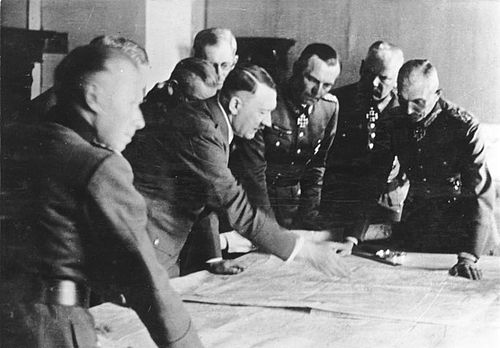
Situation briefing, Army Group South Headquarters On the Eastern Front, 1 June, 1942 Adolf Hitler during a briefing at the headquarters of Army Group South in Poltava. From left to right: Lieutenant General Adolf Ernst Heusinger, General of the Infantry von Sodenstern, Colonel General Max Freiherr von Weichs, Adolf Hitler, General of the Panzertruppe Friedrich Paulus, Colonel General Eberhard von Mackensen and Field Marshal Fedor von Bock. June 1942 People pictured: Bock, Fedor von: Field Marshal, Knight's Cross (RK), Army, Germany (GND 119294796) Heusinger, Adolf: General, Inspector of the Bundeswehr, Federal Republic of Germany Hitler, Adolf: Reich Chancellor, Germany Mackensen, Eberhard von: Colonel General, Knight's Cross (RK), Army, Germany (GND 107585448) Paulus, Friedrich: Field Marshal, Commander-in-Chief 6th Army, Knight's Cross (RK), Army, Germany (GND 118739654) Sodenstern, Georg von: General of the Infantry, Knight's Cross (RK), Army, Germany (GND 128648376) Weichs, Maximilian von Freiherr: Field Marshal, Knight's Cross, Army, Germany (GND 117235202) By Unknown author - This image was provided to Wikimedia Commons by the German Federal Archive (Deutsches Bundesarchiv) as part of a cooperation project. The German Federal Archive guarantees an authentic representation only using the originals (negative and/or positive), resp. the digitalization of the originals as provided by the Digital Image Archive., CC BY-SA 3.0 de, https://commons.wikimedia.org/w/index.php?curid=5360875
Jun 22, 1941 CE
Operation Barbarossa begins at dawn
Over 3 million Axis troops cross the Soviet border along a 2,900 km front, catching the Red Army by surprise and destroying hundreds of aircraft on the ground in the first hours. · Wikipedia: https://en.wikipedia.org/wiki/Operation_Barbarossa
The Largest Invasion in History Begins: Operation BarbarossaGerman soldiers advance through northern Russia. German flamethrower crew burns down a house in the background. German Panzer IV stuck in the snow with white camouflage paint. Soviet Ilyushin Il-2s hovering over German positions near Moscow. Soviet POWs on the way to prison campsSoviet soldiers fire artillery. By Bundesarchiv, Bild 146-1974-099-19 / Kempe / CC-BY-SA 3.0 Samaryi Guraryi / Самарий Гурарий Ustinov / Александр Устинов Bundesarchiv, Bild 101I-209-0090-28 / Zoll / CC-BY-SA 3.0 - This file was derived from: Bundesarchiv Bild 146-1974-099-19, Russland, Angriff auf ein Dorf.jpg: Bundesarchiv Bild 101I-215-0354-14, Russland, Panzer IV im Schnee.jpg: RIAN archive 2564 Soviet planes flying over Nazi positions near Moscow.jpg: Russian POW (1941).jpg: RIAN archive 607025 Soldiers of the Great Patriotic War.jpg: Bundesarchiv Bild 101I-209-0090-28, Russland-Nord, Infanterie und Panzer 35t.jpg:, CC0, https://commons.wikimedia.org/w/index.php?curid=156477159
Jun 24, 1941 CE
Battle of Białystok–Minsk encirclement begins
Army Group Center's panzer spearheads under Heinz Guderian and Hermann Hoth thrust deep into Soviet territory, beginning a massive double envelopment of Soviet forces in Belarus. · Wikipedia: https://en.wikipedia.org/wiki/Battle_of_Bia%C5%82ystok%E2%80%93Minsk
For documentary purposes the German Federal Archive often retained the original image captions, which may be erroneous, biased, obsolete or politically extreme. Scherl: An der Sowjetfront: Ruinen der Provinzhauptstadt Minsk. PK-Aufnahme: Kriegsberichter: Cusian (Sch.) 7057-41 "Fr." "Fr.OKW" Juli 41 By Albert Cusian - This image was provided to Wikimedia Commons by the German Federal Archive (Deutsches Bundesarchiv) as part of a cooperation project. The German Federal Archive guarantees an authentic representation only using the originals (negative and/or positive), resp. the digitalization of the originals as provided by the Digital Image Archive., CC BY-SA 3.0 de, https://commons.wikimedia.org/w/index.php?curid=5476219
Jun 26, 1941 CE
Soviet counterattack at Brody
Soviet mechanized corps launch a major counterattack against Army Group South's panzers near Brody in western Ukraine, resulting in one of the largest tank battles of the campaign. · Wikipedia: https://en.wikipedia.org/wiki/Battle_of_Brody
Map of the battle of Dubno (aka Battle of Brody) By Llaird McKinnley - Painted with Wacom Intuos3, prepared in Adobe Illustrator and exporterd to SVG 1.1, CC BY-SA 3.0, https://commons.wikimedia.org/w/index.php?curid=10513575
Jun 27, 1941 CE
Minsk falls to Army Group Center
German panzer divisions capture Minsk, sealing the first major encirclement and trapping over 300,000 Soviet troops in the Białystok–Minsk pocket. · Wikipedia: https://en.wikipedia.org/wiki/Battle_of_Bia%C5%82ystok%E2%80%93Minsk
For documentary purposes the German Federal Archive often retained the original image captions, which may be erroneous, biased, obsolete or politically extreme. Scherl: An der Sowjetfront: Ruinen der Provinzhauptstadt Minsk. PK-Aufnahme: Kriegsberichter: Cusian (Sch.) 7057-41 "Fr." "Fr.OKW" Juli 41 By Albert Cusian - This image was provided to Wikimedia Commons by the German Federal Archive (Deutsches Bundesarchiv) as part of a cooperation project. The German Federal Archive guarantees an authentic representation only using the originals (negative and/or positive), resp. the digitalization of the originals as provided by the Digital Image Archive., CC BY-SA 3.0 de, https://commons.wikimedia.org/w/index.php?curid=5476219
Jul 3, 1941 CE
Stalin orders scorched earth policy
In a radio address, Stalin calls for total resistance and orders the destruction of infrastructure and resources to deny them to advancing German forces. · Wikipedia: https://en.wikipedia.org/wiki/Scorched_earth
Engraving depicting Sherman's march to the sea. Size: 27 1/8 x 41 1/2 in. Original copyright: 1868 by L. Stebbins. By F. O. C. Darley / Alexander Hay Ritchie / Adam Cuerden - This image is available from the United States Library of Congress's Prints and Photographs division under the digital ID ppmsca.09326.This tag does not indicate the copyright status of the attached work. A normal copyright tag is still required. See Commons:Licensing., Public domain, https://commons.wikimedia.org/w/index.php?curid=464770
Jul 9, 1941 CE
Białystok–Minsk pocket liquidated
The encircled Soviet forces are destroyed or captured, yielding over 300,000 prisoners and eliminating the Soviet Western Front's main strength. · Wikipedia: https://en.wikipedia.org/wiki/Battle_of_Bia%C5%82ystok%E2%80%93Minsk
For documentary purposes the German Federal Archive often retained the original image captions, which may be erroneous, biased, obsolete or politically extreme. Scherl: An der Sowjetfront: Ruinen der Provinzhauptstadt Minsk. PK-Aufnahme: Kriegsberichter: Cusian (Sch.) 7057-41 "Fr." "Fr.OKW" Juli 41 By Albert Cusian - This image was provided to Wikimedia Commons by the German Federal Archive (Deutsches Bundesarchiv) as part of a cooperation project. The German Federal Archive guarantees an authentic representation only using the originals (negative and/or positive), resp. the digitalization of the originals as provided by the Digital Image Archive., CC BY-SA 3.0 de, https://commons.wikimedia.org/w/index.php?curid=5476219
Jul 10, 1941 CE
Smolensk offensive begins
Army Group Center resumes its eastward drive toward Smolensk, aiming to close another massive encirclement of Soviet forces defending the Dnieper crossing. · Wikipedia: https://en.wikipedia.org/wiki/Battle_of_Smolensk_(1941)
Battle of Smolensk Diagram By Livedawg - Own work, CC BY-SA 3.0, https://commons.wikimedia.org/w/index.php?curid=30035431
Jul 14, 1941 CE
Army Group North reaches Luga River
German forces reach the Luga River defense line, only 110 km from Leningrad, but meet determined Soviet defenses that slow the advance for several weeks. · Wikipedia: https://en.wikipedia.org/wiki/Siege_of_Leningrad
The fire of anti-aircraft guns deployed in the neighborhood of St. Isaac's cathedral during the defense of Leningrad (now called St. Petersburg, its pre-Soviet name) in 1941. By Boris Kudoyarov - "The Eastern Front in Photographs", John Erickson // http://waralbum.ru/51876/ // http://visualrian.ru/media/2352163.html, Public domain, https://commons.wikimedia.org/w/index.php?curid=3686419
Jul 16, 1941 CE
Smolensk captured by German forces
German troops take Smolensk after heavy fighting, opening a critical gateway toward Moscow, but large Soviet formations remain trapped in the surrounding area. · Wikipedia: https://en.wikipedia.org/wiki/Battle_of_Smolensk_(1941)
Battle of Smolensk Diagram By Livedawg - Own work, CC BY-SA 3.0, https://commons.wikimedia.org/w/index.php?curid=30035431
Jul 19, 1941 CE
Hitler issues Directive 33
Hitler diverts panzer forces from Army Group Center to support the north and south fronts, temporarily halting the Moscow offensive to secure Leningrad and Ukraine. · Wikipedia: https://en.wikipedia.org/wiki/Battle_of_Smolensk_(1941)
Battle of Smolensk Diagram By Livedawg - Own work, CC BY-SA 3.0, https://commons.wikimedia.org/w/index.php?curid=30035431
Jul 26, 1941 CE
Uman encirclement develops in Ukraine
Army Group South's forces encircle Soviet troops near Uman in central Ukraine, capturing over 100,000 prisoners and further weakening Soviet defenses in the south. · Wikipedia: https://en.wikipedia.org/wiki/Battle_of_Uman
Stanowisko karabinu maszynowego MG 34 na podstawie trójnożnej we wsi koło Humania. Widoczni dwaj żołnierze z pułku „Germania” 5 Dywizji Pancernej SS „Wiking”. Jeden z żołnierzy uzbrojony jest w karabinek Mauser Kar98k. By Unknown author - Nac.gov.pl, Public domain, https://commons.wikimedia.org/w/index.php?curid=54542493
Aug 5, 1941 CE
Smolensk pocket eliminated
The last Soviet resistance in the Smolensk pocket ends, with over 180,000 prisoners taken, but the engagement has cost the Germans significant time and casualties. · Wikipedia: https://en.wikipedia.org/wiki/Battle_of_Smolensk_(1941)
Battle of Smolensk Diagram By Livedawg - Own work, CC BY-SA 3.0, https://commons.wikimedia.org/w/index.php?curid=30035431
Aug 8, 1941 CE
Yelnya offensive begins
Soviet forces launch a counteroffensive at Yelnya salient east of Smolensk, pushing back German forces and demonstrating growing Soviet resilience. · Wikipedia: https://en.wikipedia.org/wiki/Battle_of_Yelnya
Aug 21, 1941 CE
Hitler shifts focus to Ukraine
Despite objections from the German high command, Hitler orders Army Group Center to halt and send panzer forces south to encircle Kiev, prioritizing economic objectives. · Wikipedia: https://en.wikipedia.org/wiki/Battle_of_Kiev_(1941)
For documentary purposes the German Federal Archive often retained the original image captions, which may be erroneous, biased, obsolete or politically extreme. Scherl Bilderdienst An der Sowjetfront: (Ukraine) Riesenbrand in der Hauptstrasse von Kiew. Als Ursache wird die Explosion einer sowjetischen Höllenmaschine angesehen. PK-Aufnahmen: Kriegsberichter: Kraayvanger 9055-41 Sept. 1941 By Kraagranger [Kraayvanger] - This image was provided to Wikimedia Commons by the German Federal Archive (Deutsches Bundesarchiv) as part of a cooperation project. The German Federal Archive guarantees an authentic representation only using the originals (negative and/or positive), resp. the digitalization of the originals as provided by the Digital Image Archive., CC BY-SA 3.0 de, https://commons.wikimedia.org/w/index.php?curid=5432553
Aug 25, 1941 CE
British-Soviet forces occupy Iran
In a strategic side-operation, British and Soviet troops jointly invade Iran to secure oil supplies and supply routes to the Soviet Union, easing logistical pressure. · Wikipedia: https://en.wikipedia.org/wiki/Anglo-Soviet_invasion_of_Iran
Soviet tankmen of the 6th Armoured Division drive through the streets of Tabriz on their T-26 battle tank. By Unknown author - topwar.ru, Public domain, https://commons.wikimedia.org/w/index.php?curid=22686657
Aug 31, 1941 CE
Leningrad siege begins to form
German forces complete their advance to the Neva River and cut the last rail line to Leningrad, beginning the encirclement that would become a 900-day siege. · Wikipedia: https://en.wikipedia.org/wiki/Siege_of_Leningrad
The fire of anti-aircraft guns deployed in the neighborhood of St. Isaac's cathedral during the defense of Leningrad (now called St. Petersburg, its pre-Soviet name) in 1941. By Boris Kudoyarov - "The Eastern Front in Photographs", John Erickson // http://waralbum.ru/51876/ // http://visualrian.ru/media/2352163.html, Public domain, https://commons.wikimedia.org/w/index.php?curid=3686419
Sep 6, 1941 CE
Yelnya salient recaptured by Soviets
Soviet forces retake the Yelnya salient in a costly but morale-boosting victory, the first successful Soviet offensive of the war. · Wikipedia: https://en.wikipedia.org/wiki/Battle_of_Yelnya
Sep 8, 1941 CE
Leningrad fully encircled
German forces cut the last land route to Leningrad, beginning the 872-day siege that would cause approximately one million civilian deaths from starvation and bombardment. · Wikipedia: https://en.wikipedia.org/wiki/Siege_of_Leningrad
The fire of anti-aircraft guns deployed in the neighborhood of St. Isaac's cathedral during the defense of Leningrad (now called St. Petersburg, its pre-Soviet name) in 1941. By Boris Kudoyarov - "The Eastern Front in Photographs", John Erickson // http://waralbum.ru/51876/ // http://visualrian.ru/media/2352163.html, Public domain, https://commons.wikimedia.org/w/index.php?curid=3686419
Sep 12, 1941 CE
Kiev encirclement completed
Guderian's panzers from Army Group Center link up with Army Group South east of Kiev, sealing hundreds of thousands of Soviet troops in a massive pocket along the Dnieper. · Wikipedia: https://en.wikipedia.org/wiki/Battle_of_Kiev_(1941)
For documentary purposes the German Federal Archive often retained the original image captions, which may be erroneous, biased, obsolete or politically extreme. Scherl Bilderdienst An der Sowjetfront: (Ukraine) Riesenbrand in der Hauptstrasse von Kiew. Als Ursache wird die Explosion einer sowjetischen Höllenmaschine angesehen. PK-Aufnahmen: Kriegsberichter: Kraayvanger 9055-41 Sept. 1941 By Kraagranger [Kraayvanger] - This image was provided to Wikimedia Commons by the German Federal Archive (Deutsches Bundesarchiv) as part of a cooperation project. The German Federal Archive guarantees an authentic representation only using the originals (negative and/or positive), resp. the digitalization of the originals as provided by the Digital Image Archive., CC BY-SA 3.0 de, https://commons.wikimedia.org/w/index.php?curid=5432553
Sep 19, 1941 CE
Kiev falls to German forces
The Soviet Southwestern Front collapses as Kiev is captured, yielding over 600,000 prisoners in one of the largest encirclements in military history. · Wikipedia: https://en.wikipedia.org/wiki/Battle_of_Kiev_(1941)
For documentary purposes the German Federal Archive often retained the original image captions, which may be erroneous, biased, obsolete or politically extreme. Scherl Bilderdienst An der Sowjetfront: (Ukraine) Riesenbrand in der Hauptstrasse von Kiew. Als Ursache wird die Explosion einer sowjetischen Höllenmaschine angesehen. PK-Aufnahmen: Kriegsberichter: Kraayvanger 9055-41 Sept. 1941 By Kraagranger [Kraayvanger] - This image was provided to Wikimedia Commons by the German Federal Archive (Deutsches Bundesarchiv) as part of a cooperation project. The German Federal Archive guarantees an authentic representation only using the originals (negative and/or positive), resp. the digitalization of the originals as provided by the Digital Image Archive., CC BY-SA 3.0 de, https://commons.wikimedia.org/w/index.php?curid=5432553
Sep 26, 1941 CE
Kiev pocket liquidated
The last Soviet resistance inside the Kiev pocket ends, with total Soviet losses exceeding 600,000 men, making it the largest single encirclement of the war. · Wikipedia: https://en.wikipedia.org/wiki/Battle_of_Kiev_(1941)
For documentary purposes the German Federal Archive often retained the original image captions, which may be erroneous, biased, obsolete or politically extreme. Scherl Bilderdienst An der Sowjetfront: (Ukraine) Riesenbrand in der Hauptstrasse von Kiew. Als Ursache wird die Explosion einer sowjetischen Höllenmaschine angesehen. PK-Aufnahmen: Kriegsberichter: Kraayvanger 9055-41 Sept. 1941 By Kraagranger [Kraayvanger] - This image was provided to Wikimedia Commons by the German Federal Archive (Deutsches Bundesarchiv) as part of a cooperation project. The German Federal Archive guarantees an authentic representation only using the originals (negative and/or positive), resp. the digitalization of the originals as provided by the Digital Image Archive., CC BY-SA 3.0 de, https://commons.wikimedia.org/w/index.php?curid=5432553
Sep 30, 1941 CE
Operation Typhoon begins
Army Group Center launches its final offensive toward Moscow with over 1.9 million troops, aiming to capture the Soviet capital before winter sets in. · Wikipedia: https://en.wikipedia.org/wiki/Battle_of_Moscow
“Defense of Moscow”. Anti-aircraft gunners on the roof of Moscow's central Hotel "Moskva". The Great Patriotic War (1941-1945). Reprophoto. By Knorring / Олег Кнорринг - RIA Novosti archive, image #887721, http://visualrian.ru/ru/site/gallery/#887721 6x7 film / 6х7 негатив, CC BY-SA 3.0, https://commons.wikimedia.org/w/index.php?curid=16790691
Oct 2, 1941 CE
Vyazma encirclement develops
German panzer forces break through Soviet lines and begin encircling Soviet armies at Vyazma, trapping over 500,000 Soviet troops west of Moscow. · Wikipedia: https://en.wikipedia.org/wiki/Battle_of_Vyazma
Vyazma encirclement develops By Peter von Hess - originally uploaded to the English Wikipedia by User:Ghirlandajo, Public domain, https://commons.wikimedia.org/w/index.php?curid=1398013
Oct 7, 1941 CE
Bryansk pocket forms
A second encirclement at Bryansk traps additional Soviet forces, bringing total Soviet prisoners in Operation Typhoon's opening phase to over 600,000. · Wikipedia: https://en.wikipedia.org/wiki/Battle_of_Bryansk_(1941)
Map showing the Battle near Bryansk (September 30th — October 23rd 1941) during the Second World War (1939—1945) at the Eastern Front. The map is created by Inkscape and is based on the Map 30 in the attachement of the book P.N. Pospelow (Hrsg.): Geschichte des Großen Vaterländischen Krieges der Sowjetunion, Bd.2, Berlin (Ost) 1963. The troop movements have been corrected. By Memnon335bc - Own work, CC BY 3.0, https://commons.wikimedia.org/w/index.php?curid=7788685
Oct 12, 1941 CE
Moscow defense line established
Soviet forces under Zhukov establish the Mozhaisk defense line, a final series of fortified positions 100-140 km west of Moscow, to slow the German advance. · Wikipedia: https://en.wikipedia.org/wiki/Battle_of_Moscow
“Defense of Moscow”. Anti-aircraft gunners on the roof of Moscow's central Hotel "Moskva". The Great Patriotic War (1941-1945). Reprophoto. By Knorring / Олег Кнорринг - RIA Novosti archive, image #887721, http://visualrian.ru/ru/site/gallery/#887721 6x7 film / 6х7 негатив, CC BY-SA 3.0, https://commons.wikimedia.org/w/index.php?curid=16790691
Oct 14, 1941 CE
Kalinin captured by Germans
German forces take Kalinin, 160 km northwest of Moscow, threatening the capital from the north and prompting partial evacuation of Soviet government offices. · Wikipedia: https://en.wikipedia.org/wiki/Battle_of_Kalinin
Oct 19, 1941 CE
Stalin declares Moscow under siege
Stalin declares a state of siege in Moscow as German forces approach to within 100 km, ordering defensive lines and mobilizing civilian labor to build anti-tank ditches. · Wikipedia: https://en.wikipedia.org/wiki/Battle_of_Moscow
“Defense of Moscow”. Anti-aircraft gunners on the roof of Moscow's central Hotel "Moskva". The Great Patriotic War (1941-1945). Reprophoto. By Knorring / Олег Кнорринг - RIA Novosti archive, image #887721, http://visualrian.ru/ru/site/gallery/#887721 6x7 film / 6х7 негатив, CC BY-SA 3.0, https://commons.wikimedia.org/w/index.php?curid=16790691
Nov 7, 1941 CE
Moscow parade boosts Soviet morale
Stalin holds the annual October Revolution parade in Red Square, with troops marching directly to the front, a powerful symbolic act of defiance broadcast nationwide. · Wikipedia: https://en.wikipedia.org/wiki/1941_October_Revolution_Parade
Parade on Red Square on November, 7th, 1941 By USSR - https://archive.org/details/ParadeOnRedSquareOnNovember7th1941, Public domain, https://commons.wikimedia.org/w/index.php?curid=16334913
Nov 15, 1941 CE
Final German push toward Moscow begins
Army Group Center launches its last offensive toward Moscow from the north and south, attempting to encircle the city before the full onset of winter. · Wikipedia: https://en.wikipedia.org/wiki/Battle_of_Moscow
“Defense of Moscow”. Anti-aircraft gunners on the roof of Moscow's central Hotel "Moskva". The Great Patriotic War (1941-1945). Reprophoto. By Knorring / Олег Кнорринг - RIA Novosti archive, image #887721, http://visualrian.ru/ru/site/gallery/#887721 6x7 film / 6х7 негатив, CC BY-SA 3.0, https://commons.wikimedia.org/w/index.php?curid=16790691
Nov 25, 1941 CE
German forces reach Krasnaya Polyana
A German reconnaissance unit reaches Krasnaya Polyana, only 27 km from the Kremlin, the closest German forces get to Moscow during the entire war. · Wikipedia: https://en.wikipedia.org/wiki/Battle_of_Moscow
“Defense of Moscow”. Anti-aircraft gunners on the roof of Moscow's central Hotel "Moskva". The Great Patriotic War (1941-1945). Reprophoto. By Knorring / Олег Кнорринг - RIA Novosti archive, image #887721, http://visualrian.ru/ru/site/gallery/#887721 6x7 film / 6х7 негатив, CC BY-SA 3.0, https://commons.wikimedia.org/w/index.php?curid=16790691
Nov 29, 1941 CE
Rostov-on-Don lost and recaptured
Soviet forces recapture Rostov-on-Don from Army Group South in a successful counteroffensive, the first major German city loss of the war, forcing a retreat. · Wikipedia: https://en.wikipedia.org/wiki/Battle_of_Rostov_(1941)
Battle of Rostov By author unknown - http://nado.znate.ru/Ростовская_операция_(1941), Public domain, https://commons.wikimedia.org/w/index.php?curid=25461256
Dec 5, 1941 CE
Soviet winter counteroffensive begins
Sovet forces under Zhukov launch a massive counteroffensive north and south of Moscow, catching exhausted German forces off guard and marking the strategic failure of Barbarossa. · Wikipedia: https://en.wikipedia.org/wiki/Battle_of_Moscow
“Defense of Moscow”. Anti-aircraft gunners on the roof of Moscow's central Hotel "Moskva". The Great Patriotic War (1941-1945). Reprophoto. By Knorring / Олег Кнорринг - RIA Novosti archive, image #887721, http://visualrian.ru/ru/site/gallery/#887721 6x7 film / 6х7 негатив, CC BY-SA 3.0, https://commons.wikimedia.org/w/index.php?curid=16790691