Number Theory: Sunzi Remainder & Zero to Fermat, Riemann & Wiles
Encyclopedia/1. The Cosmos & The Natural World/1. Mathematics & Formal Systems/06. Number Theory & Cryptography • Curated by Admin Timeline.sg
Number theory, the queen of mathematics, spans from ancient Chinese remainder problems and Indian zero to modern conjectures like the Riemann Hypothesis and Wiles' proof of Fermat's Last Theorem.
Chronological Storyline (43 Milestones)
300 CE
Sunzi's Chinese Remainder Theorem
Sunzi Suanjing (The Mathematical Classic of Sunzi) contains the earliest known statement of the Chinese remainder theorem, solving simultaneous congruences. This work laid foundations for modular arithmetic. #mathematics #history
Sunzi's Chinese Remainder Theorem By AnonymousUnknown author - Own work (my book), Public domain, https://commons.wikimedia.org/w/index.php?curid=12568381
628 CE
Brahmagupta's Brāhmasphuṭasiddhānta
Brahmagupta writes the Brāhmasphuṭasiddhānta, defining zero as a number and establishing rules for arithmetic with zero and negative numbers. This treatise also discusses Pell's equation. #mathematics #india
830 CE
Al-Khwarizmi's Algebra
Al-Khwarizmi's 'The Compendious Book on Calculation by Completion and Balancing' introduces systematic algebraic methods, influencing number theory and arithmetic. His work later transmits Hindu-Arabic numerals to Europe. #mathematics #islamic
Al-Khwarizmi's Algebra By Zarateman - Own work, CC0, https://commons.wikimedia.org/w/index.php?curid=162213187
1202 CE
Fibonacci's Liber Abaci
Fibonacci publishes Liber Abaci, introducing Hindu-Arabic numerals to Europe and featuring the Fibonacci sequence. The book includes problems on congruences and number theory. #mathematics #europe
Fibonacci's Liber Abaci By Unknown author, Public domain, https://commons.wikimedia.org/w/index.php?curid=720501
1621 CE
Bachet's Translation of Diophantus
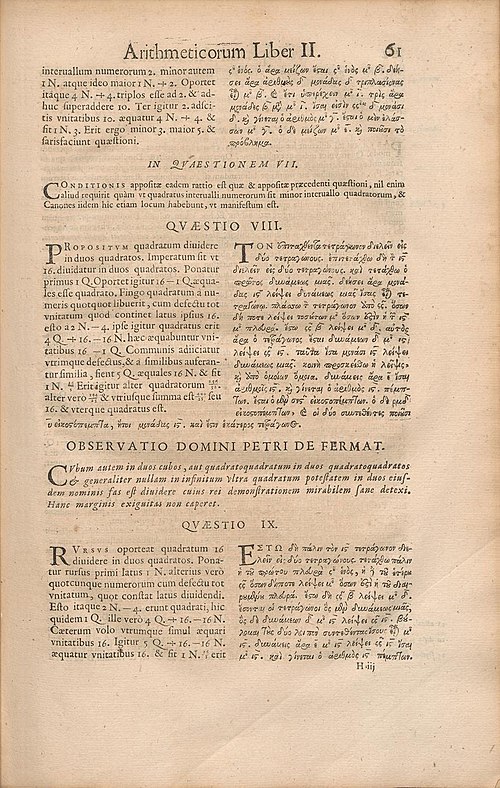
Claude Gaspard Bachet de Méziriac publishes a Latin translation of Diophantus' Arithmetica, sparking Fermat's interest in number theory. This edition contains Fermat's famous margin note on Fermat's Last Theorem. #mathematics #history
1640 CE
Fermat's Little Theorem
Pierre de Fermat states his Little Theorem: if p is prime and a is not divisible by p, then a^(p-1) ≡ 1 mod p. This foundational result in modular arithmetic is later used in cryptography. #mathematics #numbertheory
1657 CE
Fermat's Last Theorem Conjectured
Pierre de Fermat writes in the margin of Arithmetica that the equation x^n + y^n = z^n has no integer solutions for n>2, claiming a proof too large to fit. This becomes the most famous unsolved problem for centuries. #mathematics #history
Fermat's Last Theorem Conjectured By Unknown author, Public domain, https://commons.wikimedia.org/w/index.php?curid=533640
1742 CE
Goldbach's Conjecture
Christian Goldbach proposes that every even integer greater than 2 can be expressed as the sum of two primes. This conjecture remains unproven, stimulating research in additive number theory. #mathematics #conjecture
Goldbach's Conjecture By Christian Goldbach - http://www.mscs.dal.ca/~joerg/pic/g-letter.jpg, Public domain, https://commons.wikimedia.org/w/index.php?curid=1721422
1748 CE
Euler's Introduction to Number Theory
Leonhard Euler publishes 'Introductio in analysin infinitorum', which includes the Euler product formula linking the zeta function to primes. He also introduces the totient function φ(n). #mathematics #euler
Euler's Introduction to Number Theory By Cronholm144 at English Wikipedia - Transferred from en.wikipedia to Commons., CC BY-SA 3.0, https://commons.wikimedia.org/w/index.php?curid=3128774
1770 CE
Lagrange's Four-Square Theorem
Joseph-Louis Lagrange proves that every natural number can be represented as the sum of four integer squares. This is a classic result in additive number theory. #mathematics #numbertheory
Lagrange's Four-Square Theorem By Cmglee - Own work, CC BY-SA 4.0, https://commons.wikimedia.org/w/index.php?curid=132463072
1798 CE
Legendre's Conjecture on Primes
Adrien-Marie Legendre conjectures the prime number theorem, estimating π(x) ~ x/(log x - 1.08366). He also publishes 'Essai sur la théorie des nombres', a comprehensive number theory text. #mathematics #primes
1801 CE
Gauss's Disquisitiones Arithmeticae
Carl Friedrich Gauss publishes 'Disquisitiones Arithmeticae', systematizing number theory and introducing modular arithmetic, quadratic reciprocity, and cyclotomic fields. This work sets the foundation for modern number theory. #mathematics #gauss
Gauss's Disquisitiones Arithmeticae By Unknown author, Public domain, https://commons.wikimedia.org/w/index.php?curid=641724
1825 CE
Dirichlet's Theorem on Arithmetic Progressions
Johann Peter Gustav Lejeune Dirichlet proves that there are infinitely many primes in any arithmetic progression a + nd with gcd(a,d)=1, using L-functions. This is a milestone in analytic number theory. #mathematics #primes
Dirichlet's Theorem on Arithmetic Progressions By Unknown author - http://www.york.ac.uk/depts/maths/histstat/people/, Public domain, https://commons.wikimedia.org/w/index.php?curid=2914309
1832 CE
Galois Theory and Number Fields
Évariste Galois develops group theory and field theory, laying groundwork for algebraic number theory. His work on solvability of equations influences later number theory. #mathematics #algebra
Galois Theory and Number Fields By Unknown author - Iyanaga, Shokichi, "ガロアの時代 ガロアの数学 第一部 時代篇" , Springer-Verlag Tokyo, 1999 http://www.win.tue.nl/~aeb/at/GaloisCorrespondence.html, Public domain, https://commons.wikimedia.org/w/index.php?curid=103351
1837 CE
Dirichlet's Unit Theorem
Dirichlet proves the unit theorem for algebraic number fields, describing the structure of the group of units. This is a fundamental result in algebraic number theory. #mathematics #numbertheory
1859 CE
Riemann's Hypothesis on Zeta Function
Bernhard Riemann publishes 'On the Number of Primes Less Than a Given Magnitude', introducing the Riemann zeta function and conjecturing that all non-trivial zeros lie on the line Re(s)=1/2. This becomes the Riemann Hypothesis, one of the greatest unsolved problems. #mathematics #riemann
Riemann's Hypothesis on Zeta Function By No machine-readable author provided. Conscious assumed (based on copyright claims). - No machine-readable source provided. Own work assumed (based on copyright claims)., CC BY-SA 3.0, https://commons.wikimedia.org/w/index.php?curid=939039
1896 CE
Prime Number Theorem Proved
Jacques Hadamard and Charles de la Vallée-Poussin independently prove the prime number theorem, showing π(x) ~ x/ln(x). This uses complex analysis and the non-vanishing of ζ(s) on Re(s)=1. #mathematics #primes
1903 CE
Mersenne Primes and Perfect Numbers
Frank Nelson Cole factors 2^67 - 1, disproving a Mersenne prime claim. This highlights the difficulty of factoring large numbers, a theme in computational number theory. #mathematics #primes
1913 CE
Ramanujan's Letters to Hardy
Srinivasa Ramanujan sends a letter to G.H. Hardy containing many original results in number theory, including the Ramanujan tau function and mock theta functions. This begins a famous collaboration. #mathematics #india
Ramanujan's Letters to Hardy By Unknown author - https://mss-cat.trin.cam.ac.uk/manuscripts/uv/view.php?n=Add.Ms.a.94.7#?c=0&m=0&s=0&cv=6&xywh=-2849%2C-273%2C9238%2C5258, CC BY 4.0, https://commons.wikimedia.org/w/index.php?curid=153767257
1917 CE
Hardy-Ramanujan Asymptotic Partition Formula
G.H. Hardy and Srinivasa Ramanujan publish an asymptotic formula for the partition function p(n), using the circle method. This advances analytic number theory. #mathematics #partitions )
Hardy-Ramanujan Asymptotic Partition Formula By R. A. Nonenmacher - Own work, CC BY-SA 4.0, https://commons.wikimedia.org/w/index.php?curid=4766072
1921 CE
Mordell's Conjecture (Faltings' Theorem)
Louis Mordell conjectures that a curve of genus > 1 over the rationals has only finitely many rational points. This is later proved by Faltings in 1983, with implications for Fermat's Last Theorem. #mathematics #algebraicgeometry
Mordell's Conjecture (Faltings' Theorem) By Renate Schmid - https://opc.mfo.de/detail?photoID=7513, CC BY-SA 2.0 de, https://commons.wikimedia.org/w/index.php?curid=5427105
1937 CE
Turing's Computable Numbers and Primes
Alan Turing publishes 'On Computable Numbers', laying foundations for computability. He later works on the Riemann Hypothesis and develops methods for computing zeros of the zeta function. #mathematics #computing
Turing's Computable Numbers and Primes By Elliott & Fry - https://commons.wikimedia.org/wiki/File:Alan_Turing_(1951).jpg, Public domain, https://commons.wikimedia.org/w/index.php?curid=158923803
1949 CE
Selberg's Elementary Proof of Prime Number Theorem
Atle Selberg and Paul Erdős give an elementary proof of the prime number theorem, avoiding complex analysis. This sparks debate on the nature of mathematical proofs. #mathematics #primes
1950 CE
Weil Conjectures
André Weil formulates the Weil conjectures on zeta functions of algebraic varieties over finite fields, linking number theory and algebraic geometry. These are later proved by Deligne. #mathematics #algebraicgeometry
1967 CE
Langlands Program Initiated
Robert Langlands writes a letter to André Weil outlining the Langlands program, a web of conjectures linking number theory, representation theory, and automorphic forms. This becomes a major research direction. #mathematics #langlands
1974 CE
RSA Cryptosystem Invented
Ron Rivest, Adi Shamir, and Leonard Adleman invent the RSA cryptosystem, based on the difficulty of factoring large primes. This revolutionizes cryptography and applies number theory to security. #cryptography #numbertheory )
1976 CE
Elliptic Curve Cryptography Proposed
Neal Koblitz and Victor Miller independently propose elliptic curve cryptography (ECC), using the group of points on an elliptic curve over finite fields. ECC offers equivalent security with smaller key sizes. #cryptography #ellipticcurves
1977 CE
Adleman-Pomerance-Rumely Primality Test
Leonard Adleman, Carl Pomerance, and Robert Rumely develop a deterministic primality test based on cyclotomic fields, improving efficiency for large numbers. #mathematics #primes
1983 CE
Faltings Proves Mordell Conjecture
Gerd Faltings proves the Mordell conjecture (Faltings' theorem), showing that curves of genus > 1 have finitely many rational points. This implies that for each n>2, Fermat's equation has only finitely many primitive solutions. #mathematics #fermat
1985 CE
Lenstra's Elliptic Curve Factorization
Hendrik Lenstra Jr. develops the elliptic curve factorization method (ECM), using elliptic curves to factor integers. This is a practical algorithm for finding medium-sized factors. #mathematics #factoring
1993 CE
Wiles Announces Proof of Fermat's Last Theorem
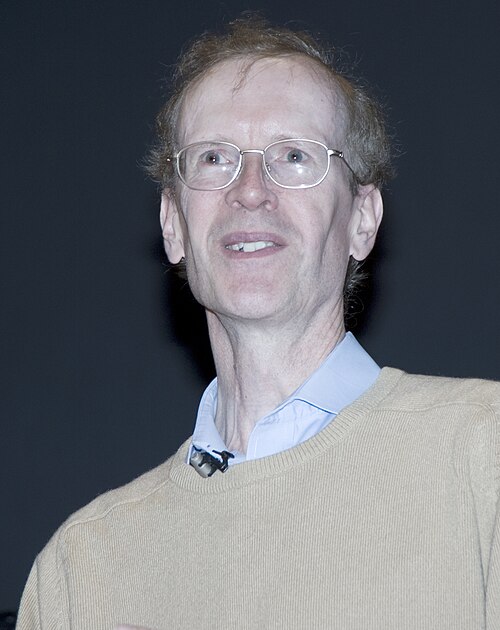
Andrew Wiles announces a proof of Fermat's Last Theorem at a conference in Cambridge, using modularity of elliptic curves. A flaw is later found and fixed with Richard Taylor's help in 1994. #mathematics #fermat
Wiles Announces Proof of Fermat's Last Theorem By "copyright C. J. Mozzochi, Princeton N.J" - http://www.mozzochi.org/deligne60/Deligne1/_DSC0024.jpg, Attribution, https://commons.wikimedia.org/w/index.php?curid=2635913
1994 CE
Wiles and Taylor Complete Proof
Andrew Wiles and Richard Taylor publish the corrected proof of Fermat's Last Theorem, establishing the modularity theorem for semistable elliptic curves. This is a landmark in number theory. #mathematics #fermat
1999 CE
Full Modularity Theorem Proved
Christophe Breuil, Brian Conrad, Fred Diamond, and Richard Taylor prove the full modularity theorem (Taniyama–Shimura conjecture), showing every elliptic curve over Q is modular. This generalizes Wiles' result. #mathematics #ellipticcurves
2002 CE
AKS Primality Test
Manindra Agrawal, Neeraj Kayal, and Nitin Saxena develop the AKS primality test, the first deterministic polynomial-time algorithm for primality testing. This is a breakthrough in computational number theory. #mathematics #primes
2004 CE
Green-Tao Theorem on Arithmetic Progressions
Ben Green and Terence Tao prove that the primes contain arbitrarily long arithmetic progressions. This result uses combinatorial number theory and ergodic theory. #mathematics #primes
2013 CE
Zhang's Bounded Gaps Between Primes
Yitang Zhang proves that there are infinitely many pairs of primes with gap less than 70 million, a breakthrough on the twin prime conjecture. This sparks rapid improvements by Polymath and others. #mathematics #primes
Zhang's Bounded Gaps Between Primes By VOA - http://www.voachinese.com/media/video/i-america-math-zhang-yitang-20131204/1803128.html, Public domain, https://commons.wikimedia.org/w/index.php?curid=33336006
2014 CE
Maynard's Improvement on Prime Gaps
James Maynard independently proves that there are infinitely many primes with bounded gaps, and shows that for any m, there are infinitely many intervals of length 600 containing m primes. #mathematics #primes )
Maynard's Improvement on Prime Gaps By Petra Lein, Copyright is MFO - Mathematisches Forschungsinstitut Oberwolfach, https://owpdb.mfo.de/detail?photo_id=18228, CC BY-SA 2.0 de, https://commons.wikimedia.org/w/index.php?curid=43553945
2015 CE
Helfgott Proves Ternary Goldbach Conjecture
Harald Helfgott proves the ternary Goldbach conjecture (every odd number > 5 is sum of three primes) using analytic number theory and extensive computation. #mathematics #goldbach
2016 CE
Polymath8 and Bounded Gaps
The Polymath8 project, led by Terence Tao, reduces the bound on gaps between primes to 246, and shows that assuming the Elliott–Halberstam conjecture, the bound can be 6. #mathematics #primes
2018 CE
Mochizuki's Inter-universal Teichmüller Theory
Shinichi Mochizuki claims a proof of the abc conjecture using his inter-universal Teichmüller theory, but the proof remains controversial and not widely accepted. #mathematics #abc
Mochizuki's Inter-universal Teichmüller Theory By George Bergman - https://opc.mfo.de/detail?photo_id=5696, GFDL 1.2, https://commons.wikimedia.org/w/index.php?curid=15783976
2020 CE
Largest Known Prime Discovered
The Great Internet Mersenne Prime Search (GIMPS) discovers the 51st known Mersenne prime, 2^82589933 - 1, with nearly 25 million digits. This continues the search for large primes. #mathematics #primes
Largest Known Prime Discovered By Nicoguaro - Own work, CC BY 4.0, https://commons.wikimedia.org/w/index.php?curid=51383347
2022 CE
Progress on Riemann Hypothesis
Researchers continue to verify zeros of the Riemann zeta function, with over 10 trillion zeros confirmed to lie on the critical line. No proof yet, but computational evidence grows. #mathematics #riemann
2023 CE
New Results on Sums of Three Cubes
Andrew Booker and Andrew Sutherland solve the Diophantine equation x^3 + y^3 + z^3 = 42, the last remaining integer solution below 100. This uses massive computation and number theory. #mathematics #diophantine
New Results on Sums of Three Cubes By Cmglee - Own work, CC BY-SA 4.0, https://commons.wikimedia.org/w/index.php?curid=78496423