Number Theory: From Sunzi's Remainder Theorem to Fermat & Wiles
Encyclopedia/1. The Cosmos & The Natural World/1. Mathematics & Formal Systems/06. Number Theory & Cryptography • Curated by Admin Timeline.sg
Number theory, the queen of mathematics, studies integers and their properties. From the Chinese Remainder Theorem to Fermat's Last Theorem, this timeline covers key milestones from 300 CE to 2000 CE.
Chronological Storyline (45 Milestones)
400 CE
Sunzi Suanjing: Chinese Remainder Theorem
The Chinese mathematical text Sunzi Suanjing contains the earliest known statement of the Chinese Remainder Theorem, solving modular systems. #NumberTheory #HistoryOfMath
Sunzi Suanjing: Chinese Remainder Theorem By AnonymousUnknown author - Own work (my book), Public domain, https://commons.wikimedia.org/w/index.php?curid=12568381
500 CE
Aryabhata's Kuttaka Method
Aryabhata describes the Kuttaka ('pulverizer') algorithm for solving linear Diophantine equations. #NumberTheory #IndianMathematics
Aryabhata's Kuttaka Method By Cpjha13 - Own work, CC BY-SA 4.0, https://commons.wikimedia.org/w/index.php?curid=49883192
628 CE
Brahmagupta on Pell's Equation
Brahmagupta's Brahmasphutasiddhanta provides the first explicit solution to Pell's equation, x^2 - Dy^2 = 1. #NumberTheory #IndianMathematics
830 CE
Al-Khwarizmi's Algebra
Muhammad ibn Musa al-Khwarizmi writes 'The Compendious Book on Calculation by Completion and Balancing', introducing algebraic methods used in number theory. #NumberTheory #IslamicGoldenAge
Al-Khwarizmi's Algebra By Zarateman - Own work, CC0, https://commons.wikimedia.org/w/index.php?curid=162213187
1000 CE
Alhazen Studies Perfect Numbers
Ibn al-Haytham (Alhazen) makes contributions to the theory of perfect numbers and congruences. #NumberTheory #IslamicScience
Alhazen Studies Perfect Numbers By Adolph Boÿ, engraved by Jeremias Falck. Used as the frontispiece to Johannes Hevelius, Selenographia, 1647 - https://www.loc.gov/resource/rbctos.2017rosen1321/?sp=9&r=0.059,0.617,0.327,0.182,0, Public domain, https://commons.wikimedia.org/w/index.php?curid=165125519
1202 CE
Fibonacci's Liber Abaci
Leonardo of Pisa (Fibonacci) publishes Liber Abaci, introducing the Fibonacci sequence and promoting modular arithmetic in Europe. #NumberTheory #HistoryOfMath
Fibonacci's Liber Abaci By Unknown author, Public domain, https://commons.wikimedia.org/w/index.php?curid=720501
1621 CE
Bachet Translates Diophantus
Claude Gaspard Bachet de Méziriac publishes a Latin translation of Diophantus's Arithmetica, which later inspires Fermat. #NumberTheory #HistoryOfMath
Bachet Translates Diophantus By Unidentified painter - (dynamische Datenbank, kein direkter Link zur Bilddatei möglich), Public domain, https://commons.wikimedia.org/w/index.php?curid=15826079
1637 CE
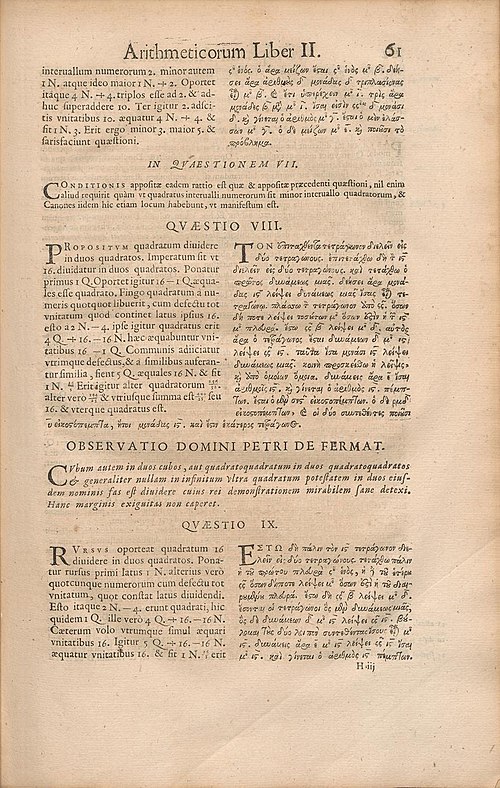
Fermat's Last Theorem Conjectured
Pierre de Fermat writes in the margin of his copy of Arithmetica that he has a proof that x^n + y^n = z^n has no integer solutions for n>2. #NumberTheory #Fermat
Fermat's Last Theorem Conjectured By Unknown author, Public domain, https://commons.wikimedia.org/w/index.php?curid=533640
1640 CE
Fermat's Little Theorem Stated
Fermat announces his little theorem: for prime p and integer a, a^p ≡ a (mod p). #NumberTheory #Fermat
1742 CE
Goldbach's Conjecture Proposed
Christian Goldbach conjectures that every even integer greater than 2 can be expressed as the sum of two primes. #NumberTheory #Conjecture
Goldbach's Conjecture Proposed By Christian Goldbach - http://www.mscs.dal.ca/~joerg/pic/g-letter.jpg, Public domain, https://commons.wikimedia.org/w/index.php?curid=1721422
1747 CE
Euler Proves Fermat's Little Theorem
Leonhard Euler provides the first published proof of Fermat's little theorem and generalizes it. #NumberTheory #Euler
Euler Proves Fermat's Little Theorem By Jakob Emanuel Handmann - This file was derived from: Leonhard Euler.jpg Edited by: Bammesk Original source: Kunstmuseum Basel, Public domain, https://commons.wikimedia.org/w/index.php?curid=113056351
1761 CE
Euler's Totient Function
Euler introduces the totient function φ(n), counting numbers coprime to n. #NumberTheory #Euler
Euler's Totient Function By Pietro Battiston (it:User:Toobaz) - Own work This W3C-unspecified plot was created with Matplotlib., CC BY-SA 4.0, https://commons.wikimedia.org/w/index.php?curid=6856451
1770 CE
Lagrange's Four-Square Theorem
Joseph-Louis Lagrange proves that every natural number is the sum of at most four squares. #NumberTheory #Lagrange
Lagrange's Four-Square Theorem By Cmglee - Own work, CC BY-SA 4.0, https://commons.wikimedia.org/w/index.php?curid=132463072
1798 CE
Legendre's Prime Number Conjecture
Adrien-Marie Legendre conjectures an approximate formula for the distribution of primes, laying groundwork for the Prime Number Theorem. #NumberTheory #PrimeNumbers
1801 CE
Gauss Publishes Disquisitiones Arithmeticae
Carl Friedrich Gauss publishes his magnum opus, establishing modern number theory. It covers modular arithmetic, quadratic reciprocity, and cyclotomic numbers. #NumberTheory #Gauss
Gauss Publishes Disquisitiones Arithmeticae By Unknown author, Public domain, https://commons.wikimedia.org/w/index.php?curid=641724
1825 CE
Dirichlet's Theorem on Arithmetic Progressions
Johann Peter Gustav Lejeune Dirichlet proves that there are infinitely many primes in any arithmetic progression a + nd with gcd(a,d)=1. #NumberTheory #Dirichlet
Dirichlet's Theorem on Arithmetic Progressions By Unknown author - http://www.york.ac.uk/depts/maths/histstat/people/, Public domain, https://commons.wikimedia.org/w/index.php?curid=2914309
1832 CE
Galois Theory of Finite Fields
Évariste Galois develops the theory of finite fields (Galois fields), essential for number theory and cryptography. #NumberTheory #Galois
1837 CE
Dirichlet Introduces L-Functions
Dirichlet introduces L-functions to prove his theorem on primes in arithmetic progressions. #NumberTheory #Dirichlet
1847 CE
Kummer's Ideal Numbers
Ernst Kummer develops ideal numbers to salvage unique factorization in cyclotomic fields, aiming to prove Fermat's Last Theorem. #NumberTheory #Kummer
Kummer's Ideal Numbers By Unknown author - https://veryimportantlot.com/fr/overview/author/artist-ernst-eduard-kummer-1810-1893#artist, Public domain, https://commons.wikimedia.org/w/index.php?curid=185413544
1850 CE
Chebyshev's Estimates on Primes
Pafnuty Chebyshev obtains bounds on the prime-counting function, giving the first significant result towards the Prime Number Theorem. #NumberTheory #Chebyshev
Chebyshev's Estimates on Primes By Dantheox (talk) (Uploads) - Own work, Public domain, https://commons.wikimedia.org/w/index.php?curid=113632968
1859 CE
Riemann Zeta Function Hypothesis
Bernhard Riemann publishes a paper on the distribution of primes, introducing the Riemann zeta function and stating the Riemann hypothesis. #NumberTheory #Riemann
Riemann Zeta Function Hypothesis By No machine-readable author provided. Conscious assumed (based on copyright claims). - No machine-readable source provided. Own work assumed (based on copyright claims)., CC BY-SA 3.0, https://commons.wikimedia.org/w/index.php?curid=939039
1863 CE
Dedekind's Theory of Ideals
Richard Dedekind introduces ideals in algebraic number theory, replacing Kummer's ideal numbers. #NumberTheory #Dedekind )
1873 CE
Hermite Proves e Transcendental
Charles Hermite proves that e, the base of natural logarithms, is transcendental, a major result in transcendentals. #NumberTheory #Transcendental
1882 CE
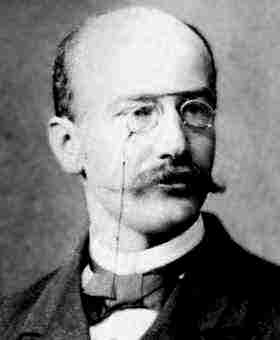
Lindemann Proves π Transcendental
Ferdinand von Lindemann proves π is transcendental, confirming that squaring the circle is impossible. #NumberTheory #Transcendental
Lindemann Proves π Transcendental By Unknown author - http://www.math.uha.fr/Pi/trans.html, Public domain, https://commons.wikimedia.org/w/index.php?curid=1060849
1896 CE
Prime Number Theorem Proved
Jacques Hadamard and Charles de la Vallée-Poussin independently prove the Prime Number Theorem using complex analysis. #NumberTheory #PrimeNumbers
1897 CE
Hensel's p-adic Numbers
Kurt Hensel introduces p-adic numbers, a powerful tool in number theory. #NumberTheory #pAdic
Hensel's p-adic Numbers By Melchoir - Own work, CC BY-SA 4.0, https://commons.wikimedia.org/w/index.php?curid=186745843
1900 CE
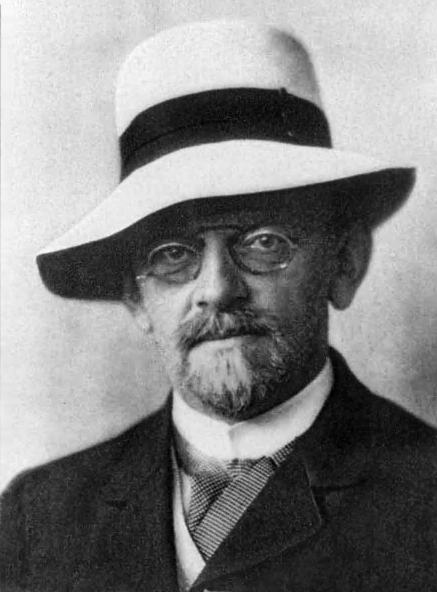
Hilbert's Problems Include Number Theory
David Hilbert presents 23 problems; among them are the Riemann hypothesis and Fermat's Last Theorem, shaping 20th-century number theory. #NumberTheory #Hilbert
Hilbert's Problems Include Number Theory By Unknown author - Possibly Reid, Constance (1970) Hilbert, Berlin, Heidelberg: Springer Berlin Heidelberg Imprint Springer, p. 230 ISBN: 978-3-662-27132-2., Public domain, https://commons.wikimedia.org/w/index.php?curid=36302
1909 CE
Hilbert Proves Waring's Problem
David Hilbert proves that for every k, there exists a number g(k) such that every integer is a sum of g(k) k-th powers. #NumberTheory #Hilbert
1913 CE
Ramanujan Writes to Hardy
Srinivasa Ramanujan sends a famous letter to G.H. Hardy containing over 100 theorems, starting a collaboration that produces major results in number theory. #NumberTheory #Ramanujan
Ramanujan Writes to Hardy By Unknown author - https://mss-cat.trin.cam.ac.uk/manuscripts/uv/view.php?n=Add.Ms.a.94.7#?c=0&m=0&s=0&cv=6&xywh=-2849%2C-273%2C9238%2C5258, CC BY 4.0, https://commons.wikimedia.org/w/index.php?curid=153767257
1918 CE
Hardy-Ramanujan Circle Method
G.H. Hardy and S. Ramanujan develop the circle method to obtain an asymptotic formula for the number of partitions. #NumberTheory #CircleMethod )
Hardy-Ramanujan Circle Method By R. A. Nonenmacher - Own work, CC BY-SA 4.0, https://commons.wikimedia.org/w/index.php?curid=4766072
1921 CE
Hardy-Littlewood Circle Method
G.H. Hardy and John Edensor Littlewood refine the circle method for additive number theory, applying it to Goldbach problems. #NumberTheory #HardyLittlewood
1930 CE
Schnirelmann's Density Theorem
Lev Schnirelmann proves that every integer can be expressed as sum of at most 300,000 primes, using density methods. #NumberTheory #Schnirelmann
1937 CE
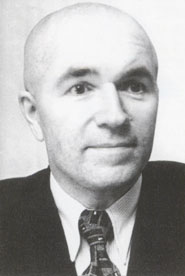
Vinogradov's Odd Goldbach Theorem
Ivan Vinogradov proves that every sufficiently large odd integer is the sum of three primes. #NumberTheory #Vinogradov
Vinogradov's Odd Goldbach Theorem By Unknown author - Original publication: Газета «Алтайская правда» №120 (7277) от 19 июня 1945 годаImmediate source: warheroes.ru, Public domain, https://commons.wikimedia.org/w/index.php?curid=95028677
1949 CE
Elementary Proof of Prime Number Theorem
Paul Erdős and Atle Selberg produce an elementary proof of the Prime Number Theorem, avoiding complex analysis. #NumberTheory #ErdosSelberg
1958 CE
Bombieri–Vinogradov Theorem
Enrico Bombieri proves the large sieve and the Bombieri–Vinogradov theorem, a fundamental result in analytic number theory. #NumberTheory #Bombieri
1966 CE
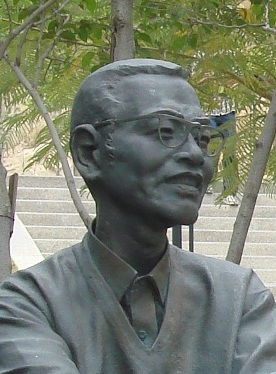
Chen's Theorem on Twin Primes
Chen Jingrun proves that every sufficiently large even integer is the sum of a prime and a product of at most two primes. #NumberTheory #Chen
Chen's Theorem on Twin Primes By user:Iamdavidtheking - File:A statue of Chen Jingrun.JPG, CC BY 3.0, https://commons.wikimedia.org/w/index.php?curid=8001620
1973 CE
Baker's Theorem on Linear Forms
Alan Baker proves effective bounds for linear forms in logarithms, with applications to Diophantine equations. #NumberTheory #Baker
1974 CE
Deligne Proves Weil Conjectures
Pierre Deligne completes the proof of the Weil conjectures, a major triumph in algebraic number theory and geometry. #NumberTheory #WeilConjectures
1983 CE
Faltings Proves Mordell's Conjecture
Gerd Faltings proves that a curve of genus at least 2 has only finitely many rational points, a result that limits solutions to many Diophantine equations. #NumberTheory #Faltings
Faltings Proves Mordell's Conjecture By Renate Schmid - https://opc.mfo.de/detail?photoID=7513, CC BY-SA 2.0 de, https://commons.wikimedia.org/w/index.php?curid=5427105
1985 CE
Taniyama–Shimura Conjecture Formalized
The Taniyama–Shimura conjecture (now modularity theorem) proposes a deep link between elliptic curves and modular forms. #NumberTheory #Modularity
1990 CE
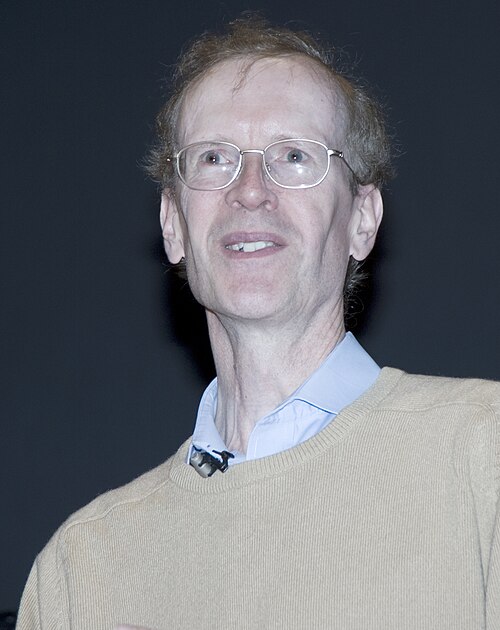
Wiles Begins Work on Fermat
Andrew Wiles begins a secret intensive effort to prove Fermat's Last Theorem, building on the Taniyama–Shimura conjecture. #NumberTheory #Fermat
Wiles Begins Work on Fermat By "copyright C. J. Mozzochi, Princeton N.J" - http://www.mozzochi.org/deligne60/Deligne1/_DSC0024.jpg, Attribution, https://commons.wikimedia.org/w/index.php?curid=2635913
Jun 23, 1993 CE
Wiles Announces Proof of Fermat's Last Theorem
Andrew Wiles announces a proof at a Cambridge conference, but a gap is later discovered. #NumberTheory #Fermat
Sep 19, 1994 CE
Wiles and Taylor Fix the Proof
Andrew Wiles and Richard Taylor fill the gap in the proof, finally proving Fermat's Last Theorem. #NumberTheory #Fermat
1995 CE
Wiles' Proof Published
Wiles' corrected proof is published in the Annals of Mathematics, solving a 350-year-old problem. #NumberTheory #Fermat
2000 CE
Riemann Hypothesis Named Millennium Problem
The Clay Mathematics Institute includes the Riemann hypothesis as one of its seven Millennium Prize Problems, offering $1 million for a proof. #NumberTheory #MillenniumProblems