Encyclopedia/2. Technology & The Built World/4. Energy & Transportation • Curated by Admin Timeline.sg
Nuclear fusion research aims to replicate the Sun's energy production on Earth, with key milestones from the Tamm-Sakharov tokamak concept to modern superconducting tokamaks and laser ignition. This timeline covers theoretical foundations, experimental devices, and recent breakthroughs in fusion energy.
Chronological Storyline (41 Milestones)
400 BCE
Democritus Proposes Atomism
Greek philosopher Democritus proposes that matter is composed of indivisible atoms, laying early groundwork for understanding nuclear processes. #science #philosophy
Democritus Proposes Atomism By user:shakko - Own work, CC BY-SA 3.0, https://commons.wikimedia.org/w/index.php?curid=5535206
1920 CE
Eddington Proposes Stellar Fusion
Arthur Eddington suggests that stars are powered by nuclear fusion of hydrogen into helium, providing the theoretical basis for fusion energy. #science #astronomy
Eddington Proposes Stellar Fusion By George Grantham Bain Collection, Library of Congress Prints and Photographs Division Washington, D.C. - This image is available from the United States Library of Congress's Prints and Photographs division under the digital ID ggbain.38064.This tag does not indicate the copyright status of the attached work. A normal copyright tag is still required. See Commons:Licensing., Public domain, https://commons.wikimedia.org/w/index.php?curid=6094619
1932 CE
Cockcroft-Walton Splits the Atom
John Cockcroft and Ernest Walton use a particle accelerator to split lithium atoms, demonstrating nuclear transformation. #physics #science
Cockcroft-Walton Splits the Atom By Kestrel - Own work, CC BY-SA 4.0, https://commons.wikimedia.org/w/index.php?curid=62252362
1934 CE
Rutherford Observes Fusion
Ernest Rutherford observes the first artificial fusion reaction by bombarding deuterium with deuterons. #physics #science
Rutherford Observes Fusion By Xiang Gao, Yao Yang, Tao Zhang, Haiqing Liu, Guoqiang Li, Tingfeng Ming, Zixi Liu, Yumin Wang, Long Zeng, Xiang Han et al. - This image has been extracted from another file, CC BY 3.0, https://commons.wikimedia.org/w/index.php?curid=85521357
1938 CE
Bethe Describes Proton-Proton Chain
Hans Bethe explains the proton-proton chain reaction that powers the Sun, winning the Nobel Prize. #science #astrophysics
Bethe Describes Proton-Proton Chain By RJHall translator: Manlleus (ca/es) - Own work. See reference below., CC BY-SA 3.0, https://commons.wikimedia.org/w/index.php?curid=5387273
Dec 2, 1942 CE
Chicago Pile-1 Goes Critical
Enrico Fermi's team achieves the first self-sustaining nuclear chain reaction, leading to nuclear power and weapons. #physics #history
Chicago Pile-1 Goes Critical By Melvin A. Miller of the Argonne National Laboratory - http://narademo.umiacs.umd.edu/cgi-bin/isadg/viewobject.pl?object=95120, Public domain, https://commons.wikimedia.org/w/index.php?curid=8147703
1946 CE
Thomson Proposes Z-Pinch
George Paget Thomson patents the Z-pinch concept for magnetic confinement fusion. #physics #fusion
Thomson Proposes Z-Pinch By Sandpiper at English Wikipedia - Own work, Public domain, https://commons.wikimedia.org/w/index.php?curid=1715259
1950 CE
Sakharov and Tamm Propose Tokamak
Andrei Sakharov and Igor Tamm propose the tokamak design for magnetic confinement fusion, using a toroidal magnetic field. #physics #fusion
Sakharov and Tamm Propose Tokamak By Chen, S., Villone, F., Xiao, B. et al. - Chen, S., Villone, F., Xiao, B. et al. 3D passive stabilization of n = 0 MHD modes in EAST tokamak. Sci Rep 6, 32440 (2016). Figure 1, CC BY 4.0, https://commons.wikimedia.org/w/index.php?curid=102602593
1951 CE
Stellarator Concept by Spitzer
Lyman Spitzer proposes the stellarator, an alternative magnetic confinement device. #physics #fusion
Stellarator Concept by Spitzer By Max-Planck Institut für Plasmaphysik, CC BY 3.0, https://commons.wikimedia.org/w/index.php?curid=24388371
Nov 1, 1952 CE
Ivy Mike Hydrogen Bomb Test
The US detonates the first thermonuclear weapon, demonstrating uncontrolled fusion. #history #weapons
Ivy Mike Hydrogen Bomb Test By USDE - Trinity and Beyond: The Atomic Bomb Movie, Public domain, https://commons.wikimedia.org/w/index.php?curid=129318165
1955 CE
ZETA Machine Begins Operation
The Zero Energy Thermonuclear Assembly (ZETA) in the UK begins experiments, initially claiming fusion neutrons. #physics #fusion )
ZETA Machine Begins Operation By Unknown UKAEA photographer - Nick Holloway, Media Manager, Communications Team, United Kingdom Atomic Energy Authority, Public domain, https://commons.wikimedia.org/w/index.php?curid=54758948
1958 CE
First Soviet Tokamak T-1
The Soviet Union builds the T-1 tokamak, the first of its kind, at the Kurchatov Institute. #physics #fusion
1968 CE
T-3 Tokamak Achieves Record Temperatures
The Soviet T-3 tokamak reaches electron temperatures of 1 keV, sparking global interest in tokamaks. #physics #fusion
1970 CE
Laser Fusion Proposed by Nuckolls
John Nuckolls proposes using lasers to compress fusion fuel, initiating inertial confinement fusion research. #physics #fusion
Laser Fusion Proposed by Nuckolls By Unknown author - Taken from Lawrence Livermore National Laboratory July/August 1999 Science & Technology Review publication. [1], Public domain, https://commons.wikimedia.org/w/index.php?curid=890622
1973 CE
PLT Tokamak Begins Operation
The Princeton Large Torus (PLT) starts operation, later achieving record ion temperatures. #physics #fusion
PLT Tokamak Begins Operation By Princeton Plasma Physics Laboratory - https://twitter.com/ppplab/status/822082438859894786, Public domain, https://commons.wikimedia.org/w/index.php?curid=75059051
1978 CE
TFTR Construction Approved
The US approves construction of the Tokamak Fusion Test Reactor (TFTR) at Princeton. #physics #fusion
TFTR Construction Approved By Princeton Plasma Physics Laboratory - Private communication with Princton's Information Services Office, CC BY 3.0, https://commons.wikimedia.org/w/index.php?curid=7676534
1980 CE
JET Project Approved
The European Community approves the Joint European Torus (JET) project, the largest tokamak at the time. #physics #fusion
1983 CE
JET Begins Operation
JET starts plasma experiments in the UK, becoming the world's largest tokamak. #physics #fusion
1985 CE
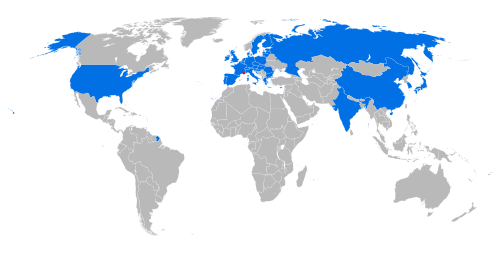
ITER Conceptual Design Begins
The International Thermonuclear Experimental Reactor (ITER) project is launched as a collaboration between the US, USSR, EU, and Japan. #physics #fusion
ITER Conceptual Design Begins By Rfassbind - Own work., Public domain, https://commons.wikimedia.org/w/index.php?curid=32503440
1986 CE
JT-60 Tokamak Starts in Japan
Japan's JT-60 tokamak begins operation, later achieving high plasma performance. #physics #fusion
Nov 9, 1991 CE
JET Produces First Controlled Fusion Power
JET generates 1.7 MW of fusion power using a deuterium-tritium mixture, a world first. #physics #fusion
1993 CE
TFTR Achieves 10 MW Fusion Power
The Tokamak Fusion Test Reactor produces 10.7 MW of fusion power, a record at the time. #physics #fusion
1997 CE
JET Sets Fusion Power Record of 16 MW
JET achieves 16 MW of fusion power with a Q value of 0.62, the highest for a tokamak. #physics #fusion
1998 CE
JT-60 Achieves Q=1.25 Equivalent
JT-60 achieves a fusion triple product equivalent to Q=1.25, demonstrating break-even conditions. #physics #fusion
2003 CE
China Joins ITER Project
China becomes a full member of the ITER project, contributing to the international fusion effort. #physics #fusion
2006 CE
EAST Tokamak Achieves First Plasma
China's Experimental Advanced Superconducting Tokamak (EAST) achieves its first plasma, the first superconducting tokamak. #physics #fusion
2007 CE
ITER Construction Officially Begins
The ITER organization is established and construction of the reactor in Cadarache, France, begins. #physics #fusion
2009 CE
NIF Laser Facility Completed
The National Ignition Facility (NIF) at Lawrence Livermore National Laboratory is completed, aiming for laser fusion ignition. #physics #fusion
NIF Laser Facility Completed By Lawrence Livermore National Security - Own work, CC BY-SA 3.0, https://commons.wikimedia.org/w/index.php?curid=19898650
2010 CE
KSTAR Achieves First Plasma
South Korea's KSTAR superconducting tokamak achieves first plasma, contributing to fusion research. #physics #fusion
KSTAR Achieves First Plasma By Michel Maccagnan - Own work, CC BY-SA 3.0, https://commons.wikimedia.org/w/index.php?curid=3083238
2012 CE
Wendelstein 7-X Stellarator Completed
Germany's Wendelstein 7-X stellarator, the largest of its kind, is completed to test advanced magnetic confinement. #physics #fusion
Wendelstein 7-X Stellarator Completed By Max-Planck-Institut für Plasmaphysik, Tino Schulz - Public Relations Department, Max-Planck-Institut, CC BY-SA 3.0, https://commons.wikimedia.org/w/index.php?curid=25105258
2013 CE
EAST Achieves 100 Million Degrees
China's EAST tokamak reaches plasma temperatures over 100 million degrees Celsius. #physics #fusion
2015 CE
Wendelstein 7-X Produces First Plasma
The Wendelstein 7-X stellarator produces its first helium plasma, validating its design. #physics #fusion
2016 CE
ITER Tokamak Assembly Begins
Assembly of the ITER tokamak starts, with components arriving from around the world. #physics #fusion
2017 CE
EAST Sets 100-Second Plasma Record
EAST sustains a plasma for over 100 seconds at high temperature, a milestone for steady-state operation. #physics #fusion
2018 CE
KSTAR Sustains 100 Million Degrees for 1.5 Seconds
KSTAR achieves a plasma temperature of 100 million degrees Celsius for 1.5 seconds. #physics #fusion
2020 CE
KSTAR Sustains 20-Second Plasma at 100 Million Degrees
KSTAR maintains a 100 million degree plasma for 20 seconds, advancing long-pulse operation. #physics #fusion
Dec 30, 2021 CE
EAST Sustains 1056-Second Plasma
EAST sets a world record by sustaining a plasma for 1056 seconds, demonstrating long-pulse capability. #physics #fusion
Dec 13, 2022 CE
NIF Achieves Net Energy Gain
The National Ignition Facility achieves a net energy gain in a fusion reaction for the first time, producing 3.15 MJ from 2.05 MJ input. #physics #fusion
2023 CE
JET Final Deuterium-Tritium Experiments
JET conducts its final D-T experiments, producing a record 69 MJ of fusion energy over 5 seconds. #physics #fusion
2024 CE
ITER First Plasma Delayed to 2035
ITER announces a revised schedule with first plasma now expected in 2035 due to technical challenges. #physics #fusion
2025 CE
SPARC Tokamak Construction Advances
Commonwealth Fusion Systems' SPARC tokamak, using high-temperature superconductors, progresses toward first plasma. #physics #fusion )
SPARC Tokamak Construction Advances By Ken Filar - Own work, CC BY-SA 4.0, https://commons.wikimedia.org/w/index.php?curid=66280635