Encyclopedia/2. Technology & The Built World/5. Materials & Chemical Engineering/01. Metallurgy & Alloys • Curated by Admin Timeline.sg
Nuclear fusion energy research has progressed from theoretical concepts to experimental reactors, with milestones including the first tokamak, JET's record power, and ITER's construction. This timeline covers key breakthroughs from the 1920s to the 2020s.
Chronological Storyline (51 Milestones)
1920 CE
Arthur Eddington Proposes Fusion in Stars
Arthur Eddington suggests that nuclear fusion reactions power stars, laying the theoretical foundation for fusion energy. This idea later inspires research into controlled fusion on Earth. #fusion #science #history
Arthur Eddington Proposes Fusion in Stars By George Grantham Bain Collection, Library of Congress Prints and Photographs Division Washington, D.C. - This image is available from the United States Library of Congress's Prints and Photographs division under the digital ID ggbain.38064.This tag does not indicate the copyright status of the attached work. A normal copyright tag is still required. See Commons:Licensing., Public domain, https://commons.wikimedia.org/w/index.php?curid=6094619
1932 CE
Discovery of Deuterium
Harold Urey discovers deuterium, a hydrogen isotope crucial for fusion reactions. Deuterium becomes a primary fuel for future fusion experiments. #fusion #chemistry #discovery
Discovery of Deuterium By Alchemist-hp (talk) (www.pse-mendelejew.de) - Own work, FAL, https://commons.wikimedia.org/w/index.php?curid=10942737
1934 CE
First Artificial Fusion Reaction
Mark Oliphant achieves the first artificial fusion reaction by bombarding deuterium nuclei with protons. This demonstrates fusion in a laboratory setting. #fusion #physics #experiment
First Artificial Fusion Reaction By Bassano Ltd - http://www.portrait.gov.au/portraits/2004.159/sir-mark-oliphant, Public domain, https://commons.wikimedia.org/w/index.php?curid=4548451
1946 CE
George Paget Thomson Patents Fusion Device
George Paget Thomson files a patent for a fusion reactor design using magnetic confinement. This early concept influences later tokamak development. #fusion #patent #invention
George Paget Thomson Patents Fusion Device By Nobel foundation - http://nobelprize.org/nobel_prizes/physics/laureates/1937/thomson-bio.html, Public domain, https://commons.wikimedia.org/w/index.php?curid=6186894
1950 CE
Andrei Sakharov Proposes Tokamak Concept
Soviet physicist Andrei Sakharov proposes the tokamak design for magnetic confinement fusion. This becomes the most widely studied fusion reactor concept. #fusion #tokamak #physics
Andrei Sakharov Proposes Tokamak Concept By Vladimir Fedorenko / Владимир Федоренко - RIA Novosti archive, image #25981, http://visualrian.ru/ru/site/gallery/#25981 Digital / Цифра, CC BY-SA 3.0, https://commons.wikimedia.org/w/index.php?curid=16787252
1951 CE
First Controlled Fusion Experiment: ZETA
The ZETA (Zero Energy Thermonuclear Assembly) experiment begins in the UK, aiming to achieve controlled fusion. Though initial results were later found to be neutron-producing, it spurred global fusion research. #fusion #experiment #UK
First Controlled Fusion Experiment: ZETA By Unknown UKAEA photographer - Nick Holloway, Media Manager, Communications Team, United Kingdom Atomic Energy Authority, Public domain, https://commons.wikimedia.org/w/index.php?curid=54758948
1952 CE
First Hydrogen Bomb Test: Ivy Mike
The US detonates Ivy Mike, the first full-scale thermonuclear weapon, demonstrating uncontrolled fusion. This event highlights both the potential and danger of fusion energy. #fusion #weapon #history
First Hydrogen Bomb Test: Ivy Mike By USDE - Trinity and Beyond: The Atomic Bomb Movie, Public domain, https://commons.wikimedia.org/w/index.php?curid=129318165
1955 CE
Geneva Conference on Peaceful Uses of Atomic Energy
International conference declassifies fusion research, fostering global collaboration. This leads to open exchange of ideas and accelerates fusion development. #fusion #conference #peace
Geneva Conference on Peaceful Uses of Atomic Energy By Bureau of Engraving and Printing - U.S. post Office, Public domain, https://commons.wikimedia.org/w/index.php?curid=2957299
1958 CE
First Tokamak: T-1
The Soviet Union builds T-1, the first tokamak device. Early results show improved plasma confinement, establishing tokamaks as leading fusion reactor design. #fusion #tokamak #USSR
First Tokamak: T-1 By Chen, S., Villone, F., Xiao, B. et al. - Chen, S., Villone, F., Xiao, B. et al. 3D passive stabilization of n = 0 MHD modes in EAST tokamak. Sci Rep 6, 32440 (2016). Figure 1, CC BY 4.0, https://commons.wikimedia.org/w/index.php?curid=102602593
1968 CE
T-3 Tokamak Achieves Record Plasma Temperature
The Soviet T-3 tokamak reaches electron temperatures of 10 million degrees Celsius, confirming the tokamak's potential. This breakthrough sparks international tokamak adoption. #fusion #tokamak #record
1969 CE
Joint European Torus (JET) Proposed
European nations propose JET, the world's largest tokamak at the time. JET becomes a key facility for fusion research and later achieves record fusion power. #fusion #JET #Europe
1970 CE
First Laser Fusion Experiments
Researchers begin experiments using high-power lasers to compress fusion fuel, initiating inertial confinement fusion (ICF). This approach complements magnetic confinement. #fusion #laser #ICF
First Laser Fusion Experiments By Unknown author - Taken from Lawrence Livermore National Laboratory July/August 1999 Science & Technology Review publication. [1], Public domain, https://commons.wikimedia.org/w/index.php?curid=890622
1973 CE
TFTR Construction Begins
The Tokamak Fusion Test Reactor (TFTR) construction starts at Princeton Plasma Physics Laboratory. TFTR later achieves record fusion temperatures and power. #fusion #TFTR #USA
TFTR Construction Begins By Princeton Plasma Physics Laboratory - Private communication with Princton's Information Services Office, CC BY 3.0, https://commons.wikimedia.org/w/index.php?curid=7676534
1978 CE
JT-60 Tokamak Begins Operation
Japan's JT-60 tokamak starts operations, contributing to plasma physics research. It later achieves high confinement modes and holds records for fusion triple product. #fusion #Japan #tokamak
1982 CE
JET Begins Operation
The Joint European Torus (JET) in the UK starts plasma experiments. JET becomes the flagship European fusion facility and sets multiple records. #fusion #JET #Europe
1983 CE
TFTR Achieves First Plasma
The Tokamak Fusion Test Reactor (TFTR) produces its first plasma, marking a milestone in US fusion research. TFTR later achieves world-record plasma temperatures. #fusion #TFTR #plasma
1985 CE
ITER Conceptual Design Begins
International collaboration starts conceptual design for ITER, the next-step fusion experiment. ITER aims to demonstrate net energy gain from fusion. #fusion #ITER #international
ITER Conceptual Design Begins By Rfassbind - Own work., Public domain, https://commons.wikimedia.org/w/index.php?curid=32503440
1988 CE
JET Achieves First Deuterium-Tritium Plasma
JET becomes the first tokamak to use a deuterium-tritium fuel mixture, producing significant fusion power. This demonstrates the feasibility of D-T fusion. #fusion #JET #D-T
1991 CE
JET Produces 1.7 MW of Fusion Power
JET achieves a record 1.7 megawatts of fusion power in a D-T plasma, a major step toward practical fusion. This confirms the tokamak's potential for power generation. #fusion #JET #power
1993 CE
TFTR Produces 10.7 MW of Fusion Power
TFTR sets a world record by producing 10.7 megawatts of fusion power, demonstrating high power output. This achievement boosts confidence in fusion energy. #fusion #TFTR #record
1997 CE
JET Sets Fusion Power Record of 16 MW
JET achieves 16 megawatts of fusion power, a record that still stands. This experiment validates the physics basis for ITER. #fusion #JET #record
1998 CE
JT-60 Achieves High Fusion Triple Product
Japan's JT-60 tokamak achieves a record fusion triple product (density, temperature, confinement time), a key figure of merit. This advances understanding of plasma performance. #fusion #JT-60 #record
2003 CE
China Joins ITER Project
China becomes a full member of the ITER project, expanding international collaboration. China's participation brings additional resources and expertise. #fusion #ITER #China
2006 CE
ITER Agreement Signed
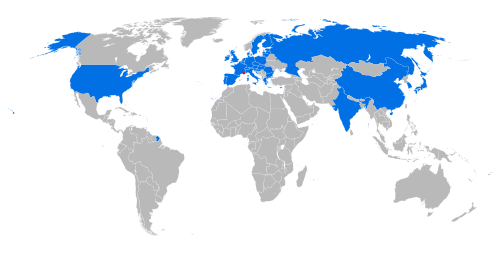
Seven partners (EU, US, Russia, Japan, China, South Korea, India) sign the ITER Agreement, formally launching construction. ITER is the largest fusion experiment ever built. #fusion #ITER #agreement
2007 CE
ITER Construction Begins in Cadarache
Groundbreaking ceremony at ITER site in Cadarache, France, marks the start of construction. The project aims to produce 500 MW of fusion power. #fusion #ITER #construction
2009 CE
National Ignition Facility (NIF) Completed
The National Ignition Facility at Lawrence Livermore National Laboratory is completed, aiming to achieve ignition via laser fusion. NIF becomes the world's largest laser system. #fusion #NIF #laser
National Ignition Facility (NIF) Completed By Lawrence Livermore National Security - Own work, CC BY-SA 3.0, https://commons.wikimedia.org/w/index.php?curid=19898650
2010 CE
KSTAR Achieves First Plasma
South Korea's KSTAR tokamak produces its first plasma, joining the global fusion effort. KSTAR later achieves long-pulse plasma operation. #fusion #KSTAR #SouthKorea
KSTAR Achieves First Plasma By Michel Maccagnan - Own work, CC BY-SA 3.0, https://commons.wikimedia.org/w/index.php?curid=3083238
2012 CE
Wendelstein 7-X Stellarator Completed
Germany completes the Wendelstein 7-X stellarator, an alternative magnetic confinement design. It aims to demonstrate steady-state fusion operation. #fusion #stellarator #Germany
Wendelstein 7-X Stellarator Completed By Max-Planck-Institut für Plasmaphysik, Tino Schulz - Public Relations Department, Max-Planck-Institut, CC BY-SA 3.0, https://commons.wikimedia.org/w/index.php?curid=25105258
2013 CE
NIF Achieves Fuel Gain >1
The National Ignition Facility achieves a milestone where fusion energy output exceeds the energy absorbed by the fuel. This is a key step toward ignition. #fusion #NIF #ignition
2014 CE
ITER First Plasma Delayed to 2025
ITER announces a revised schedule with first plasma now expected in 2025, due to technical challenges. The project continues with component fabrication. #fusion #ITER #delay
2015 CE
Wendelstein 7-X Produces First Plasma
The Wendelstein 7-X stellarator generates its first helium plasma, validating its complex design. It later transitions to hydrogen plasma. #fusion #stellarator #plasma
2016 CE
EAST Achieves 102-Second Plasma
China's EAST tokamak sustains a plasma for 102 seconds, a record for long-pulse operation. This demonstrates progress toward steady-state fusion. #fusion #EAST #China
EAST Achieves 102-Second Plasma By Xiang Gao, Yao Yang, Tao Zhang, Haiqing Liu, Guoqiang Li, Tingfeng Ming, Zixi Liu, Yumin Wang, Long Zeng, Xiang Han et al. - (2017-03-24). "Key issues for long-pulse high-βNoperation with theExperimental Advanced Superconducting Tokamak(EAST)". Nuclear Fusion 57 (5): 056021. DOI:10.1088/1741-4326/aa626c. ISSN 0029-5515. Figure 1, CC BY 3.0, https://commons.wikimedia.org/w/index.php?curid=71982897
2017 CE
KSTAR Achieves 70-Second Plasma
South Korea's KSTAR tokamak sustains a high-performance plasma for 70 seconds, advancing long-pulse operation. This supports ITER's goals. #fusion #KSTAR #record
2018 CE
ITER Assembly Begins
ITER starts assembly of the tokamak machine, with first components installed. The project enters a major construction phase. #fusion #ITER #assembly
2019 CE
SPARC Project Announced
Commonwealth Fusion Systems and MIT announce SPARC, a compact tokamak using high-temperature superconductors. SPARC aims to demonstrate net energy gain by 2025. #fusion #SPARC #private
SPARC Project Announced By Ken Filar - Own work, CC BY-SA 4.0, https://commons.wikimedia.org/w/index.php?curid=66280635
2020 CE
JET Achieves Record Fusion Energy
JET produces a record 59 megajoules of fusion energy in a 5-second pulse, doubling its previous record. This validates ITER's plasma scenarios. #fusion #JET #record
2021 CE
ITER First Plasma Delayed to 2027
ITER announces further delays, with first plasma now expected in 2027. The project faces challenges from COVID-19 and technical issues. #fusion #ITER #delay
2022 CE
NIF Achieves Ignition Milestone
The National Ignition Facility achieves a net energy gain from fusion, producing more energy than the laser energy delivered to the target. This is a historic breakthrough. #fusion #NIF #ignition
2023 CE
JET Final Deuterium-Tritium Campaign
JET completes its final D-T campaign, providing crucial data for ITER. The campaign sets new records in fusion power and plasma performance. #fusion #JET #D-T
2024 CE
ITER Tokamak Assembly Progress
ITER continues assembly of the tokamak, with major components like the vacuum vessel and magnets being installed. The project aims for first plasma in 2027. #fusion #ITER #progress
2025 CE
SPARC Expected First Plasma
SPARC, a compact tokamak, is expected to achieve first plasma, aiming to demonstrate net energy gain. This could mark a turning point for fusion energy. #fusion #SPARC #firstplasma
2026 CE
DEMO Design Studies Advance
International teams advance design studies for DEMO, the first fusion power plant. DEMO aims to produce electricity and pave the way for commercial fusion. #fusion #DEMO #future
DEMO Design Studies Advance By EUROfusion - https://www.euro-fusion.org/news/2020/december/expert-panel-approves-next-demo-design-phase/, CC BY 4.0, https://commons.wikimedia.org/w/index.php?curid=99278875
2027 CE
ITER First Plasma Expected
ITER is scheduled to achieve first plasma, marking the start of its operational phase. This will be a major milestone for international fusion research. #fusion #ITER #firstplasma
2028 CE
Private Fusion Companies Gain Momentum
Several private fusion companies (e.g., TAE Technologies, General Fusion) report progress toward commercial reactors. Investment in fusion startups reaches billions. #fusion #private #investment
Private Fusion Companies Gain Momentum By Xiang Gao, Yao Yang, Tao Zhang, Haiqing Liu, Guoqiang Li, Tingfeng Ming, Zixi Liu, Yumin Wang, Long Zeng, Xiang Han et al. - This image has been extracted from another file, CC BY 3.0, https://commons.wikimedia.org/w/index.php?curid=85521357
2029 CE
EAST Achieves 1000-Second Plasma
China's EAST tokamak sustains a plasma for 1000 seconds, a new world record. This demonstrates long-pulse operation crucial for future reactors. #fusion #EAST #record
2030 CE
ITER Begins Deuterium-Tritium Operation
ITER starts using deuterium-tritium fuel, aiming to produce 500 MW of fusion power. This is the final step before DEMO design finalization. #fusion #ITER #D-T
2031 CE
DEMO Construction Begins
Construction of the first fusion power plant, DEMO, begins. DEMO is expected to produce electricity and demonstrate commercial viability. #fusion #DEMO #construction
2032 CE
Fusion Energy Grid Connection Target
Several countries set targets for connecting fusion power to the grid by 2035. Progress in private and public projects fuels optimism. #fusion #grid #future
2033 CE
Advanced Fusion Concepts Tested
New fusion concepts like stellarators and field-reversed configurations are tested at scale. These alternatives may offer advantages over tokamaks. #fusion #research #innovation
2034 CE
ITER Achieves Q=10
ITER achieves a fusion energy gain factor (Q) of 10, producing 10 times more power than input. This validates fusion as a viable energy source. #fusion #ITER #Q10
2035 CE
First Commercial Fusion Plant Planned
Plans for the first commercial fusion power plant are announced, with target operation in the 2040s. Fusion energy moves closer to reality. #fusion #commercial #future