Encyclopedia/1. The Cosmos & The Natural World/1. Mathematics & Formal Systems/01. Geometry & Spatial Systems • Curated by Admin Timeline.sg
Non-Euclidean geometry emerged from centuries of attempts to prove Euclid's parallel postulate, leading to the development of hyperbolic and elliptic geometries in the 19th century. These geometries fundamentally changed mathematics and later became the mathematical foundation for Einstein's general theory of relativity, describing the curvature of spacetime.
Chronological Storyline (44 Milestones)
300 BCE
Euclid Writes Elements
Euclid's Elements axiomatizes geometry, defining the parallel postulate that would challenge mathematicians for two millennia. #geometry #history
Euclid Writes Elements By University of Pennsylvania Museum of Archaeology and Anthropology - https://openn.library.upenn.edu/Data/0016/html/e2748.html, CC BY-SA 4.0, https://commons.wikimedia.org/w/index.php?curid=169166171
850 CE
Thābit ibn Qurra Studies Parallel Lines
Thābit ibn Qurra translates Euclid and attempts to prove the parallel postulate, advancing Islamic geometry. #mathematics #islamicgoldenage
1021 CE
Ibn al-Haytham Attempts Euclidean Proof
Ibn al-Haytham (Alhazen) studies the parallel postulate, introducing the concept of 'motion' in geometric proofs. #geometry #optics
Ibn al-Haytham Attempts Euclidean Proof By Adolph Boÿ, engraved by Jeremias Falck. Used as the frontispiece to Johannes Hevelius, Selenographia, 1647 - https://www.loc.gov/resource/rbctos.2017rosen1321/?sp=9&r=0.059,0.617,0.327,0.182,0, Public domain, https://commons.wikimedia.org/w/index.php?curid=165125519
1077 CE
Omar Khayyám's Discussion of Parallels
Persian mathematician Omar Khayyám writes a treatise on the parallel postulate, recognizing that alternatives could lead to other geometries. #mathematics #persian
Omar Khayyám's Discussion of Parallels By Alireza Javaheri - https://web.archive.org/web/20161024154356/http://www.panoramio.com/photo/85093358, CC BY 3.0, https://commons.wikimedia.org/w/index.php?curid=55909539
1247 CE
Nasir al-Din al-Tusi on Parallels
Al-Tusi produces a sophisticated critique of the parallel postulate, laying groundwork for non-Euclidean geometry. #mathematics #islamic
Nasir al-Din al-Tusi on Parallels By Unknown author - scan of stamp 30 May 2006, Public domain, https://commons.wikimedia.org/w/index.php?curid=829461
1733 CE
Saccheri's Euclides ab Omni Naevo Vindicatus
Giovanni Saccheri attempts to prove the parallel postulate by contradiction, unknowingly deriving theorems of hyperbolic geometry. #geometry #nonEuclidean
Saccheri's Euclides ab Omni Naevo Vindicatus By Girolamo Saccheri (book author) - Girolamo Saccheri Euclide Ab Omni Naevo Vindicatus, Public domain, https://commons.wikimedia.org/w/index.php?curid=680440
1763 CE
Klügel Reviews Parallel Postulate Proofs
Georg Klügel's doctoral dissertation concludes that many attempted proofs of the parallel postulate are flawed, highlighting the need for a new geometry. #mathematics
Klügel Reviews Parallel Postulate Proofs By Gottlob August Liebe / Jakob Rieter - portraitindex.de, Public domain, https://commons.wikimedia.org/w/index.php?curid=30373391
1795 CE
Legendre's Elements of Geometry
Adrien-Marie Legendre attempts to prove the parallel postulate in his textbooks, failing and thereby stimulating further investigations. #geometry
Legendre's Elements of Geometry By Julien-Léopold Boilly - https://www.numericana.com/answer/record.htm#legendre where it was cropped from here, Public domain, https://commons.wikimedia.org/w/index.php?curid=6092195
1817 CE
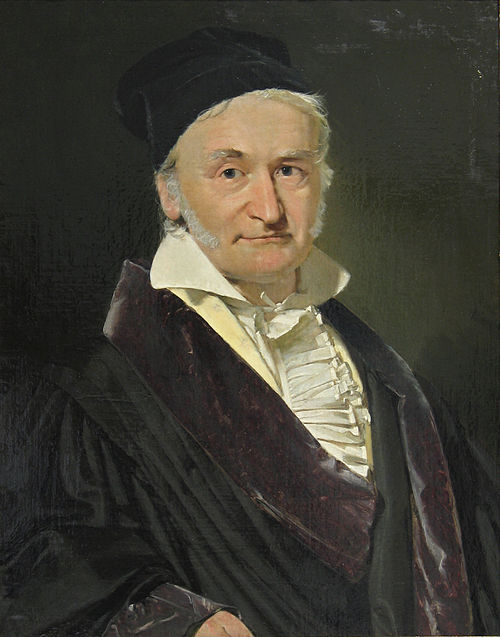
Gauss's Private Thoughts on Non-Euclidean Geometry
Carl Friedrich Gauss writes to his friend Taurinus about his work on a geometry where the parallel postulate does not hold, but declines to publish. #mathematics #gauss
Gauss's Private Thoughts on Non-Euclidean Geometry By Christian Albrecht Jensen - http://archiv.bbaw.de/archiv/archivbestaende/abteilung-sammlungen/gesamtbestand-des-kunstbesitzes/gelehrtengemaelde/gelehrtengemalde-seiten/ZIMM-0001.html, Public domain, https://commons.wikimedia.org/w/index.php?curid=6886354
1823 CE
Bolyai Discusses Non-Euclidean Geometry with His Father
János Bolyai writes to his father about his discovery of a 'strange new universe' via non-Euclidean geometry. #history #mathematics
Bolyai Discusses Non-Euclidean Geometry with His Father By Ferenc Márkos - Transferred from hu.wikipedia to Commons by Tambo., CC BY-SA 3.0, https://commons.wikimedia.org/w/index.php?curid=24338736
1826 CE
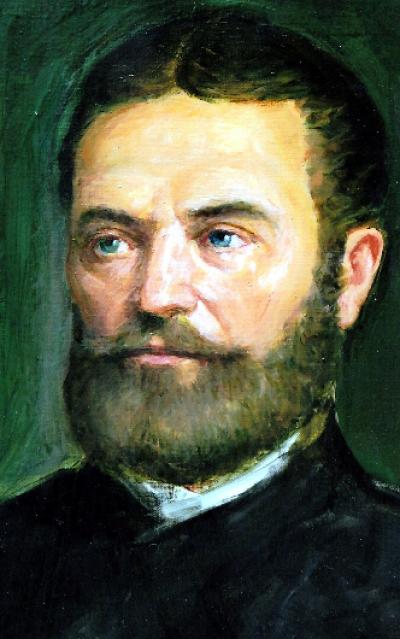
Lobachevsky's First Presentation of Non-Euclidean Geometry
Nikolai Lobachevsky gives a lecture at Kazan University outlining a new geometry independent of the parallel postulate. #nonEuclidean #mathematics
Lobachevsky's First Presentation of Non-Euclidean Geometry By Lev Kryukov - http://cczy.blog.ru/?year=2009&month=11, Public domain, https://commons.wikimedia.org/w/index.php?curid=12821190
1829 CE
Lobachevsky Publishes On the Principles of Geometry
Lobachevsky publishes his work on hyperbolic geometry in the Kazan Messenger, the first printed exposition of non-Euclidean geometry. #mathematics #history
1832 CE
Bolyai's Appendix on Absolute Geometry
János Bolyai publishes his 'Appendix Explaining the Absolutely True Science of Space', independent of Lobachevsky's work. #geometry #nonEuclidean
1840 CE
Lobachevsky's Geometrical Researches in German
Lobachevsky's book Geometrical Researches on the Theory of Parallels brings non-Euclidean geometry to a wider European audience. #mathematics #publication
Jun 10, 1854 CE
Riemann's Lecture on the Hypotheses of Geometry
Bernhard Riemann presents his habilitation lecture on the foundations of geometry, introducing Riemannian geometry and the concept of curved space. #geometry #curvedspace
Riemann's Lecture on the Hypotheses of Geometry By Unknown author - http://www.sil.si.edu/digitalcollections/hst/scientific-identity/explore.htm according to the German Wikipedia., Public domain, https://commons.wikimedia.org/w/index.php?curid=27383
1868 CE
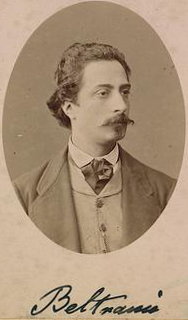
Beltrami's Models of Hyperbolic Geometry
Eugenio Beltrami publishes papers providing concrete Euclidean models (pseudosphere and disk) that establish the consistency of hyperbolic geometry. #hyperbolic #geometry
Beltrami's Models of Hyperbolic Geometry By Unknown author, Public domain, https://commons.wikimedia.org/w/index.php?curid=2094478
1870 CE
Klein's Erlangen Program Formalizes Geometries
Felix Klein's Erlangen Program classifies geometries based on symmetry groups, placing non-Euclidean geometries within a unified framework. #mathematics #classification
Klein's Erlangen Program Formalizes Geometries By Unknown author, Public domain, https://commons.wikimedia.org/w/index.php?curid=38617
1882 CE
Poincaré Introduces the Hyperbolic Disk Model
Henri Poincaré develops the conformal disk model of hyperbolic geometry, linking it to automorphic functions. #hyperbolic #math
Poincaré Introduces the Hyperbolic Disk Model By Trevorgoodchild - Own work, Public domain, https://commons.wikimedia.org/w/index.php?curid=36685779
1905 CE
Einstein's Special Relativity
Albert Einstein publishes special relativity, laying the groundwork for a four-dimensional spacetime geometry. #relativity #physics
Einstein's Special Relativity By Lucien Chavan [1] (1868 - 1942), a friend of Einstein's when he was living in Berne. - Cropped from original at the The Albert Einstein Archives, The Hebrew University of Jerusalem., Public domain, https://commons.wikimedia.org/w/index.php?curid=16699199
1908 CE
Minkowski's Spacetime Formulation
Hermann Minkowski elegantly reformulates special relativity in terms of a four-dimensional non-Euclidean spacetime geometry. #spacetime #geometry
Minkowski's Spacetime Formulation By Hermann Minkowski - scan from original book, Public domain, https://commons.wikimedia.org/w/index.php?curid=2956997
Nov 25, 1915 CE
Einstein Formulates General Relativity
Einstein presents the final field equations of general relativity, describing gravity as curvature of spacetime. #generalrelativity #curvedspace
Einstein Formulates General Relativity By Simulating eXtreme Spacetimes Lensing (SXS) - https://www.ligo.caltech.edu/video/ligo20160211v3 (video link); see also http://www.black-holes.org/gw150914, CC BY-SA 4.0, https://commons.wikimedia.org/w/index.php?curid=46994894
1916 CE
Schwarzschild Solves the Einstein Equations
Karl Schwarzschild obtains the first exact solution to Einstein's field equations, predicting black holes. #blackholes #physics
1917 CE
De Sitter Universe Model
Willem de Sitter proposes an expanding universe model without matter, based on general relativity. #cosmology #universe
De Sitter Universe Model By NASA / WMAP Science Team - http://map.gsfc.nasa.gov/media/121238/ilc_9yr_moll4096.png, Public domain, https://commons.wikimedia.org/w/index.php?curid=23285693
1917 CE
Einstein Adds Cosmological Constant
Einstein introduces the cosmological constant to his equations to allow a static universe, a step later linked to dark energy. #cosmology #cosmologicalconstant
Einstein Adds Cosmological Constant By NASA/WMAP Science Team - Original version: NASA; modified by Cherkash, Public domain, https://commons.wikimedia.org/w/index.php?curid=11885244
May 29, 1919 CE
Eddington Expedition Confirms General Relativity
Arthur Eddington's expedition to Príncipe Island measures the bending of starlight by the Sun, providing the first observational confirmation of general relativity. #relativity #astronomy
Eddington Expedition Confirms General Relativity By ESO/Landessternwarte Heidelberg-Königstuhl/F. W. Dyson, A. S. Eddington, & C. Davidson - https://www.eso.org/public/images/potw1926a/, CC BY 4.0, https://commons.wikimedia.org/w/index.php?curid=80091497
1922 CE
Friedmann's Expanding Universe Equations
Alexander Friedmann derives the Friedmann equations from general relativity, describing an expanding universe. #cosmology #expansion
1927 CE
Lemaître Proposes Expanding Universe
Georges Lemaître independently derives the expansion of the universe from Einstein's equations, anticipating Hubble's later observations. #cosmology #bigbang
Lemaître Proposes Expanding Universe By Unknown author - https://societyforthehistoryofastronomy.com/wp-content/uploads/2023/01/AA14-June-20.pdf, Public domain, https://commons.wikimedia.org/w/index.php?curid=154504242
1929 CE
Hubble Proves the Universe is Expanding
Edwin Hubble's observations of galactic redshifts provide experimental evidence for the expansion of the universe, confirming Friedmann's predictions. #astronomy #cosmology
Hubble Proves the Universe is Expanding By w:en:User:ScienceApologist - This image was copied from wikipedia:en. The original description was: The raisin bread model of the universe explains how each galaxy can perceive every other galaxy in the universe as receding from it. From the WMAP website., Public domain, https://commons.wikimedia.org/w/index.php?curid=2615116
1931 CE
Lemaître Proposes the Primeval Atom
Georges Lemaître proposes the 'primeval atom' hypothesis, what would later be called the Big Bang. #bigbang #cosmology
1936 CE
Robertson and Walker Formalize Metric
Howard Robertson and Arthur Walker independently develop the metric for a homogeneous, isotropic expanding universe, now called the FLRW metric. #cosmology #metric
1949 CE
Gödel Discovers Rotating Universe Solutions
Kurt Gödel finds a solution to Einstein's equations with rotating matter, allowing closed timelike curves and challenging notions of time. #relativity #time
1955 CE
Wheeler Coins 'Black Hole' and Geometrodynamics
John Archibald Wheeler popularizes the term black hole and develops geometrodynamics, the study of gravitational phenomena as pure geometry. #blackhole #geometry
Wheeler Coins 'Black Hole' and Geometrodynamics By AIP Emilio Segrè Visual Archives, Wheeler Collection - https://repository.aip.org/john-archibald-wheeler-lecturing-beyond-end-time-university-missouri, Attribution, https://commons.wikimedia.org/w/index.php?curid=172733880
1963 CE
Kerr Solution for Rotating Black Holes
Roy Kerr solves Einstein's equations for a rotating black hole, generalized by Newman et al. to charged rotating solutions. #blackholes #physics
Kerr Solution for Rotating Black Holes By Yukterez (Simon Tyran, Vienna) - Own work, CC BY-SA 4.0, https://commons.wikimedia.org/w/index.php?curid=50352912
1965 CE
Discovery of the Cosmic Microwave Background
Arno Penzias and Robert Wilson detect the cosmic microwave background radiation, strong evidence for the Big Bang. #cosmology #CMB
Discovery of the Cosmic Microwave Background By ESA and the Planck Collaboration - Cosmic Microwave Background, CC BY 4.0, https://commons.wikimedia.org/w/index.php?curid=130789180
1970 CE
Penrose and Hawking Singularity Theorems
Roger Penrose and Stephen Hawking prove that singularities are inevitable under general relativity, leading to black holes and the Big Bang. #singularity #relativity
1974 CE
Hawking Proposes Black Hole Radiation
Stephen Hawking shows that black holes emit thermal radiation due to quantum effects near the event horizon, linking quantum theory to curved spacetime. #blackhole #quantum
1977 CE
Yau Proves the Calabi Conjecture
Shing-Tung Yau proves the Calabi conjecture, establishing the existence of Calabi-Yau manifolds, which are key in extra-dimensional theories of string theory. #geometry #stringtheory
Yau Proves the Calabi Conjecture By Andrew J. Hanson - Ticket#2014010910010981, CC BY-SA 3.0, https://commons.wikimedia.org/w/index.php?curid=30579072
1981 CE
Guth Proposes Inflationary Universe
Alan Guth introduces cosmic inflation, a rapid expansion of the early universe, based on the curvature of spacetime in the very early moments after the Big Bang. #inflation #cosmology )
Nov 24, 1992 CE
COBE Detects CMB Anisotropies
The Cosmic Background Explorer (COBE) satellite measures tiny fluctuations in the cosmic microwave background, supporting inflation and structure formation models. #cosmology #CMB
COBE Detects CMB Anisotropies By NASA - https://science.nasa.gov/toolkits/spacecraft-icons (image link), Public domain, https://commons.wikimedia.org/w/index.php?curid=58072784
1998 CE
Discovery of the Accelerating Universe
Observations of Type Ia supernovae reveal that the expansion of the universe is accelerating, implying the existence of dark energy. #cosmology #darkenergy
Feb 11, 2003 CE
WMAP First Full-Sky Map of CMB
The Wilkinson Microwave Anisotropy Probe (WMAP) provides high-precision measurements of the CMB, determining cosmological parameters like curvature and dark energy density. #cosmology #CMB
WMAP First Full-Sky Map of CMB By NASA / WMAP Science Team - [1]; converted from the high-resolution TIFF version to a JPEG, Public domain, https://commons.wikimedia.org/w/index.php?curid=3944989
Sep 14, 2015 CE
LIGO Detects Gravitational Waves
The Laser Interferometer Gravitational-Wave Observatory (LIGO) makes the first direct detection of gravitational waves, confirming a key prediction of general relativity. #gravitationalwaves #physics
LIGO Detects Gravitational Waves By B. P. Abbott et al. (LIGO Scientific Collaboration and Virgo Collaboration) — full list at the end of the article - http://physics.aps.org/featured-article-pdf/10.1103/PhysRevLett.116.061102 . See also the associated Jupyter notebook., CC BY 3.0, https://commons.wikimedia.org/w/index.php?curid=46987868
Apr 10, 2019 CE
First Image of a Black Hole (M87)
The Event Horizon Telescope releases the first direct image of a black hole's shadow at the center of galaxy M87. #blackhole #astronomy
First Image of a Black Hole (M87) By D. Marrone/UofA - Event Horizon Telescope Collaboration, CC BY 4.0, https://commons.wikimedia.org/w/index.php?curid=133002860
May 12, 2022 CE
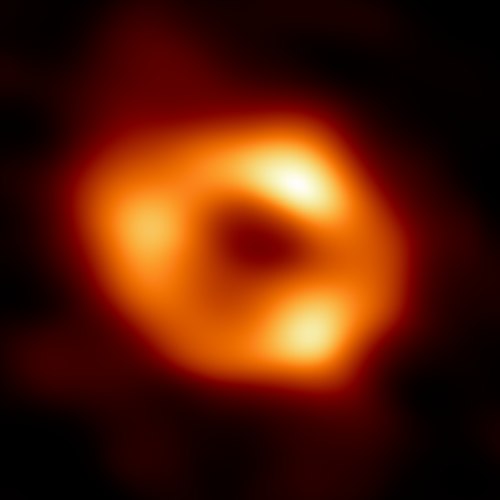
First Image of Milky Way's Black Hole
The Event Horizon Telescope releases the image of Sgr A*, the supermassive black hole at the center of our galaxy. #blackhole #astronomy
First Image of Milky Way's Black Hole By EHT Collaboration - https://www.eso.org/public/images/eso2208-eht-mwa/ (image link), CC BY 4.0, https://commons.wikimedia.org/w/index.php?curid=117933557