Encyclopedia/1. The Cosmos & The Natural World/1. Mathematics & Formal Systems/01. Geometry & Spatial Systems • Curated by Admin Timeline.sg
The development of non-Euclidean and differential geometry from the 18th to mid-20th century, including hyperbolic and elliptic geometries, Gauss's intrinsic geometry, and Riemann's manifold theory, which laid the foundation for general relativity.
Chronological Storyline (52 Milestones)
1733 CE
Saccheri Publishes 'Euclides ab omni naevo vindicatus'
Giovanni Saccheri attempts to prove Euclid's parallel postulate by contradiction, inadvertently exploring the consequences of its negation, foreshadowing non-Euclidean geometry. #geometry #history
Saccheri Publishes 'Euclides ab omni naevo vindicatus' By Girolamo Saccheri (book author) - Girolamo Saccheri Euclide Ab Omni Naevo Vindicatus, Public domain, https://commons.wikimedia.org/w/index.php?curid=680440
1763 CE
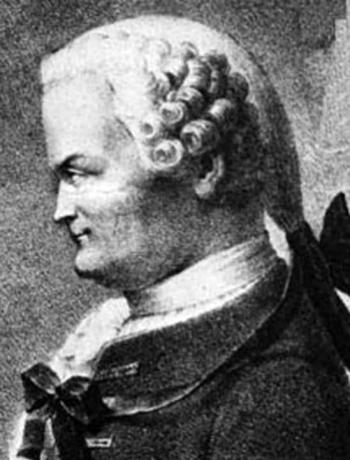
Lambert's Work on Parallel Postulate
Johann Heinrich Lambert investigates the parallel postulate, developing a theory of 'absolute geometry' and considering the possibility of geometries where the angle sum of a triangle is less than 180 degrees. #mathematics #geometry
Lambert's Work on Parallel Postulate By Unknown author, Public domain, https://commons.wikimedia.org/w/index.php?curid=370155
1788 CE
Lagrange Publishes 'Mécanique analytique'
Joseph-Louis Lagrange publishes his masterpiece on analytical mechanics, which uses differential geometry concepts like the metric tensor, influencing the development of differential geometry. #physics #mathematics
Lagrange Publishes 'Mécanique analytique' By Joseph-Louis Lagrange - https://libserv.aip.org/ipac20/ipac.jsp?session=IR67574T35919.44001&profile=rev-nbl&source=~!horizon&view=subscriptionsummary&uri=full=3100006~!44233~!15&ri=5&aspect=power&menu=search&ipp=20&spp=20&staffonly=&term=M?anique+Analytique&index=.GW&uindex=&aspect=power&menu=search&ri=5, Public domain, https://commons.wikimedia.org/w/index.php?curid=125029899
1795 CE
Monge's 'Géométrie descriptive'
Gaspard Monge publishes his work on descriptive geometry, which develops projective geometry and influences the study of surfaces and differential geometry. #geometry #engineering
Monge's 'Géométrie descriptive' By François-Séraphin Delpech - http://www.sil.si.edu/digitalcollections/hst/scientific-identity/CF/by_name_display_results.cfm?scientist=Monge,%20Gaspard, Public domain, https://commons.wikimedia.org/w/index.php?curid=646122
1813 CE
Gauss Begins Non-Euclidean Investigations
Carl Friedrich Gauss privately develops ideas about non-Euclidean geometry, realizing the possibility of a geometry where the parallel postulate does not hold, but he does not publish his findings. #mathematics #geometry
1826 CE
Lobachevsky Presents First Published Non-Euclidean Geometry
Nikolai Lobachevsky presents a paper on 'imaginary geometry' (hyperbolic geometry) to the Kazan University, becoming the first to publicly develop a consistent non-Euclidean geometry. #mathematics #geometry
Lobachevsky Presents First Published Non-Euclidean Geometry By Lev Kryukov - http://cczy.blog.ru/?year=2009&month=11, Public domain, https://commons.wikimedia.org/w/index.php?curid=12821190
1827 CE
Möbius Publishes 'Der barycentrische Calcul'
August Ferdinand Möbius publishes his work on barycentric calculus, introducing homogeneous coordinates and influencing projective geometry and the study of surfaces. #geometry #mathematics
Möbius Publishes 'Der barycentrische Calcul' By Adolf Neumann - http://www.portraitindex.de/documents/obj/33213645, Public domain, https://commons.wikimedia.org/w/index.php?curid=58320662
1827 CE
Gauss Publishes 'Disquisitiones generales circa superficies curvas'
Gauss publishes his general investigations of curved surfaces, introducing the concept of Gaussian curvature and the Theorema Egregium, showing curvature is intrinsic. #differentialgeometry #mathematics
Gauss Publishes 'Disquisitiones generales circa superficies curvas' By Eric Gaba (Sting - fr:Sting) - Own work Data : U.S. NGDC World Coast Line (public domain), CC BY-SA 4.0, https://commons.wikimedia.org/w/index.php?curid=4677929
1829 CE
Lobachevsky Publishes 'On the Principles of Geometry'
Lobachevsky publishes his first full account of hyperbolic geometry in the Kazan Messenger, describing a geometry where infinitely many parallel lines exist through a point. #mathematics #hyperbolic
Lobachevsky Publishes 'On the Principles of Geometry' By Vladimir0987 - Own work, CC BY-SA 3.0, https://commons.wikimedia.org/w/index.php?curid=7922910
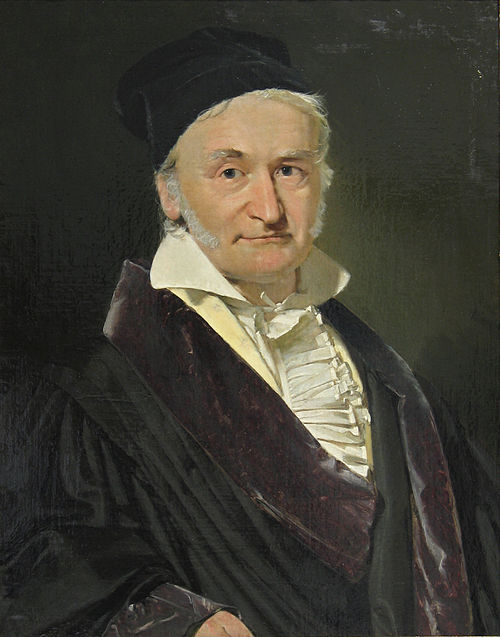
Gauss publishes his work on biquadratic residues, introducing complex numbers and providing a foundation for algebraic geometry, though not directly non-Euclidean. #mathematics #numbertheory
Gauss Publishes 'Theoria residuorum biquadraticorum' By Christian Albrecht Jensen - http://archiv.bbaw.de/archiv/archivbestaende/abteilung-sammlungen/gesamtbestand-des-kunstbesitzes/gelehrtengemaelde/gelehrtengemalde-seiten/ZIMM-0001.html, Public domain, https://commons.wikimedia.org/w/index.php?curid=6886354
1832 CE
Bolyai Publishes 'Appendix' on Absolute Geometry
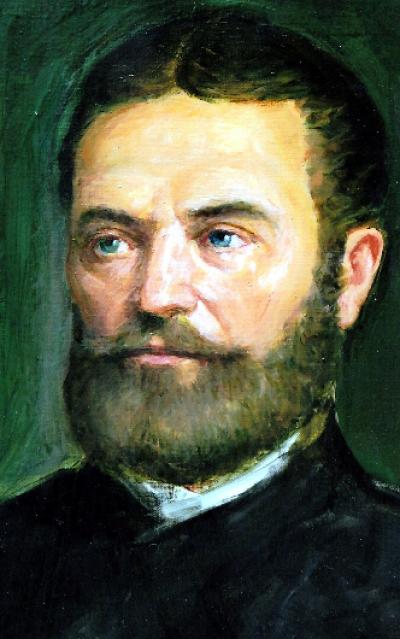
János Bolyai publishes his 'Appendix' to his father's mathematics book, describing hyperbolic geometry independently of Lobachevsky, calling it 'absolute geometry'. #geometry #hyperbolic
Bolyai Publishes 'Appendix' on Absolute Geometry By Ferenc Márkos - Transferred from hu.wikipedia to Commons by Tambo., CC BY-SA 3.0, https://commons.wikimedia.org/w/index.php?curid=24338736
1837 CE
Möbius Discovers the Möbius Strip
August Möbius discovers the Möbius strip, a non-orientable surface with only one side, contributing to topology and differential geometry. #topology #geometry
Möbius Discovers the Möbius Strip By David Benbennick - Möbius strip.jpg, CC BY-SA 2.0, https://commons.wikimedia.org/w/index.php?curid=142071794
1840 CE
Lobachevsky Publishes 'Geometrische Untersuchungen zur Theorie der Parallellinien'
Lobachevsky publishes a German summary of his hyperbolic geometry, making his work more accessible to European mathematicians. #geometry #hyperbolic
Hermann Grassmann publishes his theory of linear extension, introducing vector spaces and exterior algebra, foundational for differential geometry. #mathematics #algebra
Grassmann Publishes 'Die lineale Ausdehnungslehre' By Unknown author - From the beginning of vol. 1 of Grassmann's collected works (1894), Public domain, https://commons.wikimedia.org/w/index.php?curid=174414110
1847 CE
Sophus Lie Begins Work on Continuous Groups
Marius Sophus Lie starts developing the theory of continuous transformation groups, which later becomes crucial for differential geometry and manifold theory. #mathematics #grouptheory
Sophus Lie Begins Work on Continuous Groups By L. Szaciński (Christiania) - Flickr: Portrett av Sophus Lie, 1896, No restrictions, https://commons.wikimedia.org/w/index.php?curid=64917266
1850 CE
Cayley's Work on Projective Geometry
Arthur Cayley publishes on projective geometry, linking it to metric geometry and paving the way for the Cayley-Klein model of hyperbolic geometry. #geometry #projective
Cayley's Work on Projective Geometry By Herbert Beraud (1845–1896) - http://www-groups.dcs.st-and.ac.uk/~history/PictDisplay/Cayley.html, Public domain, https://commons.wikimedia.org/w/index.php?curid=904674
1854 CE
Riemann's Inaugural Lecture 'On the Hypotheses which lie at the Bases of Geometry'
Bernhard Riemann delivers his habilitation lecture, generalizing Gauss's ideas to higher dimensions and introducing Riemannian manifolds, curvature tensors, and the concept of a metric. #differentialgeometry #mathematics
1855 CE
Riemann Publishes 'Ueber die Hypothesen...'
Riemann's lecture is published posthumously, laying the foundation for differential geometry and eventually general relativity, with concepts like the Riemann curvature tensor. #differentialgeometry #physics
Riemann Publishes 'Ueber die Hypothesen...' By Unknown author - http://www.sil.si.edu/digitalcollections/hst/scientific-identity/explore.htm according to the German Wikipedia., Public domain, https://commons.wikimedia.org/w/index.php?curid=27383
1860 CE
Beltrami's 'Essay on the Interpretation of Non-Euclidean Geometry'
Eugenio Beltrami provides a model for hyperbolic geometry on a pseudosphere, showing its consistency and linking it to differential geometry. #geometry #hyperbolic
Beltrami's 'Essay on the Interpretation of Non-Euclidean Geometry' By Unknown author, Public domain, https://commons.wikimedia.org/w/index.php?curid=2094478
1866 CE
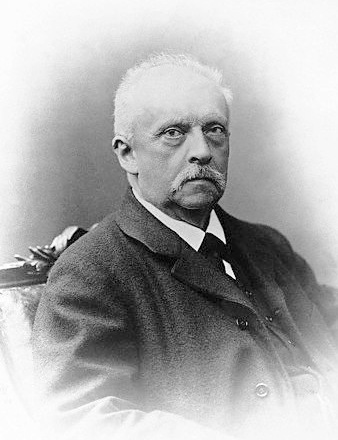
Helmholtz on the Foundations of Geometry
Hermann von Helmholtz publishes on the empirical origins of geometry and the concept of space, relating to Riemannian geometry and the philosophy of geometry. #philosophy #geometry
Helmholtz on the Foundations of Geometry By Unknown author, Public domain, https://commons.wikimedia.org/w/index.php?curid=74569
1868 CE
Beltrami Publishes 'Teoria fondamentale degli spazii di curvatura costante'
Beltrami develops the theory of constant curvature spaces, including elliptic geometry and spherical geometry, and provides models for non-Euclidean geometries. #geometry #differentialgeometry
1870 CE
Klein's Erlangen Program
Felix Klein presents the Erlangen Program, defining geometry as the study of invariants under transformation groups, unifying Euclidean and non-Euclidean geometries. #geometry #grouptheory
Klein's Erlangen Program By Unknown author, Public domain, https://commons.wikimedia.org/w/index.php?curid=38617
1871 CE
Klein Constructs Models of Hyperbolic Geometry
Felix Klein develops the Klein model (projective model) and the Poincaré disk model of hyperbolic geometry, using projective geometry to represent hyperbolic space. #geometry #hyperbolic
1872 CE
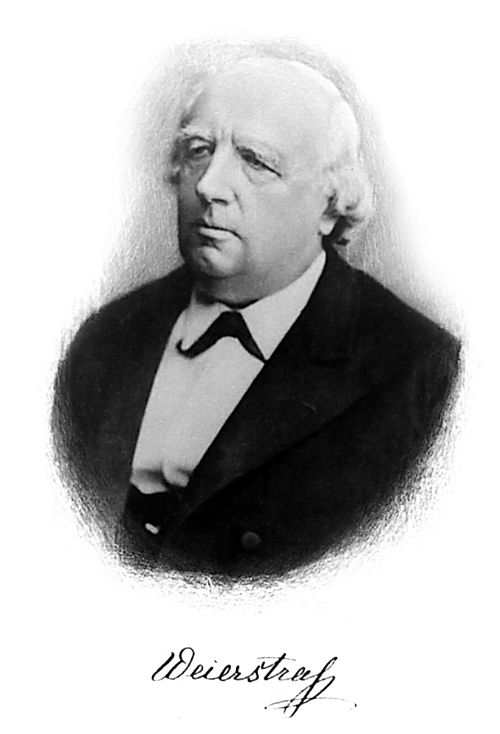
Weierstrass on Analytic Functions and Manifolds
Karl Weierstrass contributes to the rigorous foundation of analysis, indirectly supporting differential geometry with concepts of analytic manifolds. #analysis #mathematics
Weierstrass on Analytic Functions and Manifolds By Unknown author, Public domain, https://commons.wikimedia.org/w/index.php?curid=324146
1873 CE
Christoffel Introduces Christoffel Symbols
Elwin Bruno Christoffel introduces Christoffel symbols in his work on differential forms, providing a tool for connection and covariant derivative in differential geometry. #differentialgeometry #tensors
1878 CE
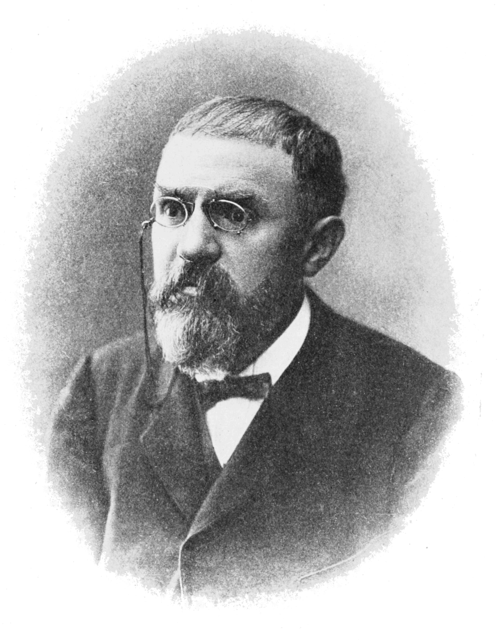
Poincaré's Work on Fuchsian Functions
Henri Poincaré discovers Fuchsian functions (automorphic functions) and their relation to non-Euclidean geometry, using hyperbolic geometry in complex analysis. #mathematics #hyperbolic
Poincaré's Work on Fuchsian Functions By Unknown author - Popular Science Monthly Volume 82, Public domain, https://commons.wikimedia.org/w/index.php?curid=20644432
1882 CE
Poincaré Publishes 'Théorie des groupes fuchsiens'
Poincaré develops the theory of Fuchsian groups and their fundamental domains, linking hyperbolic geometry with complex analysis and topology. #mathematics #geometry
Poincaré Publishes 'Théorie des groupes fuchsiens' By Adam majewski - Own work, CC BY-SA 4.0, https://commons.wikimedia.org/w/index.php?curid=62205191
1887 CE
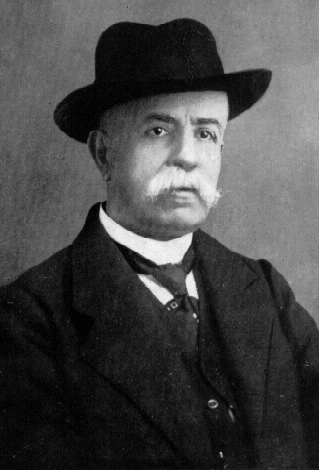
Ricci-Curbastro Develops Tensor Calculus
Gregorio Ricci-Curbastro begins developing absolute differential calculus (tensor calculus), which becomes essential for differential geometry and general relativity. #tensors #differentialgeometry
Ricci-Curbastro Develops Tensor Calculus By Unknown author - www.dm.unito.it, Public domain, https://commons.wikimedia.org/w/index.php?curid=105574075
1892 CE
Killing Classifies Homogeneous Spaces
Wilhelm Killing classifies real Lie algebras and homogeneous spaces, contributing to the geometry of symmetric spaces. #grouptheory #geometry
Killing Classifies Homogeneous Spaces By Unknown author - http://www-history.mcs.st-andrews.ac.uk/Mathematicians/Killing.html, Public domain, https://commons.wikimedia.org/w/index.php?curid=26763585
1894 CE
Klein's 'Vorlesungen über das Ikosaeder'
Felix Klein publishes lectures on the icosahedron and the solution of quintic equations, linking group theory to geometry and invariants. #geometry #grouptheory
Klein's 'Vorlesungen über das Ikosaeder' By Gebruder Noelle (m. 1917, attivo a Gottingen) - Archivio storico dell'Accademia delle Scienze - Catalogo digitale, Public domain, https://commons.wikimedia.org/w/index.php?curid=105609901
1900 CE
Hilbert's 3rd Problem on Decomposition of Polyhedra
David Hilbert poses his third problem on the decomposition of polyhedra, which influences the geometry of manifolds and measures, leading to Dehn's solution. #geometry #mathematics
Hilbert's 3rd Problem on Decomposition of Polyhedra By WatchduckYou can name the author as "T. Piesk", "Tilman Piesk" or "Watchduck". - Own work, CC BY-SA 4.0, https://commons.wikimedia.org/w/index.php?curid=109215760
1901 CE
Ricci and Levi-Civita Publish 'Méthodes de calcul différentiel absolu'
Ricci and Tullio Levi-Civita publish a landmark paper on tensor calculus, systematically developing covariant differentiation and the Riemann tensor. #tensors #differentialgeometry
1904 CE
Minkowski's Geometry of Numbers
Hermann Minkowski publishes his geometry of numbers, applying convex bodies to number theory, and later develops Minkowski space for special relativity. #geometry #numbertheory
Minkowski's Geometry of Numbers By Hermann Minkowski - scan from original book, Public domain, https://commons.wikimedia.org/w/index.php?curid=59559231
1907 CE
Poincaré Conjecture on 3-Manifolds
Henri Poincaré formulates the Poincaré conjecture, a topological statement about 3-manifolds that has deep implications for geometry, proven a century later. #topology #geometry
1908 CE
Minkowski Introduces Spacetime
Hermann Minkowski presents his geometric interpretation of special relativity, merging space and time into a four-dimensional manifold with a Lorentzian metric. #physics #relativity
Minkowski Introduces Spacetime By Hermann Minkowski - scan from original book, Public domain, https://commons.wikimedia.org/w/index.php?curid=2956997
1912 CE
Weyl Publishes 'Die Idee der Riemannschen Fläche'
Hermann Weyl publishes his book on Riemann surfaces, rigorously defining manifolds and combining topology, complex analysis, and differential geometry. #mathematics #geometry
Weyl Publishes 'Die Idee der Riemannschen Fläche' By ETH Zürich - ETH-Bibliothek Zürich, Bildarchiv, CC BY-SA 3.0, https://commons.wikimedia.org/w/index.php?curid=8098412
1913 CE
Cartan Introduces Moving Frames Method
Élie Cartan develops the method of moving frames and the theory of connections, simplifying differential geometry and leading to the notion of principal bundles. #differentialgeometry #mathematics
1913 CE
Levi-Civita Defines Parallel Transport
Tullio Levi-Civita introduces the concept of parallel transport on surfaces, which becomes crucial for connections in differential geometry and general relativity. #differentialgeometry #physics
Levi-Civita Defines Parallel Transport By Fred the Oyster, CC BY-SA 4.0, https://commons.wikimedia.org/w/index.php?curid=35124171
1915 CE
Einstein Formulates General Relativity
Albert Einstein presents general relativity, using Riemannian geometry and tensor calculus to describe gravity as curvature of spacetime. #physics #relativity
Einstein Formulates General Relativity By Simulating eXtreme Spacetimes Lensing (SXS) - https://www.ligo.caltech.edu/video/ligo20160211v3 (video link); see also http://www.black-holes.org/gw150914, CC BY-SA 4.0, https://commons.wikimedia.org/w/index.php?curid=46994894
1917 CE
Weyl Proposes Unified Field Theory
Hermann Weyl attempts a unified field theory using a generalization of Riemannian geometry with a connection that includes gauge invariance, pioneering gauge theory. #physics #geometry
1922 CE
Cartan Solves the Problem of Equivalence
Élie Cartan develops a method to solve the equivalence problem in differential geometry, classifying geometric structures using Cartan connections. #differentialgeometry #mathematics
1923 CE
Birkhoff Proves Ergodic Theorem Using Geometry
George David Birkhoff proves the ergodic theorem, linking dynamical systems to geometry, particularly on manifolds. #mathematics #dynamics
Birkhoff Proves Ergodic Theorem Using Geometry By Unknown author - Rudolf Fritsch. Der Vierfarbensatz: Geschichte, topologische Grundlagen und Beweisidee. Mannheim: BI-Wissenschaftsverlag, 1994; S.29, Public domain, https://commons.wikimedia.org/w/index.php?curid=4032315
1925 CE
Clifford-Klein Spaces Study
The study of Clifford-Klein space forms (complete Riemannian manifolds of constant sectional curvature) begins, linking geometry with topology and group theory. #geometry #topology
1926 CE
Lichnerowicz's Work on Differential Geometry and Physics
André Lichnerowicz begins his contributions to differential geometry, particularly in general relativity and relativistic fluid dynamics. #physics #differentialgeometry
Lichnerowicz's Work on Differential Geometry and Physics By George Bergman - Scanned via Epson Perfection V370; see also https://opc.mfo.de/detail?photo_id=5529, CC BY-SA 4.0, https://commons.wikimedia.org/w/index.php?curid=79654906
1932 CE
Synge Introduces Geodesic Deviation Equation
John Lighton Synge publishes papers on the geometry of general relativity, particularly the geodesic deviation equation relating curvature to tidal forces. #physics #geometry
Synge Introduces Geodesic Deviation Equation By Royal Society - https://royalsocietypublishing.org/doi/pdf/10.1098/rsbm.2007.0040, CC BY 4.0, https://commons.wikimedia.org/w/index.php?curid=150558831
1935 CE
Whitney's Embedding Theorem
Hassler Whitney proves the embedding theorem, showing that any smooth manifold can be embedded in Euclidean space, foundational for differential topology. #topology #geometry
1936 CE
Morse Theory Developed
Marston Morse develops Morse theory, relating the topology of a manifold to critical points of smooth functions, linking geometry and topology. #topology #geometry
1940 CE
Hodge Theory on Harmonic Forms
W. V. D. Hodge develops Hodge theory, using harmonic differential forms on compact manifolds, connecting Riemannian geometry with algebraic topology. #mathematics #geometry
1941 CE
Ehresmann Introduces Connections on Fiber Bundles
Charles Ehresmann defines connections on fiber bundles, formalizing the concept of parallel transport in differential geometry. #differentialgeometry #topology
1942 CE
Myers's Theorem on Diameter and Curvature
Sumner Byron Myers proves that a complete Riemannian manifold with positive Ricci curvature is compact, a key result in global differential geometry. #geometry #mathematics
1945 CE
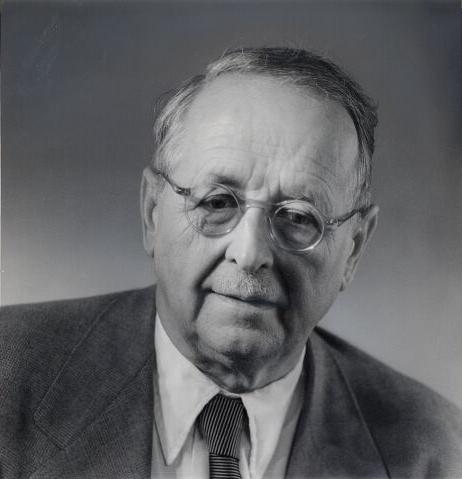
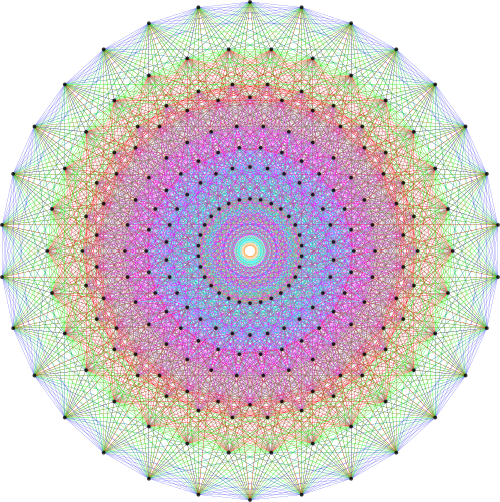
Cartan's Theory of Symmetric Spaces
Élie Cartan completes the classification of Riemannian symmetric spaces, linking Lie groups, Riemannian geometry, and algebraic geometry. #geometry #grouptheory
Cartan's Theory of Symmetric Spaces By Jgmoxness - Own work, CC BY-SA 3.0, https://commons.wikimedia.org/w/index.php?curid=8893046
1950 CE
Chern's Characteristic Classes
Shiing-Shen Chern, a Chinese mathematician, publishes foundational work on characteristic classes, particularly Chern classes, crucial to differential geometry and topology. #geometry #topology