Encyclopedia/1. The Cosmos & The Natural World/2. Physics & Chemistry/13. Physical & Chemical Biographies • Curated by Admin Timeline.sg
Historical events timeline.
Chronological Storyline (37 Milestones)
Oct 7, 1885 CE
Niels Bohr Born in Copenhagen
Niels Henrik David Bohr is born in Copenhagen, Denmark, to Christian Bohr, a professor of physiology, and Ellen Adler Bohr. #physics #history
Niels Bohr Born in Copenhagen By The American Institute of Physics credits the photo [1] to AB Lagrelius & Westphal, which is the Swedish company used by the Nobel Foundation for most photos of its book series Les Prix Nobel. - Niels Bohr's Nobel Prize biography, from 1922, Public domain, https://commons.wikimedia.org/w/index.php?curid=288274
1903 CE
Enters University of Copenhagen
Bohr enrolls at the University of Copenhagen, initially studying physics and philosophy. He wins a gold medal for his experimental investigation of surface tension. #physics #education
1907 CE
Wins Gold Medal for Surface Tension
Bohr receives the Royal Danish Academy of Sciences and Letters' gold medal for his study of surface tension using oscillating water jets. #physics #research
May 13, 1911 CE
Receives Doctorate from University of Copenhagen
Bohr earns his PhD with a dissertation on the electron theory of metals. He then travels to Cambridge to work with J.J. Thomson. #physics #education
Aug 1, 1912 CE
Marries Margrethe Nørlund
Bohr marries Margrethe Nørlund; they will have six sons, including Aage Bohr who also becomes a Nobel laureate. #personal #family
1912 CE
Works with Ernest Rutherford in Manchester
Bohr moves to Manchester to work with Ernest Rutherford, where he develops insights into atomic structure that lead to the Bohr model. #physics #atomic
Jul 1, 1913 CE
Publishes Bohr Model of the Atom
Bohr publishes his revolutionary atomic model in three papers, proposing that electrons orbit the nucleus in discrete energy levels, explaining hydrogen spectral lines. #physics #quantum
Publishes Bohr Model of the Atom By JabberWok at English Wikipedia - Transferred from en.wikipedia to Commons., CC BY-SA 3.0, https://commons.wikimedia.org/w/index.php?curid=2639910
1914 CE
Appointed Lecturer at University of Manchester
Bohr becomes a lecturer at the University of Manchester, continuing his work on atomic theory. #physics #academia
1916 CE
Becomes Professor at University of Copenhagen
Bohr is appointed professor of theoretical physics at the University of Copenhagen, where he establishes a new institute. #physics #academia
Mar 3, 1920 CE
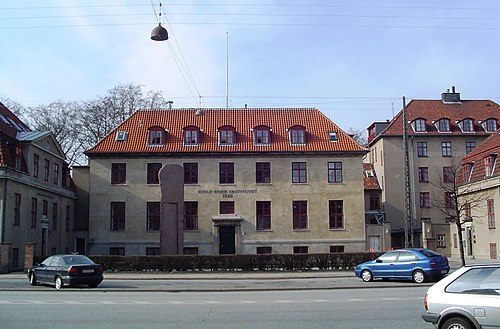
Founds Institute for Theoretical Physics
The University of Copenhagen's Institute for Theoretical Physics (now the Niels Bohr Institute) opens, becoming a world center for quantum mechanics. #physics #institution
Founds Institute for Theoretical Physics By Thue - Own work, Public domain, https://commons.wikimedia.org/w/index.php?curid=88861
Apr 18, 1921 CE
First Bohr Festival
A symposium held at the institute brings together leading physicists to discuss atomic physics, marking the institute's prominence. #physics #conference
Dec 10, 1922 CE
Awarded Nobel Prize in Physics
Bohr receives the 1922 Nobel Prize in Physics for his services in the investigation of the structure of atoms and of the radiation emanating from them. #physics #nobel
1923 CE
Introduces Correspondence Principle
Bohr formulates the correspondence principle, stating that quantum mechanics must reproduce classical physics in the limit of large quantum numbers. #physics #quantum
1924 CE
BKS Theory Proposed
Bohr, Hendrik Kramers, and John Slater propose the BKS theory, a radical attempt to abandon energy conservation in atomic transitions, later disproven. #physics #quantum
1925 CE
Welcomes Heisenberg's Matrix Mechanics
Bohr supports Werner Heisenberg's new matrix mechanics, a rigorous formulation of quantum theory, and invites Heisenberg to Copenhagen. #physics #quantum
1926 CE
Debates Schrödinger on Wave Mechanics
Bohr engages in intense debates with Erwin Schrödinger over the interpretation of wave mechanics, defending the probabilistic view. #physics #quantum
Sep 16, 1927 CE
Formulates Complementarity Principle
Bohr introduces the principle of complementarity, stating that wave and particle descriptions are complementary but mutually exclusive, at the Lake Como conference. #physics #quantum )
Oct 24, 1927 CE
Fifth Solvay Conference: Bohr-Einstein Debates Begin
Bohr and Einstein begin their famous debates on quantum mechanics at the Solvay Conference in Brussels, with Bohr defending the Copenhagen interpretation. #physics #debate
Fifth Solvay Conference: Bohr-Einstein Debates Begin By en:Paul Ehrenfest - https://www.nature.com/articles/456706a (and other sites as well), Public domain, https://commons.wikimedia.org/w/index.php?curid=141506495
1928 CE
Elected Foreign Member of Royal Society
Bohr is elected a Foreign Member of the Royal Society in recognition of his contributions to atomic physics. #physics #honor
1930 CE
Develops Liquid Drop Model of Nucleus
Bohr proposes the liquid drop model of the atomic nucleus, which later helps explain nuclear fission. #physics #nuclear
Develops Liquid Drop Model of Nucleus By Kjerish - This image has been extracted from another file, CC BY-SA 4.0, https://commons.wikimedia.org/w/index.php?curid=54378478
1932 CE
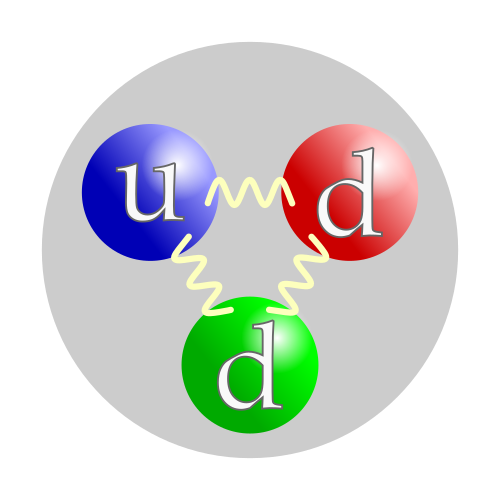
Learns of Neutron Discovery
Bohr and colleagues discuss the implications of James Chadwick's discovery of the neutron, which Bohr incorporates into his nuclear models. #physics #nuclear
Learns of Neutron Discovery By No machine-readable author provided. Harp assumed (based on copyright claims). - No machine-readable source provided. Own work assumed (based on copyright claims)., CC BY-SA 2.5, https://commons.wikimedia.org/w/index.php?curid=637381
1936 CE
Publishes Theory of Nuclear Reactions
Bohr publishes a theory of nuclear reactions based on the compound nucleus model, describing how nuclei capture and decay. #physics #nuclear
Publishes Theory of Nuclear Reactions By Sakurambo - Own work based on: Li6-D Reaction.png, CC BY-SA 3.0, https://commons.wikimedia.org/w/index.php?curid=2096742
Jan 16, 1939 CE
Explains Mechanism of Nuclear Fission
Bohr and John Wheeler develop the liquid drop model to explain nuclear fission; Bohr presents the theory at a conference in Washington, D.C. #physics #nuclear
Explains Mechanism of Nuclear Fission By Created by Fastfission in Illustrator. The SVG code is valid. This vector image was created with a text editor. Please do not replace the simplified code of this file with a version created with Inkscape or any other graphical vector graphics editor - Own work, Public domain, https://commons.wikimedia.org/w/index.php?curid=486924
Apr 9, 1940 CE
Denmark Occupied by Nazi Germany
During World War II, Bohr remains in Copenhagen, but his institute is under surveillance. He continues research while avoiding collaboration. #war #history
Denmark Occupied by Nazi Germany By Repro John Erling Blad - no:Bagn Bygdesamling, CC BY-SA 3.0, https://commons.wikimedia.org/w/index.php?curid=3339932
Sep 29, 1943 CE
Flees Denmark to Sweden
Aware of imminent arrest by the Nazis, Bohr escapes by boat to Sweden with the help of the Danish resistance. #war #escape
Oct 6, 1943 CE
Arrives in Britain, Joins Manhattan Project
Bohr is flown to Britain in a Mosquito bomber, then travels to the United States to advise on the Manhattan Project at Los Alamos. #physics #war
Arrives in Britain, Joins Manhattan Project By Unknown authorUnknown author or not provided - U.S. National Archives and Records Administration, Public domain, https://commons.wikimedia.org/w/index.php?curid=16655439
Aug 26, 1944 CE
Meets with President Roosevelt
Bohr meets with Franklin D. Roosevelt to urge international control of atomic weapons, but fails to achieve policy change. #politics #nuclear
Aug 1, 1945 CE
Returns to Denmark After War
Bohr returns to Copenhagen after World War II, resuming his role at the institute and advocating for peaceful use of atomic energy. #history #peace
Mar 1, 1947 CE
Awarded Order of the Elephant
King Christian X of Denmark awards Bohr the Order of the Elephant, one of the highest Danish honors. #honor #history
Awarded Order of the Elephant By Sodacan - Own work: Based on: File:Order of the Elephant (heraldry).svg, CC BY-SA 3.0, https://commons.wikimedia.org/w/index.php?curid=9711613
Oct 1, 1949 CE
Writes Open Letter to United Nations
Bohr publishes an open letter to the UN advocating for openness and international control of nuclear weapons. #politics #peace
Jun 9, 1950 CE
Second Open Letter on Nuclear Weapons
Bohr again appeals to the UN, emphasizing the need for an open world to prevent nuclear war. #politics #peace
1952 CE
Involved in Founding of CERN
Bohr participates in early discussions and planning for the European Organization for Nuclear Research (CERN). #physics #institution
Involved in Founding of CERN By European Organization for Nuclear Research Organisation européenne pour la recherche nucléaire - https://cernandsocietyfoundation.cern https://cernandsocietyfoundation.cern/sites/default/files/Annual%20Reviews/CERN%20&%20Society%20Foundation%20Annual%20Report%202024.pdf https://design-guidelines.web.cern.ch/guidelines/badge-logo Own work based on: CERN logo.png:, Public domain, https://commons.wikimedia.org/w/index.php?curid=178595736
1953 CE
Becomes President of Nordic Institute for Theoretical Physics
Bohr is appointed president of the newly formed Nordic Institute for Theoretical Physics (Nordita). #physics #institution
1955 CE
First Atoms for Peace Award
Bohr receives the first Atoms for Peace Award for his contributions to peaceful uses of atomic energy. #peace #nuclear
1957 CE
Receives Sonning Prize
Bohr is awarded the Sonning Prize for outstanding contributions to European culture. #honor #culture
1963 CE
Memorial Volume Published
A memorial volume for Bohr is published, featuring contributions from leading physicists worldwide. #physics #commemoration
Oct 7, 1965 CE
Niels Bohr Institute Named in His Honor
The Institute for Theoretical Physics is officially renamed the Niels Bohr Institute on what would have been his 80th birthday. #physics #institution