Nanotechnology & Quantum Dots: Feynman's Vision to Carbon Nanotubes
Encyclopedia/2. Technology & The Built World/2. Engineering & Applied Sciences/02. Nanotechnology & Smart Materials • Curated by Admin Timeline.sg
Nanotechnology involves engineering matter at the atomic and molecular scale, with milestones from Richard Feynman's visionary 1959 lecture to the discovery of carbon nanotubes and quantum dots, revolutionizing materials science and electronics.
Chronological Storyline (37 Milestones)
Dec 29, 1959 CE
Feynman's 'Plenty of Room at the Bottom'
Richard Feynman delivers a visionary lecture at Caltech, proposing the manipulation of individual atoms and molecules, laying the conceptual foundation for nanotechnology. #nanotech #science
1965 CE
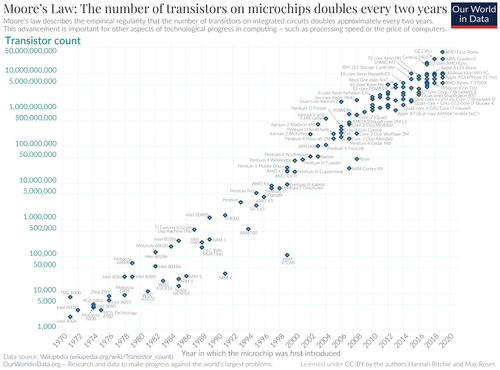
Gordon Moore Predicts Moore's Law
Gordon Moore observes that the number of transistors on a chip doubles every two years, driving miniaturization that parallels nanotechnology goals. #computing #nanotech
Gordon Moore Predicts Moore's Law By Max Roser, Hannah Ritchie - https://ourworldindata.org/uploads/2020/11/Transistor-Count-over-time.png, CC BY 4.0, https://commons.wikimedia.org/w/index.php?curid=98219918
1974 CE
Norio Taniguchi Coins 'Nanotechnology'
Japanese scientist Norio Taniguchi first uses the term 'nanotechnology' to describe precision machining at the nanometer scale. #nanotech #history
Mar 1, 1981 CE
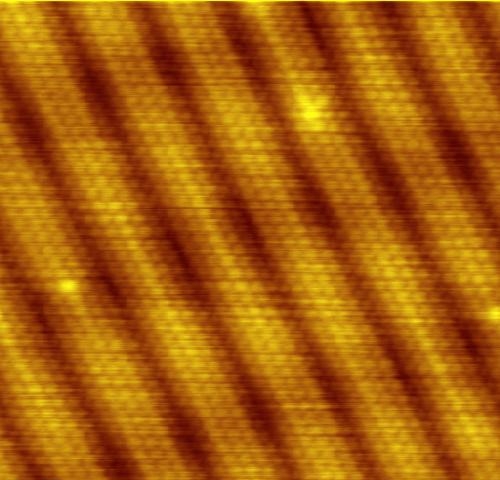
IBM Scanning Tunneling Microscope (STM)
Gerd Binnig and Heinrich Rohrer at IBM Zurich invent the STM, enabling imaging of individual atoms on surfaces, a breakthrough for nanotechnology. #nanotech #physics
IBM Scanning Tunneling Microscope (STM) By Erwinrossen - en:File:Atomic_resolution_Au100.JPG, see upload log, Public domain, https://commons.wikimedia.org/w/index.php?curid=1790142
Sep 1, 1985 CE
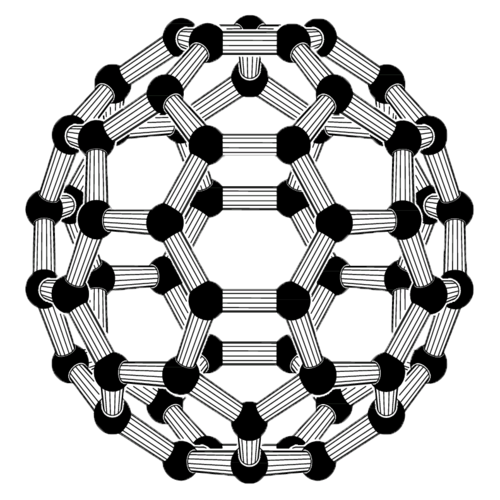
Discovery of Fullerenes (C60)
Harry Kroto, Robert Curl, and Richard Smalley discover buckminsterfullerene (C60), a spherical carbon molecule, opening the field of carbon nanostructures. #nanotech #chemistry
Discovery of Fullerenes (C60) By 痛 - Own work, CC BY-SA 4.0, https://commons.wikimedia.org/w/index.php?curid=118428240
1986 CE
Atomic Force Microscope (AFM) Invented
Gerd Binnig, Calvin Quate, and Christoph Gerber invent the AFM, allowing imaging of non-conductive surfaces at atomic resolution. #nanotech #physics
Atomic Force Microscope (AFM) Invented By Unknown author, Public domain, https://commons.wikimedia.org/w/index.php?curid=3592868
1986 CE
Eric Drexler Publishes 'Engines of Creation'
K. Eric Drexler popularizes nanotechnology with his book, envisioning molecular assemblers and self-replication. #nanotech #books
1989 CE
IBM Spells 'IBM' with Xenon Atoms
Don Eigler and Erhard Schweizer at IBM use STM to manipulate 35 xenon atoms to spell the company logo, demonstrating atomic precision. #nanotech #physics
1991 CE
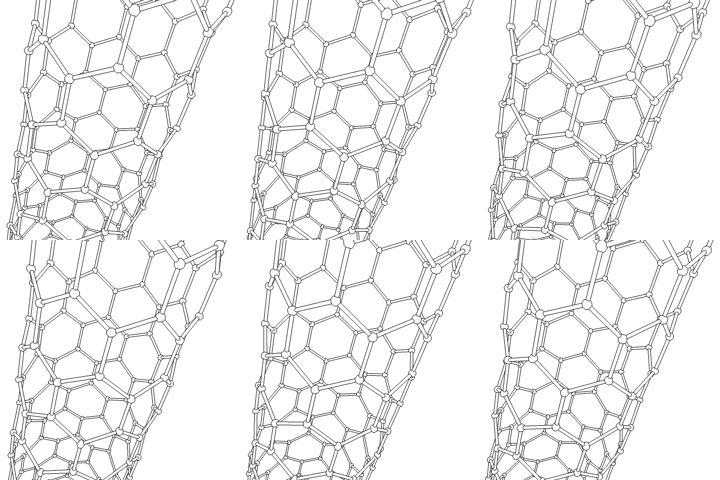
Sumio Iijima Discovers Carbon Nanotubes
Japanese physicist Sumio Iijima identifies multi-walled carbon nanotubes in soot, later single-walled tubes, with exceptional strength and conductivity. #nanotech #materials
Sumio Iijima Discovers Carbon Nanotubes By Original hochgeladen von Schwarzm am 30. Aug 2004; Selbst gemacht mit C4D/Cartoonrenderer, GNU FDL - German Wikipedia, original upload 29. Dez 2004 by APPER, CC BY-SA 3.0, https://commons.wikimedia.org/w/index.php?curid=350208
1993 CE
Single-Walled Carbon Nanotubes Synthesized
Iijima and Donald Bethune independently synthesize single-walled carbon nanotubes, enabling precise electronic properties. #nanotech #materials
1997 CE
First Nanotech Drug Delivery System Approved
The FDA approves Doxil, a liposomal doxorubicin formulation, as the first nanomedicine for cancer therapy. #nanotech #medicine
First Nanotech Drug Delivery System Approved By Fvasconcellos 23:30, 4 May 2007 (UTC) - Own work, Public domain, https://commons.wikimedia.org/w/index.php?curid=2058785
1998 CE
First Transistor Using Carbon Nanotube
Researchers at Delft University create the first carbon nanotube field-effect transistor, demonstrating potential for nanoelectronics. #nanotech #electronics
Jan 21, 2000 CE
US National Nanotechnology Initiative Launched
President Bill Clinton announces the NNI, coordinating federal R&D in nanotechnology across multiple agencies. #nanotech #policy
US National Nanotechnology Initiative Launched By US Federal Government National Nanotechnology Coordination Office - https://www.nano.gov/2025BudgetSupplement, Public domain, https://commons.wikimedia.org/w/index.php?curid=163991308
2001 CE
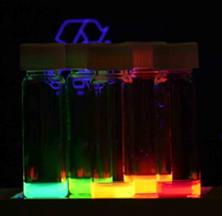
Quantum Dots Used in Biological Imaging
Researchers demonstrate quantum dots as fluorescent labels for cellular imaging, offering brighter and more stable probes than organic dyes. #nanotech #biology
Quantum Dots Used in Biological Imaging By Walkman16 - Own work, CC BY-SA 3.0, https://commons.wikimedia.org/w/index.php?curid=15266942
Andre Geim and Konstantin Novoselov isolate graphene using scotch tape, a single atomic layer of carbon with exceptional properties. #nanotech #materials
Graphene Isolated by Geim and Novoselov By AlexanderAlUS - Own work, CC BY-SA 3.0, https://commons.wikimedia.org/w/index.php?curid=11294534
2004 CE
First Commercial Quantum Dot Product (QDs in LEDs)
Quantum Dot Corporation launches Qdot nanocrystals for biological labeling, the first commercial quantum dot product. #nanotech #biotech
Zinc oxide nanoparticles are used in sunscreens for transparent UV protection, raising safety discussions. #nanotech #health
Nanotech-Based Sunscreen (Zinc Oxide Nanoparticles) By Verena Wilhelmi, Ute Fischer, Heike Weighardt, Klaus Schulze-Osthoff, Carmen Nickel, Burkhard Stahlmecke, Thomas A. J. Kuhlbusch, Agnes M. Scherbart, Charlotte Esser, Roel P. F. Schins, Catrin Albrecht - "Reactive Oxygen Species Mediated Bacterial Biofilm Inhibition via Zinc Oxide Nanoparticles and Their Statistical Determination". PLOS ONE. DOI:10.1371/journal.pone.0065704., CC BY 2.5, https://commons.wikimedia.org/w/index.php?curid=77428789
2006 CE
First Nanocar Built
Rice University researchers create a molecular car with a chassis and wheels, demonstrating molecular machinery. #nanotech #chemistry
First Nanocar Built By Shirai, Y. et al. Uploaded by Materialscientist at en.wikipedia - I (Materialscientist (talk)) created this work entirely by myself., Public domain, https://commons.wikimedia.org/w/index.php?curid=16454593
2007 CE
IBM Creates First Complete Integrated Circuit with Nanotubes
IBM builds a 10,000-transistor circuit using carbon nanotubes, a milestone for nanotube electronics. #nanotech #electronics
2008 CE
First DNA Nanorobot
Researchers create a DNA-based nanorobot that can carry cargo and open in response to molecular triggers. #nanotech #biotech
First DNA Nanorobot By Antony-22 - Own work using: Nanoengineer-1: software available under a GPL license. This model uses the PAM5 representation. As described in Goodman, R.P.; Schaap, I.A.T.; Tardin, C.F.; Erben, C.M.; Berry, R.M.; Schmidt, C.F.; Turberfield, A.J. (9 December 2005). "Rapid chiral assembly of rigid DNA building blocks for molecular nanofabrication". Science 310 (5754): 1661–1665. DOI:10.1126/science.1120367. ISSN 0036-8075., CC BY-SA 3.0, https://commons.wikimedia.org/w/index.php?curid=10064210
2009 CE
Graphene Transistor Demonstrated
IBM demonstrates a graphene transistor with a cutoff frequency of 100 GHz, showing potential for high-speed electronics. #nanotech #electronics
Oct 5, 2010 CE
Nobel Prize in Physics for Graphene
Andre Geim and Konstantin Novoselov win the Nobel Prize for isolating graphene, highlighting its nanotech significance. #nanotech #physics
2011 CE
First Commercial Quantum Dot TV (Sony)
Sony introduces the first QLED TV using quantum dots for enhanced color, launching the consumer QD display market. #nanotech #electronics
2012 CE
Nanoparticle Cancer Therapy (Abraxane) Expanded
Abraxane, a nanoparticle albumin-bound paclitaxel, is approved for pancreatic cancer, expanding nanomedicine applications. #nanotech #medicine
2013 CE
First Carbon Nanotube Computer
Stanford University builds the first basic computer using carbon nanotubes, a prototype for future nanoelectronics. #nanotech #computing
First Carbon Nanotube Computer By User Mstroeck on en.wikipedia - Originally from en.wikipedia; description page is (was) here 23:30, 1 February 2006 Mstroeck 2024x1846 (2,043,648 bytes) (A diagram showing the types of carbon nanotubes. (Created by Michael Ströck (mstroeck) on February 1, 2006. Released under the GFDL). The (n,m) nanotube naming scheme can be thought of as a vector (Ch) in an infinite graphene sheet that describes how to) 22:49, 1 February 2006 Mstroeck 1986x1756 (2,027,400 bytes) (A diagram showing the types of [[:en:carbon nanotubes]]. (Created by Michael Ströck (mstroeck) on February 1, 2006. Released under the GFDL). The (n,m) nanotube naming scheme can be thought of as a vector (Ch) in an infinite graphene sheet that describes ho) 22:40, 1 February 2006 Mstroeck 1986x1756 (1,989,910 bytes) (A diagram showing the types of carbon nanotubes. (Created by Michael Ströck (mstroeck) on February 1, 2006. Released under the GFDL). The (n,m) nanotube naming scheme can be thought of as a vector (Ch) in an infinite graphene sheet that describes how to) Version of 22:51, 1 July 2007 uploaded on behalf of en:User:Ma Baker. Lucasbfr 22:56, 1 July 2007 (UTC), CC BY-SA 3.0, https://commons.wikimedia.org/w/index.php?curid=847494
2014 CE
Nanowire Battery Technology Advances
Researchers develop silicon nanowire anodes for lithium-ion batteries, significantly increasing capacity and cycle life. #nanotech #energy
2015 CE
DNA Origami Used for Drug Delivery
DNA origami nanostructures are used to deliver drugs to cancer cells, showing programmable nanocarriers. #nanotech #biotech
DNA Origami Used for Drug Delivery By Origamimonkey - Own work, CC BY-SA 3.0, https://commons.wikimedia.org/w/index.php?curid=23081745
2016 CE
First Nanotech-Based COVID-19 Vaccine (Pfizer-BioNTech)
Pfizer-BioNTech's mRNA vaccine uses lipid nanoparticles for delivery, a breakthrough for nanomedicine. #nanotech #medicine
First Nanotech-Based COVID-19 Vaccine (Pfizer-BioNTech) By Lasse Folkersen og Ann-Louise Bergström - Own work, CC BY-SA 4.0, https://commons.wikimedia.org/w/index.php?curid=110274951
2017 CE
Quantum Dot Solar Cells Reach Record Efficiency
Quantum dot solar cells achieve over 13% efficiency, promising low-cost photovoltaics. #nanotech #energy
Quantum Dot Solar Cells Reach Record Efficiency By Lukasz Brzozowski - Lukasz Brzozowski, Director, Photovoltaics Research Program, Department of Electrical and Computer Engineering, University of Toronto, CC BY-SA 3.0, https://commons.wikimedia.org/w/index.php?curid=23042681
2018 CE
Nanoparticle-Based Water Purification
Iron oxide nanoparticles are deployed for arsenic removal from groundwater, addressing clean water access. #nanotech #environment
Nanoparticle-Based Water Purification By Nandiyanto - Own work, Public domain, https://commons.wikimedia.org/w/index.php?curid=5947359
2019 CE
First Commercial Nanotech-Based Food Packaging
Nanocomposite films with clay nanoparticles are used to extend food shelf life, entering the market. #nanotech #food
First Commercial Nanotech-Based Food Packaging By Unknown author, CC BY-SA 3.0, https://commons.wikimedia.org/w/index.php?curid=26030
2020 CE
Nanotech-Enhanced Face Masks for COVID-19
Copper and silver nanoparticle coatings are applied to masks for antiviral properties, widely used during the pandemic. #nanotech #health
2021 CE
Carbon Nanotube-Based Artificial Muscles
Researchers develop artificial muscles from carbon nanotube yarns that contract like natural muscles, for robotics. #nanotech #robotics