Molecular Biology & DNA Architecture: Major Case Studies & Paradigm Shifts
Encyclopedia/1. The Cosmos & The Natural World/5. Life Sciences • Curated by Admin Timeline.sg
A deep dive timeline into major case studies, experimental breakthroughs, and paradigm shifts in Molecular Biology & DNA Architecture, spanning from early genetic ideas to modern CRISPR and sequencing technologies.
Chronological Storyline (42 Milestones)
1865 CE
Mendel Presents Laws of Inheritance
Gregor Mendel presents his experiments on pea plants, establishing the fundamental laws of inheritance. #genetics #biology
Mendel Presents Laws of Inheritance By Unknown author - NIH, Public domain, https://commons.wikimedia.org/w/index.php?curid=1394893
1869 CE
Miescher Discovers DNA (Nuclein)
Friedrich Miescher isolates a new substance from the nuclei of white blood cells, which he calls 'nuclein', now known as DNA. #DNA #history
Miescher Discovers DNA (Nuclein) By Unknown author - copied from http://www.pbs.org/wgbh/nova/photo51/images/befo-miescher.jpg, Public domain, https://commons.wikimedia.org/w/index.php?curid=789048
1902 CE
Chromosome Theory of Inheritance
Theodor Boveri and Walter Sutton independently propose that chromosomes carry hereditary units, laying the foundation for cytogenetics. #genetics #chromosomes
Chromosome Theory of Inheritance By Walter_sutton.jpg: Unknown Theodor_Boveri.jpg: Unknown derivative work: Earthdirt (talk) - Walter_sutton.jpg Theodor_Boveri.jpg, Public domain, https://commons.wikimedia.org/w/index.php?curid=8550969
1928 CE
Griffith's Transformation Experiment
Frederick Griffith discovers a 'transforming principle' that can transfer genetic traits between bacteria, hinting at DNA as the genetic material. #bacteria #transformation
Griffith's Transformation Experiment By No machine-readable author provided. Madprime assumed (based on copyright claims). - No machine-readable source provided. Own work assumed (based on copyright claims)., CC BY-SA 3.0, https://commons.wikimedia.org/w/index.php?curid=1819839
1944 CE
Avery-MacLeod-McCarty Experiment
Oswald Avery and colleagues demonstrate that DNA is the transforming principle, providing the first direct evidence that DNA carries genetic information. #DNA #genetics
Avery-MacLeod-McCarty Experiment By Bbkkk - self-made in the Naturkunste Museum in Berlin, CC BY-SA 4.0, https://commons.wikimedia.org/w/index.php?curid=3679283
1950 CE
Chargaff's Rules
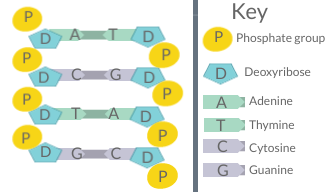
Erwin Chargaff discovers that in DNA, the amount of adenine equals thymine and guanine equals cytosine, crucial for the double helix model. #DNA #biochemistry
Chargaff's Rules By Christinelmiller - Own work, CC BY 4.0, https://commons.wikimedia.org/w/index.php?curid=79905324
May 6, 1952 CE
Rosalind Franklin's Photo 51
Rosalind Franklin captures X-ray diffraction image Photo 51, providing key evidence for the helical structure of DNA. #xraycrystallography #DNA
Rosalind Franklin's Photo 51 By Raymond Gosling - King's College London Archives: KDBP1/1/867. Taken from "The double helix: “Photo 51” revisited" by Thoru Pederson (https://doi.org/10.1096/fj.202000119), PD, https://en.wikipedia.org/w/index.php?curid=38068629
1952 CE
Hershey-Chase Experiment
Alfred Hershey and Martha Chase confirm that DNA, not protein, is the genetic material using bacteriophages. #virology #molecularbiology
Hershey-Chase Experiment By Thomasione - Modified from German Wikipedia [1], GFDL, https://commons.wikimedia.org/w/index.php?curid=15034881
Apr 25, 1953 CE
Watson and Crick Propose Double Helix
James Watson and Francis Crick publish the double helix model of DNA, revolutionizing molecular biology. #DNA #structure
Watson and Crick Propose Double Helix By 84user adapting file originally uploaded by Richard Wheeler (Zephyris) at en.wikipedia - Derived from File:DNA orbit animated.gif originally from here., CC BY-SA 3.0, https://commons.wikimedia.org/w/index.php?curid=6285050
1958 CE
Meselson-Stahl Experiment
Matthew Meselson and Franklin Stahl demonstrate that DNA replication is semi-conservative using isotopic labeling. #DNAreplication #molecularbiology
1961 CE
Nirenberg Cracks the Genetic Code
Marshall Nirenberg and Heinrich Matthaei demonstrate that the codon UUU codes for phenylalanine, beginning the deciphering of the genetic code. #geneticcode #translation
Nirenberg Cracks the Genetic Code By The original uploader was Sverdrup at English Wikipedia. Vectorized by: User:VectorVoyager - Vectorization of https://commons.wikimedia.org/wiki/File:RNA-codon.png, Public domain, https://commons.wikimedia.org/w/index.php?curid=124414787
1961 CE
Discovery of Messenger RNA
François Jacob and Jacques Monod propose the existence of messenger RNA (mRNA) as the intermediate between DNA and protein. #RNA #genetics
Discovery of Messenger RNA By National Human Genome Research Institute, NIH - Own work using: mRNA illustration, NIH, Public domain, https://commons.wikimedia.org/w/index.php?curid=126381443
1963 CE
Ramachandran Plot for Protein Structure
G.N. Ramachandran develops the Ramachandran plot, a powerful tool for visualizing allowed protein backbone conformations. #biophysics #proteinstructure
Ramachandran Plot for Protein Structure By Dcrjsr - Own work, CC BY 3.0, https://commons.wikimedia.org/w/index.php?curid=15230457
1966 CE
Khorana Completes Genetic Code Table
Har Gobind Khorana synthesizes the first complete gene and confirms the triplet nature of the genetic code. #genetics #biochemistry
Khorana Completes Genetic Code Table By Unknown author - http://www.nobelprize.org/nobel_prizes/medicine/laureates/1968/, Public domain, https://commons.wikimedia.org/w/index.php?curid=194932927
1967 CE
Discovery of DNA Ligase
DNA ligase, an enzyme that joins DNA strands, is discovered, enabling recombinant DNA technology. #enzymes #molecularbiology
Discovery of DNA Ligase By Tom Ellenberger, Washington University School of Medicine in St. Louis. - Biomedical Beat, Cool Image Gallery, Public domain, https://commons.wikimedia.org/w/index.php?curid=1604274
1968 CE
Okazaki Fragments Discovered
Reiji and Tsuneko Okazaki discover discontinuous DNA replication fragments on the lagging strand, now called Okazaki fragments. #DNAreplication #japan
Okazaki Fragments Discovered By David O Morgan - The Cell Cycle. Principles of Control., Attribution, https://commons.wikimedia.org/w/index.php?curid=89426950
1970 CE
Discovery of Restriction Enzymes
Hamilton Smith and Kent Wilcox isolate the first restriction enzyme, HindII, enabling precise DNA cutting. #biotechnology #enzymes
1970 CE
Discovery of Reverse Transcriptase
Howard Temin and David Baltimore independently discover reverse transcriptase in retroviruses, enabling RNA to DNA conversion. #virology #molecularbiology
Discovery of Reverse Transcriptase By Thomas Splettstoesser (www.scistyle.com) - Own work, CC BY-SA 3.0, https://commons.wikimedia.org/w/index.php?curid=33598425
1972 CE
First Recombinant DNA Molecule
Paul Berg creates the first recombinant DNA molecule by combining DNA from different species, launching genetic engineering. #geneticengineering #biotechnology
First Recombinant DNA Molecule By Unknown author - http://profiles.nlm.nih.gov/CD/B/B/L/L/, Public domain, https://commons.wikimedia.org/w/index.php?curid=3702286
1975 CE
Sanger Develops DNA Sequencing
Frederick Sanger introduces the 'dideoxy' chain-termination method for DNA sequencing, later used for the Human Genome Project. #biotechnology #sequencing
Sanger Develops DNA Sequencing By Estevezj - Own work, CC BY-SA 3.0, https://commons.wikimedia.org/w/index.php?curid=23264166
1976 CE
First Genetic Engineering Company Founded
Genentech, the first biotechnology company, is founded by Robert A. Swanson and Herbert Boyer to produce human proteins using recombinant DNA. #biotech #industry
1977 CE
Discovery of Introns and RNA Splicing
Phillip Sharp and Richard Roberts independently discover split genes (introns) and RNA splicing in adenovirus. #molecularbiology #genetics
1982 CE
Discovery of Ribozymes
Thomas Cech and Sidney Altman independently discover that RNA can act as a catalyst (ribozyme), challenging the protein-only dogma. #RNA #catalysis
Discovery of Ribozymes By William G. Scott - Own work, CC BY-SA 3.0, https://commons.wikimedia.org/w/index.php?curid=2257831
1983 CE
Kary Mullis Invents PCR
Kary Mullis develops the polymerase chain reaction (PCR) technique, exponentially amplifying specific DNA sequences. #biotechnology #PCR
Kary Mullis Invents PCR By Madprime - Own work, CC0, https://commons.wikimedia.org/w/index.php?curid=2104468
1984 CE
Discovery of Telomeres and Telomerase
Elizabeth Blackburn and Carol Greider identify telomeres and the enzyme telomerase, unraveling chromosome end replication. #aging #genetics
Discovery of Telomeres and Telomerase By U.S. Department of Energy Human Genome Program - http://science.nasa.gov/media/medialibrary/2006/03/16/22mar_telomeres_resources/caps.gif, Public domain, https://commons.wikimedia.org/w/index.php?curid=5234303
1985 CE
First Automated DNA Sequencer
Applied Biosystems introduces the first automated DNA sequencer, accelerating genome projects. #sequencing #technology
Oct 1, 1990 CE
Human Genome Project Launched
An international consortium begins the Human Genome Project to sequence the entire human genome, completed in 2003. #genomics #research
Human Genome Project Launched By U.S. Department of Energy, Human Genome Project - http://www.ornl.gov/hgmis, Public domain, https://commons.wikimedia.org/w/index.php?curid=2485616
1995 CE
First Bacterial Genome Sequenced
The entire genome of Haemophilus influenzae is sequenced by J. Craig Venter's team, the first complete genome of a free-living organism. #genomics #bacteria
First Bacterial Genome Sequenced By Stefan Walkowski - Own work, CC BY-SA 4.0, https://commons.wikimedia.org/w/index.php?curid=41492226
1998 CE
RNA Interference Discovered
Andrew Fire and Craig Mello discover RNA interference (RNAi), a mechanism for gene silencing by double-stranded RNA. #RNAi #genetics
RNA Interference Discovered By Dan Cojocari ✉·✍· - Own, This W3C-unspecified vector image was created with Adobe Illustrator., CC BY-SA 3.0, https://commons.wikimedia.org/w/index.php?curid=8697221
2000 CE
Draft Human Genome Announced
The Human Genome Project and Celera Genomics jointly announce a draft sequence of the human genome. #genomics #milestone
Apr 14, 2003 CE
Human Genome Project Completed
The Human Genome Project finishes sequencing the entire human genome, two years ahead of schedule. #genomics #achievement
2005 CE
First Next-Generation Sequencing Platform
454 Life Sciences launches the first next-generation DNA sequencer, massively increasing sequencing speed and reducing cost. #sequencing #innovation
2006 CE
DNA Origami Developed
Paul Rothemund introduces DNA origami, a method for creating nanoscale shapes using self-assembling DNA strands. #nanotechnology #DNA
DNA Origami Developed By Origamimonkey - Own work, CC BY-SA 3.0, https://commons.wikimedia.org/w/index.php?curid=23081745
2006 CE
Yamanaka Discovers Induced Pluripotent Stem Cells
Shinya Yamanaka discovers that somatic cells can be reprogrammed into pluripotent stem cells (iPSCs) using four transcription factors. #stemcells #regenerativemedicine
Yamanaka Discovers Induced Pluripotent Stem Cells By NIH Image Gallery from Bethesda, Maryland, USA - Human induced pluripotent stem cell colony, Public domain, https://commons.wikimedia.org/w/index.php?curid=114900547
2009 CE
First Single-Cell Genome Sequencing
Techniques for sequencing the genome of a single cell are developed, enabling analysis of heterogeneous cell populations. #genomics #singlecell
Jun 28, 2012 CE
CRISPR-Cas9 Gene Editing Published
Emmanuelle Charpentier and Jennifer Doudna publish the use of CRISPR-Cas9 as a programmable gene-editing tool, revolutionizing molecular biology. #CRISPR #geneediting
CRISPR-Cas9 Gene Editing Published By Boghog - Own work, CC BY-SA 4.0, https://commons.wikimedia.org/w/index.php?curid=68597347
2014 CE
First 3D Structure of Nucleosome Solved
The high-resolution structure of the nucleosome core particle is solved, providing detailed insights into chromatin organization. #chromatin #structuralbiology
First 3D Structure of Nucleosome Solved By David O Morgan - The Cell Cycle. Principles of Control., Attribution, https://commons.wikimedia.org/w/index.php?curid=89674546
2015 CE
First Mitochondrial DNA Replacement Therapy
The UK approves and pioneers mitochondrial replacement therapy to prevent inherited mitochondrial diseases. #genetherapy #ethics
Nov 28, 2018 CE
CRISPR Babies Controversy
He Jiankui announces the birth of the first gene-edited babies using CRISPR, sparking worldwide ethical debate. #CRISPR #ethics
CRISPR Babies Controversy By The He Lab - This image has been extracted from another file, CC BY 3.0, https://commons.wikimedia.org/w/index.php?curid=74768423
Oct 7, 2020 CE
Nobel Prize for CRISPR-Cas9
Emmanuelle Charpentier and Jennifer Doudna win the Nobel Prize in Chemistry for developing CRISPR-Cas9 gene editing. #award #CRISPR
Nobel Prize for CRISPR-Cas9 By Gösta Florman (1831–1900) / The Royal Library - Sweden.se credits image to www.imagebank.sweden.se, Gösta Florman / The Royal Library, Public domain, https://commons.wikimedia.org/w/index.php?curid=2532726
2021 CE
First Complete Human Telomere-to-Telomere Sequence
The Telomere-to-Telomere consortium publishes the first complete, gapless sequence of a human genome. #genomics #human
2022 CE
CRISPR-Based Diagnostics for COVID-19
CRISPR-based rapid diagnostic tests for SARS-CoV-2 are developed and deployed, showcasing the versatility of gene-editing tools. #diagnostics #pandemic