Molecular Biology & DNA Architecture: Foundational Epochs & Key Milestones
Encyclopedia/1. The Cosmos & The Natural World/5. Life Sciences • Curated by Admin Timeline.sg
This timeline traces the foundational epochs and key milestones in molecular biology and DNA architecture, from ancient theories of heredity to modern genomic editing. It highlights seminal discoveries, influential figures, and technological breakthroughs that shaped our understanding of the molecular basis of life.
Chronological Storyline (45 Milestones)
500 BCE
Ancient Greek theories of pangenesis
Ancient Greek philosophers like Hippocrates and Aristotle propose early theories of heredity, including pangenesis, suggesting that particles from all body parts are transmitted to offspring. #history #biology
Ancient Greek theories of pangenesis By Ian Alexander - Own work, CC BY-SA 4.0, https://commons.wikimedia.org/w/index.php?curid=62047504
300 BCE
Aristotle's scala naturae and inheritance
Aristotle categorizes living organisms and writes on inheritance, influencing biological thought for centuries. #history #biology
Aristotle's scala naturae and inheritance By SUBnormali Team Original uploader was Yoruno at it.wikipedia - Transferred from it.wikipedia (Original text : subnormali-team.blogspot.com), CC BY-SA 3.0, https://commons.wikimedia.org/w/index.php?curid=6381781
1025 CE
Avicenna's Canon of Medicine on heredity
Persian polymath Avicenna writes about heredity and infectious diseases in his influential medical encyclopedia, touching on ideas of inheritance. #history #medicine
Avicenna's Canon of Medicine on heredity By Coffeetalkh - Own work, CC BY-SA 3.0, https://commons.wikimedia.org/w/index.php?curid=11906621
1665 CE
Hooke discovers cells
Robert Hooke observes cork cells under a microscope and coins the term 'cell', laying the foundation for cell theory. #microscopy #biology
Hooke discovers cells By Mary Beale - https://arthistoryproject.com/artists/mary-beale/portrait-of-a-mathematician/, Public domain, https://commons.wikimedia.org/w/index.php?curid=92677611
1676 CE
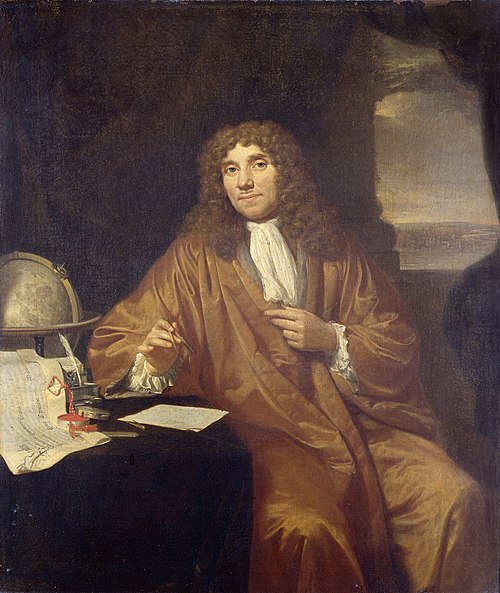
Leeuwenhoek observes bacteria and spermatozoa
Antonie van Leeuwenhoek uses improved microscopes to observe bacteria and sperm cells, providing early evidence of microscopic life and gametes. #microscopy #biology
Leeuwenhoek observes bacteria and spermatozoa By Jan Verkolje - http://www.rijksmuseum.nl/collectie/SK-A-957, Public domain, https://commons.wikimedia.org/w/index.php?curid=34320547
1831 CE
Brown describes the cell nucleus
Robert Brown identifies and describes the cell nucleus in orchid cells, a key organelle central to heredity. #biology #cellbiology
Brown describes the cell nucleus By TenOfAllTrades at English Wikipedia - Own work, Public domain, https://commons.wikimedia.org/w/index.php?curid=1583880
1839 CE
Schleiden and Schwann propose cell theory
Matthias Schleiden and Theodor Schwann formulate cell theory, stating that all living organisms are composed of cells. #biology #celltheory
1859 CE
Darwin publishes On the Origin of Species
Charles Darwin presents the theory of evolution by natural selection, emphasizing inheritance and variation. #evolution #biology
Darwin publishes On the Origin of Species By John Murray, Publisher - This image has an extracted file: Origin of Species.jpg., Public domain, https://commons.wikimedia.org/w/index.php?curid=320416
1865 CE
Mendel presents laws of inheritance
Gregor Mendel presents his experiments on pea plants, establishing the fundamental laws of heredity and introducing the concept of genes. #genetics #history
Mendel presents laws of inheritance By Unknown author - NIH, Public domain, https://commons.wikimedia.org/w/index.php?curid=1394893
1869 CE
Miescher isolates DNA as 'nuclein'
Friedrich Miescher discovers a substance he calls 'nuclein' in white blood cell nuclei, later identified as DNA. #biochemistry #history
Miescher isolates DNA as 'nuclein' By Unknown author - copied from http://www.pbs.org/wgbh/nova/photo51/images/befo-miescher.jpg, Public domain, https://commons.wikimedia.org/w/index.php?curid=789048
1880 CE
Flemming describes mitosis and chromosomes
Walther Flemming observes cell division and describes chromosomes, coining the term 'mitosis'. #cellbiology #cytogenetics
Flemming describes mitosis and chromosomes By Unknown author - [1] + [2], Public domain, https://commons.wikimedia.org/w/index.php?curid=20367236
1900 CE
Rediscovery of Mendel's work
Hugo de Vries, Carl Correns, and Erich von Tschermak independently rediscover Mendel's laws, sparking modern genetics. #genetics #history
1902 CE
Sutton and Boveri propose chromosomal theory of inheritance
Theodor Boveri and Walter Sutton independently propose that chromosomes carry hereditary units, linking Mendel's factors to chromosomes. #genetics #cytology
Sutton and Boveri propose chromosomal theory of inheritance By Walter_sutton.jpg: Unknown Theodor_Boveri.jpg: Unknown derivative work: Earthdirt (talk) - Walter_sutton.jpg Theodor_Boveri.jpg, Public domain, https://commons.wikimedia.org/w/index.php?curid=8550969
1909 CE
Johannsen coins the terms 'gene', 'genotype', and 'phenotype'
Danish botanist Wilhelm Johannsen introduces the term 'gene' to describe the unit of heredity. #genetics #terminology
Johannsen coins the terms 'gene', 'genotype', and 'phenotype' By Unknown author - The History of Biology de Erik Nordenskiöld, Ed. Knopf, 1928 (domaine public), Copyrighted free use, https://commons.wikimedia.org/w/index.php?curid=743923
1915 CE
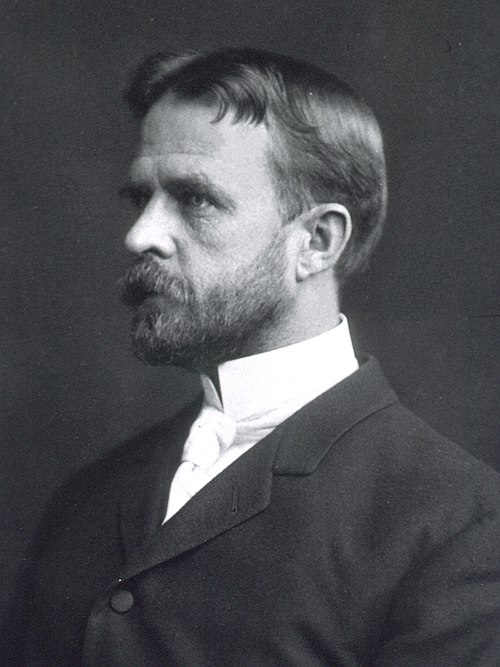
Morgan and Drosophila establish gene mapping
Thomas Hunt Morgan and his team use fruit flies to map genes on chromosomes, demonstrating linear arrangement. #genetics #drosophila
Morgan and Drosophila establish gene mapping By Unknown author - http://resource.nlm.nih.gov/101422222, Public domain, https://commons.wikimedia.org/w/index.php?curid=549067
1928 CE
Griffith's experiment on bacterial transformation
Frederick Griffith discovers transformation in bacteria, hinting at a 'transforming principle' later identified as DNA. #genetics #bacteriology
Griffith's experiment on bacterial transformation By No machine-readable author provided. Madprime assumed (based on copyright claims). - No machine-readable source provided. Own work assumed (based on copyright claims)., CC BY-SA 3.0, https://commons.wikimedia.org/w/index.php?curid=1819839
1931 CE
McClintock discovers transposable elements in corn
Barbara McClintock identifies mobile genetic elements (transposons) in maize, revolutionizing views of gene regulation. #genetics #maize
McClintock discovers transposable elements in corn By Smithsonian Institution/Science Service; Restored by Adam Cuerden - Flickr: Barbara McClintock (1902-1992)Smithsonian original, Public domain, https://commons.wikimedia.org/w/index.php?curid=25629182
1944 CE
Avery, MacLeod, and McCarty identify DNA as the transforming principle
Oswald Avery, Colin MacLeod, and Maclyn McCarty demonstrate that DNA, not protein, carries genetic information. #genetics #molecularbiology
Avery, MacLeod, and McCarty identify DNA as the transforming principle By Bbkkk - self-made in the Naturkunste Museum in Berlin, CC BY-SA 4.0, https://commons.wikimedia.org/w/index.php?curid=3679283
1950 CE
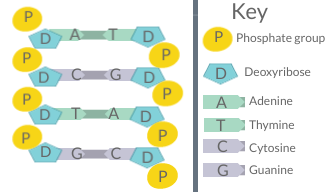
Chargaff's rules on DNA base composition
Erwin Chargaff discovers that in DNA, adenine equals thymine and guanine equals cytosine, crucial for later structural models. #biochemistry #DNA
Chargaff's rules on DNA base composition By Christinelmiller - Own work, CC BY 4.0, https://commons.wikimedia.org/w/index.php?curid=79905324
1952 CE
Hershey-Chase experiment confirms DNA as genetic material
Alfred Hershey and Martha Chase use bacteriophages to show that DNA, not protein, transmits genetic information. #genetics #virology
Hershey-Chase experiment confirms DNA as genetic material By Thomasione - Modified from German Wikipedia [1], GFDL, https://commons.wikimedia.org/w/index.php?curid=15034881
1953 CE
Watson and Crick propose the double helix structure of DNA
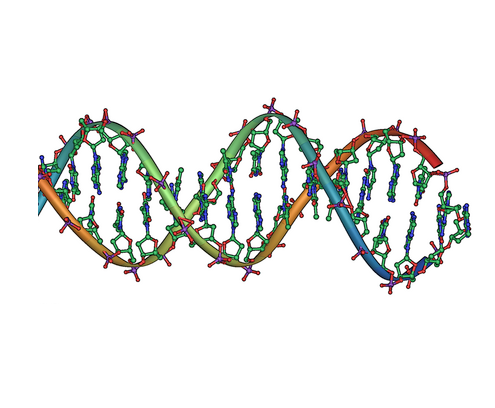
James Watson and Francis Crick, with key data from Rosalind Franklin and Maurice Wilkins, publish the double helix model of DNA. #DNA #NobelPrize
Watson and Crick propose the double helix structure of DNA By Unknown author, Public domain, https://commons.wikimedia.org/w/index.php?curid=510095
1955 CE
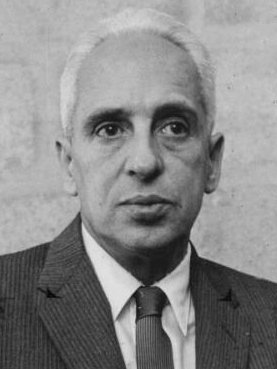
Ochoa discovers RNA polymerase
Severo Ochoa isolates the enzyme that synthesizes RNA, enabling studies of transcription. #biochemistry #molecularbiology
Ochoa discovers RNA polymerase By Irwin Gooen (NY University) - File:Severo Ochoa 1958.jpg, Public domain, https://commons.wikimedia.org/w/index.php?curid=92733667
1956 CE
Kornberg discovers DNA polymerase
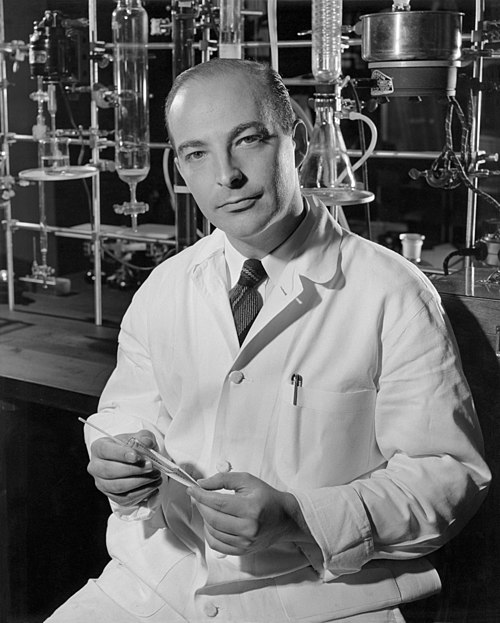
Arthur Kornberg identifies DNA polymerase I, the enzyme that synthesizes DNA. #biochemistry #molecularbiology
Kornberg discovers DNA polymerase By NIH History Office, https://www.flickr.com/people/124413887@N04 Restored by: Bammesk - https://www.flickr.com/photos/historyatnih/30828410210/, Public domain, https://commons.wikimedia.org/w/index.php?curid=90604243
1957 CE
Crick states the central dogma of molecular biology
Francis Crick articulates the central dogma: DNA → RNA → Protein, outlining the flow of genetic information. #molecularbiology #dogma
1958 CE
Meselson and Stahl prove semiconservative replication
Matthew Meselson and Franklin Stahl demonstrate that DNA replication is semiconservative. #DNA #replication
1961 CE
Nirenberg cracks the first codon of the genetic code
Marshall Nirenberg and Heinrich Matthaei discover that the RNA codon UUU codes for phenylalanine, breaking the genetic code. #genetics #biochemistry
Nirenberg cracks the first codon of the genetic code By NIH History Office from Bethesda - J. Heinreich Matthaei and Marshall Nirenberg, Public domain, https://commons.wikimedia.org/w/index.php?curid=82867048
1961 CE
Jacob and Monod propose the operon model
François Jacob and Jacques Monod introduce the operon model for gene regulation in bacteria. #genetics #molecularbiology
1965 CE
Holley sequences the first tRNA
Robert W. Holley determines the nucleotide sequence of alanine tRNA from yeast, a landmark in RNA biology. #molecularbiology #RNA
Holley sequences the first tRNA By Unknown - http://www.nobelprize.org/nobel_prizes/medicine/laureates/1968/, PD-Sweden, https://en.wikipedia.org/w/index.php?curid=34693347
1970 CE
Baltimore and Temin discover reverse transcriptase
Howard Temin and David Baltimore independently discover reverse transcriptase, enabling RNA to DNA conversion. #virology #molecularbiology
Baltimore and Temin discover reverse transcriptase By Thomas Splettstoesser (www.scistyle.com) - Own work, CC BY-SA 3.0, https://commons.wikimedia.org/w/index.php?curid=33598425
1972 CE
Berg creates the first recombinant DNA molecule
Paul Berg successfully combines DNA from different species, founding genetic engineering. #biotechnology #dna
Berg creates the first recombinant DNA molecule By Unknown author - http://profiles.nlm.nih.gov/CD/B/B/L/L/, Public domain, https://commons.wikimedia.org/w/index.php?curid=3702286
1975 CE
Sanger develops the first DNA sequencing method
Frederick Sanger introduces the 'plus and minus' method for DNA sequencing, later refined as the Sanger method. #genomics #technology
Sanger develops the first DNA sequencing method By Estevezj - Own work, CC BY-SA 3.0, https://commons.wikimedia.org/w/index.php?curid=23264166
1977 CE
Discovery of introns and RNA splicing
Phillip Sharp and Richard Roberts independently discover split genes and splicing in adenovirus. #molecularbiology #RNA
Discovery of introns and RNA splicing By Original: Iinaba Vector: Masumrezarock100 - https://commons.wikimedia.org/w/index.php?title=File:Splicesome.pdf, CC BY-SA 4.0, https://commons.wikimedia.org/w/index.php?curid=115983282
1983 CE
Mullis invents the polymerase chain reaction (PCR)
Kary Mullis develops PCR, a technique to amplify DNA exponentially, revolutionizing molecular biology. #biotechnology #DNA
Mullis invents the polymerase chain reaction (PCR) By Madprime - Own work, CC0, https://commons.wikimedia.org/w/index.php?curid=2104468
1985 CE
Jeffreys develops DNA fingerprinting
Alec Jeffreys discovers repetitive DNA patterns and uses them for individual identification. #genetics #forensics
Jeffreys develops DNA fingerprinting By Jerome Walker - Own work, created from GDFL work created by Michael Ströck, Public domain, https://commons.wikimedia.org/w/index.php?curid=934419
1990 CE
Launch of the Human Genome Project
An international effort to sequence the entire human genome begins, aiming to map all human genes. #genomics #medicine
Launch of the Human Genome Project By U.S. Department of Energy, Human Genome Project - http://www.ornl.gov/hgmis, Public domain, https://commons.wikimedia.org/w/index.php?curid=2485616
1996 CE
First complete genome sequence of a free-living organism (H. influenzae)
The first complete genome of a bacterium, Haemophilus influenzae, is sequenced, demonstrating whole-genome shotgun sequencing. #genomics #microbiology
First complete genome sequence of a free-living organism (H. influenzae) By Stefan Walkowski - Own work, CC BY-SA 4.0, https://commons.wikimedia.org/w/index.php?curid=41492226
2001 CE
Publication of the first draft of the human genome
The Human Genome Project and Celera Genomics publish the first draft of the human genome sequence. #genomics #history
2003 CE
ENCODE project launched
The Encyclopedia of DNA Elements (ENCODE) project aims to identify functional elements in the human genome. #genomics #bioinformatics
2008 CE
First complete genome of a cancer patient sequenced
The genome of a leukemia patient is sequenced, revealing somatic mutations and advancing precision oncology. #genomics #cancer
2012 CE
CRISPR-Cas9 genome editing demonstrated
Emmanuelle Charpentier and Jennifer Doudna show that CRISPR-Cas9 can be programmed to edit specific DNA sequences, revolutionizing genetic engineering. #genetics #biotechnology
CRISPR-Cas9 genome editing demonstrated By Deposition authors: Nishimasu, H., Ishitani, R., Nureki, O.; Visualization author: Synpath - Atom coordinates: https://www.rcsb.org/structure/4OO8; Visualization: Own work, CC0, https://commons.wikimedia.org/w/index.php?curid=133423568
2014 CE
First synthetic yeast chromosome built
Scientists synthesize the first yeast chromosome, a milestone in synthetic biology. #syntheticbiology #genomics
2016 CE
First human embryo gene editing reported in China
Chinese scientists report editing genes in human embryos, sparking ethical debates. #genetics #bioethics
First human embryo gene editing reported in China By Unknown author, Public domain, https://commons.wikimedia.org/w/index.php?curid=488192
2019 CE
First CRISPR therapy approved for clinical use (CTX001)
CTX001, a CRISPR-based therapy for sickle cell disease and beta-thalassemia, enters clinical trials. #genetherapy #CRISPR
2020 CE
Emmanuelle Charpentier and Jennifer Doudna win Nobel Prize in Chemistry for CRISPR
The Nobel Prize recognizes the development of CRISPR-Cas9 as a genome editing tool. #NobelPrize #geneediting
2022 CE
Complete human genome sequence (T2T consortium) published
The Telomere-to-Telomere consortium publishes the first truly complete human genome sequence, filling gaps. #genomics #humangenome