Ming & Qing Dynasties: Zheng He Voyages, Forbidden City & High Qing Era
Encyclopedia/3. History, Societies & Civilizations/01. East Asian Civilizations/01. Chinese Dynasties • Curated by Admin Timeline.sg
The Ming and Qing dynasties represent the final imperial era of China, marked by monumental achievements such as Zheng He's treasure voyages, the construction of the Forbidden City, and the High Qing prosperity under Kangxi and Qianlong. This period saw China's global maritime exploration, cultural flourishing, and eventual decline leading to the end of imperial rule in 1912.
Chronological Storyline (48 Milestones)
Jan 23, 1368 CE
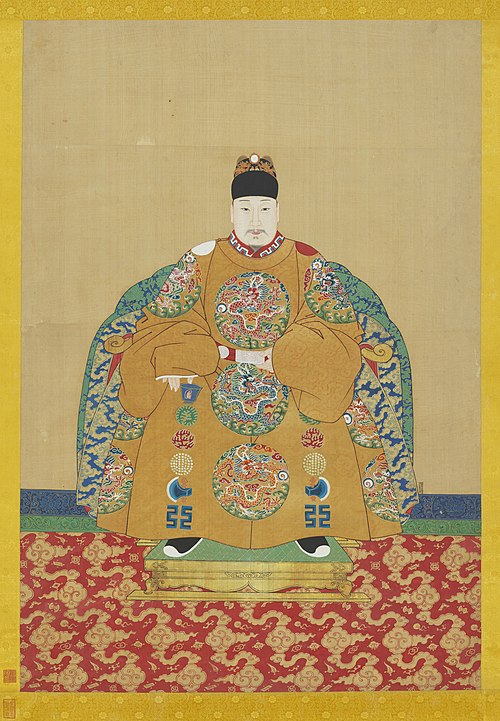
Hongwu Emperor Founds Ming Dynasty
Zhu Yuanzhang proclaimed himself Hongwu Emperor in Nanjing, establishing the Ming Dynasty after overthrowing the Mongol-led Yuan Dynasty. His reign focused on restoring Han Chinese rule, agricultural reforms, and centralizing power. #MingDynasty #ChineseHistory
Hongwu Emperor Founds Ming Dynasty By Unknown author - Digitized by NPM; image is directly from Shuge, Public domain, https://commons.wikimedia.org/w/index.php?curid=122470843
1370 CE
Ming Civil Service Examinations Restored
The Hongwu Emperor reinstated the Confucian civil service examinations, emphasizing Neo-Confucian texts. This system became the primary route to officialdom, shaping Ming governance and society. #MingDynasty #CivilService
Ming Civil Service Examinations Restored By Qiu Ying (仇英) (attributed) - In the collection of the National Palace Museum, Public domain, https://commons.wikimedia.org/w/index.php?curid=598340
1380 CE
Abolition of the Chancellor Position
The Hongwu Emperor executed Chancellor Hu Weiyong and abolished the position, centralizing power directly under the emperor. This move eliminated a key check on imperial authority and strengthened autocracy. #MingDynasty #Politics
Jul 13, 1402 CE
Yongle Emperor Seizes Throne
Zhu Di, Prince of Yan, launched a successful coup against his nephew the Jianwen Emperor, becoming the Yongle Emperor. His reign marked a shift to Beijing as the primary capital and ambitious state projects. #MingDynasty #Emperor
Yongle Emperor Seizes Throne By Unknown author - Digitized by NPM; image is directly from Shuge, Public domain, https://commons.wikimedia.org/w/index.php?curid=112316499
1403 CE
Yongle Encyclopedia Commissioned
The Yongle Emperor ordered the compilation of the Yongle Encyclopedia, a massive collection of Chinese knowledge. Completed in 1408, it contained over 22,000 manuscript rolls, showcasing Ming scholarship. #MingDynasty #Encyclopedia
Yongle Encyclopedia Commissioned By LW Yang - National Library of China, CC BY 2.0, https://commons.wikimedia.org/w/index.php?curid=71131094
Jul 11, 1405 CE
First Zheng He Voyage Begins
Admiral Zheng He departed from Nanjing with a fleet of over 300 ships, beginning the first of seven treasure voyages. These expeditions reached Southeast Asia, India, and East Africa, demonstrating Ming naval power. #MingDynasty #ZhengHe #MaritimeHistory
First Zheng He Voyage Begins By Marcin Konsek - Own work, CC BY-SA 4.0, https://commons.wikimedia.org/w/index.php?curid=51927875
1406 CE
Forbidden City Construction Starts
The Yongle Emperor ordered the construction of the Forbidden City in Beijing, moving the capital from Nanjing. The complex took 14 years to build, involving over a million workers, and became the imperial palace. #MingDynasty #Architecture
Forbidden City Construction Starts By Pixelflake - Own work, CC BY-SA 3.0, https://commons.wikimedia.org/w/index.php?curid=19989908
1407 CE
Zheng Reaches Calicut
During the first voyage, Zheng He's fleet arrived at Calicut, India, a major trading hub. This established diplomatic and trade relations with the Zamorin of Calicut, expanding Ming influence. #ZhengHe #MaritimeHistory
Zheng Reaches Calicut By Mr 037 - Own work, CC BY-SA 4.0, https://commons.wikimedia.org/w/index.php?curid=69236938
1409 CE
Second Zheng He Voyage
Zheng He embarked on his second voyage, primarily to bring envoys from Calicut and other states to China. The fleet visited Champa, Java, and Siam, reinforcing Ming tributary relationships. #ZhengHe #MaritimeHistory
1412 CE
Third Zheng He Voyage
The third voyage saw Zheng He's fleet reach Hormuz in the Persian Gulf, a key trade center. This expanded Ming reach into the Middle East, exchanging goods like silk and porcelain for spices and gems. #ZhengHe #MaritimeHistory
1413 CE
Fourth Zheng He Voyage
Zheng He's fourth voyage was the longest, reaching the Swahili coast of East Africa, including Malindi and Mogadishu. The fleet brought back exotic animals like giraffes, which were seen as auspicious. #ZhengHe #MaritimeHistory
1417 CE
Fifth Zheng He Voyage
The fifth voyage focused on returning envoys from various states, including those from Arabia and East Africa. Zheng He also suppressed piracy in the Strait of Malacca, securing trade routes. #ZhengHe #MaritimeHistory
1420 CE
Forbidden City Completed
The Forbidden City was officially completed, becoming the imperial palace for the Ming and Qing dynasties. The complex, with its 980 buildings, symbolized imperial power and Chinese architectural mastery. #MingDynasty #Architecture
Oct 28, 1421 CE
Beijing Becomes Official Capital
The Yongle Emperor formally moved the capital from Nanjing to Beijing, with the Forbidden City as the imperial seat. This shift solidified Beijing's role as the political center of China for centuries. #MingDynasty #Capital
Beijing Becomes Official Capital By N509FZ - Own work, CC BY 4.0, https://commons.wikimedia.org/w/index.php?curid=159610992
1421 CE
Sixth Zheng He Voyage
The sixth voyage was primarily to escort foreign envoys back to their countries, including those from Southeast Asia and India. It reaffirmed Ming tributary networks without major new discoveries. #ZhengHe #MaritimeHistory
Aug 12, 1424 CE
Yongle Emperor Dies
The Yongle Emperor died during a military campaign against the Mongols. His reign left a legacy of expansive projects, but also strained state resources, leading to a shift in foreign policy. #MingDynasty #Emperor
1431 CE
Seventh Zheng He Voyage
The final treasure voyage under Zheng He set sail, revisiting many previous destinations including Hormuz and East Africa. This voyage was the largest, but after Zheng He's death in 1433, the expeditions were halted. #ZhengHe #MaritimeHistory
1433 CE
Zheng He Dies
Admiral Zheng He died during the return leg of the seventh voyage, likely in Calicut. His death marked the end of China's era of maritime exploration, as subsequent emperors discontinued such expeditions. #ZhengHe #MaritimeHistory
Sep 1, 1449 CE
Tumu Crisis: Ming Emperor Captured
The Zhengtong Emperor led a disastrous campaign against the Oirat Mongols and was captured at the Battle of Tumu. This event severely weakened Ming military prestige and led to a period of political instability. #MingDynasty #Military
Tumu Crisis: Ming Emperor Captured By SY - Own work. Based on: Twitchett, Denis C; Grimm, Tilemann (1988). "The Cheng-t'ung, Ching-t'ai, and T'ien-shun reigns, 1436—1464". In Mote, Frederick W.; Twitchett, Denis C (eds.). The Cambridge History of China Volume 7: The Ming Dynasty, 1368–1644, Part 1. Cambridge: Cambridge University Press. ISBN 0521243327. p. 323. Kierman, Frank A.; Fairbank, John King (2013). Chinese Ways in Warfare. Harvard University Press. ISBN 9780674182042. p. 257., CC BY-SA 4.0, https://commons.wikimedia.org/w/index.php?curid=62675501
Feb 11, 1457 CE
Tianshun Emperor Restored
After being released from captivity, the former Zhengtong Emperor staged a coup and reclaimed the throne as the Tianshun Emperor. His restoration ended the regency of his brother, the Jingtai Emperor. #MingDynasty #Politics
Jun 8, 1505 CE
Hongzhi Emperor Dies
The Hongzhi Emperor, known for his frugality and effective governance, died after a reign that stabilized the Ming economy. His death marked the end of a relatively peaceful period before later decline. #MingDynasty #Emperor
Hongzhi Emperor Dies By Unknown author - Musée national du palais, Public domain, https://commons.wikimedia.org/w/index.php?curid=95721522
1550 CE
Altan Khan's Raid on Beijing
Mongol leader Altan Khan breached the Great Wall and raided the outskirts of Beijing, exposing Ming military weakness. This led to reforms in border defense and the eventual establishment of tribute trade. #MingDynasty #Mongols
Altan Khan's Raid on Beijing By Unknown author - https://web.archive.org/web/20061211080736/http://etudiant.univ-mlv.fr/~ehureaux/images/Altan_Khan.jpg, Public domain, https://commons.wikimedia.org/w/index.php?curid=5371738
1573 CE
Wanli Emperor Ascends Throne
The Wanli Emperor began his reign at age 10, initially guided by Grand Secretary Zhang Jizheng. His long reign saw economic growth but later descended into factionalism and imperial withdrawal. #MingDynasty #Emperor
Wanli Emperor Ascends Throne By Unknown author - Digitized by NPM; image is directly from Shuge, Public domain, https://commons.wikimedia.org/w/index.php?curid=83365624
1587 CE
Zhang Juzheng Dies
Grand Secretary Zhang Juzheng, who implemented sweeping reforms including the Single Whip tax system, died. His death led to a power vacuum and the Wanli Emperor's increasing disengagement from governance. #MingDynasty #Reform
Zhang Juzheng Dies By Rongshi - Own work, Public domain, https://commons.wikimedia.org/w/index.php?curid=73533485
1616 CE
Nurhaci Proclaims Later Jin Dynasty
Jurchen leader Nurhaci unified the Jurchen tribes and proclaimed the Later Jin dynasty, precursor to the Qing. He established the Eight Banners military system, laying the foundation for Manchu conquest. #QingDynasty #Manchu
Nurhaci Proclaims Later Jin Dynasty By Unknown author - Palace Museum, Beijing (故宫博物院), Public domain, https://commons.wikimedia.org/w/index.php?curid=181159761
Apr 25, 1644 CE
Li Zicheng Captures Beijing
Rebel leader Li Zicheng entered Beijing, and the Chongzhen Emperor committed suicide, ending the Ming Dynasty. Li's short-lived Shun dynasty failed to consolidate power, paving the way for Manchu invasion. #MingDynasty #Rebellion
Li Zicheng Captures Beijing By Sunatnight - Own work, CC BY-SA 3.0, https://commons.wikimedia.org/w/index.php?curid=155817229
Jun 6, 1644 CE
Manchu Entry into Beijing
Qing forces under Prince Dorgon entered Beijing after defeating Li Zicheng's army. The Shunzhi Emperor was installed as emperor, marking the beginning of Qing rule over China proper. #QingDynasty #Manchu
Manchu Entry into Beijing By Unknown author - https://www.dpm.org.cn/court/lineage/226262.html, Public domain, https://commons.wikimedia.org/w/index.php?curid=126879296
Feb 5, 1661 CE
Kangxi Emperor Ascends Throne
The Kangxi Emperor became emperor at age 8, with a regency led by four ministers. His reign, one of the longest in Chinese history, ushered in an era of stability, expansion, and cultural flourishing. #QingDynasty #Emperor
Kangxi Emperor Ascends Throne By AnonymousUnknown author Qing Dynasty Court Painter - Palace Museum, Beijing, Public domain, https://commons.wikimedia.org/w/index.php?curid=126877712
Jul 8, 1683 CE
Qing Conquest of Taiwan
Qing forces under Shi Lang defeated the Ming loyalist Kingdom of Tungning on Taiwan, incorporating the island into the empire. This ended the last major Ming resistance and expanded Qing control. #QingDynasty #Taiwan
Qing Conquest of Taiwan By Samhanin - 歡迎留言 (October 7th, 2014) 懷念的物!台北~總統府-正廳/台灣歷代國旗, Public domain, https://commons.wikimedia.org/w/index.php?curid=47964137
Aug 27, 1689 CE
Treaty of Nerchinsk Signed
The Qing and Russian Empires signed the Treaty of Nerchinsk, defining borders along the Amur River. It was China's first treaty with a European power, establishing diplomatic and trade relations. #QingDynasty #Diplomacy
Treaty of Nerchinsk Signed By Unknown (goverments of China/Russia) - https://k.sina.com.cn/article_5910774821_1604f442500100w60n.html, Public domain, https://commons.wikimedia.org/w/index.php?curid=119752696
1716 CE
Kangxi Dictionary Published
The Kangxi Dictionary, a comprehensive Chinese dictionary with over 47,000 characters, was completed. It became the standard reference for Chinese characters and a symbol of Qing scholarly achievement. #QingDynasty #Language
Kangxi Dictionary Published By Malcolm I'Anson - Photo taken of book in my possession, Public domain, https://commons.wikimedia.org/w/index.php?curid=78376761
Dec 20, 1722 CE
Kangxi Emperor Dies
The Kangxi Emperor died after a 61-year reign, leaving a stable and prosperous empire. His death led to a succession struggle, eventually won by his son Yinzhen, who became the Yongzheng Emperor. #QingDynasty #Emperor
1723 CE
Yongzheng Emperor Reforms
The Yongzheng Emperor initiated fiscal and administrative reforms, including cracking down on corruption and streamlining tax collection. His efficient but harsh rule strengthened Qing finances and central control. #QingDynasty #Reform
Yongzheng Emperor Reforms By Unknown author - https://www.dpm.org.cn/collection/paint/231803.html, Public domain, https://commons.wikimedia.org/w/index.php?curid=128355328
Oct 8, 1735 CE
Qianlong Emperor Ascends Throne
The Qianlong Emperor succeeded his father Yongzheng, beginning a 60-year reign that marked the height of Qing power. His rule saw territorial expansion, cultural projects, and economic prosperity. #QingDynasty #Emperor
Qianlong Emperor Ascends Throne By Giuseppe Castiglione - https://minghuaji.dpm.org.cn/paint/detail?id=420a006ed10d4e13b1075ba6e780f07a, Public domain, https://commons.wikimedia.org/w/index.php?curid=128011643
1747 CE
First Jinchuan Campaign
The Qing launched a costly campaign against the Jinchuan kingdom in Sichuan, part of the Ten Great Campaigns. The war demonstrated Qing military reach but also strained resources. #QingDynasty #Military
First Jinchuan Campaign By Unknown author - http://www.battle-of-qurman.com.cn/e/list.htm, Public domain, https://commons.wikimedia.org/w/index.php?curid=11988648
1755 CE
Conquest of Dzungar Khanate
Qing forces destroyed the Dzungar Khanate in Central Asia, incorporating Xinjiang into the empire. This campaign eliminated the last major nomadic threat and expanded Qing borders to their greatest extent. #QingDynasty #Expansion
Conquest of Dzungar Khanate By 钱维城 - 漠西蒙古, Public domain, https://commons.wikimedia.org/w/index.php?curid=12764582
1773 CE
Complete Library of the Four Treasuries Begins
The Qianlong Emperor ordered the compilation of the Siku Quanshu, a massive collection of Chinese classics. Completed in 1782, it contained over 36,000 volumes, but also involved censorship of anti-Manchu works. #QingDynasty #Culture
Complete Library of the Four Treasuries Begins By Ji, Yun, 1724-1805 - http://www.wdl.org/media/3020/service/thumbnail/6000x6000/1/1.jpg Gallery: http://www.wdl.org/en/item/3020/, Public domain, https://commons.wikimedia.org/w/index.php?curid=31402000
Sep 14, 1793 CE
Macartney Embassy to China
British diplomat Lord Macartney led a mission to the Qianlong court seeking trade concessions. The Qianlong Emperor rejected British requests, famously stating that China had no need for foreign goods. #QingDynasty #Diplomacy
Macartney Embassy to China By William Alexander - "A study of History", Arnold Toynbee (Original in the British Library's collection of Western Drawings [WD 961, f.57][1]), Public domain, https://commons.wikimedia.org/w/index.php?curid=2594135
Feb 9, 1796 CE
Qianlong Abdicates
The Qianlong Emperor abdicated in favor of his son, the Jiaqing Emperor, to avoid reigning longer than his grandfather Kangxi. He retained power as Retired Emperor until his death in 1799. #QingDynasty #Emperor
1796 CE
White Lotus Rebellion Begins
The White Lotus Rebellion, a millenarian uprising, broke out in central China, lasting until 1804. The rebellion exposed Qing military decline and fiscal strain, marking the beginning of the dynasty's decline. #QingDynasty #Rebellion
Mar 18, 1839 CE
Lin Zexu Destroys Opium
Imperial Commissioner Lin Zexu confiscated and destroyed over 20,000 chests of opium in Guangzhou, defying British traders. This action triggered the First Opium War, a turning point in Qing relations with the West. #QingDynasty #OpiumWar
Lin Zexu Destroys Opium By Lam Qua - Google Arts & Culture — portrait-of-lin-zexu-1885-1850/KgEU_tK2dT2yqQ, Public domain, https://commons.wikimedia.org/w/index.php?curid=49807007
Aug 29, 1842 CE
Treaty of Nanjing Signed
The Qing signed the Treaty of Nanjing, ending the First Opium War, ceding Hong Kong to Britain, and opening five treaty ports. This unequal treaty marked the start of China's 'Century of Humiliation'. #QingDynasty #OpiumWar
Treaty of Nanjing Signed By Painted by Captain John Platt, Bengal Volunteers. Engraved by John Burnet. - Anne S. K. Brown Military Collection, Public domain, https://commons.wikimedia.org/w/index.php?curid=12229605
Jan 11, 1851 CE
Taiping Rebellion Begins
Hong Xiuquan proclaimed the Taiping Heavenly Kingdom in Guangxi, launching a massive rebellion against the Qing. The conflict, lasting until 1864, caused tens of millions of deaths and devastated the country. #QingDynasty #Rebellion
Taiping Rebellion Begins By Wu Youru - https://www.battle-of-qurman.com.cn/e/hist.htm, Public domain, https://commons.wikimedia.org/w/index.php?curid=10326396
Aug 22, 1861 CE
Xianfeng Emperor Dies; Tongzhi Ascends
The Xianfeng Emperor died during the Second Opium War, leaving his young son Tongzhi as emperor. A regency led by Empress Dowagers Cixi and Ci'an took power, beginning Cixi's long influence. #QingDynasty #EmpressDowager
Xianfeng Emperor Dies; Tongzhi Ascends By John Yu Shuinling - Two Years with the Empress Dowager by Derling, Public domain, https://commons.wikimedia.org/w/index.php?curid=3080637
Jun 11, 1898 CE
Hundred Days' Reform
The Guangxu Emperor launched a series of modernization reforms inspired by Western models, including education and government changes. The reforms were abruptly ended by Empress Dowager Cixi's coup after 103 days. #QingDynasty #Reform
Hundred Days' Reform By Not identified - W. A. P. Martin (1901). The Lore of Cathay or the Intellect of China. New York: Fleming H. Revell Company. p. 18., Public domain, https://commons.wikimedia.org/w/index.php?curid=11307185
Jun 20, 1900 CE
Boxer Rebellion Begins
The Boxer Uprising, an anti-foreign and anti-Christian movement, besieged foreign legations in Beijing. The Qing court initially supported the Boxers, leading to intervention by the Eight-Nation Alliance. #QingDynasty #Rebellion
Boxer Rebellion Begins By Unknown author - Kaiserliche Marine, Public domain, https://commons.wikimedia.org/w/index.php?curid=10412587
Oct 10, 1911 CE
Wuchang Uprising
A military revolt in Wuchang sparked the Xinhai Revolution, leading to the collapse of Qing rule. Provincial declarations of independence followed, and the Qing court was forced to negotiate. #QingDynasty #Revolution
Wuchang Uprising By Unknown author, Public domain, https://commons.wikimedia.org/w/index.php?curid=685617
Feb 12, 1912 CE
Puyi Abdicates
The last Qing emperor, Puyi, abdicated under a republican agreement, ending 2,000 years of imperial rule in China. The Republic of China was established, with Sun Yat-sen as provisional president. #QingDynasty #EndOfEmpire
Puyi Abdicates By Unknown author - https://www.pinterest.co.uk/amp/pin/471822498445876797/, Public domain, https://commons.wikimedia.org/w/index.php?curid=158392960