Meteorology & Climate Science: Atmospheric Circulation to Global Warming
Encyclopedia/1. The Cosmos & The Natural World/4. Earth Sciences/02. Meteorology & Climate Science • Curated by Admin Timeline.sg
From the invention of the barometer in 1643 to modern climate models, this timeline traces key milestones in meteorology and climate science, including the discovery of atmospheric circulation, the greenhouse effect, and international efforts to understand and address global warming.
Chronological Storyline (40 Milestones)
1643 CE
Torricelli invents the barometer
Evangelista Torricelli creates the first mercury barometer, demonstrating that air has weight and establishing the principle of atmospheric pressure. This invention is fundamental to weather forecasting. #meteorology #science
Torricelli invents the barometer By Unknown author, CC BY-SA 3.0, https://commons.wikimedia.org/w/index.php?curid=295309
1667 CE
Hooke invents the anemometer
Robert Hooke devises a wind gauge, an early anemometer, to measure wind speed. This tool becomes essential for meteorological observations. #weather #technology
Hooke invents the anemometer By photographer: Archival Photograph by Mr. Sean Linehan, NOS, NGS - The Aims and Methods of Meteorological Work by Cleveland Abbe, in Maryland Weather Service, Johns Hopkins Press, Baltimore, 1899. Volume I, page 316. NOAA's National Weather Service (NWS) Collection, Image ID: wea00920. Source link: http://www.photolib.noaa.gov/htmls/wea00920.htm Direct link to image: http://www.photolib.noaa.gov/bigs/wea00920.jpg, Public domain, https://commons.wikimedia.org/w/index.php?curid=9682749
1686 CE
Halley maps trade winds
Edmond Halley publishes the first meteorological chart showing the global distribution of trade winds, linking solar heating to atmospheric circulation. #meteorology #history
Halley maps trade winds By KVDP - Own work, Public domain, https://commons.wikimedia.org/w/index.php?curid=8158719
1724 CE
Fahrenheit scale introduced
Daniel Gabriel Fahrenheit proposes the Fahrenheit temperature scale, providing a standard for thermometric measurements. This scale is still used in the U.S. #temperature #science
Fahrenheit scale introduced By Stilfehler - Own work, Public domain, https://commons.wikimedia.org/w/index.php?curid=1179224
1735 CE
Hadley explains atmospheric circulation
George Hadley describes the Hadley cell, explaining how solar heating at the equator drives trade winds and the general circulation of the atmosphere. #climate #science
Hadley explains atmospheric circulation By Kaidor - Own work based on: NASA depiction of earth global atmospheric circulation.jpg, CC BY-SA 3.0, https://commons.wikimedia.org/w/index.php?curid=23902538
1742 CE
Celsius scale proposed
Anders Celsius proposes a centigrade temperature scale, later adopted globally as the Celsius scale. It becomes the standard for scientific work. #temperature #science
Celsius scale proposed By Ulflund - Own work, CC0, https://commons.wikimedia.org/w/index.php?curid=78884207
1802 CE
Howard classifies clouds
Luke Howard publishes a classification of cloud types (cirrus, cumulus, stratus, nimbus), establishing a systematic nomenclature still used today. #meteorology #clouds
Howard classifies clouds By NASA/Expedition 40 crew member - http://earthobservatory.nasa.gov/IOTD/view.php?id=84308&src=ve https://www.flickr.com/photos/nasa2explore/14991571998/, Public domain, https://commons.wikimedia.org/w/index.php?curid=38072062
1805 CE
Beaufort wind scale devised
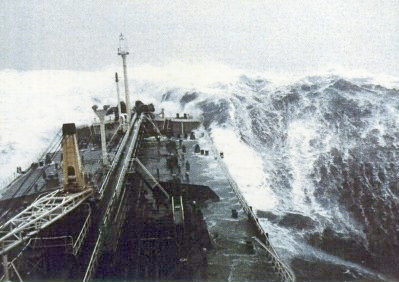
Francis Beaufort creates a scale to estimate wind speed based on sea conditions. The Beaufort scale becomes a standard for maritime and meteorological use. #wind #navigation
Beaufort wind scale devised By NOAA - This image has been extracted from another file, Public domain, https://commons.wikimedia.org/w/index.php?curid=2566306
1820 CE
First weather map created
Heinrich Wilhelm Brandes publishes the first synoptic weather map, using data from 1783 to analyze atmospheric pressure patterns. This lays groundwork for modern weather analysis. #meteorology #maps
First weather map created By Unknown author, Public domain, https://commons.wikimedia.org/w/index.php?curid=1297872
1835 CE
Coriolis effect described
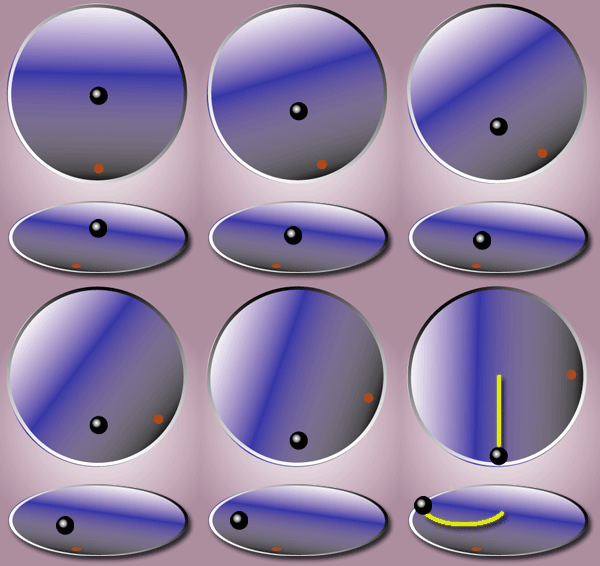
Gaspard-Gustave de Coriolis mathematically describes the deflective force caused by Earth's rotation, crucial for understanding atmospheric circulation and cyclones. #physics #meteorology
Coriolis effect described By Hubi - German Wikipedia, CC BY-SA 3.0, https://commons.wikimedia.org/w/index.php?curid=1008114
1843 CE
Aneroid barometer invented
Lucien Vidie invents the aneroid barometer, a portable device that measures atmospheric pressure without mercury. It becomes widely used for altimetry and weather forecasting. #invention #science
1854 CE
First synoptic weather map by Le Verrier
Urbain Le Verrier charts the course of a storm using telegraph data, producing the first operational synoptic weather map. This heralds modern real-time meteorology. #meteorology #history
First synoptic weather map by Le Verrier By Unknown author - https://www.observatoiredeparis.psl.eu/histoire-de-la-bibliotheque?lang=en, Public domain, https://commons.wikimedia.org/w/index.php?curid=144562226
Aug 1, 1861 CE
First daily weather forecast
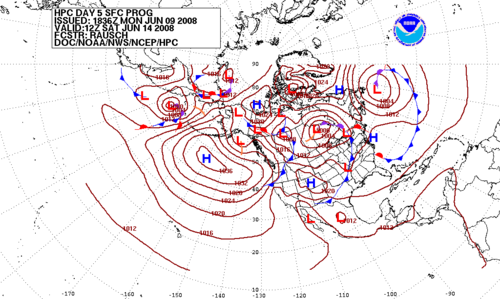
Admiral Robert FitzRoy issues the first daily weather forecast in the Times (London), using barometric data. The pioneering service is soon taken over by the UK Met Office. #weather #forecast
First daily weather forecast By Hydrometeorological Prediction Center - https://www.wpc.ncep.noaa.gov/medr/day5nav.html, Public domain, https://commons.wikimedia.org/w/index.php?curid=37193836
1875 CE
Indian Meteorological Department established
The India Meteorological Department (IMD) is founded, becoming one of the first national meteorological services in Asia. It greatly improves monsoon forecasting and disaster preparedness. #meteorology #India
Indian Meteorological Department established By Regional Meteorological Center, New Delhi (India Meteorological Department) - amssdelhi.gov.in, GODL-India, https://commons.wikimedia.org/w/index.php?curid=180760078
1896 CE
Arrhenius quantifies CO2 greenhouse effect
Svante Arrhenius publishes a paper calculating that doubling atmospheric CO2 could raise global temperature by 5–6°C, laying the foundation for climate science. #climate #greenhouse
Arrhenius quantifies CO2 greenhouse effect By Photogravure Meisenbach Riffarth & Co. Leipzig. - Zeitschrift für Physikalische Chemie, Band 69, 1909., Public domain, https://commons.wikimedia.org/w/index.php?curid=96273
1902 CE
Bergen School of Meteorology founded
Vilhelm Bjerknes establishes the Bergen School, which develops the concepts of air masses, fronts, and cyclones, forming the basis of modern synoptic meteorology. #weather #science
1915 CE
Bentley photographs snowflakes
Wilson A. Bentley photographs thousands of snowflake crystals, revealing their unique hexagonal symmetry and advancing cloud physics. His work is published in 1931. #snow #science
Bentley photographs snowflakes By Unknown author - http://snowflakebentley.com/resources.htm, Public domain, https://commons.wikimedia.org/w/index.php?curid=5764010
1920 CE
Milankovitch proposes orbital climate cycles
Milutin Milankovitch theorizes that variations in Earth's orbit and axial tilt drive long-term climate changes, including ice ages. His theory is later validated. #climate #iceages
Milankovitch proposes orbital climate cycles By Incredio - Own work, CC BY 3.0, https://commons.wikimedia.org/w/index.php?curid=6930545
1922 CE
First numerical weather prediction attempted
Lewis Fry Richardson publishes a method for weather prediction using numerical calculations, but his manual computation yields unrealistic results. It later becomes feasible with computers. #weather #computation
First numerical weather prediction attempted By NOAA - http://celebrating200years.noaa.gov/breakthroughs/climate_model/AtmosphericModelSchematic.png, Public domain, https://commons.wikimedia.org/w/index.php?curid=7263986
1930 CE
Rossby waves discovered
Carl-Gustaf Rossby identifies large-scale atmospheric waves that influence jet streams and weather patterns, now known as Rossby waves. #atmosphere #climate
1945 CE
Weather radar developed
Wartime radar technology is adapted for weather observation, allowing detection of precipitation and storms. This leads to the first weather radar networks. #weather #technology
Weather radar developed By OAR/ERL/National Severe Storms Laboratory (NSSL) - Image nssl0037, National Severe Storms Laboratory (NSSL) Collection, NOAA Photo Library, NOAA Central Library, Public domain, https://commons.wikimedia.org/w/index.php?curid=408058
1950 CE
First computer-based weather forecast
Jule Charney and a team use the ENIAC computer to produce the first successful numerical weather prediction, a milestone in computational meteorology. #computing #weather
1957 CE
International Geophysical Year
The International Geophysical Year (IGY) promotes global scientific cooperation, leading to extensive meteorological data collection and the discovery of the jet stream's structure. #science #cooperation
International Geophysical Year By Original: Special Committee for the International Geophysical Year (CSAGI) Vectorization: Draemmli (Roland Rytz) - Manually traced from the image at [2], Public domain, https://commons.wikimedia.org/w/index.php?curid=181704231
Mar 1, 1958 CE
Keeling begins CO2 measurements
Charles David Keeling starts continuous CO2 monitoring at Mauna Loa Observatory, producing the famous Keeling Curve that shows rising atmospheric carbon dioxide. #climate #CO2
Keeling begins CO2 measurements By Oeneis - Own work. Data from Dr. Pieter Tans, NOAA/ESRL and Dr. Ralph Keeling, Scripps Institution of Oceanography., CC BY-SA 4.0, https://commons.wikimedia.org/w/index.php?curid=40636957
Apr 1, 1960 CE
First weather satellite launched
NASA launches TIROS-1, the first successful weather satellite, providing global cloud images and revolutionizing weather forecasting and climate monitoring. #space #weather
First weather satellite launched By Unknown author, PD, https://en.wikipedia.org/w/index.php?curid=26969252
1963 CE
Lorenz discovers chaos theory in weather
Edward Lorenz finds that small changes in initial conditions can lead to vastly different weather outcomes, coining the 'butterfly effect' and founding chaos theory. #chaos #weather
Lorenz discovers chaos theory in weather By American Geophysical Union (AGU), courtesy of AIP Emilio Segrè Visual Archives - https://repository.aip.org/portrait-edward-lorenz, Attribution, https://commons.wikimedia.org/w/index.php?curid=174571183
1965 CE
First comprehensive climate model
Syukuro Manabe and Kirk Bryan develop the first coupled ocean-atmosphere general circulation model (GCM), enabling long-term climate simulations. #climate #modeling
First comprehensive climate model By RCraig09 - Own work, CC BY-SA 4.0, https://commons.wikimedia.org/w/index.php?curid=169750999
1969 CE
Bjerknes links El Niño to Southern Oscillation
Jacob Bjerknes explains the connection between El Niño warming and the Southern Oscillation, forming the basis for ENSO theory and seasonal forecasting. #ENSO #climate
Bjerknes links El Niño to Southern Oscillation By Content published by Rebecca Lindsey and reviewed by Tom Di Liberto. Image credit to NOAA Climate.gov - Global impacts of El Niño and La Niña. Archived from the original on 4 June 2016., Public domain, https://commons.wikimedia.org/w/index.php?curid=148459764
1979 CE
First World Climate Conference
The World Climate Conference in Geneva recognizes climate change as a global issue and calls for international collaboration, leading to the World Climate Programme. #climate #policy
May 16, 1985 CE
Ozone hole discovered
British Antarctic Survey scientists publish evidence of a dramatic thinning of the ozone layer over Antarctica, prompting global action to phase out CFCs. #ozone #environment
Ozone hole discovered By NASA - http://toms.gsfc.nasa.gov/multi/ozone_time_series.jpg, Public domain, https://commons.wikimedia.org/w/index.php?curid=815580
1988 CE
IPCC established
The Intergovernmental Panel on Climate Change (IPCC) is founded by the WMO and UNEP to assess climate science and inform policy. #climate #science
IPCC established By Intergovernmental Panel on Climate Change - Intergovernmental Panel on Climate Change Documents and Website, Public domain, https://commons.wikimedia.org/w/index.php?curid=74684917
1990 CE
First IPCC assessment report
The IPCC releases its First Assessment Report, concluding that human-caused greenhouse gas emissions are likely to warm the planet, setting the stage for climate negotiations. #climate #report
May 9, 1992 CE
UNFCCC adopted at Earth Summit
The United Nations Framework Convention on Climate Change (UNFCCC) is signed in Rio de Janeiro, establishing a framework for international climate action. #climate #treaty
UNFCCC adopted at Earth Summit By Vicente G. Cajilig, Jr. / Living Laudato Si' Philippines - https://www.facebook.com/photo/?fbid=10228588519240651&set=a.1151065499528, CC BY-SA 4.0, https://commons.wikimedia.org/w/index.php?curid=125826506
Dec 11, 1997 CE
Kyoto Protocol adopted
Nations adopt the Kyoto Protocol, the first legally binding agreement to reduce greenhouse gas emissions, though its impact is limited by non-participation of major emitters. #climate #policy
Kyoto Protocol adopted By User:Canuckguy, User:Danlaycock - File:UNFCCC parties.svg, Public domain, https://commons.wikimedia.org/w/index.php?curid=35866083
2000 CE
CMIP model intercomparison launched
The Coupled Model Intercomparison Project (CMIP) begins, providing a framework for comparing and improving climate models worldwide. #climate #modeling
Oct 12, 2007 CE
IPCC and Gore win Nobel Peace Prize
The IPCC and Al Gore jointly receive the Nobel Peace Prize for their efforts to disseminate knowledge about human-caused climate change and to lay the foundations for countermeasures. #climate #peace
IPCC and Gore win Nobel Peace Prize By World Resources Institute Staff - Al Gore 0107, CC BY 2.0, https://commons.wikimedia.org/w/index.php?curid=3189217
Dec 12, 2015 CE
Paris Agreement adopted
196 countries adopt the Paris Agreement, committing to limit global temperature rise to well below 2°C above pre-industrial levels and pursue efforts for 1.5°C. #climate #agreement
Paris Agreement adopted By L.tak - This file uses File:Detailed Blank World Map.svg as a basis. Changes to the paths and their classes, are shown in the Changelog, which is included at the beginning of the file. Please do also update the Changelog, so that at any time the file can be updated easily if the political map (state borders) changes in the future., CC BY-SA 4.0, https://commons.wikimedia.org/w/index.php?curid=48320267
Oct 8, 2018 CE
IPCC special report on 1.5°C
The IPCC releases a special report outlining the impacts of global warming of 1.5°C and the need for rapid, far-reaching reductions in greenhouse gas emissions. #climate #science
Aug 9, 2021 CE
IPCC Sixth Assessment Report released
The IPCC Sixth Assessment Report (AR6) provides the most comprehensive assessment of climate change, stating that human influence has warmed the atmosphere, ocean, and land unequivocally. #climate #report
Jul 1, 2023 CE
Hottest month on record
July 2023 is confirmed as the hottest month ever recorded globally, with average temperatures exceeding previous records, highlighting the urgency of climate action. #climate #record
Hottest month on record By European Union, Copernicus Climate Change Service data - July 2023 was the warmest globally, Attribution, https://commons.wikimedia.org/w/index.php?curid=135734659