Metallurgy & Material Transformations: Bronze Age to Bessemer Steel & Superalloys
Encyclopedia/2. Technology & The Built World/5. Materials & Chemical Engineering/01. Metallurgy & Alloys • Curated by Admin Timeline.sg
This timeline traces the evolution of metallurgy and material transformations from the Bronze Age to modern superalloys, highlighting key innovations such as Chinese cast iron smelting, Indian crucible steel, the Bessemer converter, stainless steel discovery, and single-crystal turbine superalloys. It spans over 3,500 years and includes contributions from diverse cultures worldwide.
Chronological Storyline (44 Milestones)
1500 BCE
Earliest Iron Smelting in Anatolia
Hittites in Anatolia begin smelting iron, producing small quantities of wrought iron. This marks the transition from bronze to iron, which will become the dominant metal for tools and weapons. #metallurgy #history
Earliest Iron Smelting in Anatolia By Unknown author - Own photograph by Sandstein, CC BY 3.0, https://commons.wikimedia.org/w/index.php?curid=8656346
1200 BCE
Widespread Use of Iron During the Bronze Age Collapse
The collapse of Bronze Age civilizations accelerates the adoption of iron, which is more abundant and cheaper than bronze. Blacksmiths develop techniques to forge iron tools and weapons, leading to the Iron Age in the Near East. #metallurgy #history
Widespread Use of Iron During the Bronze Age Collapse By Alexikoua - Own work, CC BY-SA 3.0, https://commons.wikimedia.org/w/index.php?curid=30160275
600 BCE
Wootz Steel Production in India
Indian metallurgists produce wootz steel in crucibles, a high-carbon steel known for its strength and toughness. This steel is later exported to the Middle East, where it becomes the basis for Damascus swords. #metallurgy #India
Wootz Steel Production in India By Rahil Alipour Ata Abadi - Transferred from en.wikipedia to Commons., GFDL, https://commons.wikimedia.org/w/index.php?curid=50800188
500 BCE
Chinese Cast Iron Production
Chinese metalworkers develop the first successful blast furnaces to produce cast iron, using coal instead of charcoal. This allows mass production of iron for plowshares, pots, and weapons, revolutionizing agriculture and warfare. #metallurgy #China
Chinese Cast Iron Production By Abob Bob - The bat, CC BY 2.0, https://commons.wikimedia.org/w/index.php?curid=46751171
400 BCE
Chinese Blast Furnace Refinements
Chinese engineers improve blast furnace design, using double-acting piston bellows to increase air blast. This enables higher temperatures and larger-scale production of cast iron, a technology not seen in Europe for centuries. #metallurgy #China
Chinese Blast Furnace Refinements By Diego Delso - Own work, CC BY-SA 4.0, https://commons.wikimedia.org/w/index.php?curid=39921010
300 BCE
Quenching and Tempering Steel in China
Chinese blacksmiths discover that heating steel to red heat and plunging it into water (quenching) hardens it, but requires tempering to reduce brittleness. These techniques become foundational for making strong, durable blades. #metallurgy #China
Quenching and Tempering Steel in China By Arthur S. Siegel - This image is available from the United States Library of Congress's Prints and Photographs division under the digital ID fsac.1a35416.This tag does not indicate the copyright status of the attached work. A normal copyright tag is still required. See Commons:Licensing., Public domain, https://commons.wikimedia.org/w/index.php?curid=3417818
200 BCE
Noric Steel in Central Europe
Celtic tribes in the Noricum region (modern Austria) produce Noric steel, a high-quality iron alloy using iron ores rich in manganese. Roman legionaries adopt this steel for their swords, enhancing military effectiveness. #metallurgy #Europe
100 CE
Damascus Steel Production in the Middle East
Middle Eastern smiths forge wootz steel ingots into weapon blades, creating Damascus steel characterized by a wavy banding pattern. The steel's hardness and edge retention make it legendary, with the technique persisting for over a millennium. #metallurgy #MiddleEast
300 CE
Chinese Co-Fusion Process for Steel
Chinese metallurgists develop the co-fusion method, melting wrought iron with cast iron in crucibles to produce steel with intermediate carbon content. This enables large-scale steel production for agricultural tools and weapons. #metallurgy #China
Chinese Co-Fusion Process for Steel By Unknown author, Public domain, https://commons.wikimedia.org/w/index.php?curid=173065
500 CE
African Early Carbon Steel Production in Tanzania
Ironworkers in the region of modern Tanzania produce high-carbon steel using a bloomery process with controlled carburization. This demonstrates advanced metallurgical knowledge in sub-Saharan Africa, independent from external influences. #metallurgy #Africa
African Early Carbon Steel Production in Tanzania By Wikipedia Loves Art participant "niborean" - Uploaded from the Wikipedia Loves Art photo pool on Flickr, CC BY-SA 2.5, https://commons.wikimedia.org/w/index.php?curid=8948064
700 CE
Japanese Sword Forging and Lamination
Japanese swordsmiths pioneer complex lamination techniques for katana, combining hard high-carbon steel edges with softer low-carbon steel cores. This produces weapons with exceptional sharpness and flexibility, reflecting a unique metallurgical tradition. #metallurgy #Japan
900 CE
Catalan Forge in Europe
The Catalan forge, a type of bloomery furnace, becomes widespread in Catalonia and across Europe. It produces wrought iron directly from ore using water-powered bellows, increasing efficiency and scale of iron production. #metallurgy #Europe
Catalan Forge in Europe By Pey09 - Own work, Public domain, https://commons.wikimedia.org/w/index.php?curid=5568042
1100 CE
Crucible Steel Production in Central Asia
Metallurgists in Central Asia, particularly in Merv and Bukhara, produce crucible steel by melting high-carbon iron in sealed clay pots. Known as pulad, this steel is used for high-quality swords and tools, influencing later Indian and Middle Eastern techniques. #metallurgy #CentralAsia
1300 CE
First European Blast Furnaces in Sweden
Sweden begins operating the first blast furnaces in Europe, producing cast iron using water-powered bellows and limestone flux. This marks a shift from direct reduction to indirect smelting, enabling larger-scale iron production. #metallurgy #Europe
1400 CE
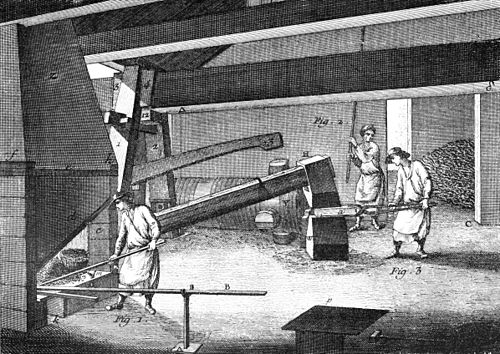
Wrought Iron Production via Finery Process
European smiths refine the finery process to convert cast iron into wrought iron by oxidising carbon in a hearth. This becomes the standard method for making tough, malleable iron for construction and tools. #metallurgy #Europe
Wrought Iron Production via Finery Process By William F. Durfee - "The Development of American Industries Since Columbus", The Popular Science Monthly, volume 38, page 171., Public domain, https://commons.wikimedia.org/w/index.php?curid=11875568
1500 CE
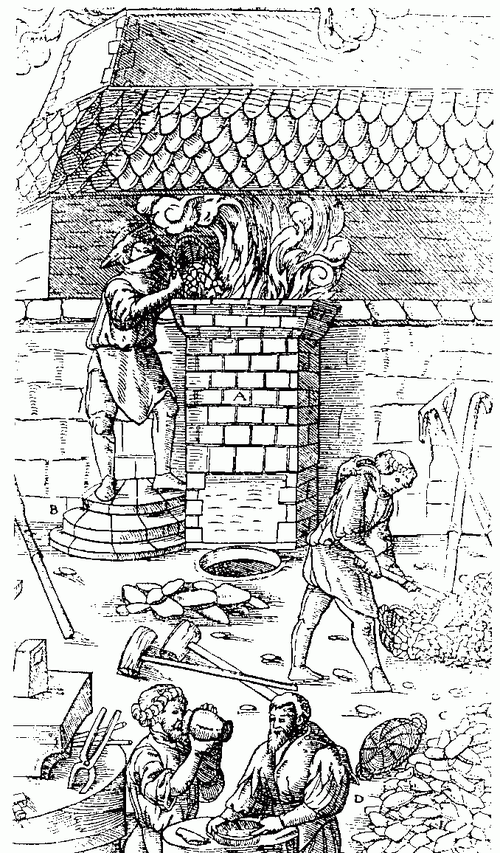
Agricola's Treatise on Mining and Metallurgy
Georgius Agricola publishes De Re Metallica, a comprehensive study of mining, smelting, and metallurgy. It becomes a standard reference in Europe for centuries, documenting techniques such as ore testing and blast furnace operation. #metallurgy #history
Agricola's Treatise on Mining and Metallurgy By Georgius Agricola - http://ihm.nlm.nih.gov/images/A13215, Public domain, https://commons.wikimedia.org/w/index.php?curid=6657599
1709 CE
Abraham Darby Uses Coke for Iron Smelting
Abraham Darby I of England successfully smelts iron ore using coke (derived from coal) instead of charcoal. This reduces cost and saves forests, enabling large-scale iron production and fueling the Industrial Revolution. #metallurgy #IndustrialRevolution
Abraham Darby Uses Coke for Iron Smelting By Stahlkocher - Own work, CC BY-SA 3.0, https://commons.wikimedia.org/w/index.php?curid=1449072
1740 CE
Huntsman's Crucible Steel Process
Benjamin Huntsman of England develops a crucible process for making high-quality steel by melting blister steel in clay pots. His method produces uniform, clean steel suitable for tools and cutlery, marking a significant advance in steelmaking. #metallurgy #IndustrialRevolution
Huntsman's Crucible Steel Process By Malcolm Campbell - From geograph.org.uk, CC BY-SA 2.0, https://commons.wikimedia.org/w/index.php?curid=9047553
1779 CE
Iron Bridge Built at Coalbrookdale
The world's first major iron bridge is constructed over the River Severn in England using cast iron. It demonstrates the structural potential of iron, inspiring its use in bridges, buildings, and machinery. #metallurgy #engineering
1788 CE
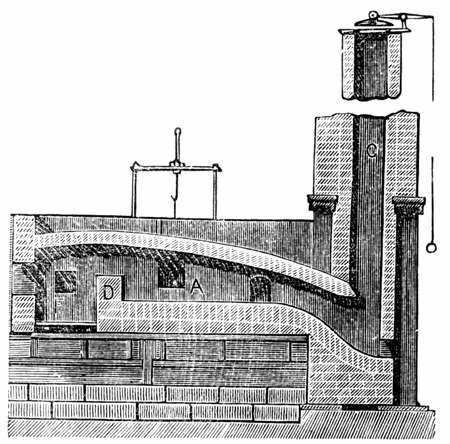
Cort's Puddling Process
Henry Cort patents the puddling process, which produces wrought iron from pig iron by stirring it in a reverberatory furnace. This method removes impurities and increases production, supporting the expanding railway industry. #metallurgy #IndustrialRevolution
Cort's Puddling Process By Unknown author, Public domain, https://commons.wikimedia.org/w/index.php?curid=551224
Aug 11, 1856 CE
Bessemer's British Patent for Steelmaking
Henry Bessemer receives a British patent for his pneumatic steelmaking process, which quickly becomes a global standard. The patent's expiry later spurs open competition and further innovation in steel. #metallurgy #patent
1856 CE
Bessemer Converter Revolutionizes Steel Production
Henry Bessemer patents the Bessemer converter, which oxidises impurities in molten iron by blowing air through it. This dramatically reduces the cost and time to produce mass quantities of steel, enabling the construction of skyscrapers, railways, and ships. #metallurgy #IndustrialRevolution
Bessemer Converter Revolutionizes Steel Production By Unknown author, Public domain, https://commons.wikimedia.org/w/index.php?curid=91836
1862 CE
First Bessemer Steel Produced in the US
The first Bessemer steel in the United States is produced in Wyandotte, Michigan. This marks the beginning of mass steel production in America, fueling rapid industrialisation and infrastructure growth. #metallurgy #usa
1864 CE
Siemens-Martin Open Hearth Process
Pierre-Émile Martin and Friedrich Siemens develop the open hearth furnace, which uses regenerative preheating to achieve high temperatures for melting scrap and iron. This becomes the dominant steelmaking method for nearly a century. #metallurgy #industrial
Siemens-Martin Open Hearth Process By Viktor Mácha - Own work, CC BY-SA 4.0, https://commons.wikimedia.org/w/index.php?curid=42224671
1878 CE
Thomas-Gilchrist Basic Process
Sidney Gilchrist Thomas and Percy Gilchrist solve the problem of high-phosphorus iron ores by using a basic lining (dolomite) in the Bessemer converter. This allows the use of widespread continental European ores, greatly expanding steel production. #metallurgy #industrial
1899 CE
Hall-Héroult Process for Aluminium
Charles Martin Hall and Paul Héroult independently develop the electrolytic smelting of aluminium from alumina. This reduces the cost of aluminium from a precious metal to a common material, enabling widespread use in transportation and packaging. #metallurgy #aluminium
Aug 13, 1913 CE
Brearley Casts First Stainless Steel
Harry Brearley casts the first stainless steel at the Brown Firth Laboratories in Sheffield. Although initially intended for gun barrels, the corrosion-resistant alloy quickly finds use in cutlery and industrial applications. #metallurgy #stainlesssteel
Brearley Casts First Stainless Steel By W.carter - Own work, CC BY-SA 4.0, https://commons.wikimedia.org/w/index.php?curid=57016790
1913 CE
Discovery of Stainless Steel by Brearley
Harry Brearley discovers that adding chromium to steel makes it resistant to rust and staining. This leads to the development of stainless steel, now ubiquitous in cutlery, medical instruments, and construction. #metallurgy #stainlesssteel
Discovery of Stainless Steel by Brearley By Unknown author - http://www.plattsnisbett.com/wordp/wp-content/uploads/2011/10/harry_brearley.jpg, Public domain, https://commons.wikimedia.org/w/index.php?curid=43669379
1919 CE
Age Hardening of Duralumin Discovered
Alfred Wilm discovers that aluminium-copper alloy (Duralumin) hardens with time after heat treatment. This age-hardening phenomenon enables strong lightweight alloys, critical for aircraft structures. #metallurgy #alloys
Age Hardening of Duralumin Discovered By Maido Merisalu - Own work, CC BY-SA 4.0, https://commons.wikimedia.org/w/index.php?curid=44943432
1923 CE
Zeroth Law of Metal Fatigue Discovered
Work by A. Wöhler and others establishes the S-N curve for fatigue life of metals, laying the foundation for safe design of cyclically loaded parts. This is crucial for railways, aircraft, and all machinery. #metallurgy #mechanics )
Zeroth Law of Metal Fatigue Discovered By Lokilech - Own work, CC BY-SA 3.0, https://commons.wikimedia.org/w/index.php?curid=2239906
1930 CE
Development of Nimonic Superalloys
The Mond Nickel Company develops Nimonic alloys, nickel-chromium-based superalloys designed for high-temperature strength in turbine blades. These enable the jet engine era by resisting creep and oxidation at elevated temperatures. #metallurgy #superalloys
1940 CE
Vacuum Arc Remelting for High-Purity Alloys
Vacuum arc remelting (VAR) is introduced to produce high-purity metals and alloys by melting in a vacuum, reducing gas content and inclusions. This is essential for superalloys used in aerospace and medical implants. #metallurgy #technology
1944 CE
First Jet Engine with Superalloy Turbine Blades
The Gloster Meteor jet fighter uses Rolls-Royce Welland engines with nickel-based superalloy turbine blades, allowing sustained high-temperature operation. This validates superalloy technology and propels jet aviation. #metallurgy #superalloys
1950 CE
Continuous Casting of Steel Developed
Continuous casting processes for steel are perfected, allowing molten metal to be directly solidified into slabs or billets. This improves efficiency, yield, and quality, becoming the standard steel casting method. #metallurgy #steel
Continuous Casting of Steel Developed By Alchemist-hp (pse-mendelejew.de) - Own work, CC BY-SA 3.0 de, https://commons.wikimedia.org/w/index.php?curid=6958463
1960 CE
Single-Crystal Turbine Blades for Jet Engines
Researchers develop single-crystal casting techniques for nickel-based superalloys, eliminating grain boundaries to improve creep resistance. These blades dramatically extend the operating temperature and efficiency of jet engines. #metallurgy #superscience
1970 CE
Rapid Solidification Processing
Rapid solidification processing (RSP) techniques are developed to produce metallic glasses and nanocrystalline alloys by cooling metals at rates over 10^6 K/s. This yields novel materials with exceptional strength and magnetic properties. #metallurgy #innovation
1980 CE
Metallic Glasses Enter Commercial Use
Bulk metallic glasses (BMGs) with amorphous structures are produced in commercial quantities, offering high strength, elasticity, and corrosion resistance. They are used in sporting goods, electronics, and aerospace. #metallurgy #materials
Metallic Glasses Enter Commercial Use By George Stobbart - Photo taken in the lab, Public domain, https://commons.wikimedia.org/w/index.php?curid=2504138
1982 CE
Introduction of Dual-Phase Steels
Dual-phase (DP) steels, with a microstructure of ferrite and martensite, are introduced for automotive applications. They offer a superior combination of strength and formability, enabling lighter and safer vehicles. #metallurgy #steel
Introduction of Dual-Phase Steels By ArcelorMittal Kryvyi Rih - Own work, CC BY-SA 4.0, https://commons.wikimedia.org/w/index.php?curid=89868773
1990 CE
Shape Memory Alloys Gain Prominence
Shape memory alloys (SMAs) like Nitinol (nickel-titanium) become widely used for their ability to recover shape upon heating. Applications include medical stents, actuators, and thermal switches, revolutionising minimally invasive surgery. #metallurgy #smaterials
2000 CE
High-Entropy Alloys Concept Introduced
Researchers Jien-Wei Yeh and Brian Cantor independently propose high-entropy alloys (HEAs) consisting of five or more principal elements in near-equal proportions. HEAs exhibit unique microstructures and properties, opening a new field of alloy design. #metallurgy #innovation
High-Entropy Alloys Concept Introduced By Shaoqing Wang - Wang, Shaoqing (13 December 2013). "Atomic Structure Modeling of Multi-Principal-Element Alloys by the Principle of Maximum Entropy". Entropy 15 (12): 5536–5548. DOI:10.3390/e15125536., CC BY 3.0, https://commons.wikimedia.org/w/index.php?curid=32060405
2003 CE
Bulk Metallic Glass Golf Clubs Introduced
Bulk metallic glasses are used in golf club heads, offering high resilience and energy transfer. This commercial application demonstrates the viability of amorphous metals in consumer products. #metallurgy #materials
2010 CE
Additive Manufacturing of Metals (3D Printing)
Metal additive manufacturing (AM) such as selective laser melting and electron beam melting matures as a fabrication method for complex geometries. Aerospace and medical industries adopt AM for lightweight, customised metal parts. #metallurgy #3dprinting
Additive Manufacturing of Metals (3D Printing) By RepRapPro - YouTube: https://www.youtube.com/watch?v=r5nDrae3gJg – View/save archived versions on archive.org, CC BY 3.0, https://commons.wikimedia.org/w/index.php?curid=45334835
2013 CE
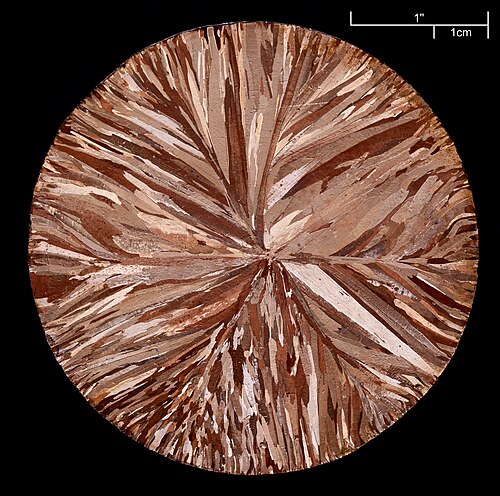
World's Strongest Alloy by Strength-to-Weight Ratio
Researchers develop a magnesium alloy with a strength-to-weight ratio surpassing all previous metals, using a nanoprecipitation structure. This holds promise for aerospace and automotive lightweighting. #metallurgy #alloys
World's Strongest Alloy by Strength-to-Weight Ratio By Jntf - Own work, CC BY-SA 3.0, https://commons.wikimedia.org/w/index.php?curid=7503022
2019 CE
First 3D-Printed Metal Part for Commercial Jet Engine
GE Aviation begins installing 3D-printed titanium fuel nozzles in LEAP jet engines, the first mass-produced additively manufactured metal components in the industry. This marks a milestone for additive manufacturing in critical applications. #metallurgy #3dprinting
First 3D-Printed Metal Part for Commercial Jet Engine By DigitalIceAge - Own work, CC BY 4.0, https://commons.wikimedia.org/w/index.php?curid=140496187