Mesopotamian Civilizations: Sumer, Babylon & The Code of Hammurabi
Encyclopedia/3. History, Societies & Civilizations/04. European Civilizations & Empires/01. Classical Antiquity • Curated by Admin Timeline.sg
Mesopotamian civilizations, including Sumer, Akkad, Babylon, and Assyria, laid the foundations for urban society, writing, law, and mathematics in the ancient Near East from around 3500 BCE to 539 BCE.
Chronological Storyline (44 Milestones)
3500 BCE
First Uruk Period Cities
The city of Uruk in Sumer becomes one of the first major urban centers, with monumental architecture and early administrative writing. #history #ancient
3400 BCE
Invention of Cuneiform Script
Sumerians develop cuneiform writing, initially for accounting, using reed styluses on clay tablets. #writing #history
Invention of Cuneiform Script By Bjørn Christian Tørrissen - Own work by uploader, http://bjornfree.com/galleries.html, CC BY-SA 3.0, https://commons.wikimedia.org/w/index.php?curid=8296178
3300 BCE
Sumerian City-States Flourish
Sumer is organized into independent city-states like Ur, Lagash, and Nippur, each with its own ruler and patron deity. #history #ancient
Sumerian City-States Flourish By NASA Overlay: पाटलिपुत्र (talk) - This image has been extracted from another file, Public domain, https://commons.wikimedia.org/w/index.php?curid=98779414
3100 BCE
Earliest Known Ziggurat
The White Temple ziggurat at Uruk is built, a stepped pyramid temple dedicated to the sky god Anu. #architecture #history
Earliest Known Ziggurat By tobeytravels - This image has been extracted from another file, CC BY-SA 2.0, https://commons.wikimedia.org/w/index.php?curid=92851923
3000 BCE
Sumerian Numerical System
Sumerians develop a sexagesimal (base-60) number system, which influences later Babylonian mathematics and time measurement. #mathematics #history
2700 BCE
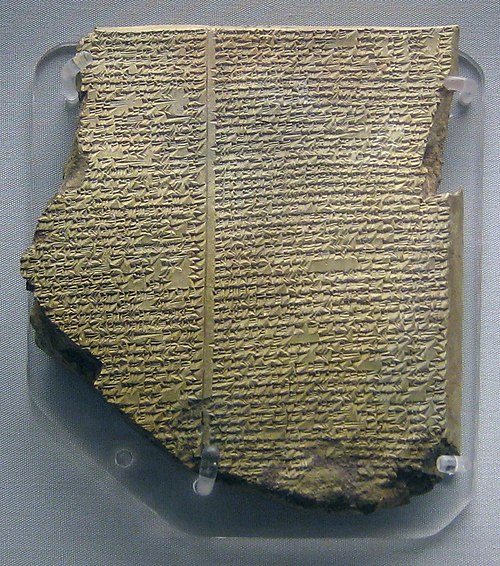
Epic of Gilgamesh Composed
The Sumerian Epic of Gilgamesh, one of the earliest known literary works, is composed, featuring themes of heroism and mortality. #literature #history
Epic of Gilgamesh Composed By Unknown author - BabelStone (Own work), CC0, https://commons.wikimedia.org/w/index.php?curid=10755114
2600 BCE
Royal Tombs of Ur
The Royal Cemetery at Ur yields elaborate burials with gold, jewelry, and musical instruments, reflecting Sumerian wealth and artistry. #archaeology #history
Royal Tombs of Ur By Joint Expedition of the British Museum and of the Museum of the University of Pennsylvania to Mesopotamia Hall, H. R. (Harry Reginald), 1873-1930, ed Woolley, Leonard, Sir, 1880-1960 Legrain, Leon, 1878- ed - This image has been extracted from another file, No restrictions, https://commons.wikimedia.org/w/index.php?curid=89149177
2334 BCE
Sargon of Akkad Conquers Sumer
Sargon the Great establishes the Akkadian Empire, uniting Sumer and Akkad under a centralized rule. #history #empire
Sargon of Akkad Conquers Sumer By ALFGRN - This image has been extracted from another file, CC BY-SA 2.0, https://commons.wikimedia.org/w/index.php?curid=90062589
2300 BCE
Akkadian Language Becomes Lingua Franca
Akkadian, a Semitic language, becomes the dominant written and spoken language in Mesopotamia, used for administration and literature. #language #history
Akkadian Language Becomes Lingua Franca By Unknown artist - Mbzt, CC BY 3.0, https://commons.wikimedia.org/w/index.php?curid=16898522
2200 BCE
Gutian Invasion and Akkadian Decline
The Gutians, a mountain people, invade Mesopotamia, contributing to the collapse of the Akkadian Empire. #history #invasion
Gutian Invasion and Akkadian Decline By 0x010C - Own work, CC BY-SA 4.0, https://commons.wikimedia.org/w/index.php?curid=89227844
2112 BCE
Ur-Nammu Establishes Third Dynasty of Ur
Ur-Nammu founds the Third Dynasty of Ur, a period of Sumerian renaissance with centralized administration and legal codes. #history #dynasty
Ur-Nammu Establishes Third Dynasty of Ur By Middle_East_topographic_map-blank.svg: Sémhur (talk) derivative work: Zunkir (talk) - Middle_East_topographic_map-blank.svg, CC BY-SA 3.0, https://commons.wikimedia.org/w/index.php?curid=12665614
2100 BCE
Code of Ur-Nammu
The Code of Ur-Nammu, one of the earliest known law codes, is written, predating Hammurabi's code by centuries. #law #history
Code of Ur-Nammu By Istanbul Archaeology Museums - Own work, CC0, https://commons.wikimedia.org/w/index.php?curid=34550484
2000 BCE
Sumerian King List Compiled
The Sumerian King List is written, recording successive dynasties and rulers, blending myth and history. #history #literature
Sumerian King List Compiled By Photograph: unknown> Transcription: Stephen Herbert Langdon (1876-1937) - This image has been extracted from another file, Public domain, https://commons.wikimedia.org/w/index.php?curid=112999971
1900 BCE
Old Assyrian Period Begins
Assyria emerges as a major power in northern Mesopotamia, with trade networks extending to Anatolia. #history #trade
1792 BCE
Hammurabi Becomes King of Babylon
Hammurabi ascends the throne of Babylon, beginning a reign that will unify much of Mesopotamia. #history #king
Hammurabi Becomes King of Babylon By Mbzt - Own work, CC BY 3.0, https://commons.wikimedia.org/w/index.php?curid=59794940
1754 BCE
Code of Hammurabi
Hammurabi issues his famous law code, inscribed on a stele, covering civil and criminal law with the principle of lex talionis. #law #history
Code of Hammurabi By Mbzt - Own work, CC BY 3.0, https://commons.wikimedia.org/w/index.php?curid=16931676
1750 BCE
Babylonian Mathematics Flourishes
Babylonian mathematicians develop advanced algebra and geometry, using a sexagesimal system and solving quadratic equations. #mathematics #history
Babylonian Mathematics Flourishes By Urcia, A., Yale Peabody Museum of Natural History, https://peabody.yale.edu, http://hdl.handle.net/10079/8931zqj derivative work, user:Theodor Langhorne Franklin - File:YBC-7289-OBV.jpg, CC0, https://commons.wikimedia.org/w/index.php?curid=76347956
1700 BCE
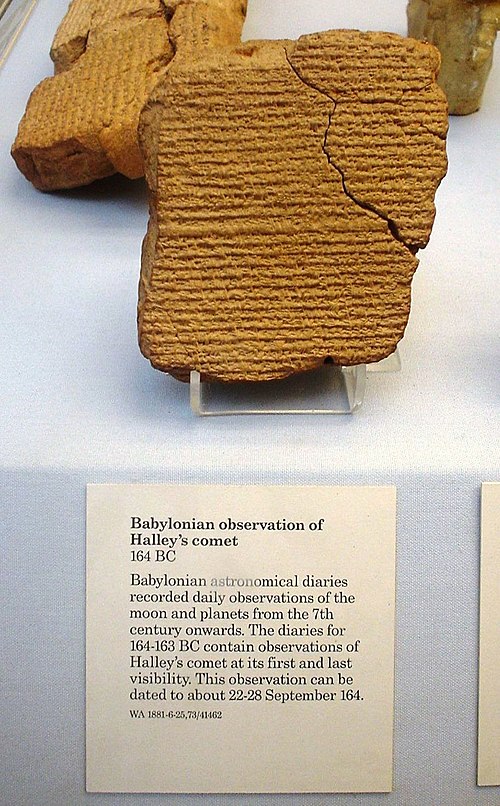
Babylonian Astronomical Records
Babylonians begin systematic astronomical observations, recording planetary movements and eclipses. #astronomy #history
Babylonian Astronomical Records By The original uploader was Linguica at English Wikipedia. - Transferred from en.wikipedia to Commons by Calliopejen1 using CommonsHelper., Public domain, https://commons.wikimedia.org/w/index.php?curid=17674029
1600 BCE
Hittite Sack of Babylon
The Hittites under Mursili I raid Babylon, ending the First Babylonian Dynasty and weakening the city. #history #war
1500 BCE
Kassite Rule of Babylon
The Kassites take control of Babylon, ruling for nearly 400 years and maintaining Babylonian culture. #history #dynasty
1400 BCE
Middle Assyrian Empire
Assyria expands under kings like Ashur-uballit I, becoming a major power in the region. #history #empire
Middle Assyrian Empire By Near_East_topographic_map-blank.svg: Sémhur derivative work: Zunkir (talk) - Near_East_topographic_map-blank.svg, CC BY-SA 3.0, https://commons.wikimedia.org/w/index.php?curid=11552918
1300 BCE
Enuma Elish Composed
The Babylonian creation epic Enuma Elish is written, describing the rise of the god Marduk. #literature #mythology
Enuma Elish Composed By editor Austen Henry Layard , drawing by L. Gruner - 'Monuments of Nineveh, Second Series' plate 5, London, J. Murray, 1853, Public domain, https://commons.wikimedia.org/w/index.php?curid=18217886
1200 BCE
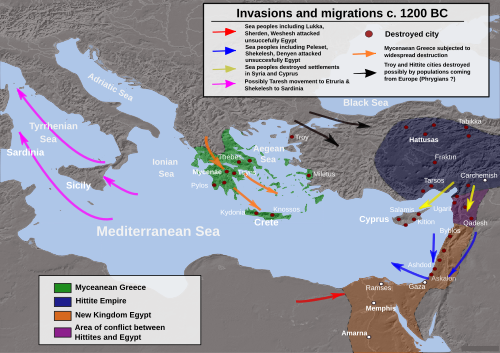
Bronze Age Collapse Affects Mesopotamia
The Late Bronze Age collapse disrupts trade and leads to the decline of many Mesopotamian states. #history #collapse
Bronze Age Collapse Affects Mesopotamia By Alexikoua - Own work, CC BY-SA 3.0, https://commons.wikimedia.org/w/index.php?curid=30160275
1100 BCE
Tiglath-Pileser I Expands Assyria
Assyrian king Tiglath-Pileser I campaigns widely, reaching the Mediterranean and asserting Assyrian dominance. #history #conquest
Tiglath-Pileser I Expands Assyria By Lehmann-Haupt, Carl Friedrich, 1861-1938 - Materialien zur älteren Geschichte Armeniens und MesopotamiensPublication date 1906, Public domain, https://commons.wikimedia.org/w/index.php?curid=91417754
1000 BCE
Neo-Assyrian Empire Begins
Assyria enters a new phase of expansion under kings like Ashurnasirpal II, building a vast empire. #history #empire
Neo-Assyrian Empire Begins By Ningyou - Own work data from Based on a map in 'Atlas of the Bible Lands', C S Hammond & Co (1959), ISBN 9780843709414., Public domain, https://commons.wikimedia.org/w/index.php?curid=600659
911 BCE
Adad-nirari II Revives Assyria
Adad-nirari II consolidates Assyrian power, marking the start of the Neo-Assyrian period. #history #king
883 BCE
Ashurnasirpal II Builds Kalhu
Ashurnasirpal II makes Kalhu (Nimrud) his capital, constructing palaces and temples with elaborate reliefs. #architecture #history
Ashurnasirpal II Builds Kalhu By Unknown author - ChrisO (Own work), Public domain, https://commons.wikimedia.org/w/index.php?curid=4933367
745 BCE
Tiglath-Pileser III Reforms Assyria
Tiglath-Pileser III reorganizes the Assyrian army and administration, expanding the empire into Syria and Babylon. #history #reform
Tiglath-Pileser III Reforms Assyria By Unknown artist - See below, Public domain, https://commons.wikimedia.org/w/index.php?curid=15378403
722 BCE
Fall of Samaria to Assyria
Assyrian king Sargon II captures Samaria, ending the Kingdom of Israel and deporting its inhabitants. #history #war
Fall of Samaria to Assyria By Osama Shukir Muhammed Amin FRCP(Glasg) - Own work, CC BY-SA 4.0, https://commons.wikimedia.org/w/index.php?curid=78780705
705 BCE
Sennacherib Makes Nineveh Capital
Sennacherib moves the Assyrian capital to Nineveh, building the magnificent 'Palace Without Rival' and extensive gardens. #architecture #history
Sennacherib Makes Nineveh Capital By Timo Roller - Own work, CC BY 3.0, https://commons.wikimedia.org/w/index.php?curid=39985581
689 BCE
Sennacherib Destroys Babylon
Sennacherib sacks Babylon in retaliation for rebellion, devastating the city and its temples. #history #destruction
681 BCE
Esarhaddon Rebuilds Babylon
Esarhaddon, Sennacherib's son, reverses his father's policy and rebuilds Babylon, restoring its temples. #history #reconstruction
Esarhaddon Rebuilds Babylon By Osama Shukir Muhammed Amin FRCP(Glasg) - Own work, CC BY-SA 4.0, https://commons.wikimedia.org/w/index.php?curid=90734401
668 BCE
Ashurbanipal's Library at Nineveh
Ashurbanipal establishes a vast library at Nineveh, collecting cuneiform tablets from across Mesopotamia, preserving literature and knowledge. #literature #history
Ashurbanipal's Library at Nineveh By Gary Todd - https://www.flickr.com/photos/101561334@N08/36562516345/, CC0, https://commons.wikimedia.org/w/index.php?curid=91138912
626 BCE
Nabopolassar Founds Neo-Babylonian Empire
Nabopolassar rebels against Assyria and establishes the Neo-Babylonian Empire, with Babylon as its capital. #history #empire
612 BCE
Fall of Nineveh
A coalition of Babylonians, Medes, and others sacks Nineveh, ending the Assyrian Empire. #history #war
Fall of Nineveh By (Mu-tamajo) むーたんじょ - Own work, CC BY-SA 4.0, https://commons.wikimedia.org/w/index.php?curid=48411583
605 BCE
Battle of Carchemish
Nebuchadnezzar II defeats the Egyptians at Carchemish, securing Babylonian control over Syria and the Levant. #history #battle
Battle of Carchemish By Egisto C. - Internet Archive identifier: hutchinsonsstory00londuoft 'Hutchinson's History of the Nations', 1915, Public domain, https://commons.wikimedia.org/w/index.php?curid=114383264
604 BCE
Nebuchadnezzar II Becomes King
Nebuchadnezzar II ascends the throne of Babylon, under whom the city reaches its zenith. #history #king
Nebuchadnezzar II Becomes King By Unknown author, Public domain, https://commons.wikimedia.org/w/index.php?curid=87505819
600 BCE
Ishtar Gate Built
Nebuchadnezzar II constructs the Ishtar Gate, a magnificent blue-glazed brick gate dedicated to the goddess Ishtar. #architecture #history
Ishtar Gate Built By LBM1948 - Own work, CC BY-SA 4.0, https://commons.wikimedia.org/w/index.php?curid=88944304
597 BCE
Babylonian Siege of Jerusalem
Nebuchadnezzar II captures Jerusalem, exiling King Jehoiachin and many Judeans to Babylon. #history #war )
Babylonian Siege of Jerusalem By Jona Lendering - Livius.org Provided under CC0 1.0 Universal per "License" notice under the photograph, CC0, https://commons.wikimedia.org/w/index.php?curid=87909002
587 BCE
Destruction of the First Temple
Nebuchadnezzar II destroys Solomon's Temple in Jerusalem and exiles the remaining population, beginning the Babylonian captivity. #history #religion )
Destruction of the First Temple By Internet Archive Book Images - https://www.flickr.com/photos/internetarchivebookimages/14783032815/ Source book page: https://archive.org/stream/artbiblecomprisi00lond/artbiblecomprisi00lond#page/n907/mode/1up, No restrictions, https://commons.wikimedia.org/w/index.php?curid=44201898
575 BCE
Hanging Gardens of Babylon
The Hanging Gardens, one of the Seven Wonders of the Ancient World, are said to have been built by Nebuchadnezzar II for his wife. #architecture #wonder
Hanging Gardens of Babylon By Unknown author - http://www.plinia.net/wonders/gardens/hgpix1.html, Public domain, https://commons.wikimedia.org/w/index.php?curid=65909
562 BCE
Death of Nebuchadnezzar II
Nebuchadnezzar II dies, leading to a period of instability in the Neo-Babylonian Empire. #history #king
556 BCE
Nabonidus Becomes King
Nabonidus, the last king of Babylon, ascends the throne, known for his archaeological interests and devotion to the moon god Sin. #history #king
Nabonidus Becomes King By Osama Shukir Muhammed Amin FRCP(Glasg) - Own work, CC BY-SA 4.0, https://commons.wikimedia.org/w/index.php?curid=122825119
539 BCE
Cyrus the Great Conquers Babylon
Persian king Cyrus the Great captures Babylon without a fight, ending Mesopotamian independence and incorporating it into the Achaemenid Empire. #history #conquest
Cyrus the Great Conquers Babylon By Unknown author - https://wellcomeimages.org/indexplus/obf_images/fc/fc/32d4c8b927dea8bfbf69f55cbd10.jpg Gallery: https://wellcomeimages.org/indexplus/image/V0034440.html Wellcome Collection gallery (2018-04-03): https://wellcomecollection.org/works/pc9e75j3 CC-BY-4.0, CC BY 4.0, https://commons.wikimedia.org/w/index.php?curid=36614814