Mathematical Logic, Set Theory & Gödel's Incompleteness
Encyclopedia/1. The Cosmos & The Natural World/1. Mathematics & Formal Systems/05. Mathematical Logic & Incompleteness • Curated by Admin Timeline.sg
This timeline traces the foundational crisis of mathematics from Boolean logic and Cantor's transfinite sets through Gödel's incompleteness theorems and Turing machines, highlighting key developments in mathematical logic and set theory.
Chronological Storyline (43 Milestones)
1847 CE
Boole Publishes The Mathematical Analysis of Logic
George Boole introduces symbolic logic, laying the groundwork for Boolean algebra and modern digital computing. #logic #mathematics
Boole Publishes The Mathematical Analysis of Logic By Unknown author - The Illustrated London News, 21 January 1865, Public domain, https://commons.wikimedia.org/w/index.php?curid=39762976
1854 CE
Boole Publishes An Investigation of the Laws of Thought
Boole expands his logical system, formalizing propositional logic and influencing later developments in set theory and computer science. #logic #mathematics
1872 CE
Dedekind Publishes Continuity and Irrational Numbers
Richard Dedekind defines real numbers via Dedekind cuts, providing a rigorous foundation for analysis. #analysis #foundations
Dedekind Publishes Continuity and Irrational Numbers By Unknown (Mondadori Publishers) - https://www.gettyimages.co.uk/detail/news-photo/portrait-of-the-german-mathematician-richard-dedekind-1900s-news-photo/141551154, Public domain, https://commons.wikimedia.org/w/index.php?curid=41284791
1874 CE
Cantor Proves Uncountability of Real Numbers
Georg Cantor demonstrates that the real numbers are uncountable, introducing diagonalization and revolutionizing set theory. #settheory #infinity
Cantor Proves Uncountability of Real Numbers By Unknown author - https://www.math.cmu.edu/~rcristof/pdf/Cantor_pubblicato.pdf and they had it from https://photos.aip.org/history-programs/niels-bohr-library/photos/cantor-georg-a1, Public domain, https://commons.wikimedia.org/w/index.php?curid=74820875
1879 CE
Frege Publishes Begriffsschrift
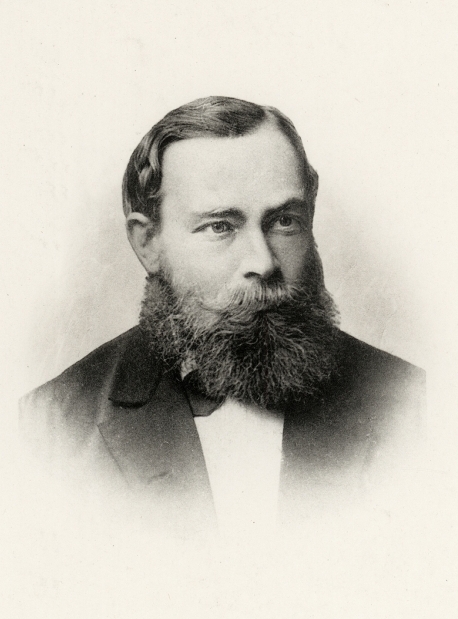
Gottlob Frege develops a formal logical notation, introducing quantifiers and predicate logic, a cornerstone of modern logic. #logic #philosophy
Frege Publishes Begriffsschrift By Unknown author - digitized version at https://gallica.bnf.fr/ark:/12148/bpt6k65658c, Public domain, https://commons.wikimedia.org/w/index.php?curid=2669038
1883 CE
Cantor Introduces Transfinite Numbers
Cantor publishes his work on transfinite ordinals and cardinals, formalizing the concept of different sizes of infinity. #settheory #infinity
1884 CE
Frege Publishes The Foundations of Arithmetic
Frege attempts to derive arithmetic from logic, a key step in logicism and the foundations of mathematics. #logic #arithmetic
Frege Publishes The Foundations of Arithmetic By Gottlob Frege - Project Gutenberg: http://www.gutenberg.org/ebooks/48312, http://www.gutenberg.org/files/48312/48312-h/images/cover.jpg, Public domain, https://commons.wikimedia.org/w/index.php?curid=66228870
1889 CE
Peano Publishes Arithmetices Principia
Giuseppe Peano axiomatizes natural numbers with the Peano axioms, influencing formal arithmetic. #axioms #arithmetic
1890 CE
Cantor Proves the Cantor-Bernstein Theorem
Cantor establishes that if two sets inject into each other, they are equinumerous, a fundamental result in set theory. #settheory #infinity
1897 CE
Burali-Forti Paradox Discovered
Cesare Burali-Forti identifies a paradox concerning the set of all ordinals, highlighting inconsistencies in naive set theory. #paradox #settheory
1899 CE
Cantor Discovers the Continuum Hypothesis
Cantor conjectures that there is no set whose cardinality is strictly between that of the integers and the real numbers. #settheory #infinity
1900 CE
Hilbert Presents His 23 Problems
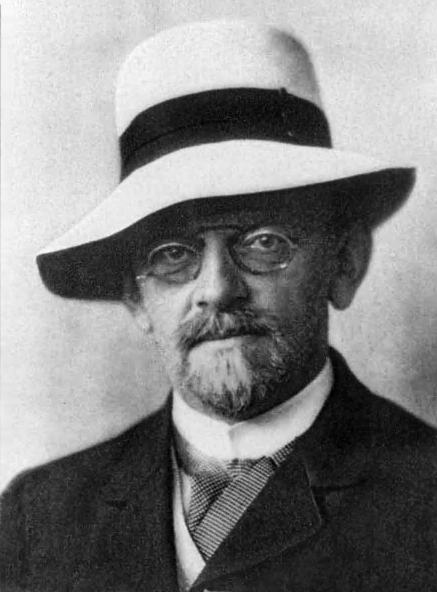
David Hilbert outlines 23 unsolved problems, including the continuum hypothesis and the consistency of arithmetic, shaping 20th-century mathematics. #problems #foundations
Hilbert Presents His 23 Problems By Unknown author - Possibly Reid, Constance (1970) Hilbert, Berlin, Heidelberg: Springer Berlin Heidelberg Imprint Springer, p. 230 ISBN: 978-3-662-27132-2., Public domain, https://commons.wikimedia.org/w/index.php?curid=36302
1901 CE
Russell Discovers Russell's Paradox
Bertrand Russell finds a contradiction in Frege's set theory: the set of all sets that do not contain themselves leads to a paradox. #paradox #settheory
1903 CE
Frege's Grundgesetze Volume II Published
Frege acknowledges Russell's paradox, undermining his logicist project and prompting the search for consistent foundations. #logic #foundations
Frege's Grundgesetze Volume II Published By Unknown author, Public domain, https://commons.wikimedia.org/w/index.php?curid=1932322
1904 CE
Zermelo Proves the Well-Ordering Theorem
Ernst Zermelo proves that every set can be well-ordered using the axiom of choice, sparking controversy. #settheory #axiomofchoice
1908 CE
Zermelo Axiomatizes Set Theory
Zermelo proposes an axiomatic set theory to avoid paradoxes, later extended to ZFC. #settheory #axioms
1910 CE
Principia Mathematica Volume I Published
Whitehead and Russell publish the first volume of Principia Mathematica, attempting to derive mathematics from logic. #logic #foundations
Principia Mathematica Volume I Published By Nick Dillinger - http://en.wikipedia.org/wiki/File:Pmdsgdbhxdfgb2.jpg, Public domain, https://commons.wikimedia.org/w/index.php?curid=6074919
1913 CE
Principia Mathematica Volume II Published
The second volume continues the formal development, covering cardinal arithmetic and ordinal numbers. #logic #foundations
1917 CE
Löwenheim Publishes the Löwenheim–Skolem Theorem
Leopold Löwenheim proves that if a first-order theory has an infinite model, it has a countable model, revealing limitations of first-order logic. #logic #modeltheory
1920 CE
Skolem Generalizes the Löwenheim–Skolem Theorem
Thoralf Skolem extends the theorem, leading to the Skolem paradox and deeper insights into model theory. #logic #modeltheory
1922 CE
Fraenkel Adds the Replacement Axiom to Zermelo Set Theory
Abraham Fraenkel improves Zermelo's axioms, leading to the ZFC set theory that becomes the standard foundation. #settheory #axioms
Fraenkel Adds the Replacement Axiom to Zermelo Set Theory By Konrad Jacobs - https://opc.mfo.de/detail?photo_id=8666, CC BY-SA 2.0 de, https://commons.wikimedia.org/w/index.php?curid=6092305
1923 CE
Skolem Introduces the Skolem Paradox
Skolem notes that ZFC has countable models despite asserting uncountable sets, highlighting the relativity of set-theoretic concepts. #paradox #settheory
Skolem Introduces the Skolem Paradox By Unknown author - Oslo Museum: image no. OB.F06426c (Byhistorisk samling/City historic collection), via oslobilder.no., Public domain, https://commons.wikimedia.org/w/index.php?curid=37457061
1928 CE
Hilbert Proposes the Entscheidungsproblem
Hilbert asks for an algorithm to decide the truth of any mathematical statement, a problem later solved by Turing and Church. #computability #logic
1930 CE
Gödel Proves the Completeness Theorem
Kurt Gödel shows that first-order logic is complete: every valid statement has a proof, a key result in logic. #logic #completeness
Gödel Proves the Completeness Theorem By Fschwarzentruber - File:Completude̠ logique premier ordre.png, CC BY-SA 4.0, https://commons.wikimedia.org/w/index.php?curid=99535467
1931 CE
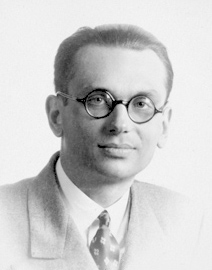
Gödel Publishes the Incompleteness Theorems
Gödel proves that any consistent formal system containing arithmetic is incomplete and cannot prove its own consistency, shaking the foundations of mathematics. #incompleteness #logic
1936 CE
Turing Publishes 'On Computable Numbers'
Alan Turing introduces the Turing machine, defines computability, and proves the undecidability of the halting problem. #computability #turing
Turing Publishes 'On Computable Numbers' By Elliott & Fry - https://commons.wikimedia.org/wiki/File:Alan_Turing_(1951).jpg, Public domain, https://commons.wikimedia.org/w/index.php?curid=158923803
1936 CE
Church Publishes the Undecidability of First-Order Logic
Alonzo Church proves that there is no algorithm to decide the truth of statements in first-order logic, using lambda calculus. #undecidability #logic
1937 CE
Turing's Halting Problem Proved Undecidable
Turing shows that no algorithm can determine whether a given Turing machine halts, a foundational result in computability theory. #undecidability #computability
1938 CE
Gödel Proves Consistency of the Continuum Hypothesis with ZFC
Gödel shows that the continuum hypothesis cannot be disproved in ZFC, using the constructible universe L. #settheory #continuumhypothesis
1940 CE
Gödel Publishes The Consistency of the Continuum Hypothesis
Gödel's monograph details his proof that the continuum hypothesis is consistent with ZFC. #settheory #continuumhypothesis
1945 CE
First Electronic Computer ENIAC Completed
ENIAC, the first general-purpose electronic computer, is built, enabling practical computation and influencing computability theory. #computing #history
First Electronic Computer ENIAC Completed By The original uploader was TexasDex at English Wikipedia. - Transferred from en.wikipedia to Commons by Andrei Stroe using CommonsHelper., CC BY-SA 3.0, https://commons.wikimedia.org/w/index.php?curid=6557095
1950 CE
Turing Publishes 'Computing Machinery and Intelligence'
Turing proposes the Turing test for machine intelligence, linking computability to artificial intelligence. #AI #turing
1963 CE
Cohen Proves Independence of the Continuum Hypothesis
Paul Cohen uses forcing to show that the continuum hypothesis is independent of ZFC, completing the solution to Hilbert's first problem. #settheory #continuumhypothesis
1964 CE
Cohen Publishes Set Theory and the Continuum Hypothesis
Cohen's monograph details the forcing technique, revolutionizing set theory and independence proofs. #settheory #forcing
1970 CE
Matiyasevich Proves Hilbert's 10th Problem is Unsolvable
Yuri Matiyasevich completes the proof that no algorithm can determine whether a Diophantine equation has integer solutions, building on work by Davis, Putnam, and Robinson. #undecidability #numbertheory
1976 CE
Four Color Theorem Proved with Computer Assistance
Kenneth Appel and Wolfgang Haken prove the four color theorem using a computer, sparking debate about the role of computation in proofs. #computation #proof
Four Color Theorem Proved with Computer Assistance By Inductiveload - Based on a this raster image by chas zzz brown on en.wikipedia., CC BY-SA 3.0, https://commons.wikimedia.org/w/index.php?curid=1680050
1977 CE
Paris and Harrington Prove Independence from Peano Arithmetic
Jeff Paris and Leo Harrington find a combinatorial statement independent of Peano arithmetic, demonstrating Gödelian phenomena in natural mathematics. #incompleteness #combinatorics
1982 CE
Friedman Introduces Finite Forms of Kruskal's Theorem
Harvey Friedman finds finite combinatorial statements independent of Peano arithmetic, further exploring incompleteness. #incompleteness #combinatorics
1990 CE
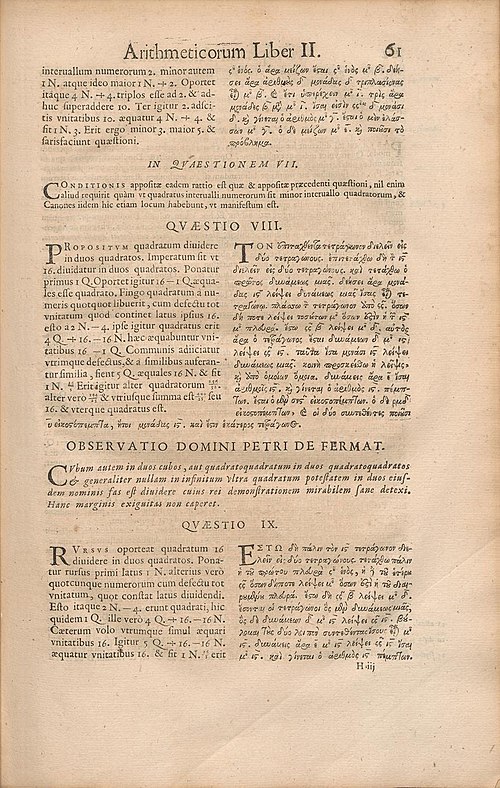
Wiles Begins Work on Fermat's Last Theorem
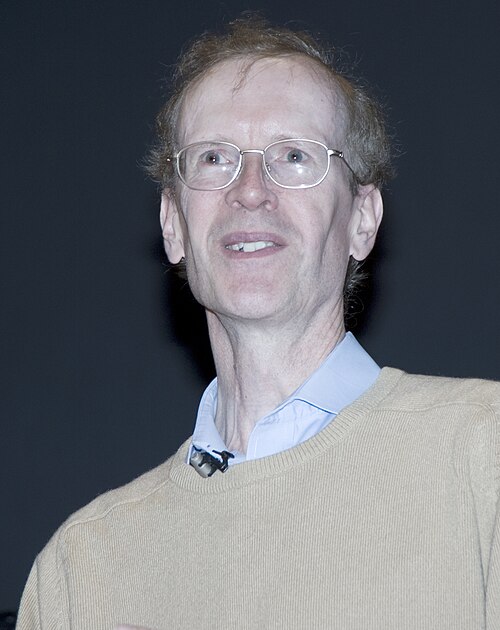
Andrew Wiles starts his secret proof of Fermat's Last Theorem, eventually using advanced number theory and modular forms. #numbertheory #proof
Wiles Begins Work on Fermat's Last Theorem By "copyright C. J. Mozzochi, Princeton N.J" - http://www.mozzochi.org/deligne60/Deligne1/_DSC0024.jpg, Attribution, https://commons.wikimedia.org/w/index.php?curid=2635913
1994 CE
Wiles Proves Fermat's Last Theorem
Andrew Wiles, with assistance from Richard Taylor, proves Fermat's Last Theorem, a landmark in number theory and mathematical logic. #numbertheory #proof
Wiles Proves Fermat's Last Theorem By Unknown author, Public domain, https://commons.wikimedia.org/w/index.php?curid=533640
2000 CE
Millennium Prize Problems Announced
The Clay Mathematics Institute lists seven unsolved problems, including the P vs NP problem, continuing Hilbert's tradition. #problems #foundations
2002 CE
Gödel's Lost Letter Published
A previously unknown letter from Gödel to von Neumann is discovered, discussing P vs NP and computational complexity. #complexity #PvsNP
Gödel's Lost Letter Published By Unknown author - http://www.arithmeum.uni-bonn.de/en/events/285, Public domain, https://commons.wikimedia.org/w/index.php?curid=120309395
2010 CE
Deolalikar Claims Proof of P ≠ NP
Vinay Deolalikar announces a proof that P ≠ NP, but the proof is later found to have flaws, highlighting the difficulty of the problem. #complexity #PvsNP