Mathematical Logic & Incompleteness: Boolean Algebra to Gödel & Turing
Encyclopedia/1. The Cosmos & The Natural World/1. Mathematics & Formal Systems/05. Mathematical Logic & Incompleteness • Curated by Admin Timeline.sg
Mathematical logic and incompleteness trace the foundational crisis of mathematics from Boolean algebra through Cantor's transfinite sets, Hilbert's program, Gödel's incompleteness theorems, and Turing's universal machine, reshaping our understanding of formal systems and computability.
Chronological Storyline (46 Milestones)
1847 CE
Boole Publishes The Mathematical Analysis of Logic
George Boole publishes The Mathematical Analysis of Logic, introducing Boolean algebra and linking logic to algebra. This work lays the foundation for modern digital circuit design and formal logic. #mathematics #logic
1854 CE
Boole Publishes An Investigation of the Laws of Thought
George Boole publishes An Investigation of the Laws of Thought, expanding his algebraic logic and establishing Boolean algebra as a formal system. This work influences later developments in set theory and computer science. #mathematics #logic
1872 CE
Dedekind Publishes Stetigkeit und irrationale Zahlen
Richard Dedekind publishes Stetigkeit und irrationale Zahlen (Continuity and Irrational Numbers), defining real numbers via Dedekind cuts and providing a rigorous foundation for analysis. #mathematics #analysis
Dedekind Publishes Stetigkeit und irrationale Zahlen By Melikamp - Own work, CC BY-SA 4.0, https://commons.wikimedia.org/w/index.php?curid=147735710
1874 CE
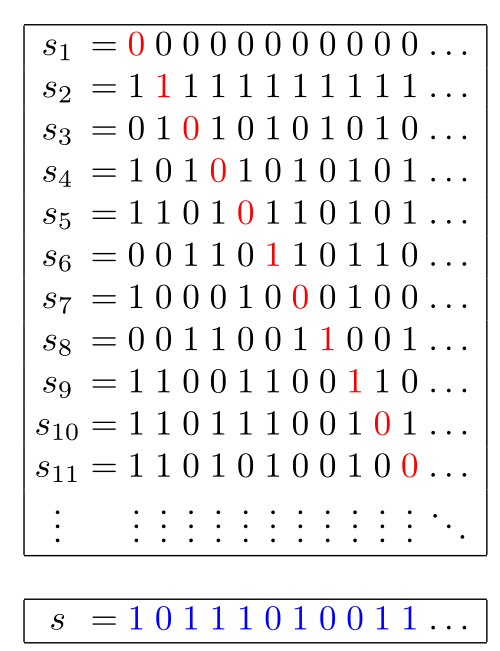
Cantor Proves Uncountability of Real Numbers
Georg Cantor publishes his proof that the set of real numbers is uncountable, introducing diagonalization and challenging prevailing notions of infinity. This marks the birth of set theory. #mathematics #settheory
Cantor Proves Uncountability of Real Numbers By Jochen Burghardt - Own work, CC BY-SA 3.0, https://commons.wikimedia.org/w/index.php?curid=30402203
1879 CE
Frege Publishes Begriffsschrift
Gottlob Frege publishes Begriffsschrift, a formal language for logic that introduces quantifiers and variables, laying the groundwork for modern mathematical logic. #logic #philosophy
Frege Publishes Begriffsschrift By Unknown author - digitized version at https://gallica.bnf.fr/ark:/12148/bpt6k65658c, Public domain, https://commons.wikimedia.org/w/index.php?curid=2669038
1883 CE
Cantor Publishes Grundlagen einer allgemeinen Mannigfaltigkeitslehre
Georg Cantor publishes Grundlagen einer allgemeinen Mannigfaltigkeitslehre, formalizing transfinite numbers and set theory, including the concept of cardinality and ordinal numbers. #mathematics #settheory
1884 CE
Frege Publishes Die Grundlagen der Arithmetik
Gottlob Frege publishes Die Grundlagen der Arithmetik, attempting to derive arithmetic from logic, a key work in logicism and the philosophy of mathematics. #logic #philosophy
Frege Publishes Die Grundlagen der Arithmetik By Gottlob Frege - Project Gutenberg: http://www.gutenberg.org/ebooks/48312, http://www.gutenberg.org/files/48312/48312-h/images/cover.jpg, Public domain, https://commons.wikimedia.org/w/index.php?curid=66228870
1888 CE
Dedekind Publishes Was sind und was sollen die Zahlen?
Richard Dedekind publishes Was sind und was sollen die Zahlen?, defining natural numbers through set theory and providing a foundation for arithmetic. #mathematics #settheory
Dedekind Publishes Was sind und was sollen die Zahlen? By Unknown (Mondadori Publishers) - https://www.gettyimages.co.uk/detail/news-photo/portrait-of-the-german-mathematician-richard-dedekind-1900s-news-photo/141551154, Public domain, https://commons.wikimedia.org/w/index.php?curid=41284791
1889 CE
Peano Publishes Arithmetices principia, nova methodo exposita
Giuseppe Peano publishes Arithmetices principia, presenting the Peano axioms for natural numbers, a foundational axiomatization of arithmetic. #mathematics #logic
1890 CE
Cantor Discovers the Diagonal Argument
Georg Cantor publishes his diagonal argument, proving that the set of real numbers is uncountable and introducing a powerful proof technique used in logic and computability. #mathematics #settheory
1895 CE
Cantor Publishes Beiträge zur Begründung der transfiniten Mengenlehre
Georg Cantor publishes Beiträge zur Begründung der transfiniten Mengenlehre, a comprehensive exposition of transfinite set theory, including cardinal and ordinal numbers. #mathematics #settheory
1897 CE
Burali-Forti Paradox Discovered
Cesare Burali-Forti discovers a paradox concerning the set of all ordinal numbers, highlighting inconsistencies in naive set theory and prompting the development of axiomatic set theories. #mathematics #paradox
1899 CE
Cantor Discovers the Cantor Paradox
Georg Cantor discovers the paradox that the set of all sets would have a cardinality larger than itself, leading to the need for a distinction between sets and proper classes. #mathematics #paradox
Aug 8, 1900 CE
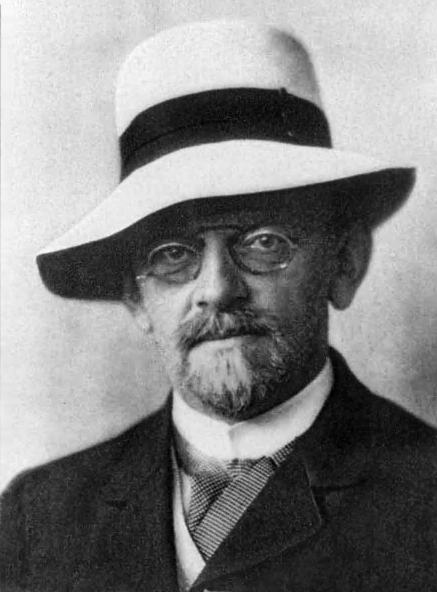
Hilbert Presents 23 Problems at ICM
David Hilbert presents his list of 23 unsolved problems at the International Congress of Mathematicians in Paris, including the consistency of arithmetic (Problem 2) and the decidability of mathematics (Problem 10). #mathematics #history
Hilbert Presents 23 Problems at ICM By Unknown author - Possibly Reid, Constance (1970) Hilbert, Berlin, Heidelberg: Springer Berlin Heidelberg Imprint Springer, p. 230 ISBN: 978-3-662-27132-2., Public domain, https://commons.wikimedia.org/w/index.php?curid=36302
1901 CE
Russell Discovers Russell's Paradox
Bertrand Russell discovers Russell's paradox in Frege's set theory, showing that the set of all sets that do not contain themselves leads to a contradiction, shaking the foundations of mathematics. #mathematics #paradox
1903 CE
Russell Publishes The Principles of Mathematics
Bertrand Russell publishes The Principles of Mathematics, discussing the foundations of mathematics and proposing logicism, the idea that mathematics is reducible to logic. #mathematics #philosophy
1904 CE
Zermelo Proves the Well-Ordering Theorem
Ernst Zermelo proves the well-ordering theorem using the axiom of choice, sparking debate about the axiom's validity and leading to the development of axiomatic set theory. #mathematics #settheory
1908 CE
Zermelo Publishes Axiomatic Set Theory
Ernst Zermelo publishes his axiomatic set theory, introducing the Zermelo axioms to avoid paradoxes, later expanded by Fraenkel to become ZFC. #mathematics #settheory
1910 CE
Whitehead and Russell Publish Principia Mathematica Vol. 1
Alfred North Whitehead and Bertrand Russell publish the first volume of Principia Mathematica, a monumental work attempting to derive all mathematics from logical axioms, using type theory to avoid paradoxes. #mathematics #logic
Whitehead and Russell Publish Principia Mathematica Vol. 1 By Nick Dillinger - http://en.wikipedia.org/wiki/File:Pmdsgdbhxdfgb2.jpg, Public domain, https://commons.wikimedia.org/w/index.php?curid=6074919
1912 CE
Principia Mathematica Vol. 2 Published
Whitehead and Russell publish the second volume of Principia Mathematica, continuing the derivation of cardinal arithmetic and ordinal numbers from logical principles. #mathematics #logic
1913 CE
Principia Mathematica Vol. 3 Published
The third and final volume of Principia Mathematica is published, covering measure theory and real analysis, completing the monumental logicist project. #mathematics #logic
1915 CE
Löwenheim Publishes the Löwenheim–Skolem Theorem
Leopold Löwenheim publishes a paper proving the Löwenheim–Skolem theorem, which states that if a first-order theory has an infinite model, it has a countable model, highlighting limitations of first-order logic. #logic #mathematics
1920 CE
Skolem Refines the Löwenheim–Skolem Theorem
Thoralf Skolem provides a simpler proof of the Löwenheim–Skolem theorem and introduces Skolem functions, furthering the study of model theory. #logic #mathematics
1921 CE
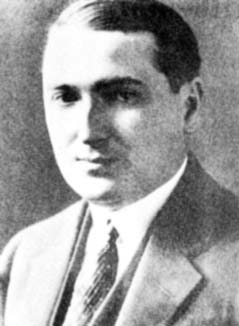
Post Publishes on the Truth-Table Method
Emil Post publishes a paper introducing truth tables and proving the consistency and completeness of propositional logic, contributing to metalogic. #logic #mathematics
Post Publishes on the Truth-Table Method By Unknown author, Public domain, https://commons.wikimedia.org/w/index.php?curid=2326395
1922 CE
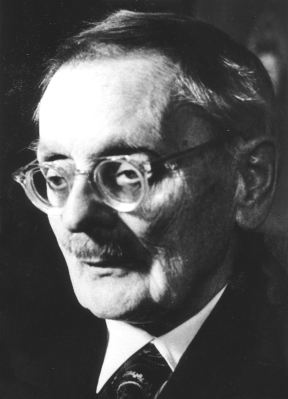
Fraenkel Adds the Replacement Axiom to Zermelo Set Theory
Abraham Fraenkel proposes the replacement axiom, strengthening Zermelo set theory and leading to the ZFC axioms, the standard foundation for mathematics. #mathematics #settheory
Fraenkel Adds the Replacement Axiom to Zermelo Set Theory By Konrad Jacobs - https://opc.mfo.de/detail?photo_id=8666, CC BY-SA 2.0 de, https://commons.wikimedia.org/w/index.php?curid=6092305
1923 CE
Skolem Publishes on the Skolem Paradox
Thoralf Skolem publishes the Skolem paradox, showing that ZFC set theory has a countable model despite asserting the existence of uncountable sets, highlighting the relativity of set-theoretic concepts. #mathematics #paradox
Skolem Publishes on the Skolem Paradox By Unknown author - Oslo Museum: image no. OB.F06426c (Byhistorisk samling/City historic collection), via oslobilder.no., Public domain, https://commons.wikimedia.org/w/index.php?curid=37457061
1928 CE
Hilbert and Ackermann Publish Grundzüge der theoretischen Logik
David Hilbert and Wilhelm Ackermann publish Grundzüge der theoretischen Logik, a textbook on mathematical logic that poses the Entscheidungsproblem (decision problem) for first-order logic. #logic #mathematics
1930 CE
Gödel Proves Completeness Theorem for First-Order Logic
Kurt Gödel proves the completeness theorem for first-order logic in his doctoral dissertation, showing that every logically valid formula is provable in a standard deductive system. #logic #mathematics
Gödel Proves Completeness Theorem for First-Order Logic By Fschwarzentruber - File:Completude̠ logique premier ordre.png, CC BY-SA 4.0, https://commons.wikimedia.org/w/index.php?curid=99535467
1931 CE
Gödel Publishes Incompleteness Theorems
Kurt Gödel publishes his incompleteness theorems, proving that any consistent formal system capable of expressing arithmetic contains true but unprovable statements, and cannot prove its own consistency. This shatters Hilbert's program. #mathematics #logic
1933 CE
Kleene Develops Recursive Functions
Stephen Cole Kleene develops the theory of recursive functions, formalizing the notion of computability and laying groundwork for recursion theory. #mathematics #computability
1934 CE
Gödel Defines General Recursive Functions
Kurt Gödel introduces general recursive functions in his lectures at Princeton, providing a precise definition of computable functions. #mathematics #computability
1935 CE
Church Publishes the Church-Turing Thesis
Alonzo Church publishes a paper proposing the Church-Turing thesis, identifying effectively calculable functions with recursive functions and lambda-definable functions. #mathematics #computability
1936 CE
Church Proves Undecidability of First-Order Logic
Alonzo Church proves that first-order logic is undecidable, meaning there is no algorithm to determine whether a given formula is valid, answering Hilbert's Entscheidungsproblem negatively. #logic #mathematics
1936 CE
Turing Publishes On Computable Numbers
Alan Turing publishes On Computable Numbers, introducing the Turing machine as a model of computation and proving the undecidability of the halting problem, independently establishing the limits of computability. #mathematics #computability
1937 CE
Turing Publishes on the Halting Problem
Alan Turing proves the undecidability of the halting problem, showing that no Turing machine can determine whether an arbitrary program will halt. This is a foundational result in computability theory. #mathematics #computability
1938 CE
Gödel Proves Consistency of the Continuum Hypothesis with ZFC
Kurt Gödel proves that the continuum hypothesis is consistent with ZFC set theory, showing it cannot be disproven from the axioms. #mathematics #settheory
1940 CE
Gödel Publishes The Consistency of the Continuum Hypothesis
Kurt Gödel publishes The Consistency of the Continuum Hypothesis, providing a detailed proof of the relative consistency of the continuum hypothesis with ZFC. #mathematics #settheory
1943 CE
Post Proposes the Post Correspondence Problem
Emil Post introduces the Post correspondence problem, an undecidable problem in formal language theory, furthering the study of undecidability. #mathematics #computability
1944 CE
Gödel Publishes on Russell's Mathematical Logic
Kurt Gödel publishes Russell's Mathematical Logic, a critical analysis of logicism and the limitations of Principia Mathematica, reflecting on the foundations of mathematics. #mathematics #philosophy
1947 CE
Turing Publishes on Computing Machinery and Intelligence
Alan Turing publishes Computing Machinery and Intelligence, introducing the Turing test and discussing the possibility of machine intelligence, linking logic to artificial intelligence. #computing #ai
1949 CE
Turing Builds the Automatic Computing Engine (ACE)
Alan Turing designs the Automatic Computing Engine (ACE), one of the first stored-program computers, demonstrating the practical application of Turing machine concepts. #computing #history
Turing Builds the Automatic Computing Engine (ACE) By Antoine Taveneaux - Own work, CC BY-SA 3.0, https://commons.wikimedia.org/w/index.php?curid=20340269
1950 CE
Turing Publishes Computing Machinery and Intelligence
Alan Turing publishes his seminal paper Computing Machinery and Intelligence, proposing the Turing test as a criterion for machine intelligence and discussing the philosophical implications. #ai #philosophy
1951 CE
Gödel Delivers Gibbs Lecture on Incompleteness
Kurt Gödel delivers the Gibbs Lecture, discussing the implications of his incompleteness theorems for the philosophy of mathematics and the limits of formal systems. #mathematics #philosophy
1954 CE
Turing Dies
Alan Turing dies, leaving a legacy in computability, artificial intelligence, and cryptography. His work on the Turing machine and the halting problem remains foundational. #computing #history
Turing Dies By Elliott & Fry - https://commons.wikimedia.org/wiki/File:Alan_Turing_(1951).jpg, Public domain, https://commons.wikimedia.org/w/index.php?curid=158923803
1963 CE
Cohen Proves Independence of the Continuum Hypothesis
Paul Cohen develops forcing and proves that the continuum hypothesis is independent of ZFC, showing it cannot be proven from the axioms, completing the solution to Hilbert's first problem. #mathematics #settheory
1970 CE
Matiyasevich Proves Hilbert's 10th Problem Unsolvable
Yuri Matiyasevich completes the proof that Hilbert's 10th problem (finding an algorithm to solve Diophantine equations) is unsolvable, building on work by Davis, Putnam, and Robinson. #mathematics #computability