Mansa Musa I, the tenth Mansa of the Mali Empire, is renowned for his immense wealth, his lavish pilgrimage to Mecca in 1324, and his patronage of architecture and education in Timbuktu. He brought Mali to the attention of Europe and the Islamic world.
Chronological Storyline (36 Milestones)
1280 CE
Birth of Mansa Musa
Mansa Musa is born in Niani, then capital of the Mali Empire, into the Keita dynasty. He will later become the wealthiest individual in history, controlling vast gold resources. #history #Mali #wealth
Birth of Mansa Musa By attributed to Abraham Cresques - This file comes from Gallica Digital Library and is available under the digital ID btv1b55002481n, Public domain, https://commons.wikimedia.org/w/index.php?curid=107077167
1285 CE
Sakura Seizes the Mali Throne
Sakura, a former slave and military commander, becomes Mansa of the Mali Empire, expanding its territory significantly. This period of expansion sets the stage for later wealth. #history #Mali )
1290 CE
Sakura Captures Timbuktu and Gao
Under Mansa Sakura, the Mali Empire conquers the prosperous trading cities of Timbuktu and Gao, enhancing control over trans-Saharan trade routes. #history #Mali #trade
Sakura Captures Timbuktu and Gao By Flickr user: Emilio Labrador Santiago de Chile https://www.flickr.com/people/3059349393/ - Flickr: https://www.flickr.com/photos/3059349393/3331431933/, CC BY 2.0, https://commons.wikimedia.org/w/index.php?curid=22534570
1300 CE
Young Mansa Musa Grows Up in Niani
Mansa Musa spends his early years in the royal court of Niani, receiving education in Islamic law, history, and governance. #history #Mali
Young Mansa Musa Grows Up in Niani By Gabriel Moss - Own work, CC BY-SA 4.0, https://commons.wikimedia.org/w/index.php?curid=49433962
1305 CE
Abu Bakr II Becomes Mansa of Mali
Abu Bakr II ascends to the throne of the Mali Empire. He is known for his fascination with the Atlantic Ocean and will commission exploratory expeditions. #history #Mali
1310 CE
Abu Bakr II's Atlantic Expedition
Mansa Abu Bakr II launches a large fleet to explore the Atlantic Ocean, but he and the expedition disappear. This event leads to the rise of Mansa Musa. #history #Mali #exploration
1311 CE
Mansa Musa Appointed as Deputy
Before his Atlantic expedition, Abu Bakr II appoints Mansa Musa as his deputy to rule Mali in his absence. Mansa Musa consolidates power during this period. #history #Mali
1312 CE
Coronation of Mansa Musa in Niani
Mansa Musa is officially crowned in the capital Niani with elaborate ceremonies, solidifying his authority and the legitimacy of the Keita dynasty. #history #Mali
1312 CE
Mansa Musa Becomes Emperor
Following the disappearance of Abu Bakr II, Mansa Musa is crowned the tenth Mansa of the Mali Empire, controlling vast gold mines and trade routes. #history #Mali #wealth
1315 CE
Mansa Musa Consolidates Gold Fields
Mansa Musa strengthens control over the Bambuk and Bure goldfields, ensuring a steady flow of gold that will fund his empire and pilgrimage. #history #Mali #economy
Mansa Musa Consolidates Gold Fields By HetmanTheResearcher - Own work, CC BY 4.0, https://commons.wikimedia.org/w/index.php?curid=143761923
1318 CE
Mali Empire Expands Westward
Mansa Musa leads a campaign to expand Mali's territory westward into the Senegal region, subduing the Takrur kingdom and gaining access to Atlantic trade. #history #Mali #expansion
Mali Empire Expands Westward By T L Miles (talk) - Own work (Original text: self-made, using map by http://www.ThomasLessman.com/History/images/East-Hem_1200ad.jpg, under the Creative Commons Attribution 3.0), CC BY-SA 3.0, https://commons.wikimedia.org/w/index.php?curid=34701194
1320 CE
Timbuktu Becomes Major Trading City
Under Mansa Musa's rule, Timbuktu grows into a thriving center of trans-Saharan trade, attracting merchants from North Africa and beyond. #history #Mali #trade
1322 CE
Mansa Musa Plans His Hajj
Mansa Musa decides to undertake the Hajj pilgrimage to Mecca, organizing an enormous caravan of gold, slaves, and supplies to showcase Mali's wealth. #history #Islam #pilgrimage
Jun 1, 1324 CE
Departure for Hajj from Niani
Mansa Musa sets out from Niani with a caravan of thousands, including soldiers, servants, and camels carrying gold. The pilgrimage will become legendary. #history #Islam #pilgrimage
Jul 1, 1324 CE
Arrival in Cairo, Egypt
Mansa Musa arrives in Cairo, then under Mamluk rule, where his extravagant spending drives down gold prices for years. He meets with the Sultan. #history #Egypt #wealth
Aug 1, 1324 CE
Meeting with Sultan Al-Nasir Muhammad
Mansa Musa meets Sultan Al-Nasir Muhammad of Egypt, who is impressed by his wealth and provides him with supplies for his continued journey to Mecca. #history #diplomacy
Sep 1, 1324 CE
Gold Distribution Causes Inflation in Cairo
Mansa Musa distributes so much gold in Cairo that its value plummets, and the economic impact is felt across the region for over a decade. #economy #history
Oct 1, 1324 CE
Completion of Hajj in Mecca
Mansa Musa performs the Hajj in Mecca, fulfilling one of the Five Pillars of Islam. He distributes gold to the poor and buys property for pilgrims. #Islam #pilgrimage
Jan 1, 1325 CE
Return Journey from Mecca to Medina
After completing the Hajj, Mansa Musa travels to Medina to visit the Prophet's Mosque, further demonstrating his piety. #Islam #history
May 1, 1325 CE
Return to Cairo and Additional Gold Gifts
On his way back, Mansa Musa stays in Cairo again, giving more gold gifts and borrowing money at high interest due to gold devaluation. #history #economy
Sep 1, 1325 CE
Arrival Back in Niani
Mansa Musa returns to Mali, bringing with him scholars, architects, and books that will transform Timbuktu into a center of learning. #history #Mali #education
1326 CE
Commissioning of Djinguereber Mosque
Inspired by the architecture he saw on his Hajj, Mansa Musa commissions the building of the Djinguereber Mosque in Timbuktu, designed by the Andalusian architect Abu Sa'id. #architecture #history
Commissioning of Djinguereber Mosque By KaTeznik - Own work, CC BY-SA 2.0 fr, https://commons.wikimedia.org/w/index.php?curid=49789
1327 CE
Construction of Djinguereber Mosque Begins
Work starts on the Djinguereber Mosque, using mud-brick (banco) and timbers. It will become one of the most famous mosques in Africa. #architecture #history
1327 CE
Construction of Sankore Madrasah
Mansa Musa commissions the Sankore Madrasah in Timbuktu, which will evolve into a major Islamic university attracting scholars from across the Muslim world. #education #history
Construction of Sankore Madrasah By Anne and David - https://www.flickr.com/photos/annedavid2012/1299279844/, Public domain, https://commons.wikimedia.org/w/index.php?curid=98491261
1328 CE
Completion of Djinguereber Mosque
The Djinguereber Mosque is completed, serving as a central place of worship and a symbol of Mali's prosperity and Islamic devotion. #architecture #Islam
1329 CE
Establishment of Sankore University
The Sankore Madrasah expands into a full university, with a curriculum covering law, medicine, astronomy, and literature. Timbuktu becomes a scholarly hub. #education #history
1330 CE
Mali Empire at Its Peak Territorial Extent
Under Mansa Musa, the Mali Empire reaches its greatest size, stretching from the Atlantic coast to the Niger Bend, encompassing modern-day Mali, Senegal, Gambia, Guinea, Niger, and Burkina Faso. #history #Mali
1331 CE
Diplomatic Mission to Morocco
Mansa Musa sends envoys to the Marinid Sultanate in Morocco, establishing formal diplomatic and trade relations between the two Muslim states. #history #diplomacy
1332 CE
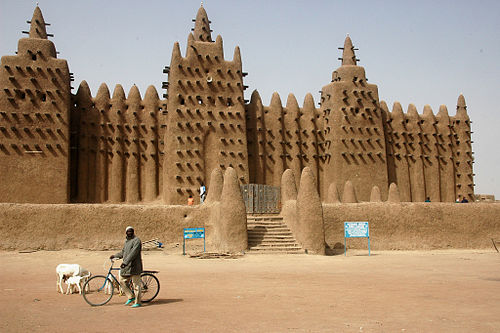
Construction of the Great Mosque of Djenné (Attributed)
Mansa Musa is credited with ordering the construction of the Great Mosque of Djenné, though it was built later. This reflects his commitment to Islamic architecture. #architecture #history
Construction of the Great Mosque of Djenné (Attributed) By Ruud Zwart - Photo taken by Ruud Zwart, CC BY-SA 3.0, https://commons.wikimedia.org/w/index.php?curid=3326719
1333 CE
Expansion of Trade Routes to the Niger River
Mansa Musa invests in improving and safeguarding trade routes along the Niger River, boosting commerce in gold, salt, and slaves. #trade #history
1334 CE
Flourishing of Arts and Scholarship
Under Mansa Musa's patronage, Timbuktu becomes a center of arts and scholarship, with poets, jurists, and scientists from around the Muslim world visiting. #culture #history
1335 CE
Introduction of Arabic Architecture to Timbuktu
Mansa Musa brings Arab architects and builders to Timbuktu, introducing new construction techniques and styles that blend with local traditions. #architecture #history
1336 CE
Mansa Musa's Health Declines
In his later years, Mansa Musa's health begins to fail, but he continues to govern the empire and promote Islamic scholarship. #history
1337 CE
Mansa Musa's Legacy Begins
Following his death, Mansa Musa's wealth and pilgrimage become legendary, with his story spreading across the Islamic world and Europe, influencing maps and chronicles. #history #legacy
1337 CE
Death of Mansa Musa
Mansa Musa dies in Niani, likely in 1337, after a reign of about 25 years. He is succeeded by his son Maghan I. #history #Mali
1337 CE
Succession of Maghan I
Mansa Musa's son, Maghan I, ascends to the throne of the Mali Empire, but the empire soon begins to decline due to internal strife and external pressures. #history #Mali