Mainframe Computing to Personal Computers: ENIAC, IBM System/360, Apple II & PC Era
Encyclopedia/2. Technology & The Built World/1. Computing, AI & Information Technology/01. Hardware & Electronics • Curated by Admin Timeline.sg
Historical events timeline.
Chronological Storyline (44 Milestones)
1945 CE
ENIAC Completed
The Electronic Numerical Integrator and Computer (ENIAC) is completed at the University of Pennsylvania. It is the first general-purpose electronic digital computer, using vacuum tubes and capable of thousands of calculations per second. #computing #history
ENIAC Completed By The original uploader was TexasDex at English Wikipedia. - Transferred from en.wikipedia to Commons by Andrei Stroe using CommonsHelper., CC BY-SA 3.0, https://commons.wikimedia.org/w/index.php?curid=6557095
Dec 23, 1947 CE
Transistor Invented
John Bardeen, Walter Brattain, and William Shockley invent the transistor at Bell Labs. This solid-state device replaces vacuum tubes, enabling smaller, more reliable computers. #computing #technology
Transistor Invented By Ulfbastel - Own work, CC BY-SA 3.0, https://commons.wikimedia.org/w/index.php?curid=3123331
Mar 30, 1951 CE
UNIVAC I Delivered
The UNIVAC I, the first commercial computer, is delivered to the U.S. Census Bureau. It uses magnetic tape for input/output and popularizes computing for business data processing. #computing #history
UNIVAC I Delivered By U.S. Census Bureau employees - https://www.census.gov/history/, Public domain, https://commons.wikimedia.org/w/index.php?curid=61118833
Apr 7, 1953 CE
IBM 701 Announced
IBM announces the IBM 701, its first commercial scientific computer. It uses vacuum tubes and magnetic drum memory, marking IBM's entry into the electronic computer market. #computing #IBM
IBM 701 Announced By Dan - Flickr: IBM 701, CC BY 2.0, https://commons.wikimedia.org/w/index.php?curid=13301780
1957 CE
FORTRAN Developed
IBM releases the FORTRAN programming language, the first high-level language. It simplifies scientific computing by allowing mathematical expressions and becomes widely adopted. #programming #computing
FORTRAN Developed By Fortran-lang community - https://github.com/fortran-lang/fortran-lang.org/blob/master/assets/img/fortran-logo.svg, Public domain, https://commons.wikimedia.org/w/index.php?curid=94909602
1958 CE
IBM 7090 Transistorized Mainframe
IBM introduces the IBM 7090, a fully transistorized version of the 709. It is faster and more reliable, becoming a popular mainframe for scientific and military applications. #computing #mainframe
IBM 7090 Transistorized Mainframe By NASA - https://web.archive.org/web/20061212160720/http://www.frobenius.com/7090Mercury.mpg (original, now broken link), Public domain, https://commons.wikimedia.org/w/index.php?curid=23246228
1960 CE
DEC PDP-1 Minicomputer
Digital Equipment Corporation launches the PDP-1, the first minicomputer, featuring a small size and interactive use. It pioneers time-sharing and influences later personal computers. #computing #minicomputer
DEC PDP-1 Minicomputer By Alexey Komarov - Own work, CC BY-SA 4.0, https://commons.wikimedia.org/w/index.php?curid=75337442
Apr 7, 1964 CE
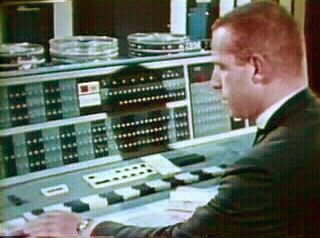
IBM System/360 Announced
IBM announces the System/360 family, a groundbreaking series of compatible mainframes. It introduces a unified architecture for both scientific and business computing, dominating the industry for decades. #computing #IBM
IBM System/360 Announced By ArnoldReinhold - Own work, CC BY-SA 3.0, https://commons.wikimedia.org/w/index.php?curid=47096462
1965 CE
DEC PDP-8 Minicomputer
Digital Equipment Corporation introduces the PDP-8, the first successful commercial minicomputer. Its low cost and small size make computing accessible to laboratories and smaller businesses. #computing #minicomputer
DEC PDP-8 Minicomputer By Kris Arnold - https://www.flickr.com/photos/wka/3735964493/, CC BY-SA 2.0, https://commons.wikimedia.org/w/index.php?curid=110392229
Oct 29, 1969 CE
ARPANET First Message
The first ARPANET message is sent from UCLA to Stanford, marking the birth of the internet. This packet-switched network connects research institutions and lays the foundation for global networking. #internet #computing
ARPANET First Message By ARPANET - The Computer History Museum ([1]), en:File:Arpnet-map-march-1977.png, Public domain, https://commons.wikimedia.org/w/index.php?curid=9990864
Nov 15, 1971 CE
Intel 4004 Microprocessor
Intel releases the 4004, the first commercially available microprocessor. It integrates a CPU on a single chip, enabling the development of microcomputers and embedding computing into many devices. #microprocessor #computing
Intel 4004 Microprocessor By Thomas Nguyen - Own work, CC BY-SA 4.0, https://commons.wikimedia.org/w/index.php?curid=47684767
Apr 1, 1972 CE
Intel 8008 Microprocessor
Intel introduces the 8008, an 8-bit microprocessor. It is used in early terminals and simple computers, advancing the move toward personal computing. #microprocessor #computing
Intel 8008 Microprocessor By Konstantin Lanzet - CPU Collection Konstantin Lanzet Camera: Canon EOS 400D, CC BY-SA 4.0, https://commons.wikimedia.org/w/index.php?curid=5694177
Apr 1, 1974 CE
Intel 8080 Microprocessor
Intel launches the 8080, a powerful 8-bit microprocessor that becomes the heart of many early microcomputers, including the Altair 8800. It sparks the personal computer revolution. #microprocessor #computing
Intel 8080 Microprocessor By The Science Museum UK - [1], CC BY 4.0, https://commons.wikimedia.org/w/index.php?curid=133514392
Jan 1, 1975 CE
Altair 8800 Kit Computer
MITS introduces the Altair 8800, a build-it-yourself microcomputer kit using the Intel 8080. It inspires hobbyists and leads to the formation of Microsoft and the early PC industry. #computing #personalcomputer
Altair 8800 Kit Computer By Swtpc6800 en:User:Swtpc6800 Michael Holley - Transfered from en.wikipedia, Public domain, https://commons.wikimedia.org/w/index.php?curid=3185062
Apr 1, 1976 CE
Apple I Computer
Steve Wozniak and Steve Jobs complete the Apple I, a single-board computer for hobbyists. Though limited in sales, it marks the beginning of Apple Inc. and democratized computing. #computing #apple
Apple I Computer By Achim Baqué - https://www.apple1registry.com/en/press.html, CC BY-SA 4.0, https://commons.wikimedia.org/w/index.php?curid=109364693
Jun 5, 1977 CE
Apple II Released
Apple introduces the Apple II, one of the first highly successful mass-produced microcomputers. With color graphics, expansion slots, and the VisiCalc spreadsheet, it becomes a dominant home and business machine. #computing #apple
Apple II Released By Rama & Musée Bolo - Own work, CC BY-SA 2.0 fr, https://commons.wikimedia.org/w/index.php?curid=36639527
Aug 3, 1977 CE
TRS-80 Model I Announced
Tandy Corporation (RadioShack) announces the TRS-80 Model I, a popular home computer with a Z80 processor and BASIC. Its low price and retail availability make it a best-seller. #computing #tandy
TRS-80 Model I Announced By Rama & Musée Bolo - Own work, CC BY-SA 2.0 fr, https://commons.wikimedia.org/w/index.php?curid=37010666
Oct 1, 1977 CE
Commodore PET 2001
Commodore releases the PET 2001, an all-in-one personal computer with an integrated monitor, keyboard, and cassette drive. It targets education and small business markets. #computing #commodore
Commodore PET 2001 By Rama & Musée Bolo - Own work, CC BY-SA 2.0 fr, https://commons.wikimedia.org/w/index.php?curid=17129317
May 1, 1979 CE
VisiCalc Spreadsheet Released
Software Arts releases VisiCalc, the first electronic spreadsheet for personal computers. It transforms the Apple II into a serious business tool and drives the adoption of PCs in offices. #software #computing
VisiCalc Spreadsheet Released By User:Gortu - apple2history.org, Public domain, https://commons.wikimedia.org/w/index.php?curid=342925
Jun 1, 1979 CE
NEC PC-8001 Released
NEC launches the PC-8001, Japan's first personal computer using a Z80 processor. It becomes highly popular in Japan and lays the foundation for the NEC PC-9800 series. #computing #japan
Aug 12, 1981 CE
IBM Personal Computer (5150) Launched
IBM introduces the IBM PC, using an Intel 8088 processor and Microsoft's MS-DOS. Its open architecture allows clones, establishing the PC-compatible standard that dominates the industry. #computing #IBM
IBM Personal Computer (5150) Launched By Own work (based on graphics by International Business Machines Corporation) - Own work, derived from various photographs of IBM PCs, Public domain, https://commons.wikimedia.org/w/index.php?curid=115457047
Aug 1, 1981 CE
MS-DOS 1.0 Released
Microsoft releases MS-DOS 1.0 for the IBM PC. This command-line operating system becomes the dominant platform for PC-compatibles, cementing Microsoft's role in the software industry. #software #microsoft
MS-DOS 1.0 Released By The original uploader was Andrewpmk at English Wikipedia. - Transferred from en.wikipedia to Commons by Codename Lisa., Public domain, https://commons.wikimedia.org/w/index.php?curid=26299991
Jan 1, 1982 CE
Commodore 64 Launched
Commodore releases the Commodore 64, an 8-bit home computer with 64KB RAM and advanced sound and graphics. It becomes the best-selling single computer model of all time. #computing #commodore
Commodore 64 Launched By Evan-Amos - Own work, Public domain, https://commons.wikimedia.org/w/index.php?curid=17414881
Jan 19, 1983 CE
Apple Lisa Introduces GUI
Apple launches the Lisa, the first personal computer with a graphical user interface (GUI). Though expensive and a commercial failure, it pioneers the mouse and windows metaphor later popularized by Macintosh. #computing #GUI
Apple Lisa Introduces GUI By Timothy Colegrove - File:Apple_Lisa_Computer.jpg, CC BY-SA 4.0, https://commons.wikimedia.org/w/index.php?curid=128132787
Jan 24, 1984 CE
Apple Macintosh Released
Apple unveils the Macintosh, a consumer-friendly GUI computer with a mouse. Its 1984 Super Bowl ad and intuitive interface revolutionize personal computing, inspiring future operating systems. #computing #apple
Apple Macintosh Released By Apple Inc. - Own work based on: IMacLogo.svg, Public domain, https://commons.wikimedia.org/w/index.php?curid=48885006
Nov 20, 1985 CE
Microsoft Windows 1.0 Released
Microsoft launches Windows 1.0, a GUI extension for MS-DOS. It provides a multitasking environment with windows and icons, laying the foundation for future Windows versions. #software #microsoft
Sep 9, 1986 CE
Compaq Deskpro 386 Introduced
Compaq launches the Deskpro 386, the first PC using Intel's 32-bit 80386 processor. It sets new performance standards and challenges IBM's dominance in the PC market. #computing #compaq
IBM announces the Personal System/2 (PS/2) line, featuring Micro Channel Architecture and VGA graphics. The PS/2 keyboard and mouse connectors become standard for PCs. #computing #IBM
IBM PS/2 Line Introduced By International Business Machines - Own trace from https://assets.paulrand.design/Works/IBM/Packaging/PS2/Web/IBM%20PS2%20Color%20Display%208513%201990%2001.jpg, Public domain, https://commons.wikimedia.org/w/index.php?curid=115423650
Apr 10, 1989 CE
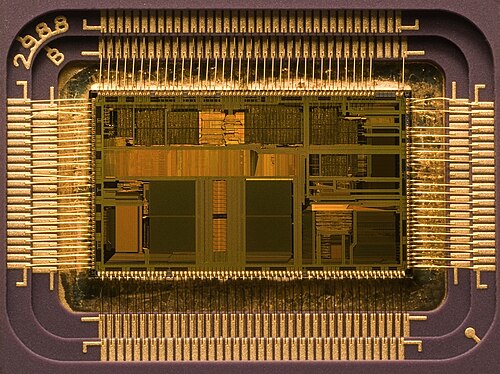
Intel 80486 Processor Launched
Intel introduces the 80486 (i486) microprocessor, integrating a math coprocessor and cache on-chip. It delivers powerful performance for desktop computing and aids the rise of Windows. #microprocessor #intel
Intel 80486 Processor Launched By Die prepared by Matt Britt w:User:Matt Britt = w:User:Uberpenguin = w:User:Uberpenguin~enwiki = https://web.archive.org/web/20080605030548/http://mattb.alwayssleeping.com/ https://web.archive.org/web/20140607040627/http://www.alwayssleeping.com:80/images/486/ https://web.archive.org/web/*/http://alwayssleeping.com/images/cleanroom/* photo taken by Matt Gibbs (matt[AT]alwayssleeping{dot}com) - Touched up a bit with GIMP to brighten the image and remove some dust specks. Die prepared by Matt Britt, photo taken by Matt Gibbs (matt[AT]alwayssleeping{dot}com)., CC BY-SA 3.0, https://commons.wikimedia.org/w/index.php?curid=5820383
May 22, 1990 CE
Windows 3.0 Released
Microsoft releases Windows 3.0, a major upgrade with improved GUI, virtual memory, and program manager. It becomes a huge commercial success, boosting PC adoption. #software #microsoft
Aug 25, 1991 CE
Linux Kernel Released
Linus Torvalds announces the first version of the Linux kernel, a free and open-source operating system. Linux becomes a major force in servers, embedded systems, and later desktop computing. #opensource #linux
Linux Kernel Released By Larry Ewing, Simon Budig, Garrett LeSage - https://isc.tamu.edu/~lewing/linux/, http://www.home.unix-ag.org/simon/penguin/, garrett/Tux on GitHub, CC0, https://commons.wikimedia.org/w/index.php?curid=753970
Mar 22, 1993 CE
Intel Pentium Processor Released
Intel launches the Pentium processor, a superscalar design with improved performance for multimedia and computing. It becomes a household name and drives the PC market through the 1990s. #microprocessor #intel
Intel Pentium Processor Released By Intel Corporation - https://www.intel.com/content/www/us/en/products/details/processors/pentium.html, Public domain, https://commons.wikimedia.org/w/index.php?curid=132640549
Aug 24, 1995 CE
Windows 95 Released
Microsoft launches Windows 95, a consumer-oriented operating system with a new Start menu, taskbar, and plug-and-play. It cements Microsoft's dominance and features built-in internet support. #software #microsoft
Jan 15, 1996 CE
USB Standard Introduced
Intel, Compaq, Microsoft, and others introduce the Universal Serial Bus (USB) standard, replacing legacy ports for peripherals. USB simplifies connectivity and becomes ubiquitous on PCs. #hardware #computing
USB Standard Introduced By Mobius at en.wikipedia - Transferred from en.wikipedia to Commons by Sreejithk2000 using CommonsHelper., Public domain, https://commons.wikimedia.org/w/index.php?curid=12724059
Nov 10, 1997 CE
Apple Power Mac G3 Launched
Apple releases the Power Mac G3, a desktop computer based on the PowerPC G3 processor. It marks a turnaround for Apple, offering high performance at competitive prices. #computing #apple
Apple Power Mac G3 Launched By fr:User:Klodo6975 - https://commons.wikimedia.org/wiki/File:Beige_Power_Macintosh_G3_Minitower.jpghttps://en.wikipedia.org/wiki/File:Power_Mac_G3_B%26W.jpg, Public domain, https://en.wikipedia.org/w/index.php?curid=55165757
May 6, 1998 CE
iMac Introduced
Apple launches the iMac, an all-in-one computer with a translucent design, USB-only ports, and no floppy drive. It revives Apple's fortunes and emphasizes ease of use and aesthetics. #computing #apple
iMac Introduced By Seasider53 - File:IMac M4 2024 2.jpg, CC BY 4.0, https://commons.wikimedia.org/w/index.php?curid=158436105
Jun 23, 1999 CE
AMD Athlon Processor Released
AMD releases the Athlon processor, outperforming Intel's Pentium III and establishing AMD as a strong competitor. This drives innovation and price competition in the PC market. #microprocessor #amd
AMD Athlon Processor Released By AMD - http://en.wikipedia.org/wiki/File:AMD_Athlon_Processor_Logo.svg, Public domain, https://commons.wikimedia.org/w/index.php?curid=48475947
Feb 17, 2000 CE
Windows 2000 Released
Microsoft ships Windows 2000, an NT-based operating system combining business reliability with consumer features. It becomes a staple for enterprise desktops and servers. #software #microsoft
Oct 25, 2001 CE
Windows XP Released
Microsoft launches Windows XP, merging the consumer and business lines. With a new interface and enhanced stability, it becomes one of the most popular operating systems worldwide. #software #microsoft
Mar 12, 2003 CE
Intel Pentium M and Centrino
Intel introduces the Pentium M processor and Centrino platform, optimizing mobile computing with low power consumption and integrated Wi-Fi. It revolutionizes laptops, making them more powerful and portable. #computing #mobile
Intel Pentium M and Centrino By Unknown author - en:File:Pentium M.jpg, Public domain, https://commons.wikimedia.org/w/index.php?curid=52739356
Apr 18, 2005 CE
First Dual-Core Desktop Processors
AMD and Intel release dual-core processors (Athlon 64 X2 and Pentium D) for desktop PCs. Multi-core design improves multitasking and performance, marking a shift from clock speed scaling. #microprocessor #computing
First Dual-Core Desktop Processors By CountingPine at English Wikipedia - Transferred from en.wikipedia to Commons by Liftarn using CommonsHelper., Public domain, https://commons.wikimedia.org/w/index.php?curid=11894458
Jan 10, 2006 CE
Apple MacBook Pro with Intel
Apple introduces the MacBook Pro, the first Mac notebook to use Intel Core Duo processors. This transition from PowerPC accelerates Mac performance and enables running Windows via Boot Camp. #computing #apple
Apple MacBook Pro with Intel By Premeditated - Own work, CC BY-SA 4.0, https://commons.wikimedia.org/w/index.php?curid=112497213
Jun 29, 2007 CE
iPhone Launched
Apple releases the iPhone, a smartphone with a multi-touch interface and mobile operating system. It redefines personal computing by making mobile devices capable of powerful applications and internet access. #mobile #computing
iPhone Launched By Rafael Fernandez - Own work, CC BY-SA 4.0, https://commons.wikimedia.org/w/index.php?curid=174771692
Oct 1, 2008 CE
Netbook Craze: Asus Eee PC
Asus launches the Eee PC, a low-cost, compact laptop running Linux. It sparks the netbook trend, making portable computing affordable but later fading with tablets and ultrabooks. #computing #mobile
Netbook Craze: Asus Eee PC By Red at English Wikipedia - Transferred from en.wikipedia to Commons. Transfer was stated to be made by User:Y4kk., CC BY 3.0, https://commons.wikimedia.org/w/index.php?curid=3112555