Encyclopedia/1. The Cosmos & The Natural World/2. Physics & Chemistry/03. Chemistry & Periodic Table of Elements • Curated by Admin Timeline.sg
This timeline traces the history of macromolecular and polymer chemistry from ancient natural polymer uses to modern synthetic polymers, highlighting key pioneers, discoveries, and industrial breakthroughs that shaped the field.
Chronological Storyline (44 Milestones)
1600 BCE
Ancient Use of Natural Polymers
Ancient civilizations use natural polymers such as natural rubber, cellulose (in papermaking), and proteins (e.g., silk, wool) for practical applications. These materials are later understood as macromolecules. #history #polymers
Ancient Use of Natural Polymers By brian0918™ - Own work, Public domain, https://commons.wikimedia.org/w/index.php?curid=404735
1839 CE
Goodyear Discovers Vulcanization of Rubber
Charles Goodyear accidentally discovers vulcanization, a process that cross-links natural rubber molecules, improving its strength and elasticity. This marks a key early step in polymer modification. #chemistry #invention
Goodyear Discovers Vulcanization of Rubber By Southworth & Hawes - http://images.zeno.org/Fotografien/I/big/PHO03916.jpg, Public domain, https://commons.wikimedia.org/w/index.php?curid=93310352
1862 CE
Parkesine, First Man-Made Plastic
Alexander Parkes creates Parkesine, a cellulose nitrate-based material, considered the first man-made plastic. It is derived from natural cellulose but chemically modified. #chemistry #plastics
1869 CE
Hyatt Invents Celluloid
John Wesley Hyatt invents celluloid, a thermoplastic made from camphor and cellulose nitrate, used for billiard balls and film. It is an early semi-synthetic polymer. #history #materials
1907 CE
Baekeland Creates Bakelite
Leo Baekeland synthesizes Bakelite, the first fully synthetic thermosetting plastic, from phenol and formaldehyde. This begins the age of synthetic polymers. #chemistry #invention
Baekeland Creates Bakelite By Original: MarkusZi Vector: Dirk Hünniger - Bakelit Struktur.png, CC BY-SA 3.0, https://commons.wikimedia.org/w/index.php?curid=20188781
1920 CE
Staudinger Proposes Macromolecular Theory
Hermann Staudinger publishes his theory that polymers consist of long chains of repeating units held together by covalent bonds, challenging the prevailing view of colloids. This lays the foundation for polymer chemistry. #science #chemistry
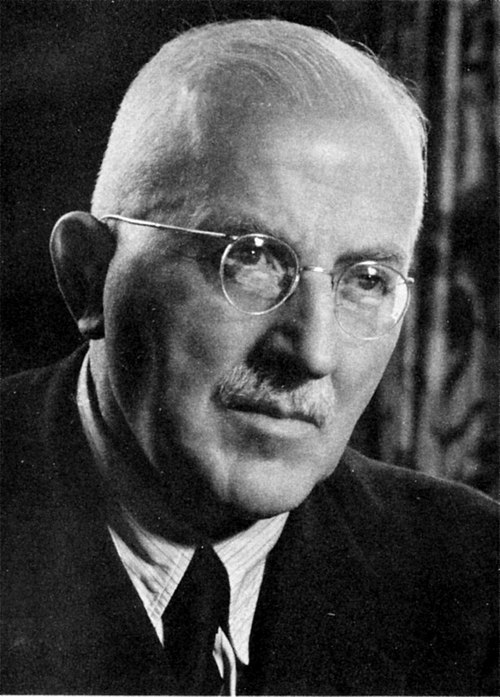
Staudinger Proposes Macromolecular Theory By Nobel Foundation - Les Prix Nobel en 1953, Public domain, https://commons.wikimedia.org/w/index.php?curid=18542861
1926 CE
Staudinger Provides Experimental Proof
Staudinger provides experimental evidence for macromolecules through viscosity measurements and synthetic polymers. His work is initially met with skepticism but later gains acceptance. #chemistry #history
1928 CE
Carothers Joins DuPont
Wallace Carothers begins work at DuPont’s fundamental research laboratory, where he will pioneer synthetic polymer chemistry, leading to neoprene and nylon. #chemistry #biography
Carothers Joins DuPont By Unknown photographer - http://listverse.com/2007/10/07/top-10-scientists-who-committed-suicide/, Public domain, https://commons.wikimedia.org/w/index.php?curid=13295767
1930 CE
Carothers Synthesizes Neoprene
Wallace Carothers invents neoprene, a synthetic rubber with superior resistance to oil and heat, the first commercially successful synthetic elastomer. #invention #polymers
Carothers Synthesizes Neoprene By Mark.murphy - English Wikipedia, Public domain, https://commons.wikimedia.org/w/index.php?curid=866990
1935 CE
Carothers Invents Nylon
Wallace Carothers develops nylon, the first synthetic polyamide fiber, using condensation polymerization. Nylon is commercialized in 1938 and revolutionizes textiles. #chemistry #innovation
Carothers Invents Nylon By User:Innerstream - Own work, Public domain, https://commons.wikimedia.org/w/index.php?curid=112727156
1937 CE
Mark and Lauffer Study Polymer Solutions
Herman Francis Mark and Peter Lauffer conduct pioneering work on polymer solutions and establish the Mark-Houwink equation, relating intrinsic viscosity to molecular weight. #science #polymers
Mark and Lauffer Study Polymer Solutions By International Union of Pure and Applied Chemistry (IUPAC), CC BY-SA 4.0, https://commons.wikimedia.org/w/index.php?curid=135909552
1937 CE
Polyurethane Invented by Bayer
Otto Bayer discovers the polyaddition reaction of diisocyanates with diols to form polyurethanes, leading to versatile polymers used in foams, coatings, and elastomers. #invention #chemistry
Polyurethane Invented by Bayer By Pieria(Uploader and Photographer), Public domain, https://commons.wikimedia.org/w/index.php?curid=888027
1938 CE
Plunkett Discovers PTFE (Teflon)
Roy Plunkett accidentally discovers polytetrafluoroethylene (PTFE), a highly stable non-stick polymer, while working at DuPont. It is commercialized as Teflon. #chemistry #accident
Plunkett Discovers PTFE (Teflon) By Vectorization: Alhadis - Own work based on: Teflon structure.PNG by Dubaj~commonswiki, Public domain, https://commons.wikimedia.org/w/index.php?curid=84729767
1940 CE
Flory Develops Polymerization Theory
Paul Flory publishes his theory of polymerization kinetics and molecular weight distribution, providing a mathematical foundation for polymer chemistry. #science #chemistry
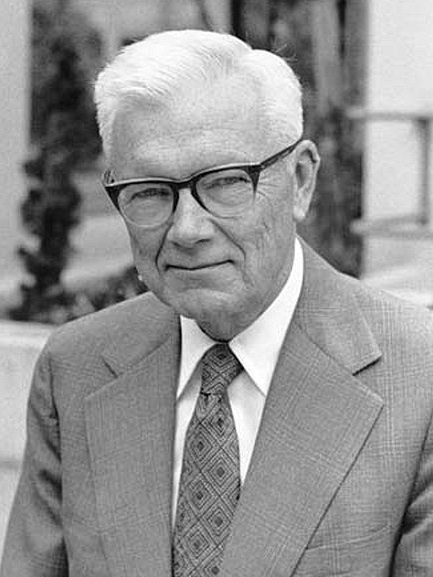
Flory Develops Polymerization Theory By Unknown (Associated Press) - [1], Public domain, https://commons.wikimedia.org/w/index.php?curid=70925529
1941 CE
Whinfield and Dickson Invent Polyester
John Rex Whinfield and James Tennant Dickson invent polyethylene terephthalate (PET), a polyester fiber that becomes widely used in textiles and packaging. #invention #polymers
Whinfield and Dickson Invent Polyester By Schippmeister - Own work, CC BY-SA 4.0, https://commons.wikimedia.org/w/index.php?curid=82979191
1947 CE
Mark Publishes Textbook on Polymers
Herman Francis Mark publishes 'High Polymers' series, a comprehensive textbook that educates a generation of polymer scientists. #education #science
1953 CE
Ziegler Discovers Catalysts for Polyethylene
Karl Ziegler develops Ziegler catalysts (organometallic compounds) that allow the production of high-density polyethylene at low pressure. #chemistry #catalysis
Ziegler Discovers Catalysts for Polyethylene By Unknown author - http://www.nobelprize.org/nobel_prizes/chemistry/laureates/1963/, Public domain, https://commons.wikimedia.org/w/index.php?curid=18334634
1954 CE
Natta Discovers Isotactic Polypropylene
Giulio Natta uses Ziegler-type catalysts to synthesize isotactic polypropylene, a stereoregular polymer with high crystallinity and strength. #chemistry #polymers
Natta Discovers Isotactic Polypropylene By Unknown (Mondadori Publishers) - http://www.gettyimages.co.uk/detail/news-photo/portrait-of-italian-engineer-giulio-natta-1960s-news-photo/174304752, Public domain, https://commons.wikimedia.org/w/index.php?curid=41259480
1955 CE
Flory Publishes Principles of Polymer Chemistry
Paul Flory publishes his seminal book 'Principles of Polymer Chemistry', which becomes a standard reference for the field. #science #book
1956 CE
Szwarc Discovers Living Polymerization
Michael Szwarc discovers living anionic polymerization, allowing precise control over molecular weight and end groups, enabling block copolymers. #chemistry #innovation
1959 CE
Ringsdorf Models Drug Delivery Polymers
Helmut Ringsdorf proposes the Ringsdorf model for polymer-drug conjugates, pioneering the use of polymers in medicine. #medicine #polymers
1963 CE
Ziegler and Natta Win Nobel Prize
Karl Ziegler and Giulio Natta share the Nobel Prize in Chemistry for their discoveries in the field of high polymers via catalysts. #award #chemistry
1964 CE
IUPAC Defines Polymer Nomenclature
IUPAC establishes systematic nomenclature for polymers, bringing order to the naming of macromolecules. #science #standards
1968 CE
Kwolek Invents Kevlar
Stephanie Kwolek discovers liquid crystalline polyamide solutions that are spun into strong, stiff fibers, later commercialized as Kevlar. #invention #materials
Kwolek Invents Kevlar By Staff photographer - Science History Institute, CC BY-SA 3.0, https://commons.wikimedia.org/w/index.php?curid=28982634
1970 CE
'Green' Polymers: Biodegradable Plastics Emerge
Research into biodegradable polymers such as poly(lactic acid) (PLA) begins, aiming to reduce environmental impact. #environment #polymers
1974 CE
Flory Wins Nobel Prize
Paul Flory receives the Nobel Prize in Chemistry for his fundamental achievements in polymer chemistry, including the Flory–Huggins solution theory. #award #science
1977 CE
Heeger, MacDiarmid, and Shirakawa Discover Conductive Polymers
Alan Heeger, Alan MacDiarmid, and Hideki Shirakawa discover that doped polyacetylene can conduct electricity, opening the field of organic electronics. #chemistry #physics
Heeger, MacDiarmid, and Shirakawa Discover Conductive Polymers By Smokefoot - Own work, Public domain, https://commons.wikimedia.org/w/index.php?curid=6893639
1982 CE
PEEK High-Performance Polymer Introduced
Polyether ether ketone (PEEK) is commercialized by Victrex, a high-temperature thermoplastic used in demanding applications. #materials #engineering
PEEK High-Performance Polymer Introduced By Roland Mattern - user:Roland1952, Public domain, https://commons.wikimedia.org/w/index.php?curid=11941336
1983 CE
Ring-Opening Metathesis Polymerization Developed
Robert Grubbs and Richard Schrock develop well-defined catalysts for ring-opening metathesis polymerization (ROMP), enabling controlled synthesis of functional polymers. #chemistry #catalysis
1987 CE
Polymerase Chain Reaction (PCR) Invented
Kary Mullis invents PCR, a method to amplify DNA using a thermostable DNA polymerase enzyme, revolutionizing molecular biology. #biology #invention
Polymerase Chain Reaction (PCR) Invented By Madprime - Own work, CC0, https://commons.wikimedia.org/w/index.php?curid=2104468
1990 CE
Living Free-Radical Polymerization Discovered
Discoveries of nitroxide-mediated polymerization (NMP) and atom transfer radical polymerization (ATRP) enable control over radical polymerization. #chemistry #innovation
Living Free-Radical Polymerization Discovered By Ben Mills and Jynto - Derivative of File:Trans-butadiene-3D-balls.png., Public domain, https://commons.wikimedia.org/w/index.php?curid=9371622
1991 CE
Carbon Nanotubes Discovered by Iijima
Sumio Iijima discovers carbon nanotubes, which are polymeric in structure (long chains of carbon) and have exceptional mechanical and electrical properties. #nanotechnology #materials
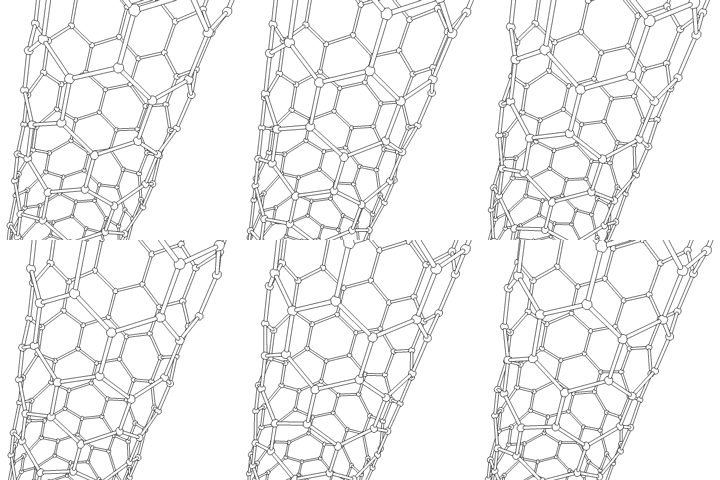
Carbon Nanotubes Discovered by Iijima By Original hochgeladen von Schwarzm am 30. Aug 2004; Selbst gemacht mit C4D/Cartoonrenderer, GNU FDL - German Wikipedia, original upload 29. Dez 2004 by APPER, CC BY-SA 3.0, https://commons.wikimedia.org/w/index.php?curid=350208
1993 CE
Superabsorbent Polymers Used in Diapers
Polyacrylate superabsorbent polymers are widely adopted in disposable diapers, demonstrating practical use of crosslinked polymer networks. #chemistry #consumer
Superabsorbent Polymers Used in Diapers By User:Ritchey - Own work, Public domain, https://commons.wikimedia.org/w/index.php?curid=2050554
2000 CE
Nobel Prize for Conductive Polymers
Heeger, MacDiarmid, and Shirakawa receive the Nobel Prize in Chemistry for the discovery and development of electrically conductive polymers. #award #science
2002 CE
Click Chemistry for Polymer Synthesis
K. Barry Sharpless introduces click chemistry, which is later applied to polymer synthesis for efficient coupling and functionalization. #chemistry #innovation
2003 CE
Polymer Gel Microfluidics Developed
Polymers are used in microfluidic devices, enabling lab-on-a-chip technologies for biomedical analyses. #technology #biomedical
Polymer Gel Microfluidics Developed By National Institute of Standards and Technology - Microfluidic Device, Public domain, https://commons.wikimedia.org/w/index.php?curid=51195022
2005 CE
Polymer-Based Drug Delivery Systems Advance
Polymeric nanoparticles and hydrogels are increasingly used for controlled drug release, with several formulations entering clinical trials. #medicine #polymers
Polymer-Based Drug Delivery Systems Advance By robin_24 - https://www.flickr.com/photos/robin24/5222119114/in/photostream, CC BY 2.0, https://commons.wikimedia.org/w/index.php?curid=16419735
2010 CE
Self-Healing Polymers Developed
Researchers create polymers that can autonomously repair damage, inspired by biological systems, using reversible bonds and microcapsules. #materials #innovation
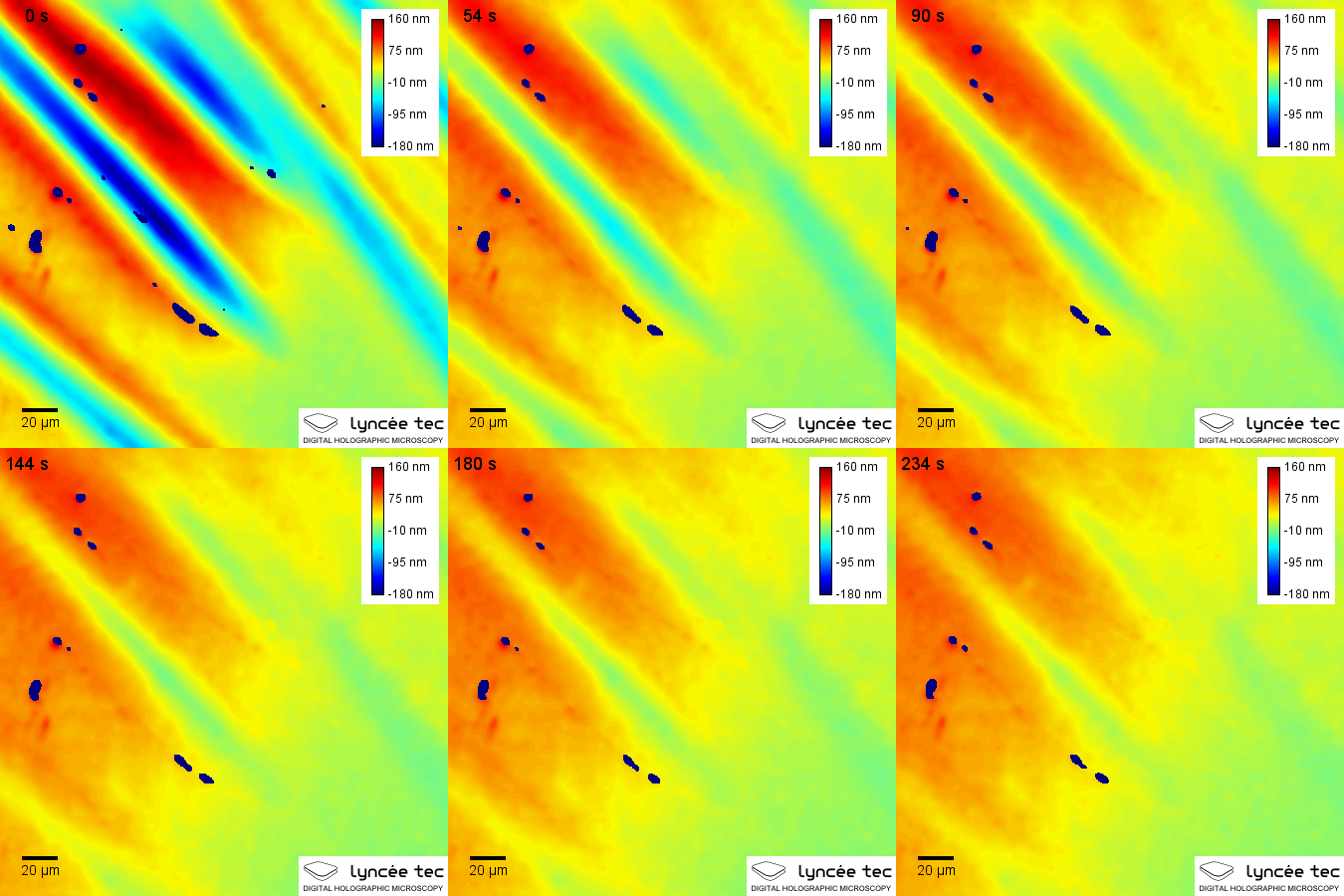
Self-Healing Polymers Developed By Jejmule - Own work, CC BY-SA 4.0, https://commons.wikimedia.org/w/index.php?curid=55714245
2012 CE
3D Printing with Polymers Goes Mainstream
Fused deposition modeling (FDM) and stereolithography using polymer filaments and resins become widely accessible for rapid prototyping and manufacturing. #technology #manufacturing
3D Printing with Polymers Goes Mainstream By RepRapPro - YouTube: https://www.youtube.com/watch?v=r5nDrae3gJg – View/save archived versions on archive.org, CC BY 3.0, https://commons.wikimedia.org/w/index.php?curid=45334835
2015 CE
Plastic Pollution Awareness Grows
Global awareness of plastic waste and microplastics increases, driving research into biodegradable polymers and recycling technologies. #environment #sustainability
Plastic Pollution Awareness Grows By Sébastien Stradal for MDC Seamarc Maldives - The uploader on Wikimedia Commons received this from the author/copyright holder., CC BY-SA 4.0, https://commons.wikimedia.org/w/index.php?curid=34858268
2016 CE
Polymer-Based Artificial Muscles Achieved
Dielectric elastomer actuators (DEAs) made from polymers show promise as artificial muscles for soft robotics. #robotics #materials
2020 CE
COVID-19 Drives Polymer Innovation for PPE
The pandemic accelerates development of polymer materials for personal protective equipment (PPE) like masks and face shields, and antiviral coatings. #healthcare #materials
COVID-19 Drives Polymer Innovation for PPE By justice.gov - https://en.wikipedia.org/wiki/File:Hazmat_DEA.jpg, Public domain, https://commons.wikimedia.org/w/index.php?curid=112636189
2021 CE
Circular Economy for Plastics Gains Momentum
Chemical recycling methods, including depolymerization and pyrolysis, are advanced to create a circular economy for plastics, aiming to reduce waste. #environment #sustainability
Circular Economy for Plastics Gains Momentum By USEPA Environmental-Protection-Agency - Municipal recycling facilities, Montgomery County, MD. 2007, Credit USEPA, Public domain, https://commons.wikimedia.org/w/index.php?curid=51969963
2023 CE
Enzymatic Polymer Recycling Breakthrough
Scientists engineer enzymes that efficiently break down PET into monomers, enabling a closed-loop recycling process. #science #environment
Enzymatic Polymer Recycling Breakthrough By Keministi - Own work, CC0, https://commons.wikimedia.org/w/index.php?curid=68401651