Encyclopedia/1. The Cosmos & The Natural World/2. Physics & Chemistry/03. Chemistry & Periodic Table of Elements • Curated by Admin Timeline.sg
Historical events timeline.
Chronological Storyline (42 Milestones)
4500 BCE
Natural Latex Use in Mesoamerica
Olmec and later Mesoamerican peoples use natural latex from rubber trees to make balls, figurines, and waterproofing. #polymer #history
Natural Latex Use in Mesoamerica By Gradstudentscholar - Own work, CC BY-SA 4.0, https://commons.wikimedia.org/w/index.php?curid=89532135
1600 BCE
Natural Polymers in Ancient China
Chinese artisans use lacquer (urushiol) from tree sap as a natural polymer coating for wood and other materials. #polymer #history
Natural Polymers in Ancient China By Unknown author - This file was donated to Wikimedia Commons as part of a project by the Metropolitan Museum of Art. See the Image and Data Resources Open Access Policy, CC0, https://commons.wikimedia.org/w/index.php?curid=58752728
1500 BCE
Protein-Based Polymers Used in Egypt
Ancient Egyptians use collagen-based animal glues for woodworking and attaching pigments. #polymer #history
Protein-Based Polymers Used in Egypt By Simon Eugster – Simon / ?! 12:57, 8 May 2008 (UTC) - Own work, CC BY-SA 3.0, https://commons.wikimedia.org/w/index.php?curid=4012429
65 CE
Pliny the Elder Describes Rubber
Roman author Pliny the Elder describes rubber obtained from the 'Ficus elastica' tree, noting its elasticity and water resistance. #polymer #history
Pliny the Elder Describes Rubber By Geoffrey - Cesare Cantù, Grande Illustrazione del Lombardo Veneto ossia storia delle città, dei borghi etc., Milano 1859, Vol. III, Public domain, https://commons.wikimedia.org/w/index.php?curid=9466113
1492 CE
Columbus Encounters Natural Rubber
Christopher Columbus observes indigenous people in Haiti playing with rubber balls, introducing natural rubber to Europe. #polymer #history
1839 CE
Charles Goodyear Discovers Vulcanization
Charles Goodyear accidentally discovers that heating natural rubber with sulfur creates a durable, elastic material (vulcanized rubber), enabling widespread commercial use. #polymer #chemistry
Charles Goodyear Discovers Vulcanization By Southworth & Hawes - http://images.zeno.org/Fotografien/I/big/PHO03916.jpg, Public domain, https://commons.wikimedia.org/w/index.php?curid=93310352
1846 CE
Christian Schönbein Invents Nitrocellulose
Christian Friedrich Schönbein treats cellulose with nitric acid to produce nitrocellulose, an early semi-synthetic polymer used in explosives and later as a plastic. #polymer #chemistry
Christian Schönbein Invents Nitrocellulose By Unknown author, Public domain, https://commons.wikimedia.org/w/index.php?curid=955075
1862 CE
Alexander Parkes Introduces Parkesine
Alexander Parkes displays Parkesine, made from nitrocellulose and camphor, at the Great International Exhibition in London. It is considered the first man-made plastic. #polymer #history
1869 CE
John Wesley Hyatt Invents Celluloid
John Wesley Hyatt develops celluloid, a thermoplastic material from nitrocellulose and camphor, used for billiard balls, film, and dental plates. #polymer #chemistry
1884 CE
Hilaire de Chardonnet Invents Rayon
Hilaire de Chardonnet patents artificial silk (rayon) made from nitrocellulose, the first commercial synthetic fiber. #polymer #textiles
Hilaire de Chardonnet Invents Rayon By Maxim Bilovitskiy - Own work, CC BY-SA 4.0, https://commons.wikimedia.org/w/index.php?curid=44965866
1907 CE
Leo Baekeland Creates Bakelite
Leo Baekeland synthesizes Bakelite, the first fully synthetic thermosetting plastic made from phenol and formaldehyde, marking the birth of the modern plastics industry. #polymer #chemistry
Leo Baekeland Creates Bakelite By Original: MarkusZi Vector: Dirk Hünniger - Bakelit Struktur.png, CC BY-SA 3.0, https://commons.wikimedia.org/w/index.php?curid=20188781
1910 CE
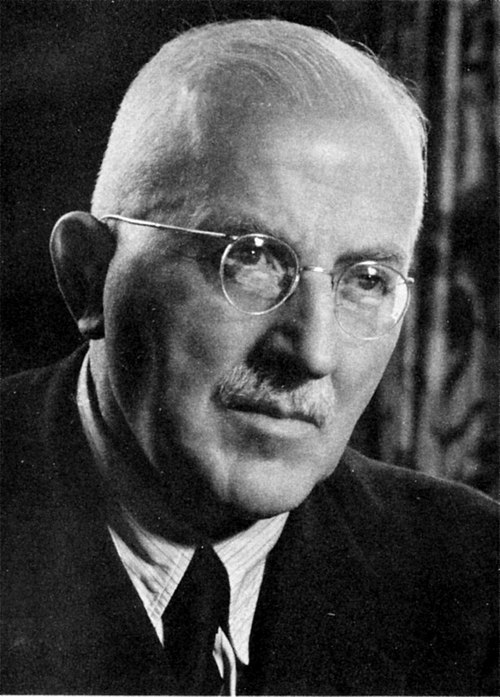
Hermann Staudinger Proposes Macromolecular Hypothesis
Hermann Staudinger proposes that polymers are long chains of repeating units held together by covalent bonds, challenging the prevailing colloidal theory. #polymer #science
Hermann Staudinger Proposes Macromolecular Hypothesis By Nobel Foundation - Les Prix Nobel en 1953, Public domain, https://commons.wikimedia.org/w/index.php?curid=18542861
1920 CE
Staudinger Publishes Paper on Polymerization
Hermann Staudinger publishes a seminal paper 'Über Polymerisation' outlining the macromolecular theory, laying the foundation for polymer chemistry. #polymer #chemistry
1926 CE
Staudinger Confirms Macromolecular Theory
Hermann Staudinger provides experimental evidence for macromolecules through viscosity and filtration studies, leading to widespread acceptance. #polymer #science
1928 CE
Wallace Carothers Joins DuPont
Wallace Carothers begins working at DuPont, where he leads research that leads to the invention of neoprene and nylon. #polymer #chemistry
Wallace Carothers Joins DuPont By Unknown photographer - http://listverse.com/2007/10/07/top-10-scientists-who-committed-suicide/, Public domain, https://commons.wikimedia.org/w/index.php?curid=13295767
1931 CE
Discovery of Neoprene
Wallace Carothers and his team synthesize neoprene (polychloroprene), the first successful synthetic rubber, used for oil-resistant applications. #polymer #chemistry
Discovery of Neoprene By Mark.murphy - English Wikipedia, Public domain, https://commons.wikimedia.org/w/index.php?curid=866990
1935 CE
Invention of Nylon
Wallace Carothers invents nylon, the first synthetic fiber made from polyamide, revolutionizing textiles and industry. #polymer #textiles
Invention of Nylon By User:Innerstream - Own work, Public domain, https://commons.wikimedia.org/w/index.php?curid=112727156
1942 CE
Polyethylene Production Begins
Low-density polyethylene (LDPE) is first produced by Imperial Chemical Industries (ICI) using high-pressure processes, becoming a major packaging material. #polymer #chemistry
Polyethylene Production Begins By Lluis tgn - Own work, CC BY-SA 3.0, https://commons.wikimedia.org/w/index.php?curid=12749082
1953 CE
Karl Ziegler Discovers Ziegler-Natta Catalysts
Karl Ziegler discovers catalysts that enable the synthesis of high-density polyethylene (HDPE) and other polyolefins at low pressure, revolutionizing polymer production. #polymer #chemistry
Karl Ziegler Discovers Ziegler-Natta Catalysts By Unknown author - http://www.nobelprize.org/nobel_prizes/chemistry/laureates/1963/, Public domain, https://commons.wikimedia.org/w/index.php?curid=18334634
1954 CE
Giulio Natta Improves Ziegler Catalysts
Giulio Natta expands Ziegler's work to produce isotactic polypropylene, a highly crystalline and useful polymer. #polymer #chemistry
Giulio Natta Improves Ziegler Catalysts By Unknown (Mondadori Publishers) - http://www.gettyimages.co.uk/detail/news-photo/portrait-of-italian-engineer-giulio-natta-1960s-news-photo/174304752, Public domain, https://commons.wikimedia.org/w/index.php?curid=41259480
1956 CE
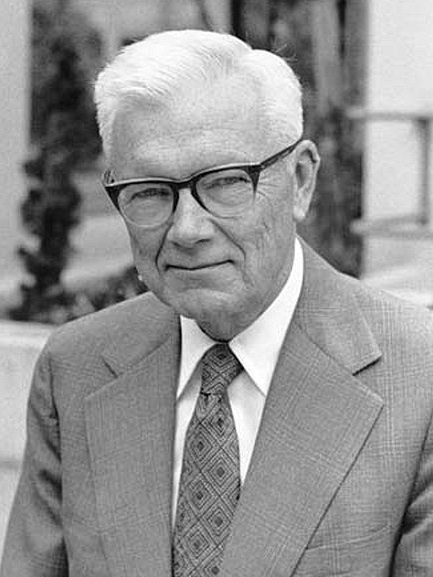
Paul Flory Develops Flory-Huggins Theory
Paul Flory establishes the thermodynamic theory of polymer solutions (Flory-Huggins theory), providing a theoretical framework for polymer physics. #polymer #science
Paul Flory Develops Flory-Huggins Theory By Unknown (Associated Press) - [1], Public domain, https://commons.wikimedia.org/w/index.php?curid=70925529
1960 CE
Polycarbonate Introduced by GE
General Electric introduces polycarbonate (Lexan), a transparent and impact-resistant thermoplastic used in eyewear, electronics, and automotive. #polymer #materials
Polycarbonate Introduced by GE By Ed (Edgar181) - Own work, Public domain, https://commons.wikimedia.org/w/index.php?curid=52831270
1963 CE
Ziegler and Natta Win Nobel Prize
Karl Ziegler and Giulio Natta receive the Nobel Prize in Chemistry for their discoveries in the field of high polymers and catalysis. #polymer #science
1965 CE
Stephanie Kwolek Invents Kevlar
Stephanie Kwolek at DuPont discovers Kevlar, a para-aramid synthetic fiber with exceptional strength-to-weight ratio, used in bulletproof vests and composites. #polymer #materials
Stephanie Kwolek Invents Kevlar By Ben Mills and Jynto - Derived from File:Benzene-aromatic-3D-balls.png and File:Oxamide-3D-balls.png., Public domain, https://commons.wikimedia.org/w/index.php?curid=9854604
1971 CE
Discovery of Conducting Polymers: Polyacetylene
Hideki Shirakawa, Alan MacDiarmid, and Alan Heeger synthesize polyacetylene and demonstrate high electrical conductivity when doped, founding conducting polymer research. #polymer #science
Discovery of Conducting Polymers: Polyacetylene By Smokefoot - Own work, Public domain, https://commons.wikimedia.org/w/index.php?curid=6893639
PET is first used for carbonated beverage bottles, revolutionizing packaging due to its clarity, strength, and recyclability. #polymer #packaging
Polyethylene Terephthalate (PET) Bottles Introduced By Schippmeister - Own work, CC BY-SA 4.0, https://commons.wikimedia.org/w/index.php?curid=82979191
1977 CE
Conducting Polymers Breakthrough
Shirakawa, MacDiarmid, and Heeger publish their results on iodine-doped polyacetylene, achieving metallic conductivity and paving the way for organic electronics. #polymer #science
1980 CE
Polymerase Chain Reaction (PCR) Invented
Kary Mullis invents PCR, a method using DNA polymerase to amplify DNA sequences, transforming molecular biology and diagnostics. #polymer #biotech
Polymerase Chain Reaction (PCR) Invented By Madprime - Own work, CC0, https://commons.wikimedia.org/w/index.php?curid=2104468
1983 CE
First Water-Soluble Polymer for Drug Delivery
Development of poly(ethylene glycol) (PEG) conjugation (PEGylation) to improve drug solubility and half-life, first approved for clinical use. #polymer #biomedical
First Water-Soluble Polymer for Drug Delivery By Ed (Edgar181) - Own work, Public domain, https://commons.wikimedia.org/w/index.php?curid=52936339
1985 CE
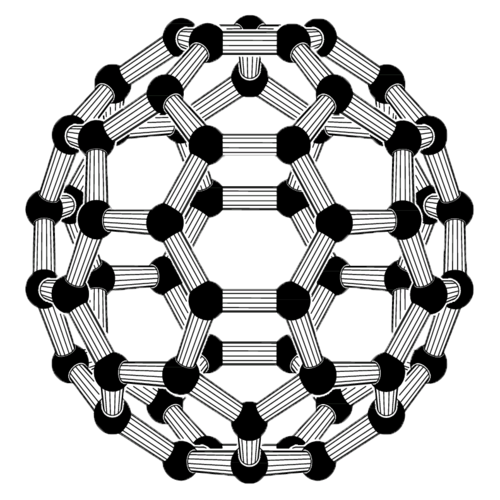
Discovery of Fullerenes
Harold Kroto, James Heath, Sean O'Brien, Robert Curl, and Richard Smalley discover fullerenes (C60), carbon allotropes with polymer-like structures, leading to new materials. #polymer #chemistry
Discovery of Fullerenes By 痛 - Own work, CC BY-SA 4.0, https://commons.wikimedia.org/w/index.php?curid=118428240
1990 CE
First Conjugated Polymer Light-Emitting Diode (LED)
Richard Friend and colleagues at Cambridge demonstrate the first polymer LED using poly(p-phenylene vinylene) (PPV), launching plastic electronics. #polymer #electronics
First Conjugated Polymer Light-Emitting Diode (LED) By STRONGlk7 - Own work, CC BY-SA 3.0, https://commons.wikimedia.org/w/index.php?curid=22585310
1991 CE
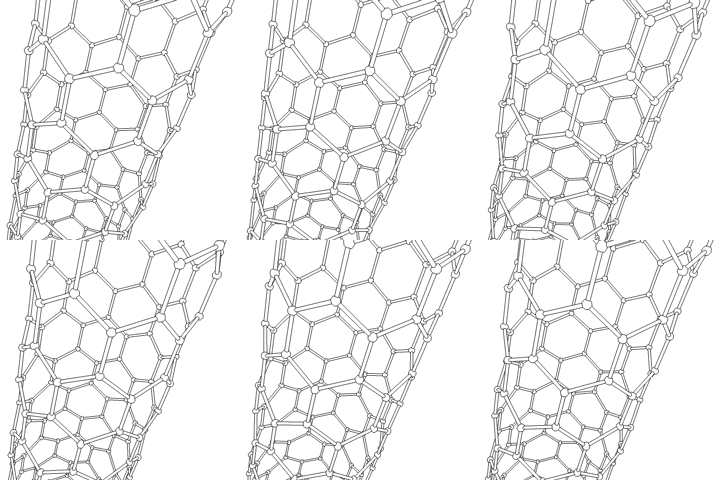
Discovery of Carbon Nanotubes
Sumio Iijima discovers multi-walled carbon nanotubes, which have exceptional mechanical and electrical properties, promising for polymer composites. #polymer #nanotech
Discovery of Carbon Nanotubes By Original hochgeladen von Schwarzm am 30. Aug 2004; Selbst gemacht mit C4D/Cartoonrenderer, GNU FDL - German Wikipedia, original upload 29. Dez 2004 by APPER, CC BY-SA 3.0, https://commons.wikimedia.org/w/index.php?curid=350208
2000 CE
Nobel Prize for Conducting Polymers
Shirakawa, MacDiarmid, and Heeger receive the Nobel Prize in Chemistry for the discovery and development of conductive polymers. #polymer #science
2002 CE
Controlled Radical Polymerization Methods Mature
ATRP (atom transfer radical polymerization) and RAFT (reversible addition-fragmentation chain transfer) become widely adopted for precise polymer synthesis. #polymer #chemistry
Controlled Radical Polymerization Methods Mature By Ben Mills and Jynto - Derivative of File:Trans-butadiene-3D-balls.png., Public domain, https://commons.wikimedia.org/w/index.php?curid=9371622
2004 CE
Graphene Isolated
Andre Geim and Konstantin Novoselov isolate graphene, a single-layer carbon material, opening up new opportunities for polymer nanocomposites. #polymer #materials
Graphene Isolated By AlexanderAlUS - Own work, CC BY-SA 3.0, https://commons.wikimedia.org/w/index.php?curid=11294534
2005 CE
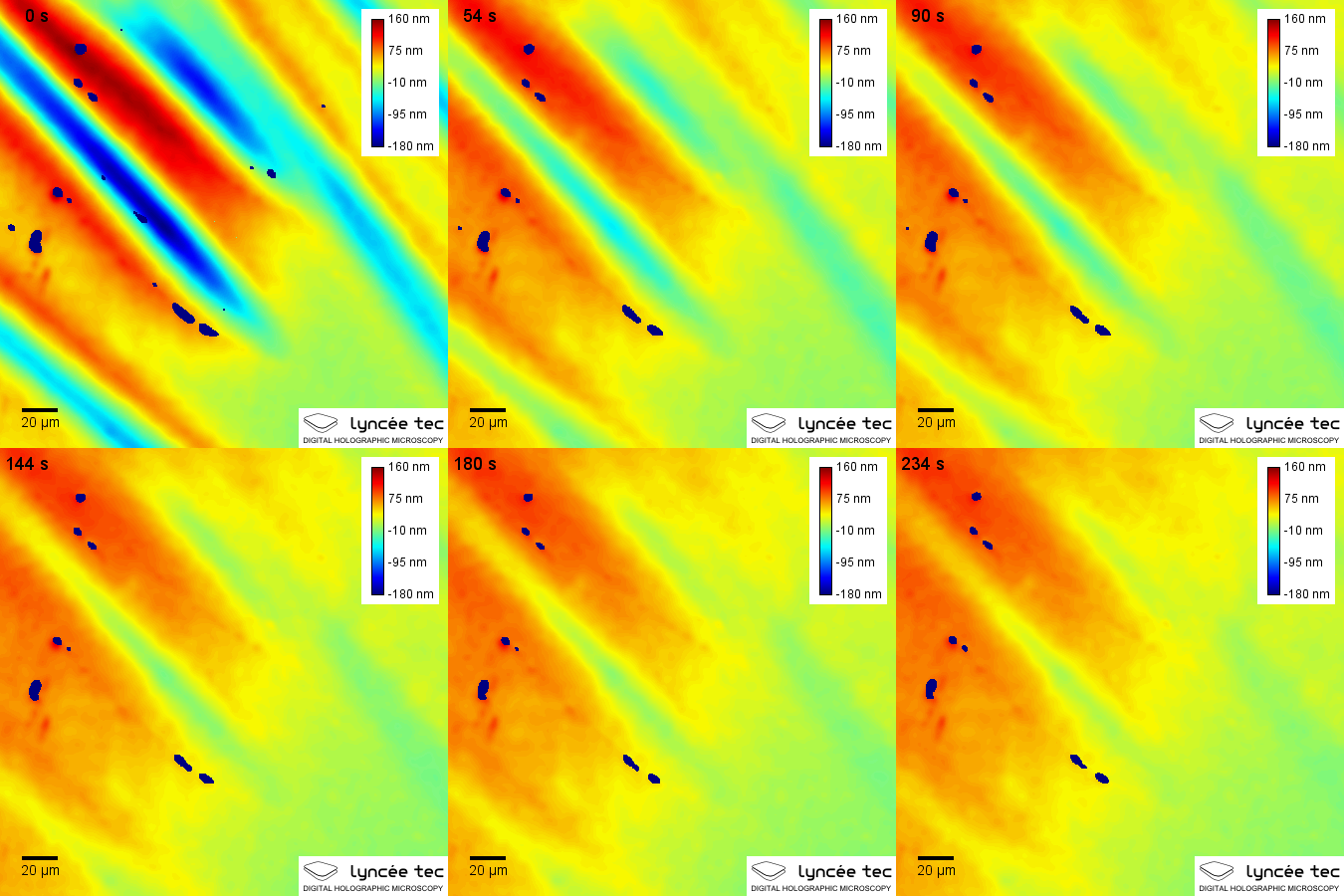
Self-Healing Polymers Developed
Researchers at the University of Illinois develop self-healing polymer materials that can repair cracks autonomously using embedded microcapsules. #polymer #materials
Self-Healing Polymers Developed By Jejmule - Own work, CC BY-SA 4.0, https://commons.wikimedia.org/w/index.php?curid=55714245
2007 CE
First 3D Printing of Polymers
RepRap project introduces open-source 3D printing using polylactic acid (PLA) filaments, democratizing additive manufacturing. #polymer #technology
First 3D Printing of Polymers By RepRapPro - YouTube: https://www.youtube.com/watch?v=r5nDrae3gJg – View/save archived versions on archive.org, CC BY 3.0, https://commons.wikimedia.org/w/index.php?curid=45334835
Organic solar cells using conjugated polymers achieve 10% power conversion efficiency, spurring research into flexible solar panels. #polymer #energy
Polymer-Based Organic Photovoltaics Reach 10% Efficiency By Solarmer (talk) - Own work (Original text: I created this work entirely by myself.), Public domain, https://commons.wikimedia.org/w/index.php?curid=6730117
2015 CE
Polymer Nanocomposites for Medical Implants
Development of biodegradable polymer nanocomposites for bone scaffolds and implants, integrating polymers with bioactive ceramics. #polymer #biomedical
Polymer Nanocomposites for Medical Implants By Unknown author, CC BY-SA 3.0, https://commons.wikimedia.org/w/index.php?curid=26030
2018 CE
Chemical Recycling of Polymers Advances
New catalytic methods for depolymerizing plastics like PET and polyolefins into monomers enable circular economy for polymers. #polymer #environment
2020 CE
Biobased Polyethylene from Sugar Cane
Braskem and other companies scale up production of biobased polyethylene from ethanol derived from sugarcane, reducing carbon footprint. #polymer #sustainability
Biobased Polyethylene from Sugar Cane By Scott Bauer - This image was released by the Agricultural Research Service, the research agency of the United States Department of Agriculture, with the ID k7245-1 (next)., Public domain, https://commons.wikimedia.org/w/index.php?curid=1675054
2022 CE
Machine Learning for Polymer Design
Artificial intelligence and machine learning models are applied to predict polymer properties and accelerate discovery of new materials. #polymer #AI