Companies/United States • Curated by Admin Timeline.sg
Lucent Technologies was a global telecommunications equipment company formed in 1996 as a spin-off from AT&T, known for innovations from Bell Labs. It experienced rapid growth and decline during the dot-com bubble, merged with Alcatel in 2006, and eventually became part of Nokia in 2016.
Chronological Storyline (42 Milestones)
Sep 20, 1995 CE
AT&T Announces Spin-off of Lucent
AT&T announces plans to spin off its equipment manufacturing and Bell Labs into a new company, Lucent Technologies. The move aims to separate manufacturing from services. #business #technology
Apr 4, 1996 CE
Lucent Technologies IPO
Lucent Technologies holds its initial public offering, raising about $3 billion. The stock lists on the NYSE under 'LU'. #finance #telecom
Oct 1, 1996 CE
Lucent Becomes Independent
Lucent Technologies officially becomes an independent company on October 1, 1996, with 150,000 employees. It includes Bell Labs, a premier research organization. #telecom #business
Dec 1, 1996 CE
Acquisition of Octel Communications
Lucent acquires Octel Communications, a leader in voice messaging systems, for $1.8 billion. This expands Lucent's enterprise offerings. #acquisitions #telecom
Jul 1, 1997 CE
Acquisition of Prominet Corporation
Lucent acquires Prominet, a Gigabit Ethernet switching company, for $180 million. This strengthens Lucent's data networking portfolio. #networking #acquisitions
Oct 1, 1997 CE
Bell Labs Develops the First Commercial FPLD
Bell Labs, Lucent's research arm, develops the first commercial field-programmable logic device (FPLD), enabling flexible chip design. #innovation #semiconductors
Bell Labs Develops the First Commercial FPLD By ™/®Nokia Corporation (Original) - Own work using: Nokia's Logopedia page, Public domain, https://commons.wikimedia.org/w/index.php?curid=129082459
Jan 1, 1998 CE
Lucent Wins Major Contract from Sprint
Lucent secures a $1.5 billion contract from Sprint to build a nationwide fiber-optic network, showcasing its leadership in optical networking. #telecom #fiber
Nov 1, 1998 CE
Lucent's Optical Networking Breakthrough
Bell Labs achieves a record 2.5 terabit per second transmission over a single fiber, highlighting advances in dense wavelength division multiplexing (DWDM). #innovation #optics
Jun 23, 1999 CE
Acquisition of Ascend Communications
Lucent acquires Ascend Communications, a leader in wide area network (WAN) equipment, for $24 billion. This is Lucent's largest acquisition. #acquisitions #telecom
Sep 1, 1999 CE
Acquisition of Kenan Systems
Lucent acquires Kenan Systems, a billing and operations support software company, for $1.5 billion. #acquisitions #software
Nov 1, 1999 CE
Lucent Spin-off of Avaya
Lucent announces the spin-off of its enterprise communications unit as Avaya, expected to close in 2000. The move focuses Lucent on service providers. #spin-off #telecom
Jan 1, 2000 CE
Lucent Acquires Channel Bank & Other Optics Firms
Lucent acquires several optical component companies, including Channel Bank and others, for over $4 billion to bolster its optical networking capabilities. #acquisitions #optics
Mar 1, 2000 CE
Bell Labs Announces First 40Gbps Optical Network
Bell Labs demonstrates the first commercial 40 gigabit per second optical network interface card, a major milestone in high-speed data transmission. #innovation #optical
Jun 1, 2000 CE
Lucent Spins Off Avaya
Avaya, Lucent's enterprise communications unit, becomes an independent company. The spin-off reduces Lucent's workforce and focuses on service provider market. #spin-off #telecom
Dec 1, 2000 CE
Lucent Warns of Revenue Shortfall
Lucent issues a profit warning due to slowing demand and inventory build-up, triggering a stock crash from $78 to $22. This marks the beginning of a severe downturn. #finance #dotcom
Jan 18, 2001 CE
CEO Richard McGinn Ousted
Lucent's board fires CEO Richard McGinn after poor performance. Henry Schacht, former CEO, returns as chairman and CEO to lead a turnaround. #leadership #turnaround
Mar 1, 2001 CE
Lucent Lays Off 10,000 Employees
Lucent announces layoffs of 10,000 employees (about 10% of workforce) as part of restructuring amid telecom industry slowdown. #layoffs #telecom
Jun 1, 2001 CE
Lucent Sells Fiber-Optic Cable Business
Lucent sells its fiber-optic cable business to Corning Incorporated for $3.5 billion to raise cash. #divestiture #optics
Lucent Sells Fiber-Optic Cable Business By No machine-readable author provided. Stilfehler assumed (based on copyright claims). - No machine-readable source provided. Own work assumed (based on copyright claims)., CC BY 2.5, https://commons.wikimedia.org/w/index.php?curid=604972
Jul 1, 2001 CE
Lucent Acquires Telica
Lucent acquires Telica, a softswitch manufacturer, for $295 million, enhancing its next-generation networking capabilities. #acquisitions #telecom
2001 CE
Lucent Regains Compliance with NYSE Listing
After stock price falls below $1, Lucent implements a reverse stock split to maintain NYSE listing. #finance #stockmarket
Jan 1, 2002 CE
Lucent Spins Off Agere Systems
Lucent spins off its semiconductor division as Agere Systems, raising $1.5 billion. The move helps Lucent focus on telecom equipment. #spin-off #semiconductors
Lucent Spins Off Agere Systems By Unknown author - SVG erstellt mit Inkscape, Public domain, https://commons.wikimedia.org/w/index.php?curid=37710285
Mar 1, 2002 CE
Lucent's Revenue Falls 50%
Lucent reports a 50% drop in revenue to $12 billion for fiscal year 2002, reflecting deep telecom slump. The company continues restructuring. #finance #telecom
Aug 1, 2002 CE
Lucent Sells Optical Components Business
Lucent sells its optical components business to TriQuint Semiconductor for $40 million, exiting the component manufacturing space. #divestiture #optics
Lucent Sells Optical Components Business By M.O. Stevens - Own work, CC BY 3.0, https://commons.wikimedia.org/w/index.php?curid=7250148
Jan 7, 2003 CE
Patricia Russo Named CEO
Patricia Russo becomes CEO of Lucent, the first woman to lead a major telecommunications equipment company. She focuses on cutting costs and innovation. #leadership #innovation
Patricia Russo Named CEO By National Security Telecommunications Advisory Committee. - http://www.ncs.gov/nstac/may2004/images/may2004_20_lg.jpg (cropped), Public domain, https://commons.wikimedia.org/w/index.php?curid=27765525
Jul 1, 2003 CE
Lucent Wins $200 Million Contract in China
Lucent secures a $200 million contract with China's leading mobile operator, expanding its footprint in the rapidly growing Chinese market. #telecom #China
Dec 1, 2003 CE
Bell Labs Introduces Reconfigurable Optical Network
Bell Labs demonstrates a reconfigurable optical add-drop multiplexer (ROADM) technology, which later becomes standard in optical networks. #innovation #optics
Feb 1, 2004 CE
Lucent Wins $5 Billion Verizon Order
Lucent receives a $5 billion multi-year contract from Verizon to supply fiber-optic and wireless equipment, one of the largest contracts in telecom history. #telecom #wireless
May 1, 2004 CE
Lucent and Alcatel Merger Talks Resume
Lucent and Alcatel reportedly hold merger discussions, but the deal falls through due to valuation disagreements. #mergers #telecom
Lucent and Alcatel Merger Talks Resume By AnaBé - Own work, CC BY-SA 3.0, https://commons.wikimedia.org/w/index.php?curid=33814401
Mar 1, 2005 CE
Lucent Acquires Riverstone Networks
Lucent acquires Riverstone Networks, a maker of metro Ethernet switches, for $207 million to enhance its IP networking portfolio. #acquisitions #networking
Jul 1, 2005 CE
Lucent's CEO Russo in China Expansion
Lucent announces a $1 billion investment in China over two years, expanding R&D and manufacturing facilities. #expansion #China
Oct 1, 2005 CE
Bell Labs Develops Wireless Picocell Technology
Bell Labs invents picocell base stations for small cell networks, precursors to today's femtocells used in 4G and 5G. #innovation #wireless
Apr 2, 2006 CE
Lucent and Alcatel Announce Merger
Lucent and Alcatel agree to merge in a $13.4 billion stock-for-stock transaction, creating Alcatel-Lucent. The combined entity becomes the largest telecom equipment maker. #mergers #telecom
Dec 1, 2006 CE
Alcatel-Lucent Begins Operations
The merger of Lucent and Alcatel is completed, forming Alcatel-Lucent with headquarters in Paris. The combined company struggles with integration and culture clash. #mergers #telecom
Oct 1, 2007 CE
Alcatel-Lucent Reports Major Loss
Alcatel-Lucent posts a $1.9 billion loss in Q3 2007, leading to a management shakeup and massive restructuring. #finance #restructuring
Jan 1, 2008 CE
Alcatel-Lucent Wins World's First LTE Contract
Alcatel-Lucent wins the first commercial LTE contract with T-Mobile Austria, paving the way for 4G networks. #telecom #LTE )
Dec 1, 2008 CE
Bell Labs Achieves 100Gbps Optical Transmission
Bell Labs demonstrates 100 gigabit per second optical transmission over 1000 km, a key milestone for next-generation networks. #innovation #optics
Apr 1, 2009 CE
Alcatel-Lucent Wins $1.5 Billion Indian Contract
Alcatel-Lucent secures a $1.5 billion contract with Bharti Airtel for 3G and broadband in India, expanding in emerging markets. #telecom #India
Jan 1, 2013 CE
Alcatel-Lucent Sells Genesys to Permira
Alcatel-Lucent sells its Genesys call center software business to private equity firm Permira for $1.5 billion, restructuring to reduce debt. #divestiture #software )
Alcatel-Lucent Sells Genesys to Permira By Genesys - www,genesys.com, CC BY-SA 4.0, https://commons.wikimedia.org/w/index.php?curid=65605415
Oct 1, 2013 CE
Alcatel-Lucent Announces The Shift Plan
CEO Michel Combes unveils 'The Shift Plan,' cutting 10,000 jobs and refocusing on IP networking, cloud, and LTE. #restructuring #telecom
Apr 15, 2015 CE
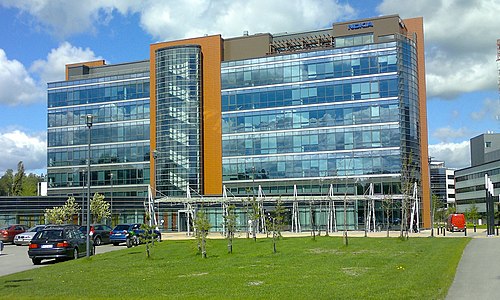
Nokia Agrees to Acquire Alcatel-Lucent
Nokia announces a $16.6 billion deal to acquire Alcatel-Lucent, aiming to create a stronger rival to Ericsson and Huawei. #mergers #telecom
Nokia Agrees to Acquire Alcatel-Lucent By pikkuanna - Flickr, CC BY-SA 2.0, https://commons.wikimedia.org/w/index.php?curid=64791586
Jan 14, 2016 CE
Nokia Completes Acquisition of Alcatel-Lucent
Nokia finalizes the acquisition of Alcatel-Lucent, integrating its assets including Bell Labs. The Lucent brand is retired. #mergers #telecom
Apr 1, 2016 CE
Bell Labs Under Nokia Launches Future X Network
Nokia's Bell Labs introduces the Future X network architecture, reflecting its ongoing R&D legacy. #innovation #telecom