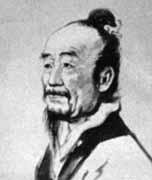
Liu Hui (劉徽): Nine Chapters Commentary, Pi Algorithm & Spatial Dissection
Encyclopedia/1. The Cosmos & The Natural World/1. Mathematics & Formal Systems/14. Mathematical Biographies • Curated by Admin Timeline.sg
Liu Hui was a 3rd-century Chinese mathematician from the Wei Kingdom, best known for his commentary on The Nine Chapters on the Mathematical Art, his Sea Island Mathematical Manual, and his algorithm for approximating π using inscribed polygons. His work on volume dissection and surveying laid foundations for Chinese mathematics.
Chronological Storyline (40 Milestones)
225 CE
Birth of Liu Hui
Liu Hui is born in the Wei Kingdom, likely in the state of Zichuan (modern Zibo, Shandong). His early life is not well documented, but he later becomes one of the most influential mathematicians in Chinese history. #mathematics #biography
Birth of Liu Hui By Unknown - "Liu Hui (220 - 280) - Biography - MacTutor History of Mathematics" https://mathshistory.st-andrews.ac.uk/Biographies/Liu_Hui/, CC BY-SA 4.0, https://commons.wikimedia.org/w/index.php?curid=130481910
240 CE
Begins Studying The Nine Chapters
Liu Hui starts his in-depth study of The Nine Chapters on the Mathematical Art, a classic Chinese mathematical text compiled around the 1st century CE. He aims to clarify and expand upon its methods. #mathematics #history
Begins Studying The Nine Chapters By 中國書店海王邨公司 - https://pmgs.kongfz.com/detail/1_158470/, Public domain, https://commons.wikimedia.org/w/index.php?curid=22913440
250 CE
Completes Commentary on Nine Chapters
Liu Hui finishes his detailed commentary on The Nine Chapters, providing proofs, algorithms, and new methods. His commentary becomes the standard edition for centuries. #mathematics #commentary
250 CE
Solves Cavalieri's Principle Problem
Liu Hui uses a principle similar to Cavalieri's principle to compare volumes of solids, demonstrating that the volume of a sphere is related to that of a cylinder and cone. #mathematics #geometry
Solves Cavalieri's Principle Problem By Christopher Grattoni - demonstrations.wolfram.com, CC BY 4.0, https://commons.wikimedia.org/w/index.php?curid=145384849
250 CE
Corrects Errors in Nine Chapters
Liu Hui identifies and corrects several errors in the original Nine Chapters, particularly in problems involving area and volume calculations. #mathematics #correction
250 CE
Introduces Volume Dissection Principles
In his commentary, Liu Hui develops methods for calculating volumes of solids such as pyramids, cones, and cylinders using dissection and limit arguments, anticipating integral calculus. #mathematics #geometry
250 CE
Refines Pi to 3.1416 with 192-gon
By doubling the number of sides to 192, Liu Hui computes π ≈ 3.1416, a remarkably accurate value for the time. He also establishes a method for calculating π to arbitrary precision. #mathematics #pi
250 CE
Develops Pi Algorithm with 96-gon
Liu Hui uses a 96-sided polygon inscribed in a circle to approximate π, obtaining a value of 3.141024. This is a significant improvement over earlier approximations. #mathematics #pi
Develops Pi Algorithm with 96-gon By derivative work: Pbroks13 (talk) Cutcircle2.jpg: Gisling - Cutcircle2.jpg, CC BY-SA 3.0, https://commons.wikimedia.org/w/index.php?curid=4322998
255 CE
Writes Sea Island Mathematical Manual
Liu Hui composes the Haidao Suanjing (Sea Island Mathematical Manual), a short work on surveying and measuring distances using similar triangles and trigonometric methods. #mathematics #surveying
Writes Sea Island Mathematical Manual By Qing dynasty goverment - my book, Public domain, https://commons.wikimedia.org/w/index.php?curid=12665143
255 CE
Applies Similar Triangles to Surveying
Liu Hui uses properties of similar triangles to solve problems of inaccessible distances, a technique that later influences Chinese and Japanese surveying. #mathematics #geometry
255 CE
Develops Double Difference Method
In the Sea Island Manual, Liu Hui describes a method using two poles to measure the height of a distant island, known as the 'double difference' method, a precursor to trigonometry. #mathematics #surveying
260 CE
Develops Gaussian Elimination Method
Liu Hui describes a method for solving simultaneous linear equations that is essentially Gaussian elimination, centuries before Gauss. #mathematics #algebra
Develops Gaussian Elimination Method By Jirka Fiala - Own work, CC BY-SA 4.0, https://commons.wikimedia.org/w/index.php?curid=142089393
260 CE
Works on Matrix Representation
Liu Hui uses a tabular arrangement of coefficients to solve linear equations, an early form of matrix representation. #mathematics #algebra
Works on Matrix Representation By Mavaddat - Own work, CC BY-SA 4.0, https://commons.wikimedia.org/w/index.php?curid=126575964
260 CE
Introduces Negative Numbers in Context
Liu Hui explains the use of negative numbers in solving systems of linear equations, a concept present in the Nine Chapters but clarified by him. #mathematics #algebra
Introduces Negative Numbers in Context By U.S. Navy photo by Chief Mass Communication Specialist Shawn P. Eklund - This image was released by the United States Navy with the ID 070317-N-3642E-379 (next). This tag does not indicate the copyright status of the attached work. A normal copyright tag is still required. See Commons:Licensing. العربية ∙ বাংলা ∙ Bahasa Indonesia ∙ Bahaso Jambi ∙ Deutsch ∙ Deutsch (Sie-Form) ∙ English ∙ español ∙ euskara ∙ فارسی ∙ français ∙ italiano ∙ 日本語 ∙ 한국어 ∙ македонски ∙ മലയാളം ∙ Plattdüütsch ∙ Nederlands ∙ polski ∙ پښتو ∙ português ∙ русский ∙ slovenščina ∙ svenska ∙ Türkçe ∙ українська ∙ 简体中文 ∙ 繁體中文 ∙ +/−, Public domain, https://commons.wikimedia.org/w/index.php?curid=8200954
260 CE
Solves Problem of the Broken Bamboo
Liu Hui includes a problem in his commentary about a bamboo broken by wind, requiring the use of the Pythagorean theorem to find the original height. #mathematics #pythagorean
260 CE
Calculates Area of a Circle Segment
Liu Hui provides a formula for the area of a circular segment, using his polygon approximation method. #mathematics #geometry
Calculates Area of a Circle Segment By Sbesson - Own work, Public domain, https://commons.wikimedia.org/w/index.php?curid=5536663
260 CE
Calculates Volume of a Pyramid
Liu Hui provides a rigorous derivation for the volume of a rectangular pyramid, using dissection and the concept of limits. #mathematics #geometry
260 CE
Studies the Gnomon and Shadow
Liu Hui discusses the use of the gnomon (sundial) for measuring time and angles, linking geometry to astronomy. #mathematics #astronomy
Studies the Gnomon and Shadow By Unknown author, Attribution, https://commons.wikimedia.org/w/index.php?curid=679465
265 CE
Liu Hui's Work Circulates in Wei Kingdom
Liu Hui's commentary and manual become known among scholars of the Wei Kingdom, influencing later mathematicians like Zu Chongzhi. #mathematics #history
270 CE
Influences Zu Chongzhi's Pi Calculation
Liu Hui's polygon method inspires Zu Chongzhi to compute π to 7 decimal places using a 12,288-gon. #mathematics #pi
Influences Zu Chongzhi's Pi Calculation By 三猎 - Own work, CC BY-SA 4.0, https://commons.wikimedia.org/w/index.php?curid=54922069
270 CE
Commentary Used in Imperial Examinations
Liu Hui's commentary becomes a standard reference for the mathematical portion of the Chinese civil service examinations. #mathematics #education
Commentary Used in Imperial Examinations By Qiu Ying (仇英) (attributed) - In the collection of the National Palace Museum, Public domain, https://commons.wikimedia.org/w/index.php?curid=598340
280 CE
Liu Hui's Work Copied by Hand
Manuscript copies of Liu Hui's works are produced by scribes, preserving his contributions through the centuries. #mathematics #manuscript
280 CE
Sea Island Manual Translated into Japanese
The Haidao Suanjing is brought to Japan and influences Japanese mathematics (wasan). #mathematics #japan
285 CE
Liu Hui's Pi Algorithm Referenced in Later Texts
Later Chinese mathematicians like Li Chunfeng reference Liu Hui's π algorithm in their own works. #mathematics #history
Liu Hui's Pi Algorithm Referenced in Later Texts By Unknown author - This image has been extracted from another file, Public domain, https://commons.wikimedia.org/w/index.php?curid=117711464
290 CE
Liu Hui's Death
Liu Hui dies, leaving a legacy as one of the greatest mathematicians of ancient China. His exact death date is unknown, but he is believed to have lived into his 60s. #mathematics #biography
300 CE
Liu Hui's Works Included in Suan Jing Shi Shu
Liu Hui's commentary and manual are included in the Ten Computational Canons (Suan Jing Shi Shu), the official mathematical texts of the Tang Dynasty. #mathematics #canon
656 CE
Li Chunfeng Annotates Liu Hui's Commentary
The Tang mathematician Li Chunfeng produces a new edition of the Nine Chapters with Liu Hui's commentary, adding his own annotations. #mathematics #commentary
1084 CE
First Printed Edition of Nine Chapters with Liu Hui's Commentary
The Song Dynasty prints the first woodblock edition of The Nine Chapters including Liu Hui's commentary, ensuring wider dissemination. #mathematics #printing
1773 CE
Liu Hui's Work Included in Siku Quanshu
The Qing Dynasty's Siku Quanshu (Complete Library of the Four Treasuries) includes Liu Hui's mathematical works, preserving them for posterity. #mathematics #encyclopedia
Liu Hui's Work Included in Siku Quanshu By Ji, Yun, 1724-1805 - http://www.wdl.org/media/3020/service/thumbnail/6000x6000/1/1.jpg Gallery: http://www.wdl.org/en/item/3020/, Public domain, https://commons.wikimedia.org/w/index.php?curid=31402000
1912 CE
Liu Hui's Pi Algorithm Studied by Modern Scholars
Western historians of mathematics begin to study Liu Hui's contributions, recognizing his anticipation of integral calculus. #mathematics #history
1956 CE
English Translation of Liu Hui's Commentary
The first English translation of Liu Hui's commentary on the Nine Chapters is published by scholars, making his work accessible globally. #mathematics #translation
1973 CE
Liu Hui's Volume Methods Recognized as Precursors to Calculus
Historians note that Liu Hui's dissection and limit methods are early forms of integration, predating Newton and Leibniz by 1400 years. #mathematics #calculus
1992 CE
Liu Hui's Pi Algorithm Simulated on Computer
A computer simulation confirms that Liu Hui's polygon method yields π accurate to 3.1416 with a 192-gon, validating his approach. #mathematics #simulation
2000 CE
Liu Hui's Work Celebrated in China
The Chinese government issues a postage stamp honoring Liu Hui as a great mathematician, raising public awareness. #mathematics #stamp
2002 CE
Liu Hui's Sea Island Manual Translated into English
A full English translation of the Haidao Suanjing is published, including commentary on its surveying methods. #mathematics #surveying
2005 CE
Liu Hui's Work Included in History of Mathematics Textbooks
Liu Hui's contributions become standard content in world history of mathematics courses. #mathematics #education
2010 CE
Liu Hui's Pi Algorithm Featured in Popular Science
Articles in Scientific American and other magazines highlight Liu Hui's π algorithm as a brilliant ancient achievement. #mathematics #popular science
2015 CE
Liu Hui's Volume Methods Inspire 3D Printing
Modern educators use 3D printing to demonstrate Liu Hui's dissection methods for calculating volumes. #mathematics #3dprinting
2020 CE
Liu Hui's Commentary Digitized
High-resolution digital scans of Liu Hui's commentary manuscripts are made available online by libraries. #mathematics #digital
2023 CE
Liu Hui's Work Recognized by UNESCO
UNESCO's Memory of the World program includes Liu Hui's mathematical works as part of China's documentary heritage. #mathematics #heritage
Liu Hui's Work Recognized by UNESCO By UNESCO, Public domain, https://commons.wikimedia.org/w/index.php?curid=168117668