Li Shizhen (李時珍): Bencao Gangmu & Botanical Medicine Taxonomy
Encyclopedia/1. The Cosmos & The Natural World/5. Life Sciences/08. Biological Biographies • Curated by Admin Timeline.sg
Li Shizhen (1518–1593) was a Ming dynasty physician and naturalist who spent 27 years compiling the Bencao Gangmu (Compendium of Materia Medica), a monumental work classifying 1,892 medicinal substances. His systematic approach to botanical taxonomy and pharmacology revolutionized traditional Chinese medicine and influenced global natural history.
Chronological Storyline (37 Milestones)
Jul 3, 1518 CE
Li Shizhen Born in Qizhou, Hubei
Li Shizhen was born in Qizhou (modern Qichun, Hubei) into a family of physicians. His father, Li Yanwen, was a respected doctor, which shaped Li's early exposure to medicine. #ChineseMedicine #Biography
Li Shizhen Born in Qizhou, Hubei By Unknown author - http://history.rsuh.ru/eremeev/china/086.htm, Public domain, https://commons.wikimedia.org/w/index.php?curid=8759850
1531 CE
Passes Imperial Examination at Age 14
Li Shizhen passed the xiucai (county-level) imperial examination, a prerequisite for a scholarly career. However, he failed higher exams and turned to medicine. #Education #MingDynasty
Passes Imperial Examination at Age 14 By Qiu Ying (仇英) (attributed) - In the collection of the National Palace Museum, Public domain, https://commons.wikimedia.org/w/index.php?curid=598340
1538 CE
Begins Medical Practice in Qizhou
After failing the provincial exams, Li Shizhen started practicing medicine under his father's guidance. He quickly gained a reputation for curing difficult cases. #Medicine #Herbalism
Begins Medical Practice in Qizhou By Félix An - Own work, CC BY 4.0, https://commons.wikimedia.org/w/index.php?curid=119997838
1540 CE
Treats Prince of Chu's Son
Li Shizhen successfully treated the son of the Prince of Chu, earning him a position as a physician in the princely court. This gave him access to rare medical texts. #CourtPhysician #MingDynasty
1545 CE
Appointed as Medical Officer in Beijing
Li Shizhen was recommended to the Imperial Medical Institute in Beijing, where he served as a medical officer. He studied the imperial medical archives and herb gardens. #Beijing #MedicalHistory
1550 CE
Resigns from Imperial Post
Disillusioned with court politics and eager to pursue his own research, Li Shizhen resigned and returned to Qizhou to focus on compiling a comprehensive materia medica. #Resignation #Research
1552 CE
Begins Compilation of Bencao Gangmu
At age 34, Li Shizhen started the monumental task of revising and expanding previous pharmacopoeias. He aimed to correct errors and include new medicinal substances. #Compendium #HerbalMedicine
Begins Compilation of Bencao Gangmu By Unknown author - http://huntbot.andrew.cmu.edu/hibd/departments/Library/ChineseHerbal.shtml, Public domain, https://commons.wikimedia.org/w/index.php?curid=19570678
1556 CE
First Field Expedition to Mount Wudang
Li Shizhen traveled to Mount Wudang, a center of Taoist medicine, to collect specimens and interview local herbalists. He documented many new plants. #Expedition #Botany
First Field Expedition to Mount Wudang By xiquinhosilva - Wudang Mountain, CC BY 2.0, https://commons.wikimedia.org/w/index.php?curid=167660190
1560 CE
Travels to Jiangxi and Anhui Provinces
Li Shizhen undertook extensive field trips across central China, gathering samples and verifying medicinal uses. He often risked his life to collect rare herbs. #Fieldwork #Exploration
Travels to Jiangxi and Anhui Provinces By Emitchan - Own work, Public domain, https://commons.wikimedia.org/w/index.php?curid=4387184
1565 CE
Visits Mount Lu and Southern Mountains
Li Shizhen explored Mount Lu and other southern regions, documenting over 300 new plant species. His detailed notes included habitat, morphology, and medicinal properties. #Botany #NaturalHistory
Visits Mount Lu and Southern Mountains By xiquinhosilva - 16137-Lushan, CC BY 2.0, https://commons.wikimedia.org/w/index.php?curid=139287987
1568 CE
Interviews Herbalists and Peasants
Li Shizhen systematically interviewed farmers, fishermen, and hunters to gather folk knowledge. He valued empirical evidence over classical texts. #FolkMedicine #Ethnobotany
Interviews Herbalists and Peasants By Not Listed - http://www.huh.harvard.edu/Libraries/Nash/schultes.htm, Public domain, https://commons.wikimedia.org/w/index.php?curid=11688495
1570 CE
Begins Drafting Manuscript
After nearly 20 years of research, Li Shizhen started writing the Bencao Gangmu. He organized entries by categories: plants, animals, minerals, and others. #Writing #Taxonomy
1572 CE
Completes First Draft
Li Shizhen finished the first draft of the Bencao Gangmu, containing over 1,800 entries. He continued to revise and expand it for another 15 years. #Draft #Milestone
1575 CE
Adds Illustrations to Manuscript
Li Shizhen commissioned or drew over 1,000 illustrations to accompany the text. These detailed drawings helped identify species and were a key feature of the work. #Illustration #Art
1578 CE
Second Major Field Expedition to Sichuan
Li Shizhen traveled to Sichuan, a biodiversity hotspot, to collect specimens of ginseng, rhubarb, and other medicinal plants. He documented their cultivation. #Expedition #Biodiversity
Second Major Field Expedition to Sichuan By chensiyuan, CC BY-SA 4.0, https://commons.wikimedia.org/w/index.php?curid=17197219
1580 CE
Revises Classification System
Li Shizhen refined his taxonomic scheme, grouping plants by morphology and medicinal use. His system was more systematic than earlier Chinese pharmacopoeias. #Classification #Science
Revises Classification System By [[:File:Hierarchical_clustering_diagram.png#file|]]: Stathis Sideris on 10/02/2005 derivative work: Mhbrugman (talk) - [[:File:Hierarchical_clustering_diagram.png#file|]], CC BY-SA 3.0, https://commons.wikimedia.org/w/index.php?curid=7344806
1582 CE
Includes Mineral and Animal Substances
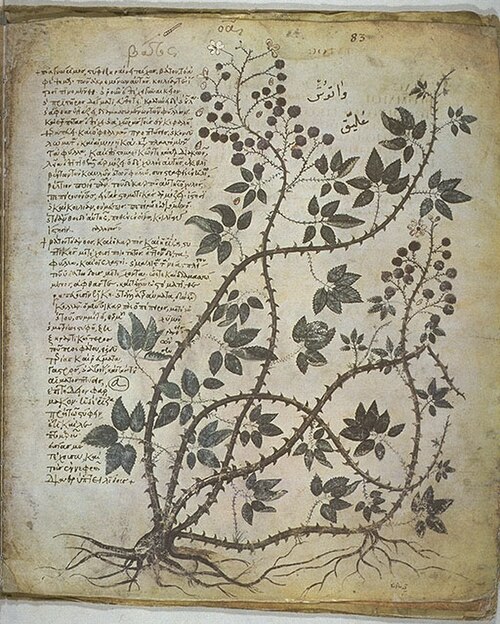
The Bencao Gangmu expanded beyond plants to cover minerals, animals, and even man-made substances. Li Shizhen described 1,892 distinct entries in total. #Pharmacology #Minerals
Includes Mineral and Animal Substances By Unknown author - Seite aus dem Wiener Dioskurides Kodex (Codex medicus graecus 1 der Österreichischen Nationalbibliothek, fol 83 recto), Public domain, https://commons.wikimedia.org/w/index.php?curid=52153
1585 CE
Final Revision of Manuscript
Li Shizhen completed the final revision of the Bencao Gangmu, now comprising 52 volumes. He wrote prefaces and added corrections based on new findings. #Revision #Completion
1587 CE
Seeks Publisher for Bencao Gangmu
Li Shizhen traveled to Nanjing and other cities to find a publisher for his massive work. Many publishers were daunted by the cost and size. #Publishing #Struggle
Seeks Publisher for Bencao Gangmu By xiquinhosilva - https://www.flickr.com/photos/xiquinho/54592499231/, CC BY 2.0, https://commons.wikimedia.org/w/index.php?curid=168623901
1590 CE
Publisher Agrees to Print Bencao Gangmu
After years of effort, Li Shizhen secured a publisher in Nanjing. The printing process began but was slow due to the work's complexity. #Printing #Publication
1593 CE
Li Shizhen Dies at Age 75
Li Shizhen passed away in Qizhou before seeing the final printed version of his life's work. He died knowing the manuscript was in press. #Death #Legacy
1596 CE
Bencao Gangmu Published Posthumously
The first printed edition of Bencao Gangmu was published in Nanjing. It contained 52 volumes, 1,892 entries, and over 1,000 illustrations. #Publication #Milestone
1603 CE
Second Edition Printed in Jiangxi
A second edition of Bencao Gangmu was printed in Jiangxi, expanding its circulation. It became a standard reference for Chinese medicine. #Edition #Dissemination
1640 CE
Bencao Gangmu Reprinted in Japan
The Bencao Gangmu was brought to Japan and reprinted, influencing Japanese herbal medicine (Kampo). It was widely studied by Japanese scholars. #Japan #Kampo
Bencao Gangmu Reprinted in Japan By Shinno_(Shennong).inscribed.artist_not_identified.19th_century.japanese.Wittig_collection_-_painting_21.JPG: artist not (yet) identified, photograph by uploader derivative work: nagualdesign (talk) - Shinno_(Shennong).inscribed.artist_not_identified.19th_century.japanese.Wittig_collection_-_painting_21.JPG, Public domain, https://commons.wikimedia.org/w/index.php?curid=17557530
1655 CE
European Missionaries Discover Bencao Gangmu
Jesuit missionaries in China sent copies of Bencao Gangmu to Europe, where it was studied by naturalists like Linnaeus. #Europe #Transmission
European Missionaries Discover Bencao Gangmu By Athanasius Kircher - "Frontispicio" 2, China Illustrata, Fondo Antiguo de la Biblioteca de la Universidad de Sevilla from Sevilla, España, CC BY 2.0, https://commons.wikimedia.org/w/index.php?curid=51334250
1735 CE
Partial Translation into French
French Jesuit Jean-Baptiste Du Halde included excerpts of Bencao Gangmu in his Description de la Chine, introducing it to European scholars. #Translation #France
Partial Translation into French By Entrecolles 1712 , published by du Halde in 1735 - Lettres édifiantes et curieuses écrites des missions étrangères par quelques missionnaires de la Compagnie de Jésus., Public domain, https://commons.wikimedia.org/w/index.php?curid=10486776
1818 CE
English Translation by John Reeves
British naturalist John Reeves translated parts of Bencao Gangmu into English, making it accessible to Western botanists. #Translation #Botany
English Translation by John Reeves By George Chinnery - Art UK, Public domain, https://commons.wikimedia.org/w/index.php?curid=91905088
1870 CE
Bencao Gangmu Cited by Darwin
Charles Darwin referenced Bencao Gangmu in his work on variation in plants and animals, acknowledging Li Shizhen's observations. #Darwin #Evolution
Bencao Gangmu Cited by Darwin By Charles_Darwin_seated.jpg: Henry Maull (1829–1914) and John Fox (1832–1907) (Maull & Fox) [3] derivative work: Beao - Charles_Darwin_seated.jpg, Public domain, https://commons.wikimedia.org/w/index.php?curid=11264065
1929 CE
Modern Chinese Edition Published
A modern annotated edition of Bencao Gangmu was published in China, with corrections and commentary by contemporary scholars. #ModernEdition #Scholarship
1953 CE
Li Shizhen Honored as National Hero
The People's Republic of China recognized Li Shizhen as a national hero and pioneer of Chinese medicine. His tomb was restored. #NationalHero #China
1970 CE
Bencao Gangmu Used in WHO Traditional Medicine
The World Health Organization included Bencao Gangmu as a reference for traditional medicine, highlighting its global significance. #WHO #TraditionalMedicine
Bencao Gangmu Used in WHO Traditional Medicine By Guilhem Vellut from Annecy, France - World Health Organization @ Pregny-Chambésy, CC BY 2.0, https://commons.wikimedia.org/w/index.php?curid=105949300
1982 CE
Li Shizhen Museum Established in Qichun
A museum dedicated to Li Shizhen opened in his hometown, displaying artifacts, manuscripts, and botanical specimens. #Museum #Heritage
1990 CE
Bencao Gangmu Digitized
The complete text of Bencao Gangmu was digitized and made available online, facilitating global research. #Digital #OpenAccess
2000 CE
Li Shizhen Featured on Chinese Stamp
China Post issued a stamp featuring Li Shizhen to commemorate his contributions to medicine and botany. #Stamp #Commemoration
2011 CE
Bencao Gangmu Inscribed on Memory of the World Register
UNESCO added the Bencao Gangmu to its Memory of the World Register, recognizing its documentary heritage value. #UNESCO #Heritage
Bencao Gangmu Inscribed on Memory of the World Register By UNESCO, Public domain, https://commons.wikimedia.org/w/index.php?curid=168117668
2018 CE
500th Anniversary of Li Shizhen's Birth Celebrated
China held international conferences and exhibitions to mark the 500th birthday of Li Shizhen, highlighting his enduring legacy. #Anniversary #Celebration
2020 CE
Bencao Gangmu Used in COVID-19 Research
Chinese researchers referenced Bencao Gangmu for potential antiviral herbs during the COVID-19 pandemic, demonstrating its continued relevance. #COVID19 #HerbalMedicine
Bencao Gangmu Used in COVID-19 Research By Gustavo Basso - https://www.flickr.com/photos/gustavocb/49913440386, CC BY-SA 4.0, https://commons.wikimedia.org/w/index.php?curid=112916636