Encyclopedia/4. Arts & Literature/2. Visual Arts, Architecture & Design/05. Visual Arts Biographies • Curated by Admin Timeline.sg
Biographical timeline of Leonardo da Vinci, archetype of the Renaissance Man—painter, sculptor, architect, engineer, and anatomist, spanning his birth in 1452 to his death in 1519.
Chronological Storyline (43 Milestones)
Apr 15, 1452 CE
Leonardo da Vinci Born
Leonardo is born in the Tuscan hill town of Vinci, the illegitimate son of Ser Piero da Vinci, a notary, and Caterina, a peasant woman. He is raised by his father's family. #art #history
Leonardo da Vinci Born By Attributed to Francesco Melzi - File:Francesco_Molzi_-_Portrait_of_Leonardo_-_WGA14795.jpg, Public domain, https://commons.wikimedia.org/w/index.php?curid=78645105
1468 CE
Leonardo Moves to Florence
At age 16, Leonardo moves to Florence, then a center of Renaissance art and culture. He soon apprentices with the renowned artist Andrea del Verrocchio. #art #renaissance
1472 CE
Leonardo Qualifies as Master Artist
Leonardo is enrolled in the Guild of Saint Luke, the Florentine guild of artists and doctors, marking his qualification as a master artist. He continues to work in Verrocchio's workshop. #art #renaissance
Aug 5, 1473 CE
Leonardo's Earliest Dated Drawing
Leonardo creates 'Landscape of the Arno Valley', his earliest dated work, a pen-and-ink drawing showing the countryside near Florence. It is held at the Uffizi Gallery. #art #landscape
1476 CE
Leonardo Accused of Sodomy
Leonardo and three other young men are anonymously accused of sodomy. The charges are dismissed after a lack of evidence. This event is known from court documents. #biography #scandal
1478 CE
Commission for the Adoration of the Magi
Leonardo is commissioned to paint the 'Adoration of the Magi' for the Monastery of San Donato in Scopeto. He leaves the work unfinished when he moves to Milan. #art #painting )
Commission for the Adoration of the Magi By Justin Benttinen - Own work, CC BY-SA 4.0, https://commons.wikimedia.org/w/index.php?curid=165344281
1482 CE
Leonardo Moves to Milan
Leonardo moves to Milan to work for Duke Ludovico Sforza. He offers his services as a military engineer, architect, and artist. #renaissance #career
1483 CE
Virgin of the Rocks Commissioned
Leonardo receives a commission for the 'Virgin of the Rocks' for the Confraternity of the Immaculate Conception in Milan. Two versions exist, one in the Louvre and one in the National Gallery, London. #art #painting
Virgin of the Rocks Commissioned By Leonardo da Vinci - gallerix.ru, Public domain, https://commons.wikimedia.org/w/index.php?curid=32430178
1485 CE
Leonardo Studies Hydraulic Engineering
Leonardo begins studying water flow and designs various hydraulic machines, including canal systems and pumps. His notebooks contain detailed plans for irrigation and flood control. #engineering #science
1487 CE
Leonardo Designs Flying Machines
Leonardo sketches designs for a flying machine, including an ornithopter, demonstrating his interest in human flight. These are part of his Codex on the Flight of Birds. #invention #engineering
1488 CE
Leonardo Designs the Sforza Horse Monument
Leonardo designs a colossal bronze equestrian statue of Francesco Sforza, but only a clay model is completed. The bronze is later used for cannons. #art #sculpture
1490 CE
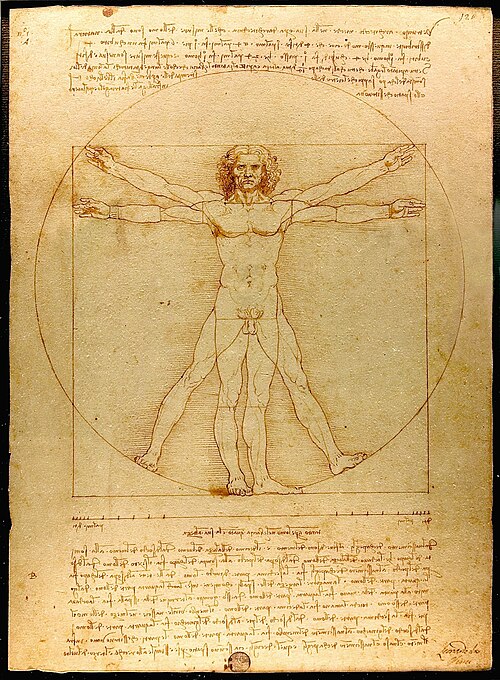
Vitruvian Man Created
Leonardo draws the 'Vitruvian Man', a study of ideal human proportions based on the writings of the Roman architect Vitruvius. The drawing becomes an iconic representation of the Renaissance. #art #science
Vitruvian Man Created By Leonardo da Vinci - Leonardo Da Vinci - Photo from www.lucnix.be. 2007-09-08 (photograph). Photograpy: This image is the work of Luc Viatour Please credit it with: Luc Viatour / https://Lucnix.be in the immediate vicinity of the image. A link to my website https://lucnix.be is much appreciated but not mandatory. An email to Viatour Luc would be appreciated too. Do not copy this image illegally by ignoring the terms of the license below, as it is not in the public domain. If you would like special permission to use, license, or purchase the image please contact me Viatour Luc to negotiate terms. More free pictures in my personal gallery [Note: this is in the public domain, despite the photographer's contradictory claim. Any use is permissible, and no credit to the photographer is necessary.] Nikon case D80 optical Sigma 17-70mm F2,8/4,5 Macro, Public domain, https://commons.wikimedia.org/w/index.php?curid=2738140
1490 CE
Leonardo's First Anatomical Studies
Leonardo begins systematic human dissections, producing detailed drawings of muscles and bones. His work combines artistry with scientific observation. #anatomy #science
1493 CE
Sala delle Asse Decorations
Leonardo paints the Sala delle Asse (Room of the Wooden Boards) in the Sforza Castle in Milan, a fresco of intertwined tree branches and roots, creating an illusion of a natural arbor. #art #fresco
Sala delle Asse Decorations By Hoclab - Own work, CC BY-SA 4.0, https://commons.wikimedia.org/w/index.php?curid=75185757
1495 CE
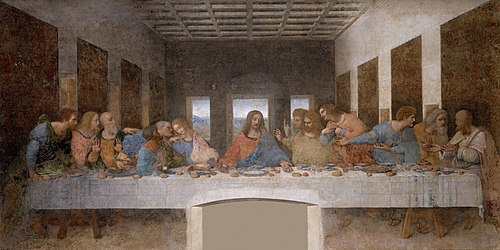
Start of The Last Supper
Leonardo begins painting 'The Last Supper' on the wall of the refectory of the Monastery of Santa Maria delle Grazie in Milan. He uses experimental techniques that lead to early deterioration. #art #masterpiece )
Start of The Last Supper By Leonardo da Vinci - Online Taken on 23 July 2013, Public domain, https://commons.wikimedia.org/w/index.php?curid=50410532
Feb 9, 1498 CE
The Last Supper Completed
Leonardo completes 'The Last Supper', one of the most famous paintings in the world. It depicts the moment Jesus announces one of his disciples will betray him. #art #masterpiece )
1498 CE
Leonardo Paints the Sala delle Asse
Leonardo completes the Sala delle Asse in the Sforza Castle, a fresco of intertwined mulberry trees, symbolizing the Sforza dynasty. The work was restored in the 20th century. #art #fresco
1499 CE
French Invasion Forces Leonardo from Milan
After the French invasion of Milan, Leonardo flees the city with his assistant Salai and friend Luca Pacioli. He travels to Mantua and Venice before returning to Florence. #history #biography
1500 CE
Leonardo Returns to Florence
Leonardo returns to Florence, where he is greeted as a celebrated artist. He begins work on several projects, including the Virgin and Child with Saint Anne. #art #renaissance
1500 CE
Leonardo Paints the Virgin and Child with Saint Anne
Leonardo begins the 'Virgin and Child with Saint Anne', a painting that shows his sfumato technique and complex composition. It is now in the Louvre. #art #painting )
Leonardo Paints the Virgin and Child with Saint Anne By Leonardo da Vinci - https://www.1jour1actu.com/culture/ou-peut-on-voir-ce-celebre-tableau/, Public domain, https://commons.wikimedia.org/w/index.php?curid=99511246
1502 CE
Leonardo Serves as Military Engineer for Cesare Borgia
Leonardo works as a military engineer and architect for Cesare Borgia, the son of Pope Alexander VI. He travels through central Italy, mapping fortresses and designing weapons. #engineering #history
1503 CE
Start of the Mona Lisa
Leonardo begins painting the 'Mona Lisa', likely of Lisa Gherardini, the wife of a Florentine silk merchant. He continues to work on it for years, never delivering it to the patron. #art #masterpiece
Start of the Mona Lisa By Leonardo da Vinci - Natural colors from 17:19, 18 August 2011 (UTC) version by Cybershot800i of File:Mona Lisa, by Leonardo da Vinci, from C2RMF retouched.jpg per this discussion. Cropped and relevelled from File:Mona Lisa, by Leonardo da Vinci, from C2RMF.jpg. Originally C2RMF: Galerie de tableaux en très haute définition: image page., Public domain, https://commons.wikimedia.org/w/index.php?curid=22963578
1503 CE
Battle of Anghiari Commission
Leonardo is commissioned to paint a large mural of the 'Battle of Anghiari' in the Palazzo Vecchio in Florence. The work is never completed and is known only through copies and studies. #art #history )
Battle of Anghiari Commission By Peter Paul Rubens / After Leonardo da Vinci - [1], Public domain, https://commons.wikimedia.org/w/index.php?curid=59569
1504 CE
Leonardo Begins Anatomical Studies
Leonardo intensifies his anatomical studies, dissecting corpses at the Hospital of Santa Maria Nuova in Florence. His detailed drawings advance the understanding of the human body. #anatomy #science
1505 CE
Leonardo Studies Bird Flight
Leonardo writes the 'Codex on the Flight of Birds', observing and sketching the aerodynamics of bird flight. His studies anticipate principles of aviation. #science #invention
Leonardo Studies Bird Flight By Photography Luc Viatour - Photography *own work www.lucnix.be Nikon case D80 optical Sigma 17-70mm F2,8/4,5 Macro, Public domain, https://commons.wikimedia.org/w/index.php?curid=2892625
1506 CE
Leonardo Returns to Milan
Leonardo moves back to Milan at the invitation of the French governor Charles d'Amboise. He works on various projects, including architecture and engineering. #biography #renaissance
1506 CE
Leonardo Works on the Mona Lisa's Landscape
Leonardo continues refining the Mona Lisa, adding the atmospheric landscape background and the subject's enigmatic smile. The painting remains in his possession until his death. #art #masterpiece
1508 CE
Leonardo Works on Virgin of the Rocks Second Version
Leonardo and his workshop produce a second version of the 'Virgin of the Rocks', now in the National Gallery, London. The work involves legal disputes over payment. #art #painting
1509 CE
Leonardo Designs Fortifications for Milan
Leonardo works on military architecture, designing fortifications and defenses for the city of Milan under French rule. His designs incorporate geometric principles. #engineering #military
1510 CE
Leonardo Dissects Human Hearts
Leonardo conducts detailed dissections of the human heart, producing accurate drawings of the heart valves and blood flow. His work predates later discoveries by centuries. #anatomy #science
1511 CE
Leonardo Moves to Rome
Leonardo moves to Rome, where he works under the patronage of Pope Leo X. He stays at the Vatican's Belvedere Court but faces competition from younger artists like Raphael and Michelangelo. #art #history
1512 CE
Leonardo Studies Optics and Light
Leonardo investigates the nature of light and shadow, producing studies on perspective and color. His observations contribute to the development of sfumato technique. #science #art
1513 CE
Leonardo Designs a Device to Measure Wind Speed
Leonardo sketches an anemometer, a device to measure wind speed, as part of his studies of meteorology and flight. #invention #science
1513 CE
Leonardo's Anatomical Drawings for De humani corporis fabrica
Leonardo collaborates with the anatomist Marcantonio della Torre, but della Torre dies before publication. Leonardo's anatomical drawings remain unpublished in his lifetime. #anatomy #science
1514 CE
Leonardo Designs a Plan for the Pontine Marshes
Leonardo proposes a drainage plan for the Pontine Marshes near Rome to reclaim agricultural land, but the project is never executed. #engineering #environment
1515 CE
Leonardo Designs a Mechanical Lion
For the entry of King Francis I of France into Lyon, Leonardo designs a mechanical lion that walks and opens its chest to display lilies. It is a marvel of engineering. #engineering #invention
1516 CE
Leonardo Moves to France as Court Painter to Francis I
King Francis I of France invites Leonardo to the Château du Clos Lucé in Amboise, where he is given the title 'Premier Painter, Engineer, and Architect to the King'. #biography #career
1517 CE
Leonardo Paints Saint John the Baptist
Leonardo paints 'Saint John the Baptist', a dark, enigmatic oil painting that may be one of his last completed works. It is now in the Louvre. #art #painting )
Leonardo Paints Saint John the Baptist By Leonardo da Vinci - Based on File:Saint Jean-Baptiste, by Leonardo da Vinci, from C2RMF.jpg, originally: C2RMF: Galerie de tableaux en très haute définition: image page, Public domain, https://commons.wikimedia.org/w/index.php?curid=15707724
1517 CE
Leonardo Suffers Stroke
Leonardo suffers a stroke that paralyzes his right hand. He continues to work using his left hand and with assistance from his pupil Francesco Melzi. #health #biography
1518 CE
Leonardo Organizes His Notebooks
Leonardo organizes his vast collection of notebooks, which contain thousands of pages of drawings, scientific observations, and inventions. He leaves them to his pupil Melzi. #science #art
May 2, 1519 CE
Leonardo da Vinci Dies at Amboise
Leonardo dies at the Château du Clos Lucé at age 67, reportedly in the arms of King Francis I. He is buried in the Chapel of Saint-Hubert at the Château d'Amboise. #biography #history
1519 CE
Leonardo's Estate Inherited by Melzi
Leonardo's pupil and assistant Francesco Melzi inherits his notebooks, paintings, tools, and library. Melzi preserves the manuscripts but later many are dispersed. #art #legacy
Leonardo's Estate Inherited by Melzi By Giovanni Antonio Boltraffio - [2], Public domain, https://commons.wikimedia.org/w/index.php?curid=164271058
1519 CE
Leonardo's Notebooks Dispersed
After Leonardo's death, his notebooks begin to be dispersed. Over centuries, they are collected by various libraries and museums. Today, major collections include the Codex Atlanticus and the Codex Leicester. #art #legacy