Korean Dynastic Eras: Three Kingdoms, Goryeo & Joseon Dynasty
Encyclopedia/3. History, Societies & Civilizations/01. East Asian Civilizations • Curated by Admin Timeline.sg
Korean history spans from the Three Kingdoms period (57 BCE) through the Goryeo and Joseon dynasties, ending in 1910. Key milestones include the unification of the Three Kingdoms by Silla, the creation of the Tripitaka Koreana and Hangul, and the naval victories of Admiral Yi Sun-sin.
Chronological Storyline (45 Milestones)
57 BCE
Traditional Founding of Silla
According to legend, Silla was founded by Bak Hyeokgeose in 57 BCE. It became one of the Three Kingdoms of Korea, eventually unifying the peninsula in 668 CE. #KoreanHistory #ThreeKingdoms
Traditional Founding of Silla By Asieon - Own work, CC0, https://commons.wikimedia.org/w/index.php?curid=192466722
37 BCE
Traditional Founding of Goguryeo
Goguryeo was founded by King Dongmyeong in 37 BCE. It became the largest of the Three Kingdoms, known for its military prowess and expansion into Manchuria. #KoreanHistory #ThreeKingdoms
Traditional Founding of Goguryeo By Asieon - Own work, CC0, https://commons.wikimedia.org/w/index.php?curid=192465789
18 BCE
Traditional Founding of Baekje
Baekje was founded by King Onjo in 18 BCE. It was known for its maritime trade and cultural influence on Japan. #KoreanHistory #ThreeKingdoms
Traditional Founding of Baekje By Asieon - Own work, CC0, https://commons.wikimedia.org/w/index.php?curid=192466581
372 CE
Buddhism Introduced to Goguryeo
Buddhism was officially introduced to Goguryeo from China, becoming a major cultural and religious force in Korea. #Buddhism #KoreanHistory
Buddhism reached Baekje, leading to the construction of temples and the spread of Buddhist art. #Buddhism #KoreanHistory
527 CE
Buddhism Adopted by Silla
Silla officially adopted Buddhism, which became a state religion and influenced its unification efforts. #Buddhism #KoreanHistory
660 CE
Fall of Baekje
Baekje fell to the Silla-Tang alliance, marking a step toward Korean unification under Silla. #KoreanHistory #ThreeKingdoms
668 CE
Fall of Goguryeo and Unification by Silla
Goguryeo fell to the Silla-Tang alliance, and Silla unified most of the Korean Peninsula, beginning the Unified Silla period. #KoreanHistory #Unification
Fall of Goguryeo and Unification by Silla By KJS615 - Own work, CC BY-SA 3.0, https://commons.wikimedia.org/w/index.php?curid=30571234
682 CE
Establishment of Gukhak (National Confucian Academy)
Silla established the Gukhak to promote Confucian education and train government officials. #Confucianism #Education
751 CE
Construction of Bulguksa Temple Begins
Bulguksa, a masterpiece of Buddhist art, was built in Gyeongju during the Unified Silla period. #Buddhism #Architecture
Construction of Bulguksa Temple Begins By Unknown author - Korea Copyright Commission, Public domain, https://commons.wikimedia.org/w/index.php?curid=24717774
828 CE
Jang Bogo Establishes Maritime Trade
Jang Bogo, a powerful maritime figure, established trade routes between Korea, China, and Japan. #Trade #KoreanHistory
918 CE
Founding of Goryeo Dynasty
Wang Geon founded the Goryeo dynasty, which would rule Korea until 1392 and give its name to modern Korea. #Goryeo #KoreanHistory
Founding of Goryeo Dynasty By Historyclassproffesor - Own work, CC BY-SA 3.0, https://commons.wikimedia.org/w/index.php?curid=61385219
936 CE
Goryeo Unifies Later Three Kingdoms
Goryeo completed the unification of the Later Three Kingdoms (Silla, Hubaekje, Taebong), consolidating its rule. #Goryeo #Unification
Goryeo Unifies Later Three Kingdoms By KJS615 - Own work, CC BY-SA 3.0, https://commons.wikimedia.org/w/index.php?curid=33617824
958 CE
Introduction of Civil Service Examinations
Goryeo adopted the gwageo civil service examination system based on Confucian classics. #Confucianism #Government
Introduction of Civil Service Examinations By National Museum of Korea - https://www.museum.go.kr/site/main/relic/search/view?relicId=6052, KOGL Type 1, https://commons.wikimedia.org/w/index.php?curid=135962160
993 CE
First Goryeo-Khitan War
Goryeo successfully repelled an invasion by the Khitan Liao dynasty, securing its northern borders. #War #Goryeo
First Goryeo-Khitan War By 玖巧仔 - File:北宋疆域图(简).png, CC BY-SA 4.0, https://commons.wikimedia.org/w/index.php?curid=75625065
1010 CE
Second Goryeo-Khitan War
The Khitan invaded again, but Goryeo's resistance led to a negotiated peace. #War #Goryeo
1019 CE
Third Goryeo-Khitan War
Goryeo decisively defeated the Khitan, ending the conflict and establishing peace. #War #Goryeo
1087 CE
First Printing of Tripitaka Koreana
The first set of woodblocks for the Tripitaka Koreana was completed, a massive collection of Buddhist scriptures. #Buddhism #Printing
First Printing of Tripitaka Koreana By Bernard Gagnon - Own work, CC0, https://commons.wikimedia.org/w/index.php?curid=145076861
1102 CE
Introduction of Metal Movable Type
Goryeo invented metal movable type printing, one of the earliest in the world, predating Gutenberg. #Printing #Innovation
Introduction of Metal Movable Type By Willi Heidelbach - http://www.sxc.hu/photo/238776; archived copy: stock.xchng - the quick brown fox ... (photo by wilhei66), CC BY 2.5, https://commons.wikimedia.org/w/index.php?curid=154912
1145 CE
Samguk Sagi Compiled
Kim Bu-sik completed the Samguk Sagi, the oldest extant history of Korea, covering the Three Kingdoms period. #History #Literature
Samguk Sagi Compiled By Gomanari - Own work, Public domain, https://commons.wikimedia.org/w/index.php?curid=12600532
1231 CE
First Mongol Invasion of Goryeo
The Mongol Empire invaded Goryeo, beginning a series of invasions that would last decades. #War #Mongol
First Mongol Invasion of Goryeo By Qiushufang - Own work, CC BY-SA 4.0, https://commons.wikimedia.org/w/index.php?curid=81391675
1259 CE
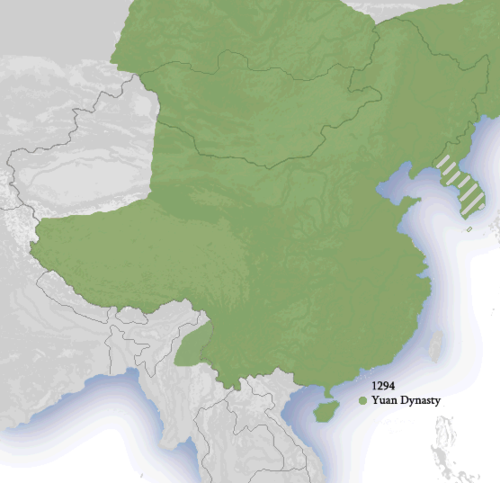
Goryeo Becomes Mongol Vassal
After years of resistance, Goryeo signed a peace treaty becoming a vassal state of the Mongol Yuan dynasty. #Mongol #Goryeo
Goryeo Becomes Mongol Vassal By Yuen_Dynasty_1294.png: Ian Kiu derivative work: Idh0854 (talk) - Yuen_Dynasty_1294.png, CC BY 3.0, https://commons.wikimedia.org/w/index.php?curid=12014395
1285 CE
Samguk Yusa Compiled
Buddhist monk Iryeon compiled the Samguk Yusa, a collection of legends and history from the Three Kingdoms. #History #Literature
Samguk Yusa Compiled By Salamander724 - Own work, Public domain, https://commons.wikimedia.org/w/index.php?curid=27853768
1377 CE
Jikji Printed with Metal Type
The Jikji, a Buddhist text, was printed using movable metal type, the oldest extant book printed with such technology. #Printing #Buddhism
Jikji Printed with Metal Type By Unknown author - https://gallica.bnf.fr/ark:/12148/btv1b10527116j, Public domain, https://commons.wikimedia.org/w/index.php?curid=148191571
1392 CE
Founding of Joseon Dynasty
General Yi Seong-gye overthrew Goryeo and established the Joseon dynasty, which would last until 1910. #Joseon #KoreanHistory
Founding of Joseon Dynasty By Daniil Ivanov - [1], Public domain, https://commons.wikimedia.org/w/index.php?curid=1762046
1394 CE
Capital Moved to Hanyang (Seoul)
Joseon moved its capital to Hanyang (modern Seoul), which became the political and cultural center. #Joseon #Capital
Capital Moved to Hanyang (Seoul) By Eunmi Park - Own work, CC BY-SA 4.0, https://commons.wikimedia.org/w/index.php?curid=51920812
1403 CE
Creation of the First Korean Metal Type
King Taejong ordered the casting of metal type for printing, advancing Korean typography. #Printing #Innovation
1418 CE
King Sejong the Great Ascends Throne
Sejong the Great became king, ushering in a golden age of cultural and scientific achievement. #Joseon #KingSejong
1420 CE
Establishment of Jiphyeonjeon (Hall of Worthies)
Sejong established a royal research institute to promote scholarship and innovation. #Science #Education
Establishment of Jiphyeonjeon (Hall of Worthies) By 문화재청, KOGL Type 1, https://commons.wikimedia.org/w/index.php?curid=107937744
1443 CE
Invention of Hangul Alphabet
King Sejong and scholars created Hangul, the Korean alphabet, to improve literacy among commoners. #Language #Innovation
Invention of Hangul Alphabet By metalslick - Own work, CC BY-SA 4.0, https://commons.wikimedia.org/w/index.php?curid=63996191
1446 CE
Promulgation of Hunminjeongeum
The Hunminjeongeum document explaining Hangul was published, officially introducing the alphabet. #Language #KingSejong
Promulgation of Hunminjeongeum By Sejong the Great of Joseon - http://www.cha.go.kr/korea/heritage/search/Culresult_Db_View.jsp?VdkVgwKey=11,00700000,11, Public domain, https://commons.wikimedia.org/w/index.php?curid=4927531
1592 CE
Admiral Yi Sun-sin's Turtle Ships Debut
Admiral Yi Sun-sin used innovative turtle ships (geobukseon) to achieve naval victories against Japan. #Naval #Innovation
Admiral Yi Sun-sin's Turtle Ships Debut By Feth - Own work, GPL, https://commons.wikimedia.org/w/index.php?curid=265912
1592 CE
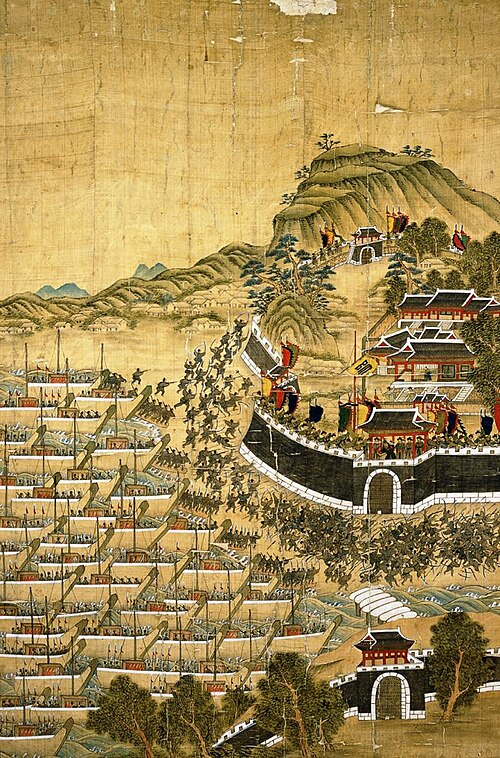
Imjin War Begins: Japanese Invasion
Toyotomi Hideyoshi's Japan invaded Korea, starting a devastating war that lasted until 1598. #War #Japan
Imjin War Begins: Japanese Invasion By Unknown author - http://www.cha.go.kr/unisearch/Culresult_Db_View.jsp?VdkVgwKey=12,03910000,11, Public domain, https://commons.wikimedia.org/w/index.php?curid=752659
1597 CE
Battle of Myeongnyang
Admiral Yi Sun-sin won a decisive naval battle against a much larger Japanese fleet with only 13 ships. #Naval #YiSunSin
Battle of Myeongnyang By 太田天洋(1884~1946) - "Chinese Siege Warfare: Mechanical Artillery & Siege Weapons of Antiquity" by Liang Jieming, ISBN 981-05-5380-3, [1], CC BY 1.0, https://commons.wikimedia.org/w/index.php?curid=1047410
1598 CE
End of Imjin War
After Hideyoshi's death, Japanese forces withdrew, ending the war. Korea and its Ming ally were devastated. #War #History
1608 CE
Introduction of Tobacco to Korea
Tobacco was introduced from Japan and quickly became popular, leading to government regulation. #Culture #Trade
1627 CE
First Manchu Invasion of Joseon
The Later Jin (Manchu) invaded Joseon, forcing a tributary relationship. #War #Manchu
First Manchu Invasion of Joseon By Qiushufang - Own work, CC BY-SA 4.0, https://commons.wikimedia.org/w/index.php?curid=81328616
1636 CE
Second Manchu Invasion of Joseon
The Qing dynasty invaded and forced Joseon to become a tributary state, ending Ming influence. #War #Manchu
Second Manchu Invasion of Joseon By Qiushufang - Own work, CC BY-SA 4.0, https://commons.wikimedia.org/w/index.php?curid=81328615
1653 CE
Dutch Shipwreck: Hendrick Hamel in Korea
Dutch sailor Hendrick Hamel was shipwrecked in Jeju and later wrote the first Western account of Korea. #Exploration #Western
Dutch Shipwreck: Hendrick Hamel in Korea By Wikifrits - Own work, CC BY-SA 3.0, https://commons.wikimedia.org/w/index.php?curid=24714094
1791 CE
Catholic Persecution Begins
Joseon began persecuting Catholics, viewing the religion as a subversive foreign influence. #Religion #Persecution
Catholic Persecution Begins By Pharexia - This vector image includes elements that have been taken or adapted from this file:, Public domain, https://commons.wikimedia.org/w/index.php?curid=88302214
1866 CE
General Sherman Incident
The American merchant ship General Sherman was destroyed in Pyongyang after attempting to open trade, leading to tensions. #Trade #Conflict
1876 CE
Treaty of Ganghwa: Opening of Korea
Japan forced Korea to sign the Treaty of Ganghwa, opening Korean ports to Japanese trade and ending isolation. #Diplomacy #Japan
Treaty of Ganghwa: Opening of Korea By World Imaging - Own work, Japan Diplomatic Archives, CC BY-SA 3.0, https://commons.wikimedia.org/w/index.php?curid=12756244
1894 CE
Donghak Peasant Revolution
Peasants led by the Donghak movement rebelled against government corruption and foreign influence, sparking the First Sino-Japanese War. #Rebellion #Peasant
Donghak Peasant Revolution By Murakami Tenshin (村上天眞) - Japanese book "History of Japan-Korea Annexation about which Image talks" published by Roudoukeizai Sha., Public domain, https://commons.wikimedia.org/w/index.php?curid=5489038
1897 CE
Establishment of the Korean Empire
King Gojong proclaimed the Korean Empire, asserting independence from Qing China and modernizing the state. #Empire #Modernization
Establishment of the Korean Empire By Lumia1234 - [1], File:Flags of Maritime Nations (1899).djvu, Public domain, https://commons.wikimedia.org/w/index.php?curid=46374231
Aug 29, 1910 CE
Japan-Korea Annexation Treaty
Japan formally annexed Korea, ending the Joseon dynasty and beginning 35 years of colonial rule. #Colonialism #Japan
Japan-Korea Annexation Treaty By Sunjong of Korean Empire - "서울대이태진교수의동경대생들에게들려준한국사 : 메이지일본의한국침략사", Yi Tae-jin (2005) p. 211. ISBN 89-7626-999-3, Public domain, https://commons.wikimedia.org/w/index.php?curid=2294468