Encyclopedia/3. History, Societies & Civilizations/02. South & Southeast Asian Civilizations • Curated by Admin Timeline.sg
The Khmer Angkor Empire (9th-15th centuries) produced some of the world's most magnificent religious architecture, blending Hindu and Buddhist cosmology with advanced hydraulic engineering. This timeline traces key milestones from pre-Angkorian foundations to modern restoration efforts.
Chronological Storyline (45 Milestones)
802 CE
Jayavarman II Declares Independence from Java
Jayavarman II returns from Java and declares independence on Mount Kulen, founding the Khmer Empire. This event marks the beginning of the Angkorian period and the cult of the devaraja (god-king). #history #architecture
820 CE
Early Brick Temples on Phnom Kulen
Jayavarman II orders the construction of the first Angkorian brick temples on Phnom Kulen, including the Prasat Rong Chen. These early structures feature stepped pyramid designs and are the forerunners of later stone temples. #architecture #history
Early Brick Temples on Phnom Kulen By Xufanc - Own work, CC BY-SA 3.0, https://commons.wikimedia.org/w/index.php?curid=7715365
889 CE
Foundation of Hariharalaya (Roluos Group)
King Indravarman I establishes the capital Hariharalaya near present-day Roluos, building the Preah Ko temple. This marks the first major temple-mountain concept with a central tower. #architecture
893 CE
Completion of Bakong Temple
Indravarman I completes Bakong, the first large stone temple-mountain at Roluos. It symbolizes Mount Meru and sets the template for future Angkorian temples. #architecture #religion
Completion of Bakong Temple By Photo Dharma from Penang, Malaysia - 005 Bakong, CC BY 2.0, https://commons.wikimedia.org/w/index.php?curid=40428140
900 CE
Lolei Baray Construction
King Yasovarman I begins construction of the Eastern Baray, a massive man-made reservoir on the Roluos plain. This is the first of many large-scale water management projects essential for Angkor's agriculture. #engineering #architecture
907 CE
Building of Phnom Bakheng Temple
King Yasovarman I moves the capital to Angkor area and builds Phnom Bakheng, the first temple-mountain on a natural hill. It is the central temple of the new capital Yasodharapura. #architecture
Building of Phnom Bakheng Temple By Satdeep Gill - Own work, CC BY-SA 4.0, https://commons.wikimedia.org/w/index.php?curid=124021006
921 CE
Prasat Kravan Brick Temple Construction
The brick temple Prasat Kravan is built by high-ranking officials under King Harshavarman I. It features unusual interior carvings of Vishnu. #architecture #art
Prasat Kravan Brick Temple Construction By Diego Delso - Own work, CC BY-SA 3.0, https://commons.wikimedia.org/w/index.php?curid=30238207
944 CE
Construction of Rajendravarman's Temples
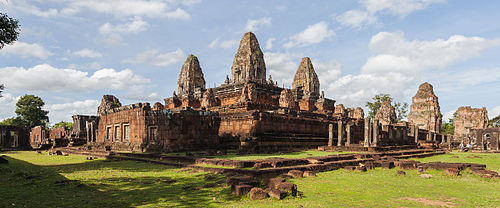
King Rajendravarman II builds Pre Rup (temple-mountain) and East Mebon (on an island in the Eastern Baray). Both are dedicated to Shiva and represent cosmic mountains. #architecture #religion
Construction of Rajendravarman's Temples By Diego Delso - Own work, CC BY-SA 3.0, https://commons.wikimedia.org/w/index.php?curid=30238197
950 CE
Banteay Srei Temple Construction Begins
Construction of Banteay Srei, a small but exquisitely decorated temple, begins under Rajendravarman. Its intricate pink sandstone carvings are considered a masterpiece of Khmer art. #architecture #art
Banteay Srei Temple Construction Begins By Tsui - Own work, CC BY-SA 3.0, https://commons.wikimedia.org/w/index.php?curid=1981784
967 CE
Banteay Srei Completed and Inaugurated
Banteay Srei is completed and dedicated to the Hindu god Shiva. It is the only Angkorian temple not built by a monarch but by a Brahmin scholar. #architecture #history
987 CE
Ta Keo Temple Construction
King Jayavarman V begins building Ta Keo, the first temple-mountain at Angkor built entirely of sandstone. Its construction is halted, leaving it largely undecorated, but it is significant for its scale. #architecture
Ta Keo Temple Construction By This Photo was taken by Supanut Arunoprayote. Feel free to use any of my images, but please mention me as the author and may send me a message. (สามารถใช้ภาพได้อิสระ แต่กรุณาใส่เครดิตผู้ถ่ายและอาจส่งข้อความบอกกล่าวด้วย) Please do not upload an updated image here without consultation with the Author. The author would like to make corrections only at his own source. This ensures that the changes are preserved.Please if you think that any changes should be required, please inform the author.Otherwise you can upload a new image with a new name. Please use one of the templates derivative or extract. - Own work, CC BY 4.0, https://commons.wikimedia.org/w/index.php?curid=90093068
1000 CE
Preah Vihear Temple Precursor Construction
The first temple on the Preah Vihear cliff is built by King Suryavarman I, initiating a sacred site that will be expanded over centuries. It is dedicated to Shiva. #architecture #religion
Preah Vihear Temple Precursor Construction By PsamatheM - Own work, CC BY-SA 4.0, https://commons.wikimedia.org/w/index.php?curid=170517476
1010 CE
Construction of Takeo Temple (Ta Keo) Continues
Ta Keo, originally named Jayendranagari, undergoes continued construction but remains unfinished. It is one of the tallest temple mountains at 45 meters. #architecture
1050 CE
Baphuon Temple Construction
King Udayadityavarman II builds Baphuon, a massive three-tiered temple-mountain dedicated to Shiva. It is located in Angkor Thom's enclosure, later modified as a Buddhist stupa. #architecture #religion
Baphuon Temple Construction By Marcin Konsek - Own work, CC BY-SA 4.0, https://commons.wikimedia.org/w/index.php?curid=65630655
1060 CE
West Baray and West Mebon Built
King Udayadityavarman II constructs the West Baray, the largest baray in Angkor (8 x 2.2 km), and the West Mebon temple on an artificial island. The baray demonstrates advanced hydraulic engineering. #engineering #architecture
West Baray and West Mebon Built By Unknown author, Public domain, https://commons.wikimedia.org/w/index.php?curid=32704
1080 CE
Phimeanakas Temple Built
King Suryavarman I or his successors build Phimeanakas, a three-tiered pyramid temple that becomes part of the royal palace complex. It is later expanded by Jayavarman VII. #architecture
Phimeanakas Temple Built By Diego Delso - Own work, CC BY-SA 3.0, https://commons.wikimedia.org/w/index.php?curid=30196914
1100 CE
Banteay Samré Temple Construction
Built under Suryavarman II, Banteay Samré is a smaller temple dedicated to Vishnu, featuring a single central tower and a surrounding moat. It exemplifies the classical Angkor Wat style. #architecture
Banteay Samré Temple Construction By yeowatzup - Banteay Samre, Cambodia, CC BY 2.0, https://commons.wikimedia.org/w/index.php?curid=24522205
1113 CE
Suryavarman II Ascends Throne
Suryavarman II comes to power after a civil war. He will unify the empire and initiate the construction of Angkor Wat, the largest and most famous Khmer temple. #history #architecture
Suryavarman II Ascends Throne By Michael Gunther - Own work, CC BY-SA 4.0, https://commons.wikimedia.org/w/index.php?curid=34716350
1116 CE
Construction of Angkor Wat Begins
King Suryavarman II orders the construction of Angkor Wat, dedicated to Vishnu. It will become the world's largest religious monument, symbolizing Mount Meru with its five towers. #architecture #religion
Construction of Angkor Wat Begins By Bjørn Christian Tørrissen - Own work, CC BY-SA 4.0, https://commons.wikimedia.org/w/index.php?curid=3991230
1145 CE
Angkor Wat Completed
Angkor Wat is completed after about 30 years of construction. It features extensive bas-reliefs depicting Hindu epics and the king's military campaigns. The temple becomes the centerpiece of Khmer architecture. #architecture #history
1177 CE
Cham Raid Angkor
The Cham fleet raids Angkor, sacking the city. This catastrophe prompts King Jayavarman VII to rebuild the capital as Angkor Thom and initiate a massive building program. #history
1181 CE
Jayavarman VII Becomes King
Jayavarman VII, a devout Mahayana Buddhist, ascends the throne. He will transform Angkor with monumental Buddhist architecture, including the Bayon, Ta Prohm, and extensive public works. #history #architecture
Jayavarman VII Becomes King By Suzan Black - Jayavarman VII head, Bayon style, Musée Guimet-Paris, CC BY 3.0, https://commons.wikimedia.org/w/index.php?curid=8479751
1186 CE
Ta Prohm Temple Built
Jayavarman VII builds Ta Prohm, a large Buddhist monastery dedicated to his mother. The temple is left largely unrestored, illustrating the 'embrace of nature' with trees growing over ruins. #architecture #religion
Ta Prohm Temple Built By This Photo was taken by Supanut Arunoprayote. Feel free to use any of my images, but please mention me as the author and may send me a message. (สามารถใช้ภาพได้อิสระ แต่กรุณาใส่เครดิตผู้ถ่ายและอาจส่งข้อความบอกกล่าวด้วย) Please do not upload an updated image here without consultation with the Author. The author would like to make corrections only at his own source. This ensures that the changes are preserved.Please if you think that any changes should be required, please inform the author.Otherwise you can upload a new image with a new name. Please use one of the templates derivative or extract. - Own work, CC BY 4.0, https://commons.wikimedia.org/w/index.php?curid=104615033
1191 CE
Preah Khan Temple and Baray Built
Jayavarman VII constructs Preah Khan, a Buddhist temple complex and monastery, along with the Jayatataka baray. The temple honors his father and serves as a university. #architecture #education
Preah Khan Temple and Baray Built By Diego Delso - Own work, CC BY-SA 3.0, https://commons.wikimedia.org/w/index.php?curid=30252687
1195 CE
Bayon Temple Construction Begins
Jayavarman VII starts building the Bayon, the state temple of Angkor Thom. It features 216 massive stone faces of Avalokiteshvara (or Jayavarman himself) and bas-reliefs of daily life and battles. #architecture #religion
Bayon Temple Construction Begins By Diego Delso - Own work, CC BY-SA 3.0, https://commons.wikimedia.org/w/index.php?curid=30256672
1200 CE
Angkor Thom City Wall and Royal Terrace Completed
Jayavarman VII completes the walls, gates, and terraces of Angkor Thom, including the Terrace of the Elephants and the Terrace of the Leper King. The city is a square with each side 3 km long. #architecture #urbanism
Angkor Thom City Wall and Royal Terrace Completed By This Photo was taken by Supanut Arunoprayote. Feel free to use any of my images, but please mention me as the author and may send me a message. (สามารถใช้ภาพได้อิสระ แต่กรุณาใส่เครดิตผู้ถ่ายและอาจส่งข้อความบอกกล่าวด้วย) Please do not upload an updated image here without consultation with the Author. The author would like to make corrections only at his own source. This ensures that the changes are preserved.Please if you think that any changes should be required, please inform the author.Otherwise you can upload a new image with a new name. Please use one of the templates derivative or extract. - Own work, CC BY 4.0, https://commons.wikimedia.org/w/index.php?curid=81425373
1210 CE
Bayon Temple Completed
The Bayon is fully completed, with its iconic face towers and intricate carvings. It becomes the symbolic center of the Khmer Empire's Buddhist turn. #architecture #history
1219 CE
Death of Jayavarman VII
Jayavarman VII dies, marking the end of a massive building era. After his death, the empire begins a gradual decline, and later kings return to Hinduism, altering some Buddhist iconography. #history
1243 CE
Neak Pean Temple Construction
The Neak Pean temple, an artificial island with a central pool, is built (possibly earlier). It features a Buddhist quadrangle and is part of the Preah Khan complex, representing a healing sanctuary. #architecture #health
Neak Pean Temple Construction By Wetstew - Own work, CC BY-SA 4.0, https://commons.wikimedia.org/w/index.php?curid=39354881
1295 CE
Theravada Buddhism Introduced
Theravada Buddhism from Sri Lanka becomes dominant, leading to the conversion of many temples into Buddhist shrines. The architectural style shifts to simpler, less monumental forms. #religion #architecture
1350 CE
Sukhothai Influence and Abandonment of Angkor
Ayutthaya Kingdom attacks Angkor, leading to gradual abandonment. The last major temple built is Mangalartha. The city is largely deserted by the 16th century. #history
Sukhothai Influence and Abandonment of Angkor By Xiengyod - Own work, Public domain, https://commons.wikimedia.org/w/index.php?curid=2587505
1431 CE
Ayutthaya Sacks Angkor Thom
Siamese forces from Ayutthaya conquer and sack Angkor, leading to the final abandonment of the capital. The city is reclaimed by the jungle for centuries. #history
Ayutthaya Sacks Angkor Thom By Javierfv1212 - http://ecaimaps.berkeley.edu/animations/2003_03_khmer_animation.swf http://www.britannica.com/EBchecked/media/3395/Khmer-empire-1200 Atlas of world history, Patrick Karl O'brien. Societies, Networks, and Transitions: A Global History, Volume B. Craig A.Lockard http://upload.wikimedia.org/wikipedia/commons/thumb/4/45/Srivijaya_Empire.svg/2000px-Srivijaya_Empire.svg.png File:DvaravatiMapThailand.png http://upload.wikimedia.org/wikipedia/commons/e/eb/Thailand_2002_CIA_map.jpg, CC0, https://commons.wikimedia.org/w/index.php?curid=105126606
1550 CE
Portuguese Visitors Describe Angkor
Portuguese missionaries and traders visit the ruins of Angkor and write accounts that introduce the lost city to the West. No major exploration yet. #exploration #history
1586 CE
Diocesan Visitor to Angkor
Portuguese friar António da Madre de Deus visits Angkor and writes a detailed description, calling it 'a city bigger than Rome.' His account is later published. #exploration #history
1800 CE
French Naturalist Observations
French naturalist Henri Mouhot visits Angkor and publishes an influential account, sparking European interest. His descriptions romanticize the 'lost city.' #exploration #history
French Naturalist Observations By The original uploader was Easter Monkey at English Wikipedia. - Originally from en.wikipedia; description page is/was here., Public domain, https://commons.wikimedia.org/w/index.php?curid=1641679
1863 CE
French Protectorate Over Cambodia
Cambodia becomes a French protectorate. The French colonial administration begins clearing the jungle and restoring Angkorian temples, initiating modern preservation. #colonialism #restoration
French Protectorate Over Cambodia By Vectorization: Mrmw - Own work based on: Flag of Cambodia (1863-1940).png:, CC BY-SA 4.0, https://commons.wikimedia.org/w/index.php?curid=177900773
1907 CE
Angkor Returned to Cambodia
The region of Siem Reap, including Angkor, is returned to Cambodia from Siam by the French. This allows systematic archaeological and restoration work by the École française d'Extrême-Orient (EFEO). #history #restoration
Angkor Returned to Cambodia By www.viajar24h.com - https://www.flickr.com/photos/soschilds/401073531/in/photostream/, CC BY 2.0, https://commons.wikimedia.org/w/index.php?curid=15665392
1930 CE
Anastylosis of Banteay Srei
EFEO archaeologists, led by Henri Marchal, begin anastylosis restoration of Banteay Srei, using original materials and methods. This becomes a model for future conservation. #restoration #archaeology
1939 CE
Restoration of Bayon Begins
EFEO starts the restoration of the Bayon temple, including the stabilization of collapsed galleries and the reconstruction of its face towers. The project continues for decades. #restoration #architecture
1970 CE
Cambodian Civil War and Angkor Damage
During the civil war and Khmer Rouge regime, Angkor temples suffer neglect and damage. Some statues are looted. The site remains largely closed to international conservation. #history #damage
Cambodian Civil War and Angkor Damage By Department of Defense - File:11ACRCambodia1970.jpg, Public domain, https://commons.wikimedia.org/w/index.php?curid=91406614
1992 CE
Angkor Designated UNESCO World Heritage
UNESCO inscribes Angkor on the World Heritage List, recognizing its universal value. This triggers international cooperation for preservation and tourism management. #heritage #unesco
Angkor Designated UNESCO World Heritage By Hobe / Holger Behr - Own work , composed from various mapreferences, Public domain, https://commons.wikimedia.org/w/index.php?curid=1579402
2000 CE
Yoshinori Yasuda's Study of Angkor Wat Alignment
Japanese archaeologist Yoshinori Yasuda proposes that Angkor Wat is aligned to the summer solstice sunrise. This adds a new dimension to understanding Khmer astronomy and architecture. #science #archaeology
Jul 7, 2008 CE
Preah Vihear Temple Listed as World Heritage
Preah Vihear temple, a spectacular Khmer temple perched on a cliff in Cambodia, is inscribed as a UNESCO World Heritage site, sparking border tensions with Thailand. #heritage #architecture
2013 CE
Angkor Wat Conservation by German Apsara Project
The German Apsara Conservation Project uses laser scanning and photogrammetry to document and preserve Angkor Wat's bas-reliefs. This high-tech approach aids long-term conservation. #conservation #technology
2019 CE
Discovery of Massive Angkorian Urban Network
Using LiDAR technology, archaeologists reveal a sprawling urban network around Angkor, including hidden temples and complex water management systems. This redefines understanding of the empire's scale. #archaeology #discovery