John von Neumann: Stored-Program Architecture, Game Theory & Cellular Automata
Encyclopedia/2. Technology & The Built World/1. Computing, AI & Information Technology/06. Computing & Tech Biographies • Curated by Admin Timeline.sg
Biographical timeline of John von Neumann, Hungarian-American mathematician and polymath, highlighting his contributions to stored-program computer architecture, game theory, quantum mechanics, and cellular automata.
Chronological Storyline (39 Milestones)
Dec 28, 1903 CE
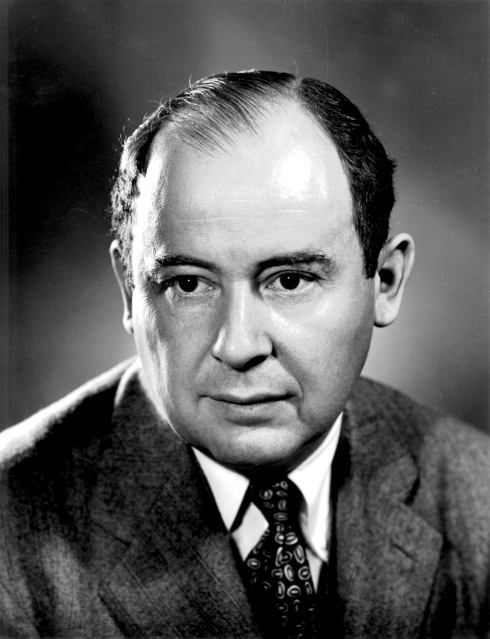
Born in Budapest
John von Neumann was born in Budapest, Hungary, into a wealthy Jewish family. He showed early mathematical talent. #history #mathematics
Born in Budapest By LANL - http://www.lanl.gov/history/atomicbomb/images/NeumannL.GIF (archive copy at the Wayback Machine), Attribution, https://commons.wikimedia.org/w/index.php?curid=3429594
1911 CE
Enters Lutheran Gymnasium
Enrolled at the prestigious Lutheran Gymnasium in Budapest, where his mathematical abilities were recognized. #education #history
1921 CE
First Mathematical Publication
Published his first paper with Michael Fekete on polynomial inequality, showcasing his early research skills. #mathematics #history
1922 CE
Wins Eötvös Prize
Won the Eötvös Prize, a national mathematics competition in Hungary. #mathematics #award
1925 CE
Diploma in Chemical Engineering
Earned a degree in chemical engineering from ETH Zurich, Switzerland. #education #engineering
1926 CE
PhD in Mathematics
Received a PhD in mathematics from the University of Budapest with a thesis on set theory. #mathematics #phd
1927 CE
Privatdozent at Berlin
Became the youngest Privatdozent at the University of Berlin, lecturing on mathematics. #academia #history
1928 CE
Minimax Theorem Published
Published the minimax theorem, a fundamental result in game theory. #mathematics #gametheory
1929 CE
Moves to Hamburg
Became a privatdozent at the University of Hamburg. #academia #history
1930 CE
Visits Princeton
Invited to lecture at Princeton University, initiating his long association with the United States. #academia #history
1931 CE
Visiting Professor at Princeton
Appointed visiting professor of mathematical physics at Princeton University. #academia #physics
1932 CE
Publishes Quantum Mechanics Book
Published 'Mathematical Foundations of Quantum Mechanics', a classic text. #physics #mathematics
1933 CE
Joins IAS
Became one of the first professors at the Institute for Advanced Study in Princeton. #academia #history
1934 CE
Full Professor at IAS
Promoted to full professor at the Institute for Advanced Study. #academia #history
1936 CE
Publishes on von Neumann Algebras
Published work on rings of operators, now known as von Neumann algebras, with F.J. Murray. #mathematics #algebra
1937 CE
US Citizenship
Became a naturalized citizen of the United States. #history #politics
1937 CE
Continuous Geometry
Developed the theory of continuous geometry, extending projective geometry. #mathematics #geometry
1938 CE
Bôcher Memorial Prize
Awarded the Bôcher Memorial Prize for his work in analysis. #mathematics #award
1939 CE
Work on Shock Waves
Began researching shock waves and hydrodynamics for military applications, leading to his involvement in the Manhattan Project. #physics #military
1940 CE
Consultant for Army
Served as a consultant to the U.S. Army Ballistics Research Laboratory. #military #history
1941 CE
Joins Manhattan Project
Began working on the implosion design for the atomic bomb as part of the Manhattan Project. #nuclear #history
Joins Manhattan Project By Unknown authorUnknown author or not provided - U.S. National Archives and Records Administration, Public domain, https://commons.wikimedia.org/w/index.php?curid=16655439
1943 CE
Moves to Los Alamos
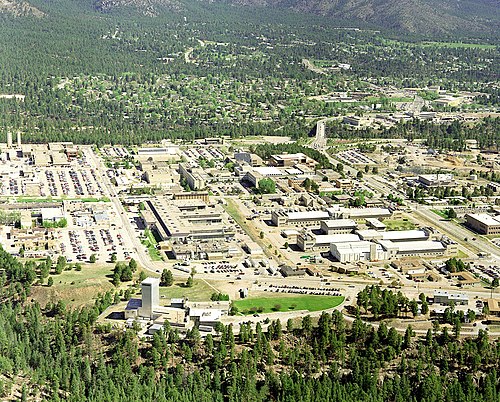
Relocated to Los Alamos, New Mexico, to work directly on the atomic bomb development. #nuclear #history
Moves to Los Alamos By Los Alamos National Laboratory - http://www.lanl.gov/worldview/news/photos/aerials.shtml, Attribution, https://commons.wikimedia.org/w/index.php?curid=134114
1944 CE
Theory of Games and Economic Behavior
Published the seminal book with Oskar Morgenstern, founding the field of game theory. #economics #mathematics #gametheory
1944 CE
Contributions to EDVAC Design
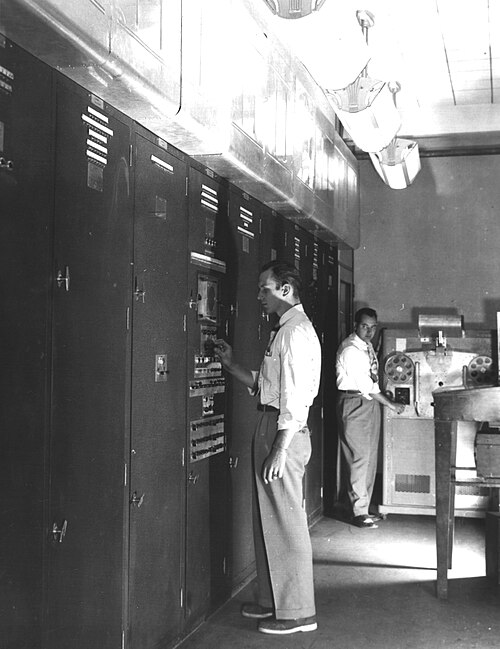
Attended the Moore School lectures and contributed to the design of the EDVAC computer, pioneering stored-program concepts. #computing #history
Contributions to EDVAC Design By Unknown author - Photo located at: http://ftp.arl.mil/ftp/historic-computers/, Public domain, https://commons.wikimedia.org/w/index.php?curid=1652631
Jun 30, 1945 CE
First Draft of the EDVAC Report
Wrote the 'First Draft of a Report on the EDVAC', outlining the stored-program architecture known as the von Neumann architecture. #computing #architecture
Jul 16, 1945 CE
Witnesses Trinity Test
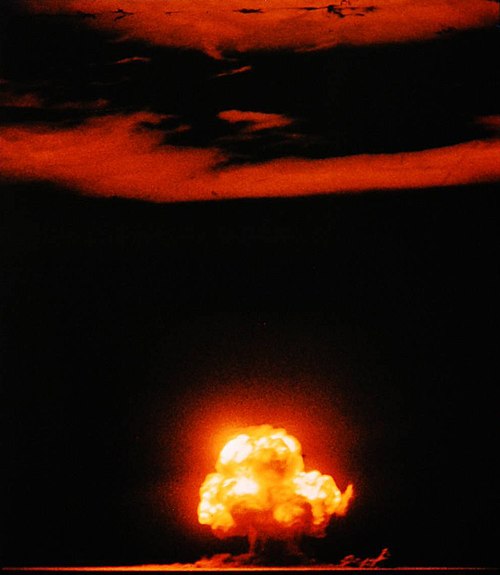
Present at the Trinity atomic bomb test in New Mexico. #nuclear #history )
Witnesses Trinity Test By Jack W. Aeby, July 16, 1945, Civilian worker at Los Alamos laboratory, working under the aegis of the Manhattan Project. - This image comes from the Google-hosted LIFE Photo Archive where it is available under the filename 96ad5a9a5c94664e. This tag does not indicate the copyright status of the attached work. A normal copyright tag is still required. See the copyright section in the template documentation for more information., Public domain, https://commons.wikimedia.org/w/index.php?curid=140895
1946 CE
Design of IAS Machine
Began design of the IAS machine, a stored-program computer that became a model for many early computers. #computing #history
Design of IAS Machine By Smithsonian Institution - https://americanhistory.si.edu/collections/search/object/nmah_334741, Public domain, https://commons.wikimedia.org/w/index.php?curid=87591067
1947 CE
Monte Carlo Method
Developed the Monte Carlo method with Stanislaw Ulam for statistical sampling in nuclear physics. #mathematics #computing
Monte Carlo Method By Titouan Christophe - Own work, CC BY-SA 3.0, https://commons.wikimedia.org/w/index.php?curid=30599003
1948 CE
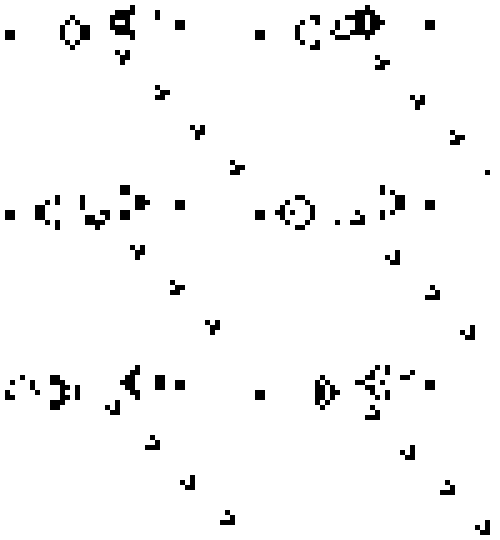
Cellular Automata Concept
Published first ideas on cellular automata and self-replicating machines, laying groundwork for artificial life. #computing #mathematics
Cellular Automata Concept By Lucas Vieira - Own work, CC BY-SA 3.0, https://commons.wikimedia.org/w/index.php?curid=101736
Weather Modeling By NOAA - http://celebrating200years.noaa.gov/breakthroughs/climate_model/AtmosphericModelSchematic.png, Public domain, https://commons.wikimedia.org/w/index.php?curid=7263986
1950 CE
IAS Machine Operational
The IAS machine became operational, serving as a prototype for many commercial computers. #computing #history
1951 CE
The Computer and the Brain
Delivered lectures on the comparison between computers and the human brain, later published as a book. #computing #neuroscience
1952 CE
Hydrogen Bomb Work
Contributed to the design of the hydrogen bomb, using his hydrodynamics expertise. #nuclear #history
1953 CE
Linear Programming Advances
Continued work on linear programming and applications of game theory to economics. #mathematics #economics
Linear Programming Advances By Ylloh - Own work, CC0, https://commons.wikimedia.org/w/index.php?curid=19413134
1954 CE
Appointed to AEC
Appointed to the United States Atomic Energy Commission, influencing nuclear policy. #nuclear #government )
1955 CE
Diagnosed with Cancer
Diagnosed with bone cancer, possibly related to radiation exposure. #health #history
1956 CE
Enrico Fermi Award
Received the Enrico Fermi Award for his contributions to nuclear energy and computing. #award #nuclear
Enrico Fermi Award By ENERGY.GOV - KSA1952, Public domain, https://commons.wikimedia.org/w/index.php?curid=133922402
Feb 8, 1957 CE
Death in Washington, D.C.
John von Neumann died at age 53. His work profoundly impacted computing, game theory, and mathematics. #history #obituary
1957 CE
Posthumous Publications
Numerous posthumous papers and collections were published, cementing his legacy as a polymath. #mathematics #computing