John Harrison: Marine Chronometer & Solving the Longitude Problem
Encyclopedia/8. Knowledge of Space & Time/2. Time, Calendars & Measurement/02. Horological & Timekeeping Biographies • Curated by Admin Timeline.sg
Timeline of English carpenter and clockmaker John Harrison, who invented the marine chronometer to solve the longitude problem, from his birth in 1693 to his death in 1776.
Chronological Storyline (45 Milestones)
Mar 24, 1693 CE
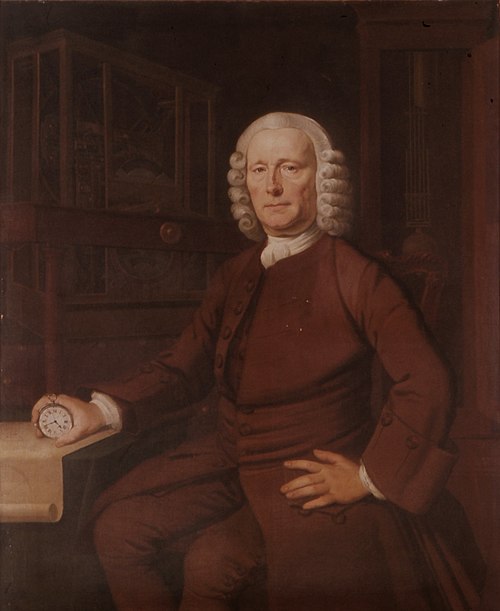
John Harrison Born in Foulby
John Harrison is born in Foulby, West Yorkshire, England, the eldest of five children. His father, Henry Harrison, works as a carpenter. #history #invention
John Harrison Born in Foulby By Thomas King († circa 1796date QS:P,+1796-00-00T00:00:00Z/9,P1480,Q5727902) - http://www.worldtempus.ch/images/john_harrison.jpg, Public domain, https://commons.wikimedia.org/w/index.php?curid=13286643
1700 CE
Family Moves to Barrow upon Humber
Harrison's family moves to Barrow upon Humber, Lincolnshire, where he grows up and learns carpentry and clockmaking from his father. #history
1713 CE
Builds First Longcase Clock
At age 20, Harrison builds his first longcase clock entirely from wood, demonstrating his innovative use of materials and design. #clockmaking #horology
1715 CE
Second Wooden Longcase Clock
Harrison completes another wooden longcase clock, now in the Science Museum, London. It features a unique grasshopper escapement. #horology #innovation
1717 CE
Marries Elizabeth Barret
Harrison marries Elizabeth Barret; they have one son, John Harrison Jr., who later becomes an assistant. #personal
1718 CE
Grasshopper Escapement Invented
Harrison invents the grasshopper escapement, a low-friction mechanism that would be crucial for his future chronometers. #invention #horology
1725 CE
Builds Precision Turret Clock
Harrison builds a precision turret clock for Brocklesby Park, regulating it with a grasshopper escapement and a gridiron pendulum. #clockmaking
1728 CE
Gridiron Pendulum Invented
Harrison develops the gridiron pendulum, using alternating brass and steel rods to compensate for temperature expansion. #invention #physics
1730 CE
Travels to London Seeking Support
Harrison travels to London to present his ideas for a marine timekeeper to the Board of Longitude, gaining initial support. #longitude #history
Travels to London Seeking Support By Racklever at English Wikipedia - Originally from en.wikipedia; description page is/was here. Original uploader was Racklever at en.wikipedia, CC BY 2.5, https://commons.wikimedia.org/w/index.php?curid=3105679
1735 CE
Completes H1 Marine Chronometer
Harrison finishes H1, his first marine timekeeper, a large and heavy device with springs and balances but no pendulum. #chronometer #invention
1736 CE
Test of H1 on HMS Centurion
H1 is tested on a voyage to Lisbon and back on HMS Centurion and HMS Orford. The clock performs well, allowing Harrison to apply for further funding. #navigation #history
1737 CE
Board of Longitude Grants Funding for H2
After the successful test, the Board of Longitude grants Harrison £500 to build a second, improved timekeeper, H2. #longitude #innovation
1739 CE
Completes H2 Chronometer
Harrison completes H2, which incorporates a more advanced design with a remontoire and a pair of balances to counter ship motion. #chronometer
1740 CE
Begins Work on H3
Harrison starts building H3, intended to be his most accurate timekeeper. It takes 19 years to complete and includes a bimetallic compensation curb. #invention
1741 CE
Harrison's Wife Elizabeth Dies
Elizabeth Barret dies; Harrison remarries later in life. #personal
1749 CE
Receives Copley Medal from Royal Society
The Royal Society awards Harrison the Copley Medal for his contribution to horology, especially the gridiron pendulum and temperature compensation. #award #science
Receives Copley Medal from Royal Society By Teresa Stokes - Sir George Gabriel Stokes, Copley gold medal, CC BY-SA 2.0, https://commons.wikimedia.org/w/index.php?curid=118624561
1753 CE
Completes H3 Chronometer
After years of labor, Harrison finishes H3, a massive and complex timekeeper weighing 75 pounds. It introduces the bimetallic strip and caged anti-friction bearings. #chronometer #innovation
1755 CE
Begins Work on H4 Pocket Watch
Harrison, realizing the shortcomings of large clocks, starts designing a much smaller precision watch, H4, intended as the ultimate solution. #horology
1759 CE
Completes H4 Breakthrough Chronometer
Harrison completes H4, a large pocket watch of unprecedented accuracy. It uses a high-frequency balance and a remontoire, and later proves successful at sea. #breakthrough #navigation
Nov 18, 1761 CE
First Sea Trial of H4 to Jamaica
H4 is tested on a voyage from Portsmouth to Jamaica aboard HMS Deptford. Harrison's son William accompanies the watch. #trial #navigation
Jan 19, 1762 CE
H4 Arrives in Jamaica with Small Error
After 81 days at sea, H4 is only 5 seconds slow, equivalent to a longitude error of 1.25 minutes, well within the prize requirements. #success
1762 CE
Board of Longitude Questions Results
The Board of Longitude, skeptical of Harrison's method, demands a second test and refuses to award the full prize immediately. #controversy
Mar 28, 1764 CE
Second Sea Trial of H4 to Barbados
H4 undergoes a second trial on a voyage to Barbados. William Harrison again accompanies the watch. #trial
Jun 14, 1764 CE
H4 Passes Barbados Test with Exceptional Accuracy
H4 is found to be only 39.2 seconds off after 47 days, corresponding to a longitude error of less than 10 miles. #success #navigation
1765 CE
Board of Longitude Awards Partial Prize
The Board of Longitude awards Harrison £10,000 (half the grand prize) but demands he fully reveal the design of H4 and hand over his timekeepers. #prize
1765 CE
Harrison Submits Detailed Drawings of H4
Harrison provides complete descriptions and drawings of H4 to the Board, which then has copies made by watchmakers. #documentation
1766 CE
Larcum Kendall's Copy K1 Completed
Watchmaker Larcum Kendall creates a faithful copy of H4, designated K1, with Harrison's approval. This chronometer later accompanies Captain Cook. #horology
1767 CE
Harrison Requests Remaining Prize Money
Harrison petitions the Board for the remaining £10,000, but they refuse, demanding further tests and that he build replicas. #dispute
1768 CE
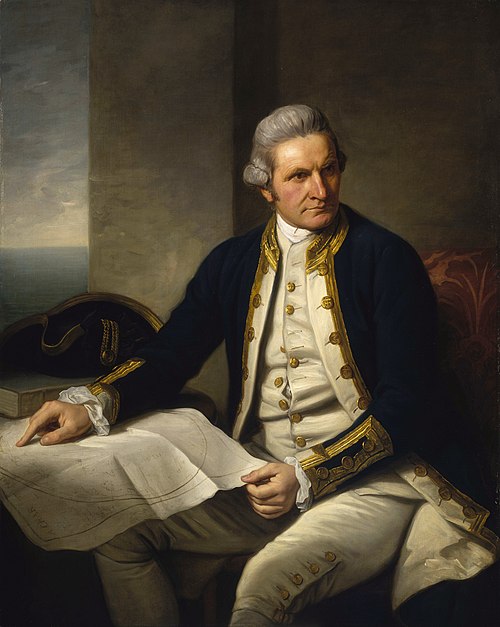
Captain Cook's First Voyage with K1
Captain James Cook takes Kendall's K1 on his first voyage to the Pacific. The chronometer proves invaluable for mapping. #exploration #navigation
Captain Cook's First Voyage with K1 By Nathaniel Dance-Holland - from the National Maritime Museum, United Kingdom, Public domain, https://commons.wikimedia.org/w/index.php?curid=18059
1769 CE
King George III Intervenes
Harrison appeals to King George III, who tests H5 (a precision watch) at his private observatory and supports Harrison's case. #royalty #history
1772 CE
Harrison Builds H5
Harrison constructs H5, an even more refined watch, to demonstrate his capability and to show the board that his methods are reliable. #invention
1773 CE
Act of Parliament Grants Final Prize
Parliament passes a special act awarding Harrison a final payment of £8,750, bringing his total compensation to £23,065. #victory
1774 CE
Publishes 'The Principles of Mr. Harrison's Time-Keeper'
Harrison publishes a detailed account of his timekeeper's principles and construction, solidifying his legacy. #publication
1775 CE
Health Declines
John Harrison's health deteriorates in his final years; he continues to work on clocks. #life
Mar 24, 1776 CE
John Harrison Dies in London
John Harrison dies in London at age 83. He is buried in St. John's Church, Hampstead, and his contributions to navigation are widely recognized posthumously. #legacy #history
1777 CE
Harrison's Son William Continues Advocacy
After John's death, his son William continues to promote his father's work and eventually donates the timekeepers to the nation. #legacy
1783 CE
H1, H2, H3, and H4 Placed in Royal Observatory
Harrison's original marine timekeepers H1 through H4 are deposited at the Royal Observatory, Greenwich, now part of the National Maritime Museum. #preservation
1792 CE
Kendall's K1 Returns with Cook's Third Voyage
K1 survives Cook's third voyage and is returned, proving the reliability of Harrison's design. #exploration
1805 CE
Harrison's Techniques Become Standard
By the early 19th century, Harrison's design principles are adopted by makers like Thomas Earnshaw and John Arnold, revolutionizing navigation. #legacy #navigation
1815 CE
Board of Longitude Dissolved
The Board of Longitude is dissolved, having fulfilled its purpose; Harrison's chronometer is credited with solving the longitude problem. #history
1880 CE
Harrison's Tomb Restored
The Clockmakers' Company restores Harrison's tomb in St. John's, Hampstead, marking renewed recognition of his contribution. #commemoration
1920 CE
Harrison's Timekeepers Transferred to National Maritime Museum
The original Harrison timekeepers are moved to the National Maritime Museum in Greenwich, where they remain on display. #preservation
1995 CE
Dava Sobel's 'Longitude' Publishes
Dava Sobel's book 'Longitude' brings Harrison's story to a wide audience, sparking renewed interest in his life and work. #literature #history )
2000 CE
John Harrison Statue Unveiled in Barrow upon Humber
A bronze statue of John Harrison is unveiled in his childhood village to honor his achievements. #commemoration
2013 CE
Harrison's H1 on Display at Science Museum
The Science Museum in London features H1 in a major exhibition, highlighting its significance. #exhibition