Johannes Gutenberg: Movable Type Printing Press & 42-Line Bible
Encyclopedia/5. Human Thought & Philosophy/1. Philosophy, Religion & Ethics/01. Eastern Philosophy & Religious Thought • Curated by Admin Timeline.sg
Biographical timeline of Johannes Gutenberg, inventor of the movable type printing press in Europe, highlighting his life, experiments, partnership with Johann Fust, printing of the 42-line Bible, and the spread of printing.
Chronological Storyline (40 Milestones)
1400 CE
Johannes Gutenberg Born in Mainz
Johannes Gensfleisch zur Laden zum Gutenberg is born in Mainz, Germany, into a patrician family. Exact date unknown, estimated around 1400. #history #inventor
Johannes Gutenberg Born in Mainz By Kenneth C. Zirkel - Own work, CC BY-SA 4.0, https://commons.wikimedia.org/w/index.php?curid=163942915
1410 CE
Gutenberg Family Life in Mainz
Gutenberg grows up in Mainz, likely receiving a basic education and learning the goldsmith trade from his father. #history #biography
1418 CE
First Historical Mention of Gutenberg
Gutenberg is first mentioned in a document from Mainz, but details of his early life remain scarce. #history
1428 CE
Gutenberg Exiled from Mainz
Due to a conflict between patrician families and guilds, Gutenberg leaves Mainz and moves to Strasbourg, where he spends many years. #history #exile
1434 CE
Gutenberg in Strasbourg
Gutenberg is documented in Strasbourg, living there and engaging in various business ventures, including gem polishing and metalworking. #history
1436 CE
Partnership for Pilgrim Mirrors
Gutenberg partners with Hans Dunne, Andreas Dritzehn, and Andreas Heilmann to produce mirrors for pilgrims. This venture funds his early printing experiments. #history #business
1437 CE
Secret Arts Taught to Andreas Dritzehn
Gutenberg begins teaching Andreas Dritzehn his 'secret arts' related to printing, marking the start of his movable type experiments. #printing #history
1438 CE
Development of Movable Type Begins
Gutenberg, with partners, works on developing movable type using lead-tin alloy and oil-based ink. This year marks significant progress. #invention #printing
1439 CE
Death of Andreas Dritzehn and Lawsuit
Andreas Dritzehn dies, leading to a lawsuit from his brothers claiming Gutenberg owed them money. Gutenberg keeps his printing methods secret during the trial. #lawsuit #history
1440 CE
Gutenberg Perfects Movable Type
Around this year, Gutenberg achieves a workable system of movable type printing, including the hand mould and adjustable type. Often considered the invention date. #invention #printing
1444 CE
Return to Mainz
Gutenberg returns to Mainz after spending about 15 years in Strasbourg. He continues refining his printing press. #history #biography
1448 CE
Loan from Johann Fust
Gutenberg borrows 800 guilders from wealthy financier Johann Fust to fund his printing enterprise. This partnership is crucial. #finance #printing
1450 CE
Partnership with Johann Fust Formalized
Fust lends another 800 guilders, and the two formally become partners. Gutenberg sets up a printing workshop in Mainz. #history #partnership
1451 CE
Printing of Indulgence Letters
Gutenberg’s shop prints the earliest known large-scale printed documents: 30-line Indulgence letters for the Church. #printing #history
1452 CE
Start of the Gutenberg Bible
Gutenberg begins printing the 42-line Bible, his magnum opus. The project takes about three years to complete. #bible #printing
Start of the Gutenberg Bible By NYC Wanderer (Kevin Eng) - originally posted to Flickr as Gutenberg Bible, CC BY-SA 2.0, https://commons.wikimedia.org/w/index.php?curid=9914015
1453 CE
Continuation of Bible Printing
Work continues on the Bible. Gutenberg uses approximately 290 different type pieces and sophisticated layout. #art #history
Oct 1, 1454 CE
Bible Displayed at Frankfurt Book Fair
Gutenberg likely presents the first printed Bibles at the Frankfurt Book Fair in October, attracting attention. #bookfair #history
1454 CE
Completion of the 42-Line Bible
The Gutenberg Bible (42-line Bible) is completed by early 1455. About 180 copies are printed, some on vellum. #milestone #printing
Nov 6, 1455 CE
Fust Lawsuit Against Gutenberg
Johann Fust sues Gutenberg for repayment of loans plus interest. The court rules in Fust's favor, giving him control of the printing shop. #lawsuit #history
Fust Lawsuit Against Gutenberg By Unknown author - http://home.pages.at/druckmuseum/gutenberg.htm, Public domain, https://commons.wikimedia.org/w/index.php?curid=3693424
Nov 1, 1455 CE
Gutenberg Loses Printing Equipment
After the lawsuit, Fust takes possession of Gutenberg's printing equipment and type, including the Bible. Gutenberg effectively loses his shop. #business #setback
1455 CE
Peter Schöffer Joins Fust
Peter Schöffer, Gutenberg's former employee, becomes Fust's partner and continues printing. Schöffer improves the press and types. #printing #partnership
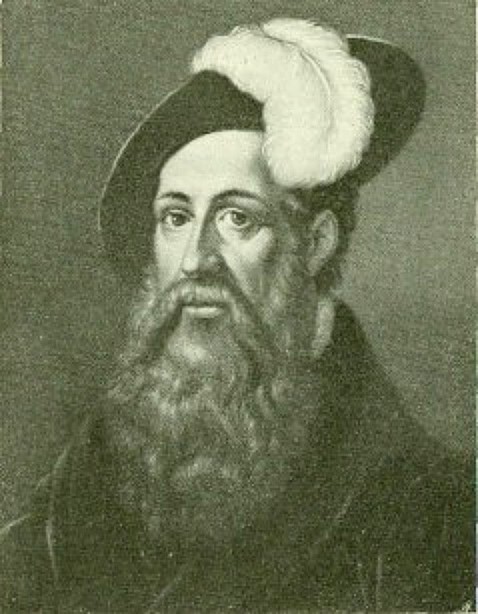
Peter Schöffer Joins Fust By unbekannter Künstler - Transferred from de.wikipedia to Commons., Public domain, https://commons.wikimedia.org/w/index.php?curid=2589048
1456 CE
First Printed Bibles Sold
The Gutenberg Bible is now sold across Germany and Europe. Its quality impresses buyers. #books #history
Aug 14, 1457 CE
Psalter Printed by Fust and Schöffer
Johann Fust and Peter Schöffer print the Mainz Psalter, the first book with a printed date and printer’s mark. #printing #milestone )
Psalter Printed by Fust and Schöffer By Jürgen Howaldt - Self-photographed, CC BY-SA 2.0 de, https://commons.wikimedia.org/w/index.php?curid=3822445
1457 CE
Gutenberg's New Printing Shop
With help from Conrad Humery, Gutenberg sets up a new printing shop in Mainz and continues printing, possibly starting work on the Catholicon. #comeback #printing
1458 CE
Gutenberg's Catholicon Begins
Gutenberg starts printing the Catholicon, a large Latin dictionary/encyclopedia by Johannes Balbus. He uses a smaller typeface. #literature #printing )
1459 CE
Gutenberg Prints an Astronomical Calendar
Gutenberg's shop produces an astronomical calendar for 1459, demonstrating the utility of printing for scientific texts. #science #printing
1460 CE
Completion of the Catholicon
Gutenberg completes printing the Catholicon, a 748-page folio. This is his last major project. #encyclopedia #history )
1461 CE
Printing Businesses Spread from Mainz
After the sack of Mainz in 1462, many printers flee and spread the technology to other cities like Bamberg, Strasbourg, and Cologne. #spread #technology
Printing Businesses Spread from Mainz By vlasta2 - Flickr: PrintMus 038, CC BY 2.0, https://commons.wikimedia.org/w/index.php?curid=16412858
Oct 28, 1462 CE
Sack of Mainz
Archbishop Adolf von Nassau captures Mainz, leading to the dispersion of printers and the rapid spread of printing across Europe. #history #war
Sack of Mainz By salomon10 from Germany - Mainzer Dom Blaue Stunde, CC BY 2.0, https://commons.wikimedia.org/w/index.php?curid=141845502
1462 CE
Gutenberg's Status Diminishes
After the sack, Gutenberg's influence wanes. He continues working but is not as prominent. #history #biography
1463 CE
Gutenberg Receives Support from Archbishop
Archbishop Adolf von Nassau grants Gutenberg an annuity of 20 guilder and appoints him as a courtier, acknowledging his contributions. #recognition #support
1464 CE
Gutenberg's Later Years
Gutenberg lives in relative comfort thanks to the annuity, but is no longer actively printing. He may have been blind or ill. #oldage #biography
1465 CE
Gutenberg Honored as Hofmann
Archbishop Adolf officially names Gutenberg a Hofmann (courtier) and provides a stipend of 20 gulden and provisions. #honor #history
1466 CE
Gutenberg's Health Declines
Gutenberg is reported to have poor health and possible blindness. He remains in Mainz. #health #biography
1467 CE
Last Known Document Mentioning Gutenberg
A document from this year refers to Gutenberg, showing he is still alive but retired from printing. #history #biography
Feb 3, 1468 CE
Johannes Gutenberg Dies
Johannes Gutenberg dies in Mainz at around 68 years of age. He is buried in the Franciscan church, though the exact location is unknown. #death #history
1468 CE
Gutenberg's Legacy Begins
Though unrecognized in his lifetime, Gutenberg's invention revolutionizes communication. By 1468, printing presses exist in many European cities. #legacy #printing
1469 CE
Printing Spreads to Venice
Johann and Wendelin of Speyer set up a press in Venice, which becomes a major printing center. #spread #history
1470 CE
First Printers Begin in Paris
Printing reaches Paris, and the technology spreads across France. #spread #history
1471 CE
William Caxton Learns Printing in Cologne
William Caxton, the first English printer, learns the craft in Cologne and later brings it to England. #spread #history
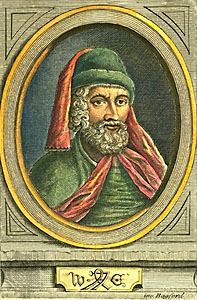
William Caxton Learns Printing in Cologne By Unknown author - The Granger Collection, New York, Public domain, https://commons.wikimedia.org/w/index.php?curid=2446080