Islamic Golden Age: House of Wisdom, Translation & Scientific Flourishing
Encyclopedia/3. History, Societies & Civilizations/03. Middle Eastern & Islamic Civilizations/02. Islamic Golden Age • Curated by Admin Timeline.sg
The Islamic Golden Age (8th–13th centuries) witnessed an unprecedented flourishing of science, philosophy, and culture across the Islamic world, centered in Baghdad's House of Wisdom, Cordoba, and Cairo. Key figures like Al-Khwarizmi, Al-Razi, Ibn al-Haytham, and Al-Biruni made foundational contributions to algebra, medicine, optics, and Indology, while the translation movement preserved and expanded upon Greek, Persian, and Indian knowledge.
Chronological Storyline (47 Milestones)
750 CE
Abbasid Caliphate Established
The Abbasid Caliphate overthrows the Umayyads, moving the capital to Baghdad. This shift ushers in a new era of intellectual patronage and cultural exchange. #history #islamicgoldenage
Abbasid Caliphate Established By Ec.Domnowall - Own work, Public domain, https://commons.wikimedia.org/w/index.php?curid=33988856
754 CE
Caliph Al-Mansur Founds Baghdad
Caliph Al-Mansur establishes the Round City of Baghdad, which becomes the epicenter of the Islamic Golden Age. The city's design reflects advanced urban planning and astronomical knowledge. #history #architecture
Caliph Al-Mansur Founds Baghdad By 1598 author - This image has been extracted from another file, Public domain, https://commons.wikimedia.org/w/index.php?curid=144863744
762 CE
Construction of Baghdad Begins
The official founding of Baghdad as the new Abbasid capital. The city quickly grows into a global hub for trade, scholarship, and culture. #history #urbanism
Construction of Baghdad Begins By USACE HQ , JIM GORDAN, CIV, USACE - https://www.flickr.com/photos/60095477@N08/5628442718/, Public domain, https://commons.wikimedia.org/w/index.php?curid=15654541
765 CE
Jabir ibn Hayyan Develops Alchemy
Jabir ibn Hayyan (Geber) pioneers experimental chemistry, introducing techniques like distillation, crystallization, and the alembic still. His works influence both Islamic and European science. #science #chemistry
Jabir ibn Hayyan Develops Alchemy By Unknown author - https://cdn.britannica.com/10/132710-050-CECF006B/illustration-manuscript-Abu-Musa-Jabir-ibn-Hayyan.jpg, Public domain, https://commons.wikimedia.org/w/index.php?curid=166835469
771 CE
Indian Numerals Reach Baghdad
An Indian scholar visits the Abbasid court, bringing the Sanskrit text 'Brahmasphutasiddhanta' containing the decimal numeral system. This knowledge is later translated and adapted by Al-Khwarizmi. #mathematics #history
786 CE
Harun al-Rashid Becomes Caliph
Caliph Harun al-Rashid's reign marks the peak of Abbasid power and cultural flourishing. He patronizes the arts and sciences, and his court becomes legendary. #history #islamicgoldenage
Harun al-Rashid Becomes Caliph By Unknown author - Scanned from a book first published in Egypt in 1951, entitled Harun Al-Rashid. Check OCLC, Public domain, https://commons.wikimedia.org/w/index.php?curid=122680832
800 CE
House of Wisdom Established
The Bayt al-Hikma (House of Wisdom) is founded in Baghdad as a library, translation center, and academy. It becomes the intellectual heart of the Islamic world, attracting scholars from diverse backgrounds. #education #history
House of Wisdom Established By Zereshk - Own work, Public domain, https://commons.wikimedia.org/w/index.php?curid=2809505
810 CE
Al-Khwarizmi's Algebra Treatise
Muhammad ibn Musa al-Khwarizmi writes 'The Compendious Book on Calculation by Completion and Balancing' (Al-Kitab al-Mukhtasar fi Hisab al-Jabr wal-Muqabala), introducing systematic algebraic methods. The word 'algebra' derives from 'al-jabr'. #mathematics #science
Al-Khwarizmi's Algebra Treatise By Zarateman - Own work, CC0, https://commons.wikimedia.org/w/index.php?curid=162213187
813 CE
Caliph Al-Ma'mun's Translation Movement
Caliph Al-Ma'mun expands the House of Wisdom and sponsors large-scale translations of Greek, Persian, and Indian works into Arabic. This movement preserves and advances global knowledge. #history #translation
Caliph Al-Ma'mun's Translation Movement By Classical Numismatic Group; [1] - https://www.cngcoins.com/Coin.aspx?CoinID=201200, CC BY-SA 3.0, https://commons.wikimedia.org/w/index.php?curid=33419858
820 CE
Al-Khwarizmi's Astronomical Tables
Al-Khwarizmi compiles the 'Zij al-Sindhind', astronomical tables based on Indian and Greek sources. These tables influence later Islamic and European astronomy. #astronomy #science
825 CE
Banu Musa Brothers' Mechanics
The Banu Musa brothers publish 'The Book of Ingenious Devices', describing over 100 mechanical inventions including automatic machines and trick devices. Their work advances engineering and automation. #engineering #invention
Banu Musa Brothers' Mechanics By Unknown author - Book of of Ahmad ibn Musa ibn Shakir, Public domain, https://commons.wikimedia.org/w/index.php?curid=14730630
830 CE
Al-Kindi's Philosophical Works
Al-Kindi (Alkindus), the 'Philosopher of the Arabs', writes extensively on philosophy, mathematics, and optics. He integrates Greek thought with Islamic theology, influencing later scholars. #philosophy #science
Al-Kindi's Philosophical Works By Iraqi Post - Personal collection, Public domain, https://commons.wikimedia.org/w/index.php?curid=91832934
840 CE
Al-Khwarizmi's Geography
Al-Khwarizmi revises Ptolemy's 'Geography', correcting coordinates and adding new regions. His work improves cartography and geographic knowledge in the Islamic world. #geography #science )
Al-Khwarizmi's Geography By Ptolemy - This file has been provided by the British Library from its digital collections. Links to the British Library's website may be broken as the library recovers from a October 2023 cyber attack, and will be updated once material becomes accessible online. For more information on the attack see: https://www.bl.uk/about/cyber-attack A full catalogue record for the item shown is available on the British Library website., Public domain, https://commons.wikimedia.org/w/index.php?curid=170931006
850 CE
Al-Farghani's Astronomy Compendium
Al-Farghani (Alfraganus) writes 'Elements of Astronomy', a concise summary of Ptolemaic astronomy. This work becomes a standard textbook in both Islamic and European universities. #astronomy #education
Al-Farghani's Astronomy Compendium By Roland Unger - Own work, CC BY-SA 3.0, https://commons.wikimedia.org/w/index.php?curid=22677452
855 CE
Ahmad ibn Tulun Builds Mosque
The Ibn Tulun Mosque in Cairo is completed, showcasing innovative architecture and engineering. It remains one of the oldest and best-preserved mosques in Egypt. #architecture #history
Ahmad ibn Tulun Builds Mosque By User:Berthold Werner - Own work, CC BY 3.0, https://commons.wikimedia.org/w/index.php?curid=12110936
859 CE
University of al-Qarawiyyin Founded
Fatima al-Fihri founds the al-Qarawiyyin Mosque and University in Fez, Morocco. It is recognized as the oldest existing, continually operating educational institution in the world. #education #history
University of al-Qarawiyyin Founded By Abdel Hassouni - Own work, CC BY-SA 4.0, https://commons.wikimedia.org/w/index.php?curid=61468974
864 CE
Al-Razi's Medical Encyclopedia
Abu Bakr al-Razi (Rhazes) writes 'Al-Hawi' (The Comprehensive Book on Medicine), a vast medical encyclopedia that synthesizes Greek, Indian, and Islamic knowledge. It influences European medicine for centuries. #medicine #science
Al-Razi's Medical Encyclopedia By Unknown 10th century scribe - National Library of Medicine, United States: https://www.nlm.nih.gov/hmd/arabic/images/a17231b.jpg, Public domain, https://commons.wikimedia.org/w/index.php?curid=79102237
870 CE
Al-Battani's Astronomical Observations
Al-Battani (Albategnius) makes precise astronomical observations, correcting Ptolemy's calculations and discovering the movement of the solar apogee. His work is used by Copernicus and Kepler. #astronomy #science
Al-Battani's Astronomical Observations By unknown, copied from a work by Al-Battani - https://gallica.bnf.fr/ark:/12148/btv1b52505729k/f161.item.zoom# - a Latin translation of al-Battani's work Kitāb az-Zīj aṣ-Ṣābi’, CC BY-SA 4.0, https://commons.wikimedia.org/w/index.php?curid=128222946
873 CE
Al-Kindi's Cryptography
Al-Kindi writes 'A Manuscript on Deciphering Cryptographic Messages', introducing frequency analysis and early cryptanalysis. This is considered the first known work on cryptography. #cryptography #science
900 CE
Al-Razi's Smallpox and Measles
Al-Razi publishes 'The Book of Smallpox and Measles', providing the first accurate clinical descriptions of these diseases. He distinguishes between them and suggests treatments. #medicine #science
Al-Razi's Smallpox and Measles By Hossein Behzad - http://sadmu.ir/detail/5999, Public domain, https://commons.wikimedia.org/w/index.php?curid=161546923
910 CE
Al-Farabi's Political Philosophy
Al-Farabi (Alpharabius) writes 'The Virtuous City', a work on political philosophy that blends Plato's ideas with Islamic thought. He is known as the 'Second Teacher' after Aristotle. #philosophy #politics
Al-Farabi's Political Philosophy By Mr.Nostalgic - File:Al-Farabi_Alpharabius_philosophus_(titel_op_object)_Liber_Chronicarum_(serietitel),_RP-P-2016-49-86-16.jpg, Public domain, https://commons.wikimedia.org/w/index.php?curid=128430609
929 CE
Cordoba Caliphate Declared
Abd al-Rahman III declares the Caliphate of Cordoba, making al-Andalus a major cultural and scientific center. Cordoba becomes a rival to Baghdad in learning and sophistication. #history #andalusia
Cordoba Caliphate Declared By DaniCBP - Own work, based on: Abū ʿUbayd al-Bakrī, VIDAL BELTRÁN, Eliseo (1984). Geografía de España (Kitab al-Masalik wa-l-Malik). Colección Textos Medievales, Anubar Ediciones, ISBN 84-7013-188-5. Acién Almansa, M., & Manzano Moreno, E. (2012). Organización social y administración política en Al-Ándalus bajo el emirato. Territorio, Sociedad Y Poder. Recuperado a partir de https://reunido.uniovi.es/index.php/TSP/article/view/9494 Alfonso Carmona González (1987). Noticias geográficas arabes referentes a la" Bilád Tudmir". Murgetana, Número 72, Páginas 115-122. Barroca, M. J. (2018). Fortificações e povoamento no Norte de Portugal (séc. IX a XI). PORTVGALIA: Revista De Arqueologia Do Departamento De Ciências E Técnicas Do Património Da Faculdade De Letras Da Universidade Do Porto, 25, 181–204. Obtido de https://ojs.letras.up.pt/index.php/Port/article/view/4219 Bermejo Crespo, José Luis; Muñoz López-Astilleros, Kenia (1996). La producción cerámica en el entorno del Henares durante los siglos IX y X. V Encuentro de Historiadores del Valle del Henares: Guadalajara 21-24 noviembre de 1996, 1996, ISBN 84-87743-77-3, págs. 79-86 Boloix Gallardo, Bárbara (2001). «La Taifa de Toledo en el siglo XI. Aproximación a sus límites y extensión territorial». Tulaytula 8: 23-57. ISSN 1575-653X. Bramon, D. (2006). De Hispania a Alandalús y al esplendor del califato. Aula-Historia Social, 17, 6–30. http://www.jstor.org/stable/40343205 Cabrera, R. B. (2019). De la provincia Celtiberia a la qūrā de Santabariyya: Arqueología de la Antigüedad tardía en la provincia de Cuenca (siglos V-VIII d.C.). Archaeopress. https://doi.org/10.2307/j.ctvndv5h5 Cañada Juste (1999), “El nombre de Cella. Su posible origen y el Reino de as-Sahla”, en Xiloca. Revista del Centro de Estudios del Jiloca, 23 (1999), págs. 61-74. Cañada Juste A. (1993). Nuevas propuestas para la identificación de topónimos e itinerarios en las campañas de Almanzor. Anaquel de Estudios Árabes, 4, 25. https://revistas.ucm.es/index.php/ANQE/article/view/ANQE9393110025A Cañada Juste, Alberto: “Los Banū Qāsī (714-924)”, Príncipe de Viana, 41 (1980), pp. 5-95. Carmona Gonzalez, Alfonso (1987, Noticias geográficas arabes referentes a la "Bilád Tudmir", Murgetana, ISSN 0213-0939, Nº. 72, 1987, págs. 115-122 Carriedo Tejero, Manuel (2009). ¿Sampiro Toresano? Revista de Folklore. Núm. 338, 2009, p.39-45, https://www.cervantesvirtual.com/nd/ark:/59851/bmc9p4v4 Clara Elena Prieto Entrialgo (2011), Sobre el concepto de Galicia y los gallegos en los autores árabes medievales, Árabes in patria Asturiensium, ISBN 978-84-615-2630-7, págs. 255-271 Congreso de Historia de Carmona (1997). Edad Media : Actas del I Congreso de Historia de Carmona. Archivo hispalense ; 1997, No.243-244-245. ISBN : 8477981515 Corral Lafuente, José Luis (1987). El Sistema Urbano en la Marca Superior de al-Ándalus, Turiaso, ISSN 0211-7207, Nº 7, 1987 (Ejemplar dedicado a: El Islam en Aragón), págs. 23-64. De Epalza, Mikel (1987). El Islam Aragonés, un Islam de Frontera. Domínguez de la Concha, Alfonso (2018), Nuevas perspectivas en la organización del territorio en el noreste extremeño en época islámica, Norba vol. 31 (2018) p. 69-95. Universidad de Extremadura, Servicio de Publicaciones. Domínguez de la Concha, Alfonso (2019). Nuevas perspectivas en la organización del territorio en el noreste extremeño en época islámica. Norba Historia Nº 31 (2018) http://hdl.handle.net/10662/9761 Ferreira, M. d. S. d. C. P. (2004). O Douro no Garb Al-Ândalus: A Região de Lamego durante a presença árabe. Repositórios Científicos de Acesso Aberto de Portugal (RCAAP), http://hdl.handle.net/1822/3001 Franco Moreno, Bruno (2015), La Lusitania tras la presencia islámica (713-756 d.C./94-138 H), Frontera inferior de al-Andalus, vol. 2, https://dialnet.unirioja.es/servlet/libro?codigo=583470 FRANCO SÁNCHEZ, Francisco (2006). “Sagunto/Murbīṭar en el período islámico: su historia a través de los textos”. En: De Murbiter a Morvedre. Valencia : Bancaja, 2006. ISBN 84-8471-106-4, pp. 45-65 Franco, B. (2004). Territorio y poblamiento en la kura de Marida durante el emirato omeya (siglos VIII-X/II-IV), Espacio, Tiempo y Forma, Serie III, H.ª Medieval, T. 17, 2004, p. 167-184. Franco-Sánchez, Francisco & Josep A. Gisbert Santonja, editores (2019). Dénia. Poder y el mar en el siglo XI: El reino taifa de los Banū Muŷāhid. Alicante/Dénia/Madrid/El Cairo: Universidad de Alicante (Servicio de Publicaciones)/Ajuntament de Dénia (Cultura)/Instituto Egipcio de Estudios Islámicos en Madrid, 2019. ISBN: 978-84-1302-013-6 y 978-84-948116-4-7 García San Juan, Alejandro (2009), La caracterización geográfica del Garb al-Andalus en las fuentes árabes medievales, Medievalista [Em linha]. Nº6, (Julho 2009). Direc. José Mattoso. Lisboa: IEM. ISSN: 1646-740X. García-Contreras Ruiz, Guillermo (2012). Cerámica, territorio y explotación de la sal en el valle del Salado (Guadalajara) en época andalusí. Universidad de Granada, https://dx.doi.org/10.30827/Digibug.20649 Gonzalo Arango, X. (2013). La integración de Tarrakuna y su territorio en al-Andalus (s. VIII). Arqueología Y Territorio Medieval, 20, 11-30. https://doi.org/10.17561/aytm.v20i0.1444 Guzmán, R. M. (2004). Las fuentes árabes para la reconstrucción de la historia social de la España musulmana. Estudio y clasificación. Estudios de Asia y Africa, 39(3 (125)), 513–572. http://www.jstor.org/stable/40313560 Herrera Casado, Antonio (1985). La Marca Media de Al-Andalus en tierras de Guadalajara. Hugo CAPELLÁ I MITERNIQUE (2010), Territorio y cultura: las comarcas del Matarraña, la Terra Alta y Els Ports. Instituto de Estudios Turolenses. ISBN: 978-84-96053-51-9 Juan Antonio Souto Lasala (2004). El noroeste de la frontera superior de Al-Andalus en época omeya: poblamiento y organización territorial. V Semana de Estudios Medievales, Nájera, Tricio y San Millán de la Cogolla del 2 al 6 de agosto de 2004-2005, ISBN 84-95747-34-0, págs. 253-268. Latorre Ciria, José Manuel (s.f.). Historia de Albarracín (síntesis). Llorente Maldonado de Guevara, Antonio (1964), La toponimia, árabe, mozárabe y morisca de la provincia de Salamanca, Miscelánea de estudios árabes y hebraicos. Sección Árabe-Islam, ISSN 1696-5868, Vol. 12-13, 1963-1964, págs. 89-112 López Asensio, Álvaro (2020). La Alta Edad Media y los Musulmanes de Serrablo. Lorenzo Jiménez, Jesús: La dawla de los Banu Qasi. Origen, auge y caída de una dinastía muladí en la frontera superior de al-Andalus, Madrid: Consejo Superior de Investigaciones Científicas (CSIC), 2010. Luis Miguel Fdez.-Montes y Corrales (2016). Fortificación y Colonización: Herencia antes y durante la Carta Puebla. II Jornadas de Historia de Herencia, 2016, ISBN 978-84-920280-9-2, págs. 13-34 Maíllo Salgado, Felipe (1991). Zamora en las fuentes árabes. Primer Congreso de Historia de Zamora: Medieval y moderna, pg. 87-92. ISBN 8486873150. Martínez Enamorado, V. 2004: “Frontera de al-Andalus. El Valle del Tiétar en el contexto de la Tagr al-Awsat”, J. M. González Muñoz, J. A. Chavarría Varas y J. López Sáez (eds.), Lanzahíta (Ávila). Historia, naturaleza, tradiciones, Madrid, 61-74. Molina Martínez, Luis and María-Luisa Ávila Navarro, "La división territorial en la marca Superior de al-Andalus", Historia de Aragón, 3 (1985), pp. 11–30. ISBN 84-7611-024-3. Negre, Joan; Suñé, Josep (2019), Territorio, fiscalidad y actividad militar en la formación de un espacio fronterizo. La consolidación de Tortosa, como límite extremo de Al-Andalus Omeya, “Anuario de Estudios Medievales” 49/2, pp. 705-740. https://doi.org/10.3989/aem.2019.49.2.12 Paniagua, J. A. P. (1984). Chinchilla en las fuentes árabes. Al-Basit: Revista de estudios albacetenses, (13), 13-24. Pérez Macías, Juan Aurelio. (2018). Paisaje y territorio en la kura de Labla (Niebla, Huelva). Arqueología medieval Bd. 14 (2018) S. 25-41 https://opac.regesta-imperii.de/id/2919421 Piqueras Haba, . J. Cartografía islámica de Sharq Al-Andalus. Siglos X-XII. Al-Idrisi y los precursores. Cuadernos De Geografía De La Universitat De València. https://doi.org/10.7203/CGUV.14285 Piqueras Haba, . J., & Fansa, . G. Geografia dels països catalans segons el llibre de Roger d’Al-Sarif Al-Idrisi. Cuadernos De Geografía De La Universitat De València. https://doi.org/10.7203/CGUV.14277 Rebollo Bote, Juan (2015). Espacios de nadie y de todos: Territorio y sociedad en la frontera andalusí al norte del Tajo extremeño (Siglos VIII–XI). Vegueta. Anuario de la Facultad de Geografía e Historia15, 2015, 185-209ISSN: 1133-598X Rebollo Bote, Juan (2017). Tierra de frontera, comunidades de frontera: el norte de Extremadura entre los siglos VIII y XIII, Memoria Histórica de Plasencia y las Comarcas. Universidad Popular de Plasencia, ISBN: 978-84-697-5648-5. Sáenz de Haro, T. (2007). Calahorra islámica (siglos VIII-XI). Notas sobre la organización de los espacios urbano y rural. Brocar. Cuadernos De Investigación Histórica, (31), 107–154. https://doi.org/10.18172/brocar.1669 Sáenz Preciado, Juan Carlos (2022). LOS ANTECEDENTES HISTÓRICOS DE LA PROVINCIA DE CALATAYUD: DESDE LA CELTIBERIA HASTA EL ABSOLUTISMO BORBÓN, La provincia de Calatayud durante el Trienio Liberal. Centro de Estudios Bilbilitanos, Institución Fernando el Católico. ISBN 978-84-9911-648-8 Sophie Gilotte (2011). El yacimiento de Albalat en el contexto del poblamiento medieval en el norte de Extremadura. Frontera inferior de al-Andalus, 2011, ISBN 978-84-615-6551-1, págs. 147-164 VALOR PIECHOTTA, Magdalena (1998), Las fortificaciones de la Banda Gallega: algunos ejemplos de las provincias de Huelva y Badajoz y del Alentejo portugués, La fortaleza medieval. Realidad y símbolo, págs. 91-108. ΕΙ 'ΤΟLΜΟ DΕ MINATEDA' UΝΑ HISTORIA DE TRES ΜΙL QUINIENTOS AÑOS - Scientific Figure on ResearchGate. Available from: https://www.researchgate.net/figure/Limites-de-la-Cora-de-Tudmir-segun-Molina-Lopez-L-y-Vallve-Bermejo-2_fig17_331802923, CC BY 4.0, https://commons.wikimedia.org/w/index.php?curid=178850504
936 CE
Cordoba Library Founded
Caliph Abd al-Rahman III establishes the Library of Cordoba, which grows to house hundreds of thousands of volumes. It becomes a beacon of learning in Europe, attracting scholars from across the continent. #education #history
940 CE
Al-Masudi's Historical Encyclopedia
Al-Masudi writes 'The Meadows of Gold', a comprehensive historical and geographical encyclopedia covering the Islamic world and beyond. His work is a key source for medieval history. #history #geography
Al-Masudi's Historical Encyclopedia By Hubertl - Own work, CC BY-SA 4.0, https://commons.wikimedia.org/w/index.php?curid=48235565
950 CE
Ibn al-Haytham Born
Abu Ali al-Hasan ibn al-Haytham (Alhazen) is born in Basra. He will later revolutionize optics and the scientific method, becoming one of the most influential scientists of the medieval period. #science #optics
Ibn al-Haytham Born By Adolph Boÿ, engraved by Jeremias Falck. Used as the frontispiece to Johannes Hevelius, Selenographia, 1647 - https://www.loc.gov/resource/rbctos.2017rosen1321/?sp=9&r=0.059,0.617,0.327,0.182,0, Public domain, https://commons.wikimedia.org/w/index.php?curid=165125519
965 CE
Al-Mutanabbi's Poetry
The great Arab poet Al-Mutanabbi dies, leaving a legacy of powerful verse that influences Arabic literature for centuries. His poetry is celebrated for its eloquence and philosophical depth. #literature #poetry
Al-Mutanabbi's Poetry By Muntadher Saleh - Expo 2020, CC BY-SA 4.0, https://commons.wikimedia.org/w/index.php?curid=193790542
970 CE
Al-Azhar University Founded
The Fatimid Caliphate establishes Al-Azhar Mosque and University in Cairo. It becomes a leading center of Islamic learning and one of the oldest universities in the world. #education #history
Al-Azhar University Founded By خالد حسني - Own work, Public domain, https://commons.wikimedia.org/w/index.php?curid=5927904
980 CE
Ibn Sina (Avicenna) Born
Abu Ali al-Husayn ibn Sina (Avicenna) is born in Bukhara. He will become one of the most influential philosophers and physicians of the Islamic Golden Age, known for 'The Canon of Medicine'. #medicine #philosophy
Ibn Sina (Avicenna) Born By National Library of Medicine - https://www.flickr.com/photos/nlmhmd/54093321223/, No restrictions, https://commons.wikimedia.org/w/index.php?curid=168831766
1000 CE
Al-Biruni's Indology
Al-Biruni travels to India and writes 'Kitab al-Hind' (The Book of India), a comprehensive study of Indian culture, religion, and science. His work is a model of cross-cultural scholarship. #anthropology #history
Al-Biruni's Indology By The original uploader was Romanm at Slovenian Wikipedia. - Originally from sl.wikipedia; description page is/was here., Public domain, https://commons.wikimedia.org/w/index.php?curid=2590841
1010 CE
Firdawsi's Shahnameh Completed
The Persian poet Firdawsi completes the 'Shahnameh' (Book of Kings), an epic poem that preserves Persian mythology and history. It is a masterpiece of Persian literature. #literature #poetry
Firdawsi's Shahnameh Completed By Attributed to Sultan Muhammad - Transferred from ru.wikipedia to Commons. Original uploader was Евгений Ардаев at ru.wikipedia (28 August 2008 (first version); 28 August 2008 (last version)), Public domain, https://commons.wikimedia.org/w/index.php?curid=139263041
1020 CE
Ibn al-Haytham's Optics
Ibn al-Haytham writes 'Kitab al-Manazir' (Book of Optics), which corrects Greek theories of vision and introduces the scientific method. His work influences later European scientists like Roger Bacon and Kepler. #optics #science
Ibn al-Haytham's Optics By Ibn al-Haytham, Vitello, Friedrich Risner - University of Oklahoma History of Science Collections et BnF Gallica : http://gallica.bnf.fr/ark:/12148/bpt6k312873d.r=Haytham?rk=407727;2, Public domain, https://commons.wikimedia.org/w/index.php?curid=48189707
1025 CE
Avicenna's Canon of Medicine
Ibn Sina (Avicenna) completes 'The Canon of Medicine', a five-volume medical encyclopedia that becomes the standard textbook in Europe and the Islamic world for centuries. #medicine #science
Avicenna's Canon of Medicine By Coffeetalkh - Own work, CC BY-SA 3.0, https://commons.wikimedia.org/w/index.php?curid=11906621
1030 CE
Al-Biruni's Chronology
Al-Biruni writes 'The Remaining Signs of Past Centuries', a comparative study of calendars and festivals across cultures. His work demonstrates meticulous historical and astronomical research. #history #astronomy
1037 CE
Avicenna Dies
Ibn Sina dies in Hamadan, leaving a profound legacy in medicine, philosophy, and science. His works continue to be studied for centuries. #medicine #philosophy
1040 CE
Al-Mawardi's Political Theory
Al-Mawardi writes 'The Ordinances of Government', a treatise on Islamic political theory and governance. It remains a key text on the caliphate and Islamic law. #politics #law
1050 CE
Omar Khayyam's Calendar Reform
Omar Khayyam, a Persian mathematician and astronomer, helps reform the Persian calendar, creating the Jalali calendar. It is more accurate than the Gregorian calendar. #astronomy #mathematics
Omar Khayyam's Calendar Reform By Alireza Javaheri - https://web.archive.org/web/20161024154356/http://www.panoramio.com/photo/85093358, CC BY 3.0, https://commons.wikimedia.org/w/index.php?curid=55909539
1060 CE
Al-Zarqali's Toledo Tables
Al-Zarqali (Arzachel) of Cordoba constructs the Toledan Tables, astronomical tables that improve on Ptolemy's models. His work influences European astronomy until the Renaissance. #astronomy #science
Al-Zarqali's Toledo Tables By Eulogia Merle - Fundación Española para la Ciencia y la Tecnología, CC BY-SA 4.0, https://commons.wikimedia.org/w/index.php?curid=37026521
1070 CE
Al-Ghazali's Philosophical Critique
Al-Ghazali writes 'The Incoherence of the Philosophers', a critique of Greek-influenced philosophy. His work sparks debate on the relationship between faith and reason in Islam. #philosophy #theology
1085 CE
Toledo Captured by Christians
The Christian capture of Toledo leads to the translation of Arabic works into Latin, sparking the European Renaissance. The Toledo School of Translators becomes a key center of knowledge transfer. #history #translation
Toledo Captured by Christians By Unknown author, CC BY-SA 3.0, https://commons.wikimedia.org/w/index.php?curid=407620
1100 CE
Al-Idrisi's World Map
Muhammad al-Idrisi creates the Tabula Rogeriana, a world map and geographic compendium for King Roger II of Sicily. It is one of the most advanced maps of its time. #geography #cartography
Al-Idrisi's World Map By unknown copyist - Arabe 2221 BNF, earliest known surviving copy of Idrisi's Nuzhat al-Mushtaq, 13th century copy https://gallica.bnf.fr/ark:/12148/btv1b6000547t/f165.item.zoom, Public domain, https://commons.wikimedia.org/w/index.php?curid=128511980
1130 CE
Ibn Rushd (Averroes) Born
Ibn Rushd (Averroes) is born in Cordoba. He becomes a leading commentator on Aristotle and a influential philosopher in both Islamic and Christian Europe. #philosophy #science
Ibn Rushd (Averroes) Born By Sailko - Own work, CC BY 3.0, https://commons.wikimedia.org/w/index.php?curid=39974830
1150 CE
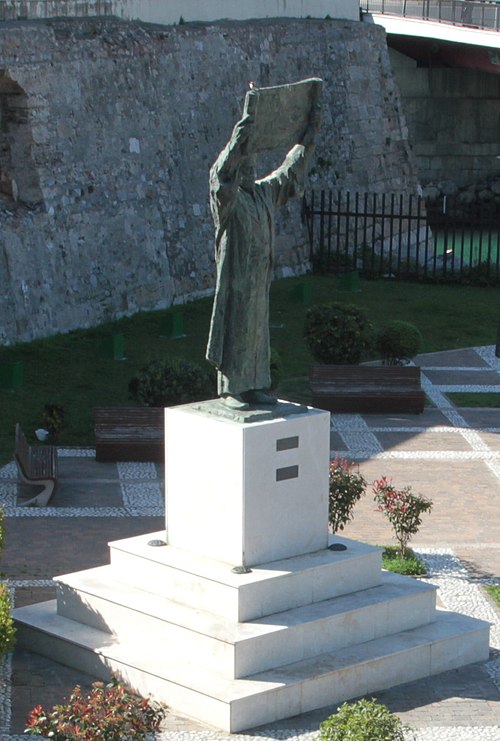
Al-Idrisi's Geography Completed
Al-Idrisi completes 'The Book of Roger', a comprehensive geography describing the known world. It remains a standard reference for centuries. #geography #science
Al-Idrisi's Geography Completed By Estatua_de_Al-Idrisi_bajo_el_baluarte_de_los_Mallorquines,_Ceuta_(3).jpg: Mario Sánchez Bueno derivative work: Ecemaml - This file was derived from: Estatua de Al-Idrisi bajo el baluarte de los Mallorquines, Ceuta (3).jpg:, CC BY-SA 3.0, https://commons.wikimedia.org/w/index.php?curid=23198254
1174 CE
Maimonides' Guide for the Perplexed
Moses Maimonides, a Jewish philosopher in Cairo, writes 'The Guide for the Perplexed', reconciling Aristotelian philosophy with Jewish theology. His work influences both Islamic and Christian thought. #philosophy #theology
Maimonides' Guide for the Perplexed By Cambridge University Library - https://cudl.lib.cam.ac.uk/view/MS-TS-00010-KA-00004-00001/3, Public domain, https://commons.wikimedia.org/w/index.php?curid=468509
1198 CE
Averroes Dies
Ibn Rushd (Averroes) dies in Marrakech. His commentaries on Aristotle become foundational in European scholasticism, earning him the title 'The Commentator'. #philosophy #science
1200 CE
Nasir al-Din al-Tusi's Astronomy
Nasir al-Din al-Tusi establishes the Maragheh observatory, where he develops the Tusi-couple, a mathematical device that later influences Copernicus. His work advances planetary theory. #astronomy #mathematics
Nasir al-Din al-Tusi's Astronomy By Unknown author - scan of stamp 30 May 2006, Public domain, https://commons.wikimedia.org/w/index.php?curid=829461
1220 CE
Ibn al-Nafis Discovers Pulmonary Circulation
Ibn al-Nafis, a physician in Cairo, describes pulmonary circulation for the first time, challenging Galen's theories. His work is a major advance in anatomy and physiology. #medicine #science
Ibn al-Nafis Discovers Pulmonary Circulation By Unknown author - Arabic book on ibn al Nafis Takrouri M.S. M & Khalaf M 2003, CC BY-SA 3.0, https://commons.wikimedia.org/w/index.php?curid=4759221
1258 CE
Mongol Sack of Baghdad
The Mongol Empire under Hulagu Khan sacks Baghdad, destroying the House of Wisdom and ending the Abbasid Caliphate. This event marks the symbolic end of the Islamic Golden Age. #history #tragedy )
Mongol Sack of Baghdad By Sayf al-vâhidî et al. - Rashid al-Din's Jami al-tarawikh; Bibliothèque nationale de France, Département des Manuscrits, Division orientale, Supplément persan 1113, fol. 180v-181, Public domain, https://commons.wikimedia.org/w/index.php?curid=7438129