Encyclopedia/3. History, Societies & Civilizations/02. South & Southeast Asian Civilizations • Curated by Admin Timeline.sg
The Islamic Golden Age, spanning roughly the 8th to 13th centuries, saw groundbreaking advancements in science, medicine, philosophy, and culture, centered in Baghdad and Cordoba. This timeline highlights key milestones from the founding of these cities to their enduring legacy.
Chronological Storyline (43 Milestones)
Jul 30, 762 CE
Founding of Baghdad
Caliph Al-Mansur establishes Baghdad as the new capital of the Abbasid Caliphate, designed as a circular 'City of Peace.' It becomes a global center for learning and trade. #history #islamicgoldenage
Founding of Baghdad By USACE HQ , JIM GORDAN, CIV, USACE - https://www.flickr.com/photos/60095477@N08/5628442718/, Public domain, https://commons.wikimedia.org/w/index.php?curid=15654541
785 CE
Construction of the Great Mosque of Cordoba
Abd al-Rahman I begins building the Great Mosque of Cordoba, an architectural masterpiece that symbolizes Islamic presence in Spain. The mosque features double-tiered arches and later expansion phases. #architecture #islamicgoldenage
Construction of the Great Mosque of Cordoba By Toni Castillo Quero - Flickr: [1], CC BY-SA 2.0, https://commons.wikimedia.org/w/index.php?curid=13926840
786 CE
Harun al-Rashid's Reign Begins
Caliph Harun al-Rashid ascends to power, presiding over a cultural and scientific flourishing in Baghdad. His reign is later mythologized in 'One Thousand and One Nights.' #history #culture
Harun al-Rashid's Reign Begins By Unknown author - Scanned from a book first published in Egypt in 1951, entitled Harun Al-Rashid. Check OCLC, Public domain, https://commons.wikimedia.org/w/index.php?curid=122680832
800 CE
House of Wisdom Established
The Bayt al-Hikma (House of Wisdom) in Baghdad becomes a major intellectual center, translating Greek, Persian, and Indian works into Arabic. Scholars like Hunayn ibn Ishaq contribute to the translation movement. #science #history
House of Wisdom Established By Zereshk - Own work, Public domain, https://commons.wikimedia.org/w/index.php?curid=2809505
820 CE
Al-Khwarizmi Writes 'The Compendious Book on Calculation by Completion and Balancing'
Persian scholar Al-Khwarizmi publishes his seminal work on algebra, introducing systematic solutions for linear and quadratic equations. The word 'algorithm' derives from his name. #mathematics #science
Al-Khwarizmi Writes 'The Compendious Book on Calculation by Completion and Balancing' By Zarateman - Own work, CC0, https://commons.wikimedia.org/w/index.php?curid=162213187
850 CE
Al-Kindi's Philosophical Works
Al-Kindi, the 'Philosopher of the Arabs,' writes on metaphysics, ethics, and mathematics, integrating Greek philosophy with Islamic thought. He also advances cryptography and optics. #philosophy #science
Al-Kindi's Philosophical Works By Iraqi Post - Personal collection, Public domain, https://commons.wikimedia.org/w/index.php?curid=91832934
859 CE
Fatima al-Fihri Founds the University of al-Qarawiyyin
Fatima al-Fihri establishes the University of al-Qarawiyyin in Fez, Morocco, often considered the world's oldest existing, continually operating educational institution. It becomes a major center for Islamic and scientific studies. #education #history
Fatima al-Fihri Founds the University of al-Qarawiyyin By Abdel Hassouni - Own work, CC BY-SA 4.0, https://commons.wikimedia.org/w/index.php?curid=61468974
868 CE
Ahmad ibn Tulun Builds the Ibn Tulun Mosque
The Ibn Tulun Mosque in Cairo is completed, showcasing distinct Samarran influences and the earliest surviving minaret in Egypt. It represents the architectural innovations of the Tulunid dynasty. #architecture #history
Ahmad ibn Tulun Builds the Ibn Tulun Mosque By User:Berthold Werner - Own work, CC BY 3.0, https://commons.wikimedia.org/w/index.php?curid=12110936
900 CE
Al-Battani's Astronomical Tables
Al-Battani (Albatenius) publishes his accurate astronomical tables, refining Ptolemaic models and introducing trigonometric functions like sine and tangent. His work influences European astronomers like Copernicus. #astronomy #science
Al-Battani's Astronomical Tables By unknown, copied from a work by Al-Battani - https://gallica.bnf.fr/ark:/12148/btv1b52505729k/f161.item.zoom# - a Latin translation of al-Battani's work Kitāb az-Zīj aṣ-Ṣābi’, CC BY-SA 4.0, https://commons.wikimedia.org/w/index.php?curid=128222946
929 CE
Cordoba Caliphate Proclaimed
Abd al-Rahman III declares the Caliphate of Córdoba, breaking away from Abbasid suzerainty. Córdoba becomes a rival to Baghdad in culture, science, and political power. #history #politics
Cordoba Caliphate Proclaimed By DaniCBP - Own work, based on: Abū ʿUbayd al-Bakrī, VIDAL BELTRÁN, Eliseo (1984). Geografía de España (Kitab al-Masalik wa-l-Malik). Colección Textos Medievales, Anubar Ediciones, ISBN 84-7013-188-5. Acién Almansa, M., & Manzano Moreno, E. (2012). Organización social y administración política en Al-Ándalus bajo el emirato. Territorio, Sociedad Y Poder. Recuperado a partir de https://reunido.uniovi.es/index.php/TSP/article/view/9494 Alfonso Carmona González (1987). Noticias geográficas arabes referentes a la" Bilád Tudmir". Murgetana, Número 72, Páginas 115-122. Barroca, M. J. (2018). Fortificações e povoamento no Norte de Portugal (séc. IX a XI). PORTVGALIA: Revista De Arqueologia Do Departamento De Ciências E Técnicas Do Património Da Faculdade De Letras Da Universidade Do Porto, 25, 181–204. Obtido de https://ojs.letras.up.pt/index.php/Port/article/view/4219 Bermejo Crespo, José Luis; Muñoz López-Astilleros, Kenia (1996). La producción cerámica en el entorno del Henares durante los siglos IX y X. V Encuentro de Historiadores del Valle del Henares: Guadalajara 21-24 noviembre de 1996, 1996, ISBN 84-87743-77-3, págs. 79-86 Boloix Gallardo, Bárbara (2001). «La Taifa de Toledo en el siglo XI. Aproximación a sus límites y extensión territorial». Tulaytula 8: 23-57. ISSN 1575-653X. Bramon, D. (2006). De Hispania a Alandalús y al esplendor del califato. Aula-Historia Social, 17, 6–30. http://www.jstor.org/stable/40343205 Cabrera, R. B. (2019). De la provincia Celtiberia a la qūrā de Santabariyya: Arqueología de la Antigüedad tardía en la provincia de Cuenca (siglos V-VIII d.C.). Archaeopress. https://doi.org/10.2307/j.ctvndv5h5 Cañada Juste (1999), “El nombre de Cella. Su posible origen y el Reino de as-Sahla”, en Xiloca. Revista del Centro de Estudios del Jiloca, 23 (1999), págs. 61-74. Cañada Juste A. (1993). Nuevas propuestas para la identificación de topónimos e itinerarios en las campañas de Almanzor. Anaquel de Estudios Árabes, 4, 25. https://revistas.ucm.es/index.php/ANQE/article/view/ANQE9393110025A Cañada Juste, Alberto: “Los Banū Qāsī (714-924)”, Príncipe de Viana, 41 (1980), pp. 5-95. Carmona Gonzalez, Alfonso (1987, Noticias geográficas arabes referentes a la "Bilád Tudmir", Murgetana, ISSN 0213-0939, Nº. 72, 1987, págs. 115-122 Carriedo Tejero, Manuel (2009). ¿Sampiro Toresano? Revista de Folklore. Núm. 338, 2009, p.39-45, https://www.cervantesvirtual.com/nd/ark:/59851/bmc9p4v4 Clara Elena Prieto Entrialgo (2011), Sobre el concepto de Galicia y los gallegos en los autores árabes medievales, Árabes in patria Asturiensium, ISBN 978-84-615-2630-7, págs. 255-271 Congreso de Historia de Carmona (1997). Edad Media : Actas del I Congreso de Historia de Carmona. Archivo hispalense ; 1997, No.243-244-245. ISBN : 8477981515 Corral Lafuente, José Luis (1987). El Sistema Urbano en la Marca Superior de al-Ándalus, Turiaso, ISSN 0211-7207, Nº 7, 1987 (Ejemplar dedicado a: El Islam en Aragón), págs. 23-64. De Epalza, Mikel (1987). El Islam Aragonés, un Islam de Frontera. Domínguez de la Concha, Alfonso (2018), Nuevas perspectivas en la organización del territorio en el noreste extremeño en época islámica, Norba vol. 31 (2018) p. 69-95. Universidad de Extremadura, Servicio de Publicaciones. Domínguez de la Concha, Alfonso (2019). Nuevas perspectivas en la organización del territorio en el noreste extremeño en época islámica. Norba Historia Nº 31 (2018) http://hdl.handle.net/10662/9761 Ferreira, M. d. S. d. C. P. (2004). O Douro no Garb Al-Ândalus: A Região de Lamego durante a presença árabe. Repositórios Científicos de Acesso Aberto de Portugal (RCAAP), http://hdl.handle.net/1822/3001 Franco Moreno, Bruno (2015), La Lusitania tras la presencia islámica (713-756 d.C./94-138 H), Frontera inferior de al-Andalus, vol. 2, https://dialnet.unirioja.es/servlet/libro?codigo=583470 FRANCO SÁNCHEZ, Francisco (2006). “Sagunto/Murbīṭar en el período islámico: su historia a través de los textos”. En: De Murbiter a Morvedre. Valencia : Bancaja, 2006. ISBN 84-8471-106-4, pp. 45-65 Franco, B. (2004). Territorio y poblamiento en la kura de Marida durante el emirato omeya (siglos VIII-X/II-IV), Espacio, Tiempo y Forma, Serie III, H.ª Medieval, T. 17, 2004, p. 167-184. Franco-Sánchez, Francisco & Josep A. Gisbert Santonja, editores (2019). Dénia. Poder y el mar en el siglo XI: El reino taifa de los Banū Muŷāhid. Alicante/Dénia/Madrid/El Cairo: Universidad de Alicante (Servicio de Publicaciones)/Ajuntament de Dénia (Cultura)/Instituto Egipcio de Estudios Islámicos en Madrid, 2019. ISBN: 978-84-1302-013-6 y 978-84-948116-4-7 García San Juan, Alejandro (2009), La caracterización geográfica del Garb al-Andalus en las fuentes árabes medievales, Medievalista [Em linha]. Nº6, (Julho 2009). Direc. José Mattoso. Lisboa: IEM. ISSN: 1646-740X. García-Contreras Ruiz, Guillermo (2012). Cerámica, territorio y explotación de la sal en el valle del Salado (Guadalajara) en época andalusí. Universidad de Granada, https://dx.doi.org/10.30827/Digibug.20649 Gonzalo Arango, X. (2013). La integración de Tarrakuna y su territorio en al-Andalus (s. VIII). Arqueología Y Territorio Medieval, 20, 11-30. https://doi.org/10.17561/aytm.v20i0.1444 Guzmán, R. M. (2004). Las fuentes árabes para la reconstrucción de la historia social de la España musulmana. Estudio y clasificación. Estudios de Asia y Africa, 39(3 (125)), 513–572. http://www.jstor.org/stable/40313560 Herrera Casado, Antonio (1985). La Marca Media de Al-Andalus en tierras de Guadalajara. Hugo CAPELLÁ I MITERNIQUE (2010), Territorio y cultura: las comarcas del Matarraña, la Terra Alta y Els Ports. Instituto de Estudios Turolenses. ISBN: 978-84-96053-51-9 Juan Antonio Souto Lasala (2004). El noroeste de la frontera superior de Al-Andalus en época omeya: poblamiento y organización territorial. V Semana de Estudios Medievales, Nájera, Tricio y San Millán de la Cogolla del 2 al 6 de agosto de 2004-2005, ISBN 84-95747-34-0, págs. 253-268. Latorre Ciria, José Manuel (s.f.). Historia de Albarracín (síntesis). Llorente Maldonado de Guevara, Antonio (1964), La toponimia, árabe, mozárabe y morisca de la provincia de Salamanca, Miscelánea de estudios árabes y hebraicos. Sección Árabe-Islam, ISSN 1696-5868, Vol. 12-13, 1963-1964, págs. 89-112 López Asensio, Álvaro (2020). La Alta Edad Media y los Musulmanes de Serrablo. Lorenzo Jiménez, Jesús: La dawla de los Banu Qasi. Origen, auge y caída de una dinastía muladí en la frontera superior de al-Andalus, Madrid: Consejo Superior de Investigaciones Científicas (CSIC), 2010. Luis Miguel Fdez.-Montes y Corrales (2016). Fortificación y Colonización: Herencia antes y durante la Carta Puebla. II Jornadas de Historia de Herencia, 2016, ISBN 978-84-920280-9-2, págs. 13-34 Maíllo Salgado, Felipe (1991). Zamora en las fuentes árabes. Primer Congreso de Historia de Zamora: Medieval y moderna, pg. 87-92. ISBN 8486873150. Martínez Enamorado, V. 2004: “Frontera de al-Andalus. El Valle del Tiétar en el contexto de la Tagr al-Awsat”, J. M. González Muñoz, J. A. Chavarría Varas y J. López Sáez (eds.), Lanzahíta (Ávila). Historia, naturaleza, tradiciones, Madrid, 61-74. Molina Martínez, Luis and María-Luisa Ávila Navarro, "La división territorial en la marca Superior de al-Andalus", Historia de Aragón, 3 (1985), pp. 11–30. ISBN 84-7611-024-3. Negre, Joan; Suñé, Josep (2019), Territorio, fiscalidad y actividad militar en la formación de un espacio fronterizo. La consolidación de Tortosa, como límite extremo de Al-Andalus Omeya, “Anuario de Estudios Medievales” 49/2, pp. 705-740. https://doi.org/10.3989/aem.2019.49.2.12 Paniagua, J. A. P. (1984). Chinchilla en las fuentes árabes. Al-Basit: Revista de estudios albacetenses, (13), 13-24. Pérez Macías, Juan Aurelio. (2018). Paisaje y territorio en la kura de Labla (Niebla, Huelva). Arqueología medieval Bd. 14 (2018) S. 25-41 https://opac.regesta-imperii.de/id/2919421 Piqueras Haba, . J. Cartografía islámica de Sharq Al-Andalus. Siglos X-XII. Al-Idrisi y los precursores. Cuadernos De Geografía De La Universitat De València. https://doi.org/10.7203/CGUV.14285 Piqueras Haba, . J., & Fansa, . G. Geografia dels països catalans segons el llibre de Roger d’Al-Sarif Al-Idrisi. Cuadernos De Geografía De La Universitat De València. https://doi.org/10.7203/CGUV.14277 Rebollo Bote, Juan (2015). Espacios de nadie y de todos: Territorio y sociedad en la frontera andalusí al norte del Tajo extremeño (Siglos VIII–XI). Vegueta. Anuario de la Facultad de Geografía e Historia15, 2015, 185-209ISSN: 1133-598X Rebollo Bote, Juan (2017). Tierra de frontera, comunidades de frontera: el norte de Extremadura entre los siglos VIII y XIII, Memoria Histórica de Plasencia y las Comarcas. Universidad Popular de Plasencia, ISBN: 978-84-697-5648-5. Sáenz de Haro, T. (2007). Calahorra islámica (siglos VIII-XI). Notas sobre la organización de los espacios urbano y rural. Brocar. Cuadernos De Investigación Histórica, (31), 107–154. https://doi.org/10.18172/brocar.1669 Sáenz Preciado, Juan Carlos (2022). LOS ANTECEDENTES HISTÓRICOS DE LA PROVINCIA DE CALATAYUD: DESDE LA CELTIBERIA HASTA EL ABSOLUTISMO BORBÓN, La provincia de Calatayud durante el Trienio Liberal. Centro de Estudios Bilbilitanos, Institución Fernando el Católico. ISBN 978-84-9911-648-8 Sophie Gilotte (2011). El yacimiento de Albalat en el contexto del poblamiento medieval en el norte de Extremadura. Frontera inferior de al-Andalus, 2011, ISBN 978-84-615-6551-1, págs. 147-164 VALOR PIECHOTTA, Magdalena (1998), Las fortificaciones de la Banda Gallega: algunos ejemplos de las provincias de Huelva y Badajoz y del Alentejo portugués, La fortaleza medieval. Realidad y símbolo, págs. 91-108. ΕΙ 'ΤΟLΜΟ DΕ MINATEDA' UΝΑ HISTORIA DE TRES ΜΙL QUINIENTOS AÑOS - Scientific Figure on ResearchGate. Available from: https://www.researchgate.net/figure/Limites-de-la-Cora-de-Tudmir-segun-Molina-Lopez-L-y-Vallve-Bermejo-2_fig17_331802923, CC BY 4.0, https://commons.wikimedia.org/w/index.php?curid=178850504
961 CE
Al-Hakam II's Library in Cordoba
Caliph Al-Hakam II establishes one of the largest libraries in the Islamic world, containing over 400,000 volumes. Córdoba becomes a premier center for scholarship, attracting scholars from across the globe. #education #history
Al-Hakam II's Library in Cordoba By Numismática Pliego, CC BY-SA 3.0, https://commons.wikimedia.org/w/index.php?curid=26093096
969 CE
Fatimid Conquest of Egypt
The Fatimid Caliphate, following Isma'ili Shi'ism, conquers Egypt and founds the city of Cairo. Cairo soon rivals Baghdad and Cordoba as a cultural and intellectual hub. #history #politics
Fatimid Conquest of Egypt By Omar-toons - Own work, CC BY-SA 4.0, https://commons.wikimedia.org/w/index.php?curid=36397574
970 CE
Al-Azhar University Founded
The Fatimid dynasty establishes Al-Azhar Mosque and University in Cairo, one of the world's oldest continuously operating universities. It becomes a premier institution for Islamic learning and theology. #education #history
Al-Azhar University Founded By خالد حسني - Own work, Public domain, https://commons.wikimedia.org/w/index.php?curid=5927904
1000 CE
Al-Zahrawi's 'Al-Tasrif'
Al-Zahrawi (Abulcasis), the father of modern surgery, publishes 'Al-Tasrif,' a 30-volume medical encyclopedia. It includes illustrations of surgical instruments and techniques, influencing European medicine for centuries. #medicine #science
1011 CE
Ibn al-Haytham's 'Book of Optics'
Ibn al-Haytham (Alhazen) publishes his revolutionary 'Kitab al-Manazir,' correctly explaining vision and introducing the scientific method. His work on optics influences later European scientists like Kepler and Newton. #science #optics
Ibn al-Haytham's 'Book of Optics' By Ibn al-Haytham, Vitello, Friedrich Risner - University of Oklahoma History of Science Collections et BnF Gallica : http://gallica.bnf.fr/ark:/12148/bpt6k312873d.r=Haytham?rk=407727;2, Public domain, https://commons.wikimedia.org/w/index.php?curid=48189707
1025 CE
Ibn Sina's 'The Canon of Medicine'
Avicenna (Ibn Sina) completes 'The Canon of Medicine,' an encyclopedia that becomes the standard medical text in Europe and the Islamic world for over 500 years. It systematically covers diseases, pharmacology, and anatomy. #medicine #science
Ibn Sina's 'The Canon of Medicine' By Coffeetalkh - Own work, CC BY-SA 3.0, https://commons.wikimedia.org/w/index.php?curid=11906621
1031 CE
Collapse of the Umayyad Caliphate of Cordoba
The Caliphate of Córdoba disintegrates into smaller Taifa kingdoms after years of civil war. Despite political fragmentation, intellectual life continues, particularly in Toledo and Seville. #history #politics
1040 CE
Al-Biruni's 'The Remaining Signs of Past Centuries'
Al-Biruni writes comparative studies of calendars and chronologies across cultures, demonstrating his deep scholarship in history, geography, and anthropology. He also works on astronomy and mathematics. #science #history
Al-Biruni's 'The Remaining Signs of Past Centuries' By The original uploader was Romanm at Slovenian Wikipedia. - Originally from sl.wikipedia; description page is/was here., Public domain, https://commons.wikimedia.org/w/index.php?curid=2590841
1070 CE
Omar Khayyam's Work on Algebra and the Calendar
Persian polymath Omar Khayyam writes 'Treatise on Demonstration of Problems of Algebra,' classifying cubic equations and solving them geometrically. He also helps reform the Jalali calendar, one of the most accurate pre-modern calendars. #mathematics #astronomy
Omar Khayyam's Work on Algebra and the Calendar By Alireza Javaheri - https://web.archive.org/web/20161024154356/http://www.panoramio.com/photo/85093358, CC BY 3.0, https://commons.wikimedia.org/w/index.php?curid=55909539
1085 CE
Christian Reconquest of Toledo
King Alfonso VI of León and Castile captures Toledo from the Taifa kingdom. The city's libraries become accessible to European scholars, sparking the Toledo School of Translators and a wave of translation from Arabic to Latin. #history #translation
Christian Reconquest of Toledo By Dmitry Dzhus from London - Toledo, CC BY 2.0, https://commons.wikimedia.org/w/index.php?curid=68164390
1096 CE
Al-Ghazali's 'The Incoherence of the Philosophers'
Al-Ghazali, a prominent theologian, critiques Greek-influenced philosophy in his work, defending Islamic orthodoxy. His arguments spur further philosophical debate, including a response from Ibn Rushd. #philosophy #theology
1126 CE
Birth of Averroes (Ibn Rushd)
Ibn Rushd, born in Cordoba, becomes a leading philosopher, jurist, and physician. His comprehensive commentaries on Aristotle earn him the title 'The Commentator' and greatly influence European Scholasticism. #philosophy #history
Birth of Averroes (Ibn Rushd) By Sailko - Own work, CC BY 3.0, https://commons.wikimedia.org/w/index.php?curid=39974830
1145 CE
Al-Idrisi's 'Tabula Rogeriana'
Al-Idrisi, commissioned by King Roger II of Sicily, creates a world map and geographic compendium (Kitab Rujar). The map is among the most accurate of its time, blending Islamic and European knowledge. #geography #science
Al-Idrisi's 'Tabula Rogeriana' By unknown copyist - Arabe 2221 BNF, earliest known surviving copy of Idrisi's Nuzhat al-Mushtaq, 13th century copy https://gallica.bnf.fr/ark:/12148/btv1b6000547t/f165.item.zoom, Public domain, https://commons.wikimedia.org/w/index.php?curid=128511980
1150 CE
Translation of Arabic Texts in Toledo
The Toledo School of Translators flourishes under Archbishop Raymond, translating works by Al-Khwarizmi, Avicenna, and others into Latin. These translations become foundational to the European Renaissance. #translation #history
Translation of Arabic Texts in Toledo By Unknown author, CC BY-SA 3.0, https://commons.wikimedia.org/w/index.php?curid=407620
1165 CE
Maimonides' 'Guide for the Perplexed'
Maimonides, a Jewish philosopher born in Cordoba, writes his seminal work reconciling Jewish theology with Aristotelian philosophy. He also serves as physician to Saladin and writes influential medical texts. #philosophy #religion
Maimonides' 'Guide for the Perplexed' By Cambridge University Library - https://cudl.lib.cam.ac.uk/view/MS-TS-00010-KA-00004-00001/3, Public domain, https://commons.wikimedia.org/w/index.php?curid=468509
1172 CE
Almohad Conquest of Al-Andalus
The Almohad Caliphate, originating in North Africa, takes control of much of Al-Andalus. They promote a strict religious doctrine but also patronize science and philosophy, notably supporting Ibn Tufayl and Averroes. #history #politics
Almohad Conquest of Al-Andalus By Flaspec - This file was derived from: Empire almohade-es.svg: RowanwindwhistlerSelon: Qantara-Med.org [1] [2], CC BY-SA 4.0, https://commons.wikimedia.org/w/index.php?curid=96587264
Dec 10, 1198 CE
Death of Averroes
Ibn Rushd dies in Marrakech, his works later banned in the Islamic world but widely studied in Europe. His rationalist philosophy influences Thomas Aquinas and the development of Scholasticism. #philosophy #history
1200 CE
Al-Sufi's 'Book of Fixed Stars'
Abd al-Rahman al-Sufi's star catalog updates Ptolemy's work, including the first recorded observations of galaxies like the Andromeda Galaxy. His work influences both Islamic and European astronomy. #astronomy #science
Al-Sufi's 'Book of Fixed Stars' By Albrecht Dürer - File:Albrecht_Dürer,_The_Northern_Celestial_Hemisphere,_1515,_NGA_43181.jpg, CC BY-SA 4.0, https://commons.wikimedia.org/w/index.php?curid=131171930
1206 CE
Al-Jazari's 'The Book of Knowledge of Ingenious Mechanical Devices'
Al-Jazari, a mechanical engineer from the Artuqid dynasty, publishes his compendium of automata, water clocks, and machines. He describes innovative mechanisms like the crankshaft and programmable automata. #engineering #science
1217 CE
Al-Ashari's Impact on Theology
Al-Ashari's theological school (Ashariyya) becomes dominant in Sunni Islam, balancing reason and revelation. His ideas shape Islamic philosophy and jurisprudence, influencing later thinkers like Al-Ghazali. #theology #philosophy
1220 CE
Mongol Siege of Bukhara and Samarkand
Genghis Khan's Mongol armies destroy two of the Islamic world's greatest cities, leading to the loss of countless manuscripts and the decline of the eastern Islamic golden age. However, many scholars flee westward. #history #tragedy
1236 CE
Cordoba Falls to Castile
King Ferdinand III of Castile captures Cordoba from the Almohads. The Great Mosque is consecrated as a cathedral, but intellectual life in Al-Andalus continues in Granada. #history #politics
Cordoba Falls to Castile By kallerna - Own work, CC BY-SA 4.0, https://commons.wikimedia.org/w/index.php?curid=97239829
1248 CE
Seville Falls to Castile
Ferdinand III captures Seville, another major cultural center of Al-Andalus. The city's libraries and manuscripts are largely plundered or assimilated into Christian Europe. #history #politics
Seville Falls to Castile By Ingo Mehling - Own work, CC BY-SA 4.0, https://commons.wikimedia.org/w/index.php?curid=37545223
Feb 13, 1258 CE
Mongol Sack of Baghdad
Hulagu Khan's Mongol forces destroy Baghdad, ending the Abbasid Caliphate. The House of Wisdom is razed, and the city loses its status as the intellectual capital of the Islamic world. This event marks the traditional end of the Islamic Golden Age. #history #tragedy )
Mongol Sack of Baghdad By Sayf al-vâhidî et al. - Rashid al-Din's Jami al-tarawikh; Bibliothèque nationale de France, Département des Manuscrits, Division orientale, Supplément persan 1113, fol. 180v-181, Public domain, https://commons.wikimedia.org/w/index.php?curid=7438129
1274 CE
Nasir al-Din al-Tusi's Maragheh Observatory
Al-Tusi establishes the observatory at Maragheh, one of the most advanced of its time. He and his team produce the Ilkhanic Tables and develop mathematical models that influence later European astronomy. #astronomy #science
Nasir al-Din al-Tusi's Maragheh Observatory By Unknown author - scan of stamp 30 May 2006, Public domain, https://commons.wikimedia.org/w/index.php?curid=829461
1325 CE
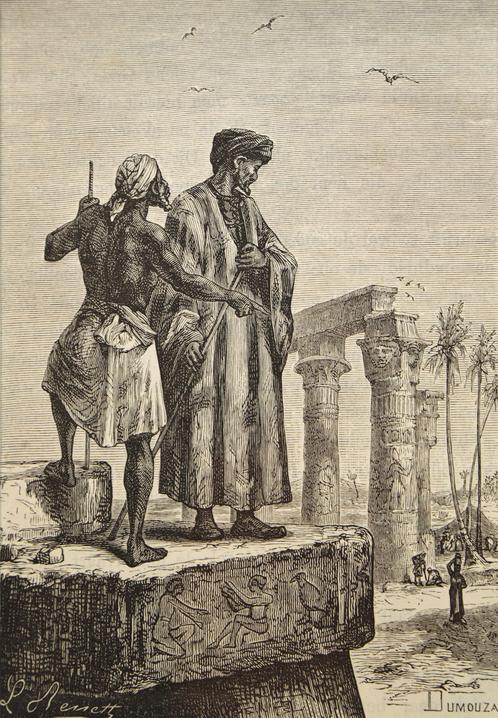
Ibn Battuta Begins His Travels
Moroccan scholar Ibn Battuta leaves Tangier on a 30-year journey across Africa, Asia, and Europe. His travelogue, the Rihla, provides invaluable insights into the medieval world and Islamic societies. #history #travel
Ibn Battuta Begins His Travels By Léon Benett - Verne, Jules (1878). Les Grands voyages et les grands voyageurs. Découverte de la Terre. Paris: J. Hetzel. Page 81 available from Gallica.Immediate source: http://www.artfinder.com/work/ibn-battuta-in-egypt-hippolyte-leon-benett/, Public domain, https://commons.wikimedia.org/w/index.php?curid=17332982
1377 CE
Ibn Khaldun's 'Muqaddimah'
Ibn Khaldun, a Tunisian historian, writes the 'Muqaddimah' (Prolegomena), considered the foundation of historiography, sociology, and economics. He analyzes the rise and fall of civilizations, anticipating modern social sciences. #history #sociology
Ibn Khaldun's 'Muqaddimah' By Riad Salih - Own work, CC BY 4.0, https://commons.wikimedia.org/w/index.php?curid=154963244
1420 CE
Ulugh Beg's Observatory in Samarkand
Timurid ruler Ulugh Beg builds an observatory in Samarkand, producing highly accurate star tables. His work represents a late flowering of Islamic astronomy, before decline set in under religious orthodoxy. #astronomy #science
Ulugh Beg's Observatory in Samarkand By Bgag - Own work, CC0, https://commons.wikimedia.org/w/index.php?curid=142098469
Jan 2, 1492 CE
Fall of Granada and End of Al-Andalus
The Emirate of Granada, the last Muslim stronghold in Spain, surrenders to Ferdinand and Isabella. This marks the end of 781 years of Islamic rule in the Iberian Peninsula, leading to forced conversions and the Inquisition. #history #politics
Fall of Granada and End of Al-Andalus By Amitchell125 (based on the map produced by Tyk and Redtony) - Own work based on File:Reino de Granada.svg Sources for dates of the Christian captures of Muslim towns: Alcalá la Real, 1341: O'Callaghan 2011, p. 190 Algeciras, 1344: Harvey 1992, pp. 203-204 Almeria, 1489: Harvey 1992, p. 304 Antequera, 1410: O'Callaghan 2014, p. 52 Archidona, 1462: O'Callaghan 2013, p. 110 Baza, 1489: Harvey 1992, p. 302 Ceuta, 1415: O'Callaghan 2014, p. 52 Gibraltar, 1462: O'Callaghan 2014, pp. 108-110 Granada, 1492: Harvey 1993, p. 322 Guadix, 1489: Harvey 1992, p. 304 Huelma, 1438: O'Callaghan 2014, p. 52 Huescar, 1434: O'Callaghan 2014, p. 80 Malaga, 1487: Harvey 1992, p. 300 Marbella, 1485: Harvey 1992, pp. 287-288 Olvera, 1327: O'Callaghan 2011, p. 152 Priego, 1341: O'Callaghan 2011, p. 190 Ronda, 1485: Harvey 1992, pp. 285-286 Tarifa, 1292: O'Callaghan 2011, p. 101 Vera, 1488: Harvey 1992, p. 301 Xiquena, 1433: O'Callaghan 2014, p. 171 Zahara, 1407: Harvey 1992, pp. 231-232 Compare similar maps: O'Callaghan 2014, p. 52 (Granada's west) O'Callaghan 2014, p. 171 (Granada's east) Harvey 1992, p. xvi Bibliography: Harvey, L. P. (1992) Islamic Spain, 1250 to 1500, Chicago: University of Chicago Press ISBN: 978-0-226-31962-9. O'Callaghan, Joseph F. (2011) The Gibraltar Crusade: Castile and the Battle for the Strait, Philadelphia: University of Pennsylvania Press ISBN: 0812204638. O'Callaghan, Joseph F. (2014) The Last Crusade in the West: Castile and the Conquest of Granada, Philadelphia: University of Pennsylvania Press ISBN: 978-0-8122-0935-8., CC BY-SA 4.0, https://commons.wikimedia.org/w/index.php?curid=93827741
1492 CE
Expulsion of Jews from Spain
Following the conquest of Granada, the Alhambra Decree orders the expulsion of all Jews from Spain. Many Jewish scholars who had contributed to the golden age flee to North Africa and the Ottoman Empire. #history #religion
Expulsion of Jews from Spain By Unknown author - Unknown source, Public domain, https://commons.wikimedia.org/w/index.php?curid=3381590
1529 CE
Süleyman the Magnificent's Patronage
Ottoman sultan Süleyman I supports architecture, law, and the arts, building the Süleymaniye Mosque in Istanbul. Ottoman scholarship continues the Islamic intellectual tradition, though not centered in Baghdad or Cordoba. #history #architecture
Süleyman the Magnificent's Patronage By Circle of Titian - Kunsthistorisches Museum Wien, Public domain, https://commons.wikimedia.org/w/index.php?curid=2646041
1850 CE
Rediscovery of Al-Andalus by Romantics
European travelers and scholars, such as Washington Irving, revisit the legacy of Al-Andalus. Irving's 'Tales of the Alhambra' sparks renewed interest in Islamic Spain, influencing architecture and literature. #culture #history
Rediscovery of Al-Andalus by Romantics By Washington Irving - Original source: The Alhambra, published London, 1832 Immediate source: https://historical.ha.com/itm/books/literature-pre-1900/-washington-irving-the-alhambra-london-1832-first-edition-in-the-scarce-publisher-s-boards-total-2-items-/a/6174-46041.s, Public domain, https://commons.wikimedia.org/w/index.php?curid=183667998
1950 CE
Modern Revival of Islamic Philosophy
Scholars like Seyyed Hossein Nasr and Muhammad Iqbal revive interest in Islamic philosophy and Sufism, reinterpreting classical works for contemporary contexts. The legacy of Baghdad and Cordoba inspires modern Islamic thought. #philosophy #culture
Modern Revival of Islamic Philosophy By Tariqabjotu at English Wikipedia - Transferred from en.wikipedia to Commons by Raayen., CC BY 3.0, https://commons.wikimedia.org/w/index.php?curid=5216193