Isaac Newton: Principia Mathematica, Gravity & Optics
Encyclopedia/1. The Cosmos & The Natural World/2. Physics & Chemistry/13. Physical & Chemical Biographies • Curated by Admin Timeline.sg
Sir Isaac Newton (1642–1727) was an English mathematician, physicist, astronomer, and author who is widely recognized as one of the most influential scientists of all time. His work on universal gravitation, the laws of motion, and optics laid the foundation for classical mechanics and dominated the scientific view of the physical universe for the next three centuries.
Chronological Storyline (39 Milestones)
Dec 25, 1642 CE
Isaac Newton Born
Isaac Newton was born on Christmas Day 1642 (Julian calendar) in Woolsthorpe-by-Colsterworth, Lincolnshire, England. He was born prematurely and was not expected to survive. #physics #history #science
Isaac Newton Born By Godfrey Kneller - File:Portrait of Sir Isaac Newton, 1689.jpg from https://exhibitions.lib.cam.ac.uk/linesofthought/artifacts, Public domain, https://commons.wikimedia.org/w/index.php?curid=132521185
1653 CE
Newton Begins School at The King's School
After his mother was widowed a second time, Newton was sent to The King's School in Grantham, where he studied Latin and the Bible. He showed early aptitude for mechanics and invention. #education #history
Newton Begins School at The King's School By iain.standen - King's School Grantham, CC BY 2.0, https://commons.wikimedia.org/w/index.php?curid=70322675
Jun 1, 1661 CE
Newton Enters Trinity College, Cambridge
Newton matriculated at Trinity College, Cambridge, as a subsizar (a student who performed domestic duties to pay for his education). He studied the works of Aristotle, Descartes, and other philosophers. #university #history
Newton Enters Trinity College, Cambridge By Rafa Esteve - Own work, CC BY-SA 4.0, https://commons.wikimedia.org/w/index.php?curid=51077381
Aug 1, 1665 CE
University Closes Due to Plague; Newton Returns to Woolsthorpe
The Great Plague forced Cambridge to close, and Newton returned to his family home in Woolsthorpe. This period, often called his 'annus mirabilis,' saw his most creative work. #plague #history
University Closes Due to Plague; Newton Returns to Woolsthorpe By unknwn - http://theloveforhistory.com/wp-content/uploads/2011/06/plague_380x529_712060a.jpg, Public domain, https://commons.wikimedia.org/w/index.php?curid=17582564
1665 CE
Newton Develops Binomial Theorem
During his early years at Cambridge, Newton discovered the generalized binomial theorem, which allowed the expansion of expressions raised to any power. This was a key step toward his later work in calculus. #mathematics #calculus
1666 CE
Newton Experiments with Prisms and Light
At Woolsthorpe, Newton conducted experiments with prisms, discovering that white light is composed of a spectrum of colors. This laid the foundation for his later work in optics. #optics #light
Newton Experiments with Prisms and Light By Unknown author, Public domain, https://commons.wikimedia.org/w/index.php?curid=510265
1666 CE
Newton Formulates Laws of Motion and Universal Gravitation
During the plague years, Newton conceived the three laws of motion and the law of universal gravitation, though he did not publish them until later. The famous apple story is associated with this period. #gravity #physics
1666 CE
Newton Develops Calculus (Fluxions)
Newton invented the method of fluxions, his version of calculus, to solve problems in geometry and physics. This work was not published until much later, leading to a priority dispute with Leibniz. #mathematics #calculus
Oct 1, 1667 CE
Newton Elected Fellow of Trinity College
After the plague subsided, Newton returned to Cambridge and was elected a fellow of Trinity College. This position provided him with financial stability and time for research. #academia #history
Oct 29, 1669 CE
Newton Appointed Lucasian Professor of Mathematics
At age 26, Newton succeeded Isaac Barrow as the Lucasian Professor of Mathematics at Cambridge. This prestigious chair allowed him to focus on his research. #professor #mathematics
1670 CE
Newton Lectures on Optics
As Lucasian Professor, Newton delivered lectures on optics, presenting his discoveries about light and color. These lectures were later published as part of his Opticks. #optics #lectures
Jan 11, 1672 CE
Newton Elected Fellow of the Royal Society
Newton was elected a Fellow of the Royal Society after presenting his reflecting telescope. This marked his entry into the scientific community. #science #society
Newton Elected Fellow of the Royal Society By Royal Society - https://royalsociety.org/, PD, https://en.wikipedia.org/w/index.php?curid=81747653
Feb 6, 1672 CE
Newton Publishes First Paper on Light and Colors
Newton's first scientific paper, 'New Theory about Light and Colors,' was published in the Philosophical Transactions of the Royal Society. It sparked controversy with Robert Hooke. #optics #publication
Newton Publishes First Paper on Light and Colors By Henry Oldenburg - Philosophical Transactions, CC BY 4.0, https://commons.wikimedia.org/w/index.php?curid=36495651
1675 CE
Newton's Work on Calculus and Optics Continues
Newton continued his work on calculus and optics, but his reluctance to publish led to disputes. He also began studying alchemy and theology. #calculus #alchemy
1679 CE
Newton Corresponds with Hooke on Planetary Motion
In a letter to Robert Hooke, Newton discussed the inverse-square law of gravitation. This correspondence helped refine his ideas on celestial mechanics. #gravity #correspondence
Newton Corresponds with Hooke on Planetary Motion By Mary Beale - https://arthistoryproject.com/artists/mary-beale/portrait-of-a-mathematician/, Public domain, https://commons.wikimedia.org/w/index.php?curid=92677611
Aug 1, 1684 CE
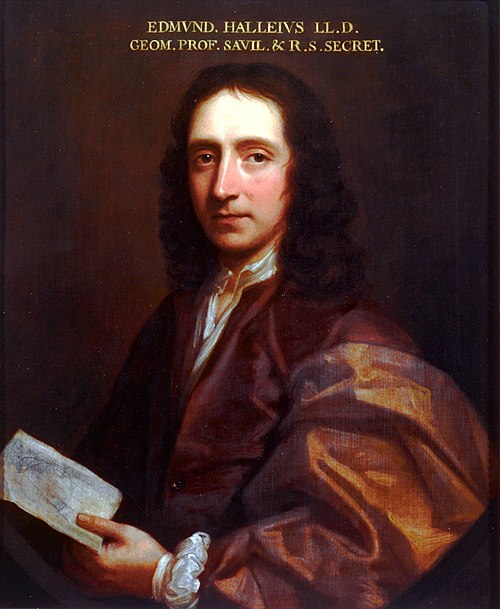
Halley Visits Newton and Prompts Principia
Edmond Halley visited Newton in Cambridge and asked about planetary orbits. Newton revealed he had already solved the problem, leading Halley to urge him to publish. #astronomy #principia
Halley Visits Newton and Prompts Principia By Thomas Murray - https://commons.wikimedia.org/wiki/File:Edmund_Halley.gif, Public domain, https://commons.wikimedia.org/w/index.php?curid=128394552
Jul 5, 1687 CE
Publication of Philosophiæ Naturalis Principia Mathematica
Newton's magnum opus, the Principia, was published with financial support from Edmond Halley. It laid out the laws of motion and universal gravitation, revolutionizing physics. #physics #gravity #classicalmechanics
Publication of Philosophiæ Naturalis Principia Mathematica By The original uploader was Zhaladshar at English Wikisource. - Transferred from en.wikisource to Commons. (previous image from another copy) Internet Archive (current image from the Bern Dibner copy), Public domain, https://commons.wikimedia.org/w/index.php?curid=2681838
1689 CE
Newton Elected to Parliament
Newton served as a Member of Parliament for Cambridge University in the Convention Parliament. He was largely silent during his tenure. #politics #history
Newton Elected to Parliament By Sodacan - Own work, CC BY-SA 3.0, https://commons.wikimedia.org/w/index.php?curid=11315602
1693 CE
Newton Suffers Nervous Breakdown
Newton experienced a period of mental instability, possibly due to overwork, mercury poisoning from alchemical experiments, or personal conflicts. He recovered after a year. #health #history
Mar 1, 1696 CE
Newton Appointed Warden of the Royal Mint
Newton moved to London to become Warden of the Royal Mint, overseeing the recoinage of English currency. He took the job seriously and pursued counterfeiters. #mint #economics
1699 CE
Newton Promoted to Master of the Royal Mint
Newton was promoted to Master of the Royal Mint, a position he held until his death. He reformed the currency and improved the mint's efficiency. #mint #finance
Nov 30, 1703 CE
Newton Elected President of the Royal Society
Newton became President of the Royal Society, a position he held until his death. He wielded significant influence over British science. #science #leadership
1704 CE
Publication of Opticks
Newton published Opticks, detailing his experiments and theories on light and color. The book was written in English and became widely influential. #optics #light #book
Apr 16, 1705 CE
Newton Knighted by Queen Anne
Queen Anne knighted Newton at Trinity College, Cambridge, making him the first scientist to receive a knighthood for his work. #knighthood #honor
Newton Knighted by Queen Anne By Master of the Codex Manesse - http://digi.ub.uni-heidelberg.de/diglit/cpg848/0364, Public domain, https://commons.wikimedia.org/w/index.php?curid=190394
1711 CE
Priority Dispute with Leibniz over Calculus
The dispute over who invented calculus escalated, with Newton and Leibniz accusing each other of plagiarism. The Royal Society, under Newton's presidency, ruled in Newton's favor. #calculus #controversy
Priority Dispute with Leibniz over Calculus By Andrew Gray — original photos, Alexey Gomankov — collage - 1 and 2, CC BY-SA 3.0, https://commons.wikimedia.org/w/index.php?curid=51521808
1713 CE
Second Edition of Principia Published
A second edition of the Principia was published, edited by Roger Cotes. It included corrections and a new preface by Newton. #physics #edition
1718 CE
Newton Publishes Second Edition of Opticks
A second edition of Opticks was published with additional queries, including speculations on the nature of light and matter. #optics #science
1726 CE
Third Edition of Principia Published
The third edition of the Principia was published, with further revisions. It remained the standard text for physics for centuries. #physics #classic
Mar 20, 1727 CE
Death of Isaac Newton
Isaac Newton died in London at age 84. He was buried in Westminster Abbey, a rare honor for a scientist. #death #legacy
1727 CE
Posthumous Publication of Chronology of Ancient Kingdoms
Newton's work on ancient chronology was published posthumously. He had spent years studying biblical history and ancient civilizations. #history #chronology
Posthumous Publication of Chronology of Ancient Kingdoms By w:Isaac Newton (Life time: (1642–1726/7)) - Original publication Immediate source: Google Books, Public domain, https://commons.wikimedia.org/w/index.php?curid=137765573
1730 CE
Posthumous Publication of Observations upon the Prophecies
Newton's theological writings on biblical prophecy were published. He had written extensively on religion and alchemy. #theology #prophecy
1742 CE
Newton's Hair Analyzed for Mercury
In modern times, analysis of Newton's hair revealed high levels of mercury, possibly from his alchemical experiments, which may have contributed to his health issues. #science #alchemy
1802 CE
Newton's Laws Applied to Celestial Mechanics
Pierre-Simon Laplace and others used Newton's laws to precisely calculate planetary orbits, confirming the universality of gravitation. #astronomy #physics
1905 CE
Einstein's Special Relativity Challenges Newtonian Physics
Albert Einstein's theory of special relativity showed that Newton's laws break down at high speeds, but they remain accurate for everyday phenomena. #relativity #physics
Einstein's Special Relativity Challenges Newtonian Physics By Lucien Chavan [1] (1868 - 1942), a friend of Einstein's when he was living in Berne. - Cropped from original at the The Albert Einstein Archives, The Hebrew University of Jerusalem., Public domain, https://commons.wikimedia.org/w/index.php?curid=16699199
1915 CE
General Relativity Refines Newton's Gravity
Einstein's general relativity described gravity as curvature of spacetime, superseding Newton's inverse-square law for extreme conditions. #gravity #relativity
General Relativity Refines Newton's Gravity By Simulating eXtreme Spacetimes Lensing (SXS) - https://www.ligo.caltech.edu/video/ligo20160211v3 (video link); see also http://www.black-holes.org/gw150914, CC BY-SA 4.0, https://commons.wikimedia.org/w/index.php?curid=46994894
1987 CE
Tercentenary of Principia Celebrated
The 300th anniversary of the Principia was celebrated with conferences and publications, reaffirming Newton's enduring legacy. #anniversary #science
1995 CE
Newton's Manuscripts Digitized
The Newton Project began digitizing Newton's manuscripts, making his theological, alchemical, and scientific writings widely accessible. #archives #digital
2005 CE
Newton's Apple Tree Still Growing
A descendant of the apple tree that inspired Newton's theory of gravity still stands at Woolsthorpe Manor, cared for by the National Trust. #apple #history
Newton's Apple Tree Still Growing By Bs0u10e01 - Own work, CC BY-SA 4.0, https://commons.wikimedia.org/w/index.php?curid=117432663
2016 CE
Gravitational Waves Confirm Newton's Legacy
The detection of gravitational waves by LIGO confirmed predictions of general relativity, but Newton's framework remains essential for most gravitational calculations. #gravity #waves
Gravitational Waves Confirm Newton's Legacy By Simulating eXtreme Spacetimes Collaboration/Canadian Institute for Theoretical Astrophysics/SciNet - http://www.black-holes.org/gw150914 (see https://www.youtube.com/watch?v=c-2XIuNFgD0), CC BY-SA 4.0, https://commons.wikimedia.org/w/index.php?curid=46983496