Encyclopedia/3. History, Societies & Civilizations/11. Pre-Modern & Modern History • Curated by Admin Timeline.sg
The Industrial Revolution's first epoch (c. 1760-1840) saw the rise of steam power and factory systems, transforming agrarian societies into industrial powerhouses. Key milestones include Watt's steam engine, textile mechanization, and the advent of railways.
Chronological Storyline (50 Milestones)
1712 CE
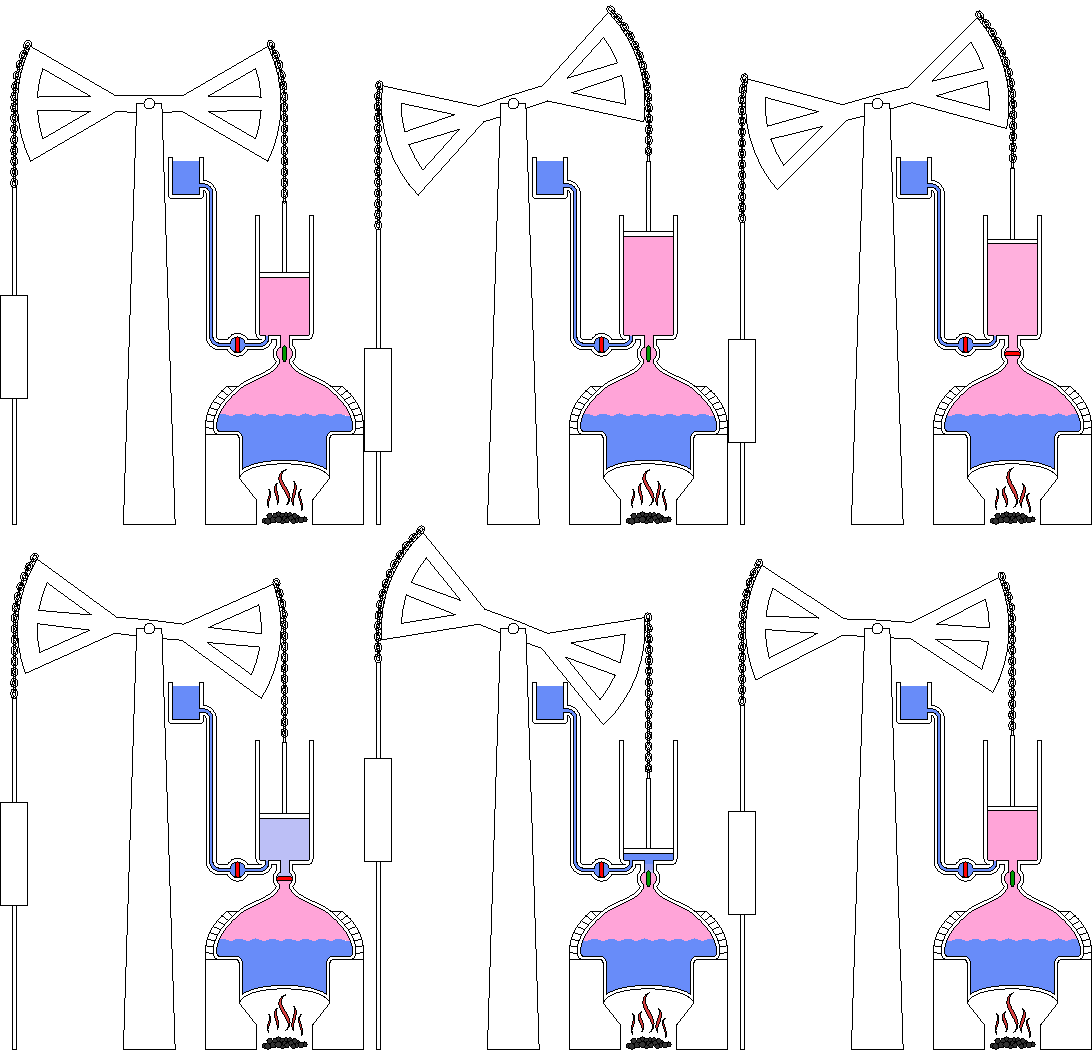
Thomas Newcomen Builds First Practical Steam Engine
Newcomen's atmospheric engine, used to pump water from coal mines, marks the first practical steam engine. It laid the groundwork for later improvements by Watt and others. #IndustrialRevolution #SteamEngine
Thomas Newcomen Builds First Practical Steam Engine By Emoscopes - Own work, drawn using XaraX software, CC BY 2.5, https://commons.wikimedia.org/w/index.php?curid=607235
1733 CE
John Kay Invents the Flying Shuttle
Kay's flying shuttle doubled weaving speed, increasing demand for yarn and spurring mechanization of spinning. It was a key early textile innovation. #TextileRevolution #Invention
John Kay Invents the Flying Shuttle By Conrado Secassi - Immigration Museum of the State of São Paulo, CC BY-SA 4.0, https://commons.wikimedia.org/w/index.php?curid=48689694
1764 CE
James Hargreaves Invents the Spinning Jenny
The spinning jenny allowed one worker to spin multiple threads simultaneously, boosting cotton yarn production. It faced resistance from hand spinners. #TextileRevolution #Invention
James Hargreaves Invents the Spinning Jenny By Markus Schweiß - Self-photographed, CC BY-SA 3.0, https://commons.wikimedia.org/w/index.php?curid=195501
1769 CE
Richard Arkwright Patents the Water Frame
Arkwright's water frame used water power to produce strong cotton thread, enabling factory-based spinning. It marked a shift from home to factory production. #TextileRevolution #FactorySystem
Richard Arkwright Patents the Water Frame By The original uploader was Markus Schweiß at German Wikipedia. - Transferred from de.wikipedia to Commons., CC BY-SA 3.0, https://commons.wikimedia.org/w/index.php?curid=1987212
1775 CE
James Watt and Matthew Boulton Form Partnership
Watt's improved steam engine, with a separate condenser, became commercially viable through Boulton's funding. Their partnership drove steam power adoption across industries. #SteamEngine #IndustrialRevolution
James Watt and Matthew Boulton Form Partnership By Murgatroyd49 - Own work, CC BY-SA 4.0, https://commons.wikimedia.org/w/index.php?curid=90950568
1779 CE
Samuel Crompton Invents the Spinning Mule
Crompton's mule combined features of the spinning jenny and water frame, producing fine, strong yarn. It became a staple in textile mills. #TextileRevolution #Invention
Samuel Crompton Invents the Spinning Mule By Espt123 - Own work, CC BY-SA 3.0, https://commons.wikimedia.org/w/index.php?curid=9816003
1781 CE
James Watt Develops Rotary Motion for Steam Engine
Watt's sun-and-planet gear converted the steam engine's reciprocating motion into rotary motion, enabling it to power machinery. This expanded steam use beyond pumping. #SteamEngine #IndustrialRevolution
James Watt Develops Rotary Motion for Steam Engine By Newtown grafitti from Sydney, Australia - flywheel of the Boulton-Watt steam engine, CC BY 2.0, https://commons.wikimedia.org/w/index.php?curid=38852277
1784 CE
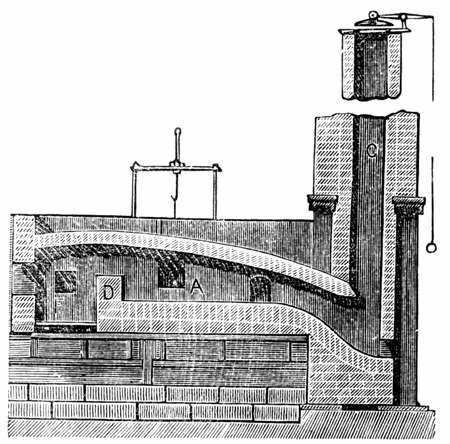
Henry Cort Develops the Puddling Process
Cort's puddling process produced high-quality wrought iron using coal, reducing reliance on charcoal. It revolutionized iron production and lowered costs. #IronIndustry #IndustrialRevolution
Henry Cort Develops the Puddling Process By Unknown author, Public domain, https://commons.wikimedia.org/w/index.php?curid=551224
1785 CE
Edmund Cartwright Invents the Power Loom
Cartwright's power loom mechanized weaving, but early versions were unreliable. Later improvements made it central to factory textile production. #TextileRevolution #FactorySystem
Edmund Cartwright Invents the Power Loom By švabo - Own work, CC BY-SA 3.0, https://commons.wikimedia.org/w/index.php?curid=5102137
1790 CE
First Steam-Powered Rolling Mill Built in England
The rolling mill used steam power to shape iron, increasing efficiency in metalworking. It exemplified steam's application beyond textiles. #SteamPower #IronIndustry
First Steam-Powered Rolling Mill Built in England By Romary - Own work, CC BY 2.5, https://commons.wikimedia.org/w/index.php?curid=870040
1793 CE
Eli Whitney Invents the Cotton Gin
Whitney's cotton gin quickly separated seeds from cotton fiber, boosting cotton production in the American South. It increased demand for slave labor and raw cotton for British mills. #CottonIndustry #Invention
Eli Whitney Invents the Cotton Gin By Tom Murphy VII - Taken by uploader, user:brighterorange., Public domain, https://commons.wikimedia.org/w/index.php?curid=3296372
1800 CE
Richard Trevithick Builds High-Pressure Steam Engine
Trevithick's engine used high-pressure steam without a condenser, making it smaller and more powerful. It enabled steam locomotives and portable engines. #SteamEngine #Transportation
Richard Trevithick Builds High-Pressure Steam Engine By John Linnell - Original publication: Unknown Immediate source: [1], Public domain, https://commons.wikimedia.org/w/index.php?curid=48280672
1801 CE
First Steam-Powered Vehicle Runs in Cornwall
Trevithick's 'Puffing Devil' carried passengers on a road, demonstrating steam locomotion. It was an early precursor to railways. #SteamVehicle #Transportation
1804 CE
Trevithick's Locomotive Hauls First Train on Rails
Trevithick's locomotive pulled a train along a tramway in Wales, proving steam traction on rails. It paved the way for future railway development. #Railway #SteamLocomotive
1807 CE
Robert Fulton's Steamboat Clermont Begins Service
Fulton's North River Steamboat (Clermont) traveled from New York to Albany, demonstrating commercial steamboat viability. It revolutionized river transport. #Steamboat #Transportation
Robert Fulton's Steamboat Clermont Begins Service By Detroit Publishing Co. - This image is available from the United States Library of Congress's Prints and Photographs division under the digital ID det.4a16094.This tag does not indicate the copyright status of the attached work. A normal copyright tag is still required. See Commons:Licensing., Public domain, https://commons.wikimedia.org/w/index.php?curid=9948737
1811 CE
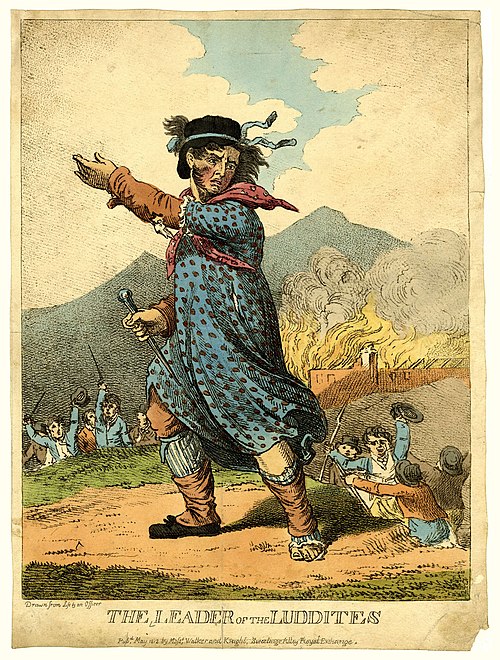
Luddite Riots Begin in England
Textile workers destroyed machinery they blamed for unemployment and low wages. The Luddite protests highlighted social tensions of industrialization. #LaborHistory #SocialUnrest
Luddite Riots Begin in England By Unknown. 195 years since publication, copyright extinguished - Working Class Movement Library catalogue, Public domain, https://commons.wikimedia.org/w/index.php?curid=2603296
1812 CE
First Gas Lighting Installed in London Streets
Pall Mall became the first street lit by coal gas, improving safety and extending working hours. Gas lighting spread rapidly in factories and cities. #Urbanization #Technology
First Gas Lighting Installed in London Streets By Aw58 - Own work, CC BY-SA 4.0, https://commons.wikimedia.org/w/index.php?curid=82007661
1813 CE
William Hedley's 'Puffing Billy' Locomotive
Hedley's locomotive used adhesion to haul coal wagons on smooth rails, proving steam traction without rack rails. It influenced later locomotive design. #Railway #SteamLocomotive
1814 CE
George Stephenson Builds the Blücher Locomotive
Stephenson's first locomotive hauled coal at Killingworth colliery. It incorporated a steam blast to improve draft, increasing efficiency. #Railway #SteamLocomotive
George Stephenson Builds the Blücher Locomotive By Unknown author, Public domain, https://commons.wikimedia.org/w/index.php?curid=837991
1815 CE
Humphry Davy Invents the Miner's Safety Lamp
Davy's lamp prevented methane explosions in coal mines, improving safety. It allowed deeper mining, fueling the Industrial Revolution's energy needs. #Mining #Safety
Humphry Davy Invents the Miner's Safety Lamp By Acme Newspictures (New York City) - Digital Commonwealth, Public domain, https://commons.wikimedia.org/w/index.php?curid=145104912
1819 CE
Savannah Crosses Atlantic Partly Under Steam
The SS Savannah became the first steamship to cross the Atlantic, though it used sails for most of the voyage. It demonstrated steam's potential for ocean travel. #Steamship #Transportation
Savannah Crosses Atlantic Partly Under Steam By Hunter Wood - http://www.sip.armstrong.edu/Transportation/FullView/Trans_Img14.html, Public domain, https://commons.wikimedia.org/w/index.php?curid=17872150
1821 CE
Michael Faraday Demonstrates Electromagnetic Rotation
Faraday's experiment showed that electricity could produce continuous motion, laying groundwork for electric motors. It hinted at future power sources beyond steam. #Electricity #Science
Michael Faraday Demonstrates Electromagnetic Rotation By Unknown author - [1], Public domain, https://commons.wikimedia.org/w/index.php?curid=141504840
1825 CE
Stockton and Darlington Railway Opens
The world's first public railway to use steam locomotives began operation. It carried coal and passengers, proving railway viability and sparking railway mania. #Railway #Transportation
Stockton and Darlington Railway Opens By The Committee of The Stockton and Darlington Railway - Report of the intended Rail or Tram Road from Stockton to Darlington 1821, Public domain, https://commons.wikimedia.org/w/index.php?curid=29863260
1829 CE
Stephenson's Rocket Wins Rainhill Trials
The Rocket's superior speed and reliability won the competition to choose locomotives for the Liverpool and Manchester Railway. It set standards for future locomotive design. #Railway #SteamLocomotive
Stephenson's Rocket Wins Rainhill Trials By Unknown author, Public domain, https://commons.wikimedia.org/w/index.php?curid=216014
1830 CE
Liverpool and Manchester Railway Opens
The first inter-city railway powered entirely by steam locomotives began service. It demonstrated the transformative potential of railways for passenger and freight transport. #Railway #Transportation
Liverpool and Manchester Railway Opens By A.B. Clayton - Not necessary, PD by age., Public domain, https://commons.wikimedia.org/w/index.php?curid=2401054
1831 CE
Michael Faraday Discovers Electromagnetic Induction
Faraday's discovery enabled the generation of electricity mechanically, leading to generators and transformers. It laid the foundation for electrical power systems. #Electricity #Science
Michael Faraday Discovers Electromagnetic Induction By Ponor - Own work, CC BY-SA 4.0, https://commons.wikimedia.org/w/index.php?curid=95026784
1833 CE
Factory Act of 1833 Passed in Britain
The Act limited child labor (ages 9-13 to 9 hours, 13-18 to 12 hours) and appointed inspectors. It was a landmark in labor legislation and factory reform. #LaborHistory #Reform
Factory Act of 1833 Passed in Britain By Baines - www.handweaving.net Upload User:ClemRutter, Public domain, https://commons.wikimedia.org/w/index.php?curid=6641215
1834 CE
Henry Cort's Puddling Process Widely Adopted
By the 1830s, puddling became the dominant method for producing wrought iron, enabling mass production for railways, bridges, and buildings. #IronIndustry #IndustrialRevolution
1835 CE
First Steam-Powered Printing Press Installed
The steam press, developed by Koenig and Bauer, dramatically increased printing speed. It enabled mass circulation of newspapers and books, spreading knowledge. #Printing #Communication
1837 CE
William Fothergill Cooke and Charles Wheatstone Patent Electric Telegraph
Their telegraph system used needles to indicate letters, enabling rapid long-distance communication. It revolutionized business and railway operations. #Telegraph #Communication
William Fothergill Cooke and Charles Wheatstone Patent Electric Telegraph By Geof Sheppard - Own work, CC BY-SA 4.0, https://commons.wikimedia.org/w/index.php?curid=7673770
1838 CE
SS Great Western Makes First Regular Steamship Atlantic Crossing
Brunel's Great Western was the first steamship built for regular transatlantic service, crossing in 15 days. It marked the beginning of steam-powered ocean liners. #Steamship #Transportation
SS Great Western Makes First Regular Steamship Atlantic Crossing By A. Robertson; Napoleon Sarony; Robinson, H. R. - http://collections.rmg.co.uk/collections/objects/148806, Public domain, https://commons.wikimedia.org/w/index.php?curid=63198045
1839 CE
Charles Goodyear Discovers Vulcanization of Rubber
Goodyear's process made rubber durable and elastic, enabling its use in machinery, footwear, and later tires. It was crucial for industrial applications. #Rubber #Invention
Charles Goodyear Discovers Vulcanization of Rubber By Southworth & Hawes - http://images.zeno.org/Fotografien/I/big/PHO03916.jpg, Public domain, https://commons.wikimedia.org/w/index.php?curid=93310352
1839 CE
First Commercial Steam Shovel Built
William Otis's steam shovel mechanized excavation for canals and railways. It increased construction speed and reduced manual labor. #Construction #SteamPower
First Commercial Steam Shovel Built By Unknown author, Public domain, https://commons.wikimedia.org/w/index.php?curid=6361230
1840 CE
First Factory Act in France Limits Child Labor
France passed a law restricting child labor to 8 hours for ages 8-12 and 12 hours for ages 12-16. It reflected growing concern over working conditions. #LaborHistory #Reform
First Factory Act in France Limits Child Labor By Our World In Data - https://ourworldindata.org/grapher/children-aged-5-17-engaged-in-labor, CC BY 4.0, https://commons.wikimedia.org/w/index.php?curid=187171231
1841 CE
First Railway in Continental Europe Opens (Austria)
The Kaiser Ferdinands Nordbahn connected Vienna to Brno, marking the spread of railways beyond Britain. It spurred economic integration in Europe. #Railway #Europe
1842 CE
Sir John Franklin Expedition Departs to Find Northwest Passage
Franklin's ill-fated expedition used steam-powered ships, illustrating steam's role in exploration. Its loss highlighted the dangers of Arctic travel. #Exploration #Steamship
Sir John Franklin Expedition Departs to Find Northwest Passage By Hans van der Maarel - Previously unpublished. Provided by author to me for uploading on his behalf., CC BY-SA 4.0, https://commons.wikimedia.org/w/index.php?curid=42861754
1843 CE
Isambard Kingdom Brunel's SS Great Britain Launched
The Great Britain was the first iron-hulled, screw-propeller-driven steamship to cross the Atlantic. It set new standards for ship design and efficiency. #Steamship #Engineering
Isambard Kingdom Brunel's SS Great Britain Launched By mattbuck (category) - Photo by mattbuck., CC BY-SA 3.0, https://commons.wikimedia.org/w/index.php?curid=7335238
1844 CE
Samuel Morse Sends First Telegraph Message
Morse's message 'What hath God wrought' inaugurated the first telegraph line between Washington and Baltimore. The telegraph revolutionized communication. #Telegraph #Communication
Samuel Morse Sends First Telegraph Message By Mathew Benjamin Brady - This image is available from the United States Library of Congress's Prints and Photographs division under the digital ID cwpbh.00853.This tag does not indicate the copyright status of the attached work. A normal copyright tag is still required. See Commons:Licensing., Public domain, https://commons.wikimedia.org/w/index.php?curid=33781
1845 CE
First Steam-Powered Cotton Mill in China Established
Western merchants set up a steam-powered mill in Shanghai, introducing industrial machinery to China. It marked the beginning of China's industrialization. #TextileRevolution #Globalization
1846 CE
Elias Howe Patents the Sewing Machine
Howe's lockstitch sewing machine mechanized garment production, leading to the ready-made clothing industry. It transformed textile manufacturing and home sewing. #SewingMachine #Invention
Elias Howe Patents the Sewing Machine By Elias_Howe-Southworth_&_Hawes.jpg: Southwarth and Hawes derivative work: TheCuriousGnome (talk) - Elias_Howe-Southworth_&_Hawes.jpg, Public domain, https://commons.wikimedia.org/w/index.php?curid=14077536
1847 CE
First Steam-Powered Agricultural Tractor Built
The steam traction engine could plow fields and power threshing machines, increasing farm productivity. It marked the mechanization of agriculture. #Agriculture #SteamPower
First Steam-Powered Agricultural Tractor Built By Geni - photo by user:geni, CC BY-SA 4.0, https://commons.wikimedia.org/w/index.php?curid=72073977
1848 CE
Revolutions of 1848 Sweep Europe
Economic hardship from industrialization fueled uprisings across Europe. Workers demanded better conditions and political reforms, though most revolutions were suppressed. #Revolution #LaborHistory
Revolutions of 1848 Sweep Europe By Horace Vernet - memo.fr and gallerix.org, Public domain, https://commons.wikimedia.org/w/index.php?curid=71217
1850 CE
First Steam-Powered Fire Engine in London
The steam fire engine could pump water continuously, improving firefighting capabilities. It reduced fire damage in rapidly growing industrial cities. #Firefighting #Urbanization
1851 CE
Great Exhibition Opens in London's Crystal Palace
The exhibition showcased industrial innovations from around the world, including steam engines and machinery. It celebrated industrial progress and promoted global trade. #Exhibition #IndustrialRevolution
Great Exhibition Opens in London's Crystal Palace By Read & Co. Engravers & Printers - View from the Knightsbridge Road of The Crystal Palace in Hyde Park for Grand International Exhibition of 1851. Dedicated to the Royal Commissioners., London: Read & Co. Engravers & Printers, 1851., Public domain, https://commons.wikimedia.org/w/index.php?curid=48718934
1852 CE
First Steam-Powered Submarine Built
The French submarine 'Le Plongeur' used a steam engine for surface propulsion and compressed air underwater. It was a precursor to modern submarines. #Submarine #SteamPower
1853 CE
First Railway in India Opens (Bombay to Thane)
The 21-mile line marked the beginning of India's railway network, which later became one of the world's largest. It facilitated trade and colonial control. #Railway #India
First Railway in India Opens (Bombay to Thane) By RegentsPark - Own work, Public domain, https://commons.wikimedia.org/w/index.php?curid=25414736
1854 CE
Henry Bessemer Patents the Bessemer Process
Bessemer's method produced steel cheaply by blowing air through molten iron to remove impurities. It enabled mass production of steel for railways, bridges, and buildings. #SteelIndustry #IndustrialRevolution
Henry Bessemer Patents the Bessemer Process By Unknown author, Public domain, https://commons.wikimedia.org/w/index.php?curid=91836
1856 CE
First Transatlantic Telegraph Cable Laid
The cable connected Newfoundland and Ireland, enabling near-instant communication between Europe and America. It failed after a few weeks but proved feasibility. #Telegraph #Communication
First Transatlantic Telegraph Cable Laid By Robert Charles Dudley - https://www.flickr.com/photos/lac-bac/31367042642/in/album-72157677492475586/, Public domain, https://commons.wikimedia.org/w/index.php?curid=55655760
1859 CE
First Oil Well Drilled in Pennsylvania
Edwin Drake's well struck oil, launching the petroleum industry. Oil would later fuel internal combustion engines, challenging steam's dominance. #OilIndustry #Energy
First Oil Well Drilled in Pennsylvania By Unknown author - Ohio Department for Natural Resources - see [1] (copied from n.wikipedia.org), Public domain, https://commons.wikimedia.org/w/index.php?curid=1048454
1860 CE
First Steam-Powered Carousel Built
The steam-powered roundabout appeared at fairs, providing entertainment. It exemplified steam's use in leisure and amusement parks. #Amusement #SteamPower
First Steam-Powered Carousel Built By Jebulon - Own work, CC BY-SA 3.0, https://commons.wikimedia.org/w/index.php?curid=10486096