Encyclopedia/3. History, Societies & Civilizations/02. South & Southeast Asian Civilizations • Curated by Admin Timeline.sg
The Indus Valley Civilization (c. 3300–1300 BCE) and the subsequent Vedic Civilization (c. 1500–500 BCE) laid the foundations for South Asian culture, with urban planning, trade, and literary traditions. The timeline covers their rise, decline, archaeological rediscovery, and legacy.
Chronological Storyline (42 Milestones)
7000 BCE
Mehrgarh Neolithic Settlement
One of the earliest known farming settlements in South Asia, located in present-day Pakistan. It shows early domestication of wheat, barley, and goats, and the use of mud-brick architecture. #history #archaeology
Mehrgarh Neolithic Settlement By Ashish_Premier - Wikimapia, CC BY-SA 3.0, https://commons.wikimedia.org/w/index.php?curid=78304132
5500 BCE
Early Farming Communities in Indus Valley
Agricultural villages emerge across the Indus region, using stone tools and beginning pottery production. This marks the transition from nomadic lifestyles to settled agriculture. #history #agriculture
Early Farming Communities in Indus Valley By Avantiputra7 - Own work, CC BY-SA 3.0, https://commons.wikimedia.org/w/index.php?curid=33202416
3300 BCE
Early Harappan Period Begins
The Indus Valley Civilization enters the Early Harappan phase, characterized by standardized pottery, use of copper, and emergence of trade networks. #history #ancient
2600 BCE
Mature Harappan Period
The peak of the Indus Valley Civilization, with large cities like Harappa and Mohenjo-daro featuring advanced urban planning, drainage systems, and standardized weights. #history #urbanism
2500 BCE
Indus Valley Seals Used for Trade
Small stone seals carved with animal motifs and the Indus script are used for stamping goods. Thousands have been found, indicating widespread trade with Mesopotamia. #history #trade
Indus Valley Seals Used for Trade By PHGCOM IndusValleySeals.JPG - IndusValleySeals.JPG, CC BY-SA 3.0, https://commons.wikimedia.org/w/index.php?curid=5243844
2500 BCE
Construction of the Great Bath, Mohenjo-daro
A large, brick-lined public bathing platform built in Mohenjo-daro, likely used for ritual purification. It is one of the earliest known public water tanks. #history #architecture
Construction of the Great Bath, Mohenjo-daro By The original uploader was M.Imran at English Wikipedia. - Transferred from en.wikipedia to Commons., CC SA 1.0, https://commons.wikimedia.org/w/index.php?curid=2560364
2350 BCE
Mesopotamian Records Mention Meluhha
Sumerian texts refer to 'Meluhha' as a trade partner, identified with the Indus Valley Civilization. Evidence includes carnelian beads and Indus seals found in Ur. #history #trade
Mesopotamian Records Mention Meluhha By Middle_East_topographic_map-blank.svg: Sémhur (talk) derivative work: Zunkir (talk) - Middle_East_topographic_map-blank.svg, CC BY-SA 3.0, https://commons.wikimedia.org/w/index.php?curid=17330302
2000 BCE
Decline of Harappan Cities
Major urban centers like Mohenjo-daro and Harappa begin to decline, possibly due to climate change, river shifts, or overexploitation. The civilization gradually de-urbanizes. #history #collapse
1900 BCE
Late Harappan Period
The Indus Valley Civilization transitions to a rural phase, with smaller settlements and reduced trade. Many areas become depopulated, and the script falls out of use. #history #archaeology
1500 BCE
Indo-Aryan Migration into South Asia
Pastoral Indo-European groups migrate into the Indian subcontinent, bringing the Vedic language and culture. This period marks the beginning of the Vedic Civilization. #history #migration
1500 BCE
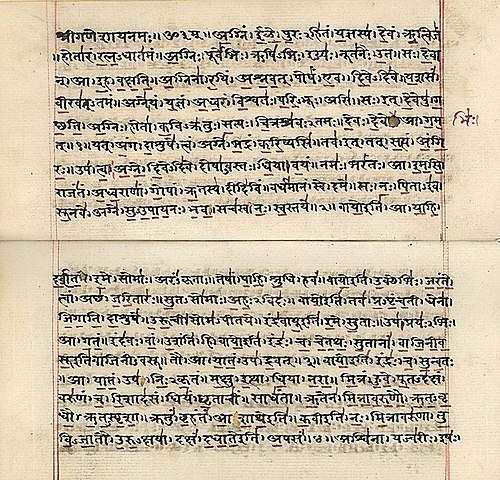
Composition of the Rigveda Begins
The oldest known Vedic Sanskrit text, the Rigveda, is composed orally by the Indo-Aryan tribes. It contains hymns to deities and reflects early Vedic society. #history #literature
Composition of the Rigveda Begins By Unknown author - http://www.nb.no/baser/schoyen/5/5.20/ms2097.jpg[dead link], Public domain, https://commons.wikimedia.org/w/index.php?curid=103513
1200 BCE
Battle of the Ten Kings
A battle described in the Rigveda (Book 7) between King Sudas of the Bharata tribe and a coalition of ten tribes. It marks the rise of the Kuru kingdom and consolidation of Vedic culture. #history #warfare
1200 BCE
Iron Working Introduced in India
Iron smelting technology appears in the Indian subcontinent, leading to stronger tools and weapons. This technological shift influences agriculture and warfare in the Vedic period. #history #technology
Iron Working Introduced in India By user:Serg!o - India (orthographic projection).svg, CC BY-SA 3.0, https://commons.wikimedia.org/w/index.php?curid=8038972
1000 BCE
Later Vedas Composed
The Yajurveda, Samaveda, and Atharvaveda are composed, expanding the Vedic corpus and introducing new hymns, rituals, and philosophical ideas. #history #literature
Later Vedas Composed By Ms Sarah Welch - Own work, CC BY-SA 4.0, https://commons.wikimedia.org/w/index.php?curid=73838568
900 BCE
Kuru Kingdom Ascendant
The Kuru tribe, centered around the Ganges-Yamuna doab, establishes one of the earliest state-like polities in India. They codify Vedic rituals and the use of iron. #history #politics
Kuru Kingdom Ascendant By Roshan Krishna Dhanawade (Srimant ROSHAN) - Own work, CC BY-SA 4.0, https://commons.wikimedia.org/w/index.php?curid=121829859
800 BCE
Composition of the Brahmanas
Prose texts explaining Vedic rituals and sacrifices are composed. They form a key part of the early Vedic literature and emphasize priestly authority. #history #religion
Composition of the Brahmanas By Ms Sarah Welch - Own work, CC BY-SA 4.0, https://commons.wikimedia.org/w/index.php?curid=73863412
700 BCE
Upanishads Composed
Philosophical texts that explore concepts like Brahman and Atman mark a shift from ritualism to spiritual inquiry. The Upanishads influence later Hindu, Jain, and Buddhist thought. #history #philosophy
Upanishads Composed By Unknown author - https://asia.si.edu/object/F2006.4/, Public domain, https://commons.wikimedia.org/w/index.php?curid=24823617
600 BCE
Emergence of Mahajanapadas
Sixteen major kingdoms or republics (Mahajanapadas) arise in northern India, including Magadha, Kosala, and Gandhara. This period sees urbanization and centralization of power. #history #politics
Emergence of Mahajanapadas By Avantiputra7 - Own work, CC BY-SA 3.0, https://commons.wikimedia.org/w/index.php?curid=33202412
500 BCE
Birth of Mahavira and Buddha
Mahavira (Jainism) and Siddhartha Gautama (Buddhism) are born in the late Vedic period. Their teachings challenge Vedic orthodoxy and lead to new religious movements. #history #religion
Birth of Mahavira and Buddha By Unknown 11th century sculptor - Seattle Art Museum: https://art.seattleartmuseum.org/objects/21127/mahavira, CC BY-SA 4.0, https://commons.wikimedia.org/w/index.php?curid=170809462
500 BCE
Panini Writes the Ashtadhyayi
The Sanskrit grammarian Panini composes the Ashtadhyayi, a systematic treatise on Sanskrit grammar. It remains a foundational work in linguistics. #history #linguistics
326 BCE
Alexander the Great Invades the Indus Valley
Alexander of Macedon crosses the Indus River and battles King Porus at the Hydaspes. This contact introduces Greek elements but also weakens local kingdoms, paving the way for the Maurya Empire. #history #warfare
Alexander the Great Invades the Indus Valley By Unknown author - This image has been extracted from another file, Public domain, https://commons.wikimedia.org/w/index.php?curid=182741814
1826 CE
Charles Masson Describes Harappa
British explorer Charles Masson visits the ruins of Harappa and mentions the site in his travelogue. He notes the high brick mounds but does not recognize their antiquity. #history #archaeology
Charles Masson Describes Harappa By Charles Masson - Ariana antiqua: a descriptive account of the antiquities and coins of Afghanistan Horace Hayman Wilson, Charles Masson East India Company, 1841, Public domain, https://commons.wikimedia.org/w/index.php?curid=54314097
1856 CE
Brick Robbers Reveal Harappan Site
British engineers building the Lahore–Multan railway use bricks from Harappa, exposing ancient structures. This leads to later archaeological interest. #history #archaeology
Brick Robbers Reveal Harappan Site By Muhammad Bin Naveed - Own work, CC BY-SA 3.0, https://commons.wikimedia.org/w/index.php?curid=35609614
1872 CE
Alexander Cunningham Visits Harappa
The first director-general of the Archaeological Survey of India, Alexander Cunningham, surveys Harappa and publishes a report. He misidentifies the site as Buddhist. #history #archaeology
Alexander Cunningham Visits Harappa By Unknown author - Reprinted in Sandes, E.W.C. (1935) The Military Engineer in India. Volume II. Institution of Royal Engineers, Chatham., Public domain, https://commons.wikimedia.org/w/index.php?curid=38877907
1921 CE
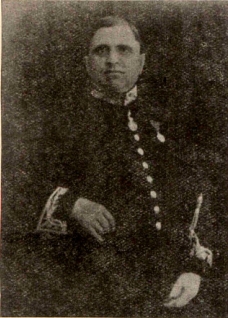
Daya Ram Sahni Excavates Harappa
Indian archaeologist Daya Ram Sahni begins systematic excavations at Harappa, uncovering seals and pottery that hint at a prehistoric civilization. #history #archaeology
Daya Ram Sahni Excavates Harappa By Unknown author - The Modern Review. May 1939, Public domain, https://commons.wikimedia.org/w/index.php?curid=115303601
1922 CE
Rakhaldas Banerjee Discovers Mohenjo-daro
Indian archaeologist Rakhaldas Banerjee excavates the site of Mohenjo-daro in Sindh, revealing impressive urban remains. The discovery confirms the existence of the Indus Valley Civilization. #history #archaeology
Rakhaldas Banerjee Discovers Mohenjo-daro By Unknown author - The Modern Review. January 1925, Public domain, https://commons.wikimedia.org/w/index.php?curid=115506129
1924 CE
John Marshall Announces Indus Civilization
Sir John Marshall, director-general of the ASI, publicly announces the discovery of a new civilization dating back to the third millennium BCE, naming it the Indus Valley Civilization. #history #archaeology )
1935 CE
Channeling of the Indus River Changes Site Access
Flood control measures in Sindh reduce groundwater levels, aiding excavations at Mohenjo-daro but also accelerating decay of exposed structures. #history #archaeology
Channeling of the Indus River Changes Site Access By Saqib Qayyum - Own work, CC BY-SA 3.0, https://commons.wikimedia.org/w/index.php?curid=31519717
1944 CE
Mortimer Wheeler Excavates Harappa
British archaeologist Mortimer Wheeler conducts excavations at Harappa, establishing a stratigraphic sequence and linking the civilization to Mesopotamia. #history #archaeology
Mortimer Wheeler Excavates Harappa By Bassano Ltd - one or more third parties have made copyright claims against Wikimedia Commons in relation to the work from which this is sourced or a purely mechanical reproduction thereof. This may be due to recognition of the "sweat of the brow" doctrine, allowing works to be eligible for protection through skill and labour, and not purely by originality as is the case in the United States (where this website is hosted). These claims may or may not be valid in all jurisdictions. As such, use of this image in the jurisdiction of the claimant or other countries may be regarded as copyright infringement. Please see Commons:When to use the PD-Art tag for more information., Public domain, https://commons.wikimedia.org/w/index.php?curid=175391535
1947 CE
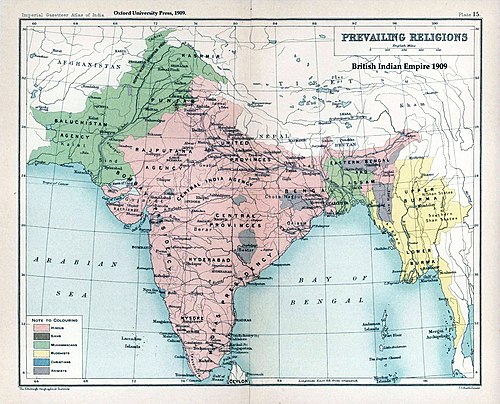
Partition of India Affects Archaeological Sites
The partition of British India places major Indus sites (Harappa, Mohenjo-daro) in Pakistan, while Indian archaeologists continue work at sites like Lothal and Kalibangan. #history #politics
Partition of India Affects Archaeological Sites By John George Bartholomew - The Imperial Gazetteer of India, Oxford University Press, 1909. Scanned from personal copy and annotated by me (Fowler&fowler«Talk» 04:16, 19 March 2007 (UTC)), Public domain, https://commons.wikimedia.org/w/index.php?curid=2786767
1950 CE
Discovery of Lothal in India
The site of Lothal in Gujarat, with a dockyard and bead-making workshops, is excavated. It provides evidence of Harappan maritime trade. #history #archaeology
Discovery of Lothal in India By Abhilashdvbk - Own work, CC BY-SA 3.0, https://commons.wikimedia.org/w/index.php?curid=20997257
1961 CE
Kalibangan Excavations Begin
Italian and Indian archaeologists excavate Kalibangan in Rajasthan, revealing a fortified Harappan settlement with fire altars and plow marks. #history #archaeology
Kalibangan Excavations Begin By Kk himalaya - Own work, Public domain, https://commons.wikimedia.org/w/index.php?curid=5292409
1974 CE
Discovery of Dholavira
The site of Dholavira in Kutch, Gujarat, is discovered. It features a sophisticated water management system and a large signboard with Indus script. #history #archaeology
Discovery of Dholavira By Lalit Gajjer - Own work, CC BY-SA 4.0, https://commons.wikimedia.org/w/index.php?curid=51450186
1990 CE
Rakhigarhi Excavations Highlight Largest Harappan Site
Excavations at Rakhigarhi in Haryana reveal it as one of the largest Harappan settlements, with evidence of urban planning and a cemetery. #history #archaeology
Rakhigarhi Excavations Highlight Largest Harappan Site By Durgeshkushvaha - Own work, CC BY-SA 4.0, https://commons.wikimedia.org/w/index.php?curid=82252324
1992 CE
Indus Script Decipherment Claims
Various scholars propose decipherments of the Indus script, but no consensus emerges. Debates continue over whether it represents a language or symbols. #history #linguistics
2000 CE
Aryan Migration Theory Gains New Evidence
Genetic and linguistic studies support the Indo-Aryan migration theory, indicating a significant population movement from Central Asia into South Asia around 1500 BCE. #history #science
2005 CE
UNESCO Declares Mohenjo-daro a World Heritage Site
Mohenjo-daro is inscribed as a UNESCO World Heritage Site, recognizing its outstanding universal value as one of the world's earliest cities. #history #heritage
2012 CE
New Insights from Harappan Skeleton Studies
Ancient DNA analysis of Harappan skeletons from Rakhigarhi provides clues about the genetic makeup and origins of the Indus people. #history #science
2015 CE
Skeleton from Rakhigarhi Reveals No Steppe Ancestry
DNA from a Harappan skeleton at Rakhigarhi indicates no steppe pastoralist ancestry, challenging the Aryan migration narrative for the decline. #history #genetics
2018 CE
Climate Change Linked to Indus Decline
Studies of ancient sediments show a weakening of the Indian monsoon around 2000 BCE, likely causing agricultural collapse and urbanization decline. #history #climate
2020 CE
New Discoveries at Rakhigarhi and Dholavira
Ongoing excavations continue to reveal more about Harappan society, including burial practices, trade networks, and urban layout. #history #archaeology
2022 CE
75th Anniversary of Partition and Shared Heritage
India and Pakistan collaborate on virtual exhibitions and joint research on the Indus Valley Civilization, emphasizing a common heritage. #history #culture