Immanuel Kant: Categorical Imperative, Critique of Pure Reason & Enlightenment Philosophy
Encyclopedia/5. Human Thought & Philosophy/1. Philosophy, Religion & Ethics/01. Eastern Philosophy & Religious Thought • Curated by Admin Timeline.sg
Immanuel Kant (1724-1804) was a German philosopher who profoundly shaped modern philosophy by synthesizing rationalism and empiricism, developing the concept of synthetic a priori knowledge, and formulating the categorical imperative as a foundation for ethics.
Chronological Storyline (41 Milestones)
Apr 22, 1724 CE
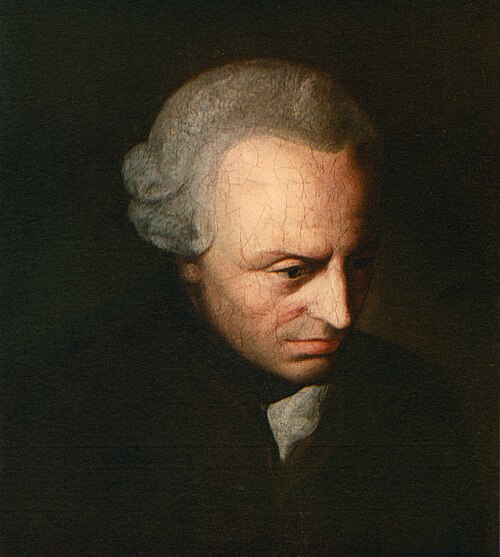
Immanuel Kant Born in Königsberg
Immanuel Kant was born in Königsberg, Prussia (now Kaliningrad, Russia) to a modest Pietist family. He spent his entire life in Königsberg. #philosophy #biography
Immanuel Kant Born in Königsberg By Johann Gottlieb Becker (1720-1782) - https://web.archive.org/web/20220308160432/https://andreasvieth.de/kant/das-bildmaterial, Public domain, https://commons.wikimedia.org/w/index.php?curid=32860677
1732 CE
Enters Collegium Fridericianum
Kant entered the Pietist Collegium Fridericianum school, where he received a rigorous education in Latin, theology, and classics. #education #philosophy
1740 CE
Enrolls at the University of Königsberg
Kant enrolled at the University of Königsberg at age 16, studying philosophy, mathematics, and physics. He was influenced by the works of Leibniz and Wolff. #philosophy #education
Enrolls at the University of Königsberg By Unknown author - Jahrbuch der Albertus-Universität zu Königsberg/Pr., Public domain, https://commons.wikimedia.org/w/index.php?curid=14797905
1746 CE
Publishes First Work on Living Forces
Kant's first publication, 'Thoughts on the True Estimation of Living Forces,' addressed the Leibnizian-Cartesian debate on the measurement of force. This work showed his early interest in metaphysics and physics. #philosophy #science
Publishes First Work on Living Forces By Immanuel Kant - http://81.169.222.198/still/kunst/pic570/391/410707346-4.jpg / http://www.kettererkunst.de/kunst/kd/details.php?obnr=410707346&anummer=391&detail=1, Public domain, https://commons.wikimedia.org/w/index.php?curid=76037090
1747 CE
Serves as a Private Tutor
Due to financial constraints, Kant worked as a private tutor for several families in the countryside, gaining practical experience but pausing his academic publications. #biography #employment
1754 CE
Essay on the Rotation of the Earth
Kant published an essay on whether the Earth's rotation has slowed due to tidal friction, anticipating later geophysical theories. #science #astronomy
1755 CE
Earns Doctorate and Publishes 'Universal Natural History'
Kant received his doctorate and published 'Universal Natural History and Theory of the Heavens,' proposing the nebular hypothesis for the formation of the solar system. #science #philosophy
Earns Doctorate and Publishes 'Universal Natural History' By Immanuel Kant - Scan of book cover, Public domain, https://commons.wikimedia.org/w/index.php?curid=76062534
1755 CE
Becomes Privatdozent at University of Königsberg
Kant began teaching as an unsalaried lecturer (Privatdozent) at the University of Königsberg, giving lectures on logic, metaphysics, ethics, mathematics, and physics. #academia #philosophy
1756 CE
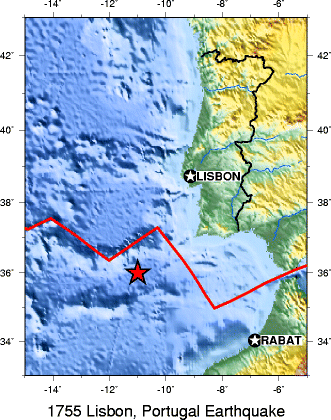
Essay on the Lisbon Earthquake
Kant wrote three essays on the 1755 Lisbon earthquake, analyzing its causes from a scientific perspective and addressing the problem of natural evil. #science #philosophy
Essay on the Lisbon Earthquake By USGS - USGS http://neic.usgs.gov/neis/eq_depot/world/1755_11_01_loc.gif archived at https://web.archive.org/web/20061124075317/http://neic.usgs.gov/neis/eq_depot/world/1755_11_01_loc.gif, Public domain, https://commons.wikimedia.org/w/index.php?curid=33929811
1762 CE
Encounter with Rousseau's Émile
Kant read Rousseau's 'Émile' and it profoundly influenced his thinking, leading him to shift emphasis from theoretical to practical philosophy. He later said that Rousseau 'set him straight.' #philosophy #ethics
Encounter with Rousseau's Émile By Jean-Jacques Rousseau (1712-1778) - http://www.allposters.com/-sp/Frontispiece-for-Emile-by-Jean-Jacques-Rousseau-1762-Posters_i1587514_.htm, Public domain, https://commons.wikimedia.org/w/index.php?curid=1860008
1763 CE
Publishes 'The Only Possible Ground of Proof for a Demonstration of God's Existence'
Kant argued against traditional proofs for God's existence while proposing a new moral argument. This work marks his departure from Leibnizian rationalism. #philosophy #religion
1764 CE
Publishes 'Observations on the Feeling of the Beautiful and Sublime'
Kant explored aesthetic and moral feelings, anticipating his later work on aesthetics. The book was popular and written in a more accessible style. #aesthetics #philosophy
Publishes 'Observations on the Feeling of the Beautiful and Sublime' By Unknown, possibly Elisabeth von Stägemann (Anton Graff school) - original from the Norwegian Digital Learning Arena (NDLA) https://ndla.no/image/43900, Public domain, https://commons.wikimedia.org/w/index.php?curid=139262788
1766 CE
Publishes 'Dreams of a Spirit-Seer'
Kant critically examined the claims of Emanuel Swedenborg about spiritual visions, distinguishing between empirical science and metaphysics. #philosophy #metaphysics
1768 CE
Essay on the Distinctness of the Principles of Natural Theology and Morality
Kant wrote an award-winning essay distinguishing the foundations of morality from theology, foreshadowing his later ethical autonomy. #philosophy #ethics
1770 CE
Appointed Professor of Logic and Metaphysics
Kant was appointed to the chair of logic and metaphysics at the University of Königsberg, after decades as a Privatdozent. He delivered his inaugural dissertation 'On the Form and Principles of the Sensible and Intelligible World.' #academia #philosophy
1770 CE
Inaugural Dissertation: Distinguishes Sensibility and Understanding
In his dissertation, Kant argued that space and time are forms of our sensibility, not properties of things-in-themselves. This laid the groundwork for his critical philosophy. #philosophy #metaphysics
1771 CE
Begins the 'Silent Decade' of Reflection
Kant entered a period of intense study and minimal publication, during which he developed the critical philosophy. He published almost nothing for nearly ten years. #philosophy #biography
Feb 21, 1772 CE
Letter to Marcus Herz Outlines Critical Project
In a famous letter, Kant outlined the problem of how a priori concepts can relate to objects, marking the birth of the critical philosophy. #philosophy #epistemology
May 1, 1781 CE
Critique of Pure Reason Published
Kant published the first edition of the 'Critique of Pure Reason,' his magnum opus, which argued for synthetic a priori knowledge and limited the scope of theoretical reason to make room for faith. #philosophy #epistemology
1783 CE
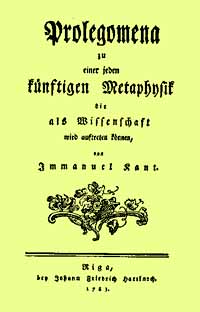
Publishes 'Prolegomena to Any Future Metaphysics'
Kant wrote the 'Prolegomena' as a more accessible summary of the 'Critique of Pure Reason,' responding to criticisms and clarifying his transcendental idealism. #philosophy #metaphysics
Publishes 'Prolegomena to Any Future Metaphysics' By Immanuel Kant - Scan of book cover, Public domain, https://commons.wikimedia.org/w/index.php?curid=76062519
1784 CE
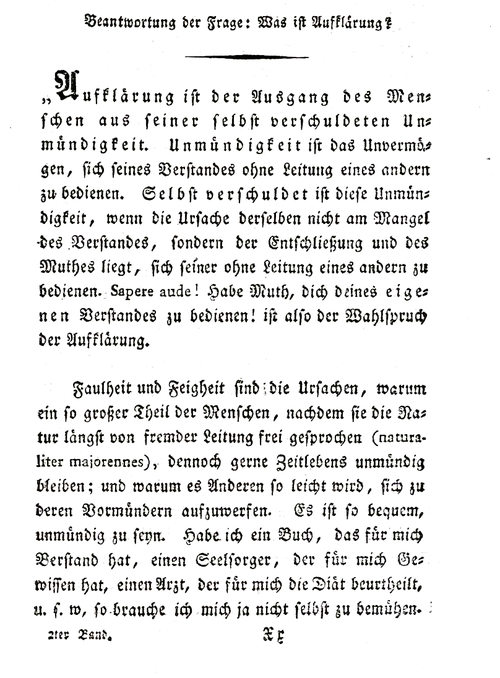
Essay 'What is Enlightenment?'
Kant famously answered the question of the age, urging individuals to think for themselves and defining enlightenment as 'man's emergence from his self-incurred immaturity.' #philosophy #enlightenment
Essay 'What is Enlightenment?' By Unknown author, Public domain, https://commons.wikimedia.org/w/index.php?curid=560663
1785 CE
Groundwork of the Metaphysics of Morals Published
Kant presented his foundational work in ethics, introducing the categorical imperative as the supreme principle of morality and emphasizing duty over inclination. #ethics #philosophy
1786 CE
Publishes 'Metaphysical Foundations of Natural Science'
Kant applied his critical principles to natural science, grounding Newtonian physics in a priori principles of matter and motion. #science #philosophy
Publishes 'Metaphysical Foundations of Natural Science' By Immanuel Kant - Scan of book cover, Public domain, https://commons.wikimedia.org/w/index.php?curid=76062491
1787 CE
Second Edition of the Critique of Pure Reason
Kant substantially revised the 'Critique of Pure Reason' for its second edition, adding a preface that refutes idealism and modifying key arguments in response to criticism. #philosophy #epistemology
1787 CE
Elected Rector of the University of Königsberg
Kant served as rector of the university, a position he held twice (1786-1787 and again later). #academia #biography
1788 CE
Critique of Practical Reason Published
Kant's second Critique established his moral philosophy on a firm rational basis, arguing for the autonomy of the will and the existence of God and immortality as postulates of practical reason. #ethics #philosophy
1790 CE
Critique of Judgment Published
The third Critique bridged Kant's theoretical and practical philosophy, exploring aesthetics and teleology. It introduced the concept of purposiveness without purpose. #aesthetics #philosophy
Critique of Judgment Published By Immanuel Kant - The Hackett edition of the Critique of Judgment, Public domain, https://commons.wikimedia.org/w/index.php?curid=76037107
1791 CE
Essay on the Failure of All Philosophical Theodicies
Kant argued that philosophical attempts to justify God's ways are impossible, emphasizing moral faith rather than speculative theodicy. #philosophy #religion
1793 CE
Religion Within the Boundaries of Mere Reason Published
Kant argued that religion should be grounded in morality rather than historical revelation. The work led to censorship by the Prussian authorities. #philosophy #religion
1794 CE
Censorship Conflict with Prussian Government
King Friedrich Wilhelm II of Prussia ordered Kant to refrain from writing on religious topics, after which Kant published less controversial works until the king's death. #politics #philosophy
1795 CE
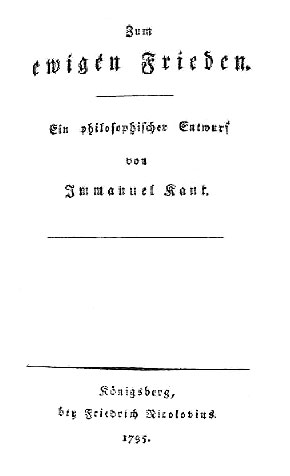
Perpetual Peace: A Philosophical Sketch Published
Kant outlined a plan for lasting peace among nations, advocating for republics, a federation of free states, and cosmopolitan rights. This work influenced modern international relations theory. #politics #philosophy
Perpetual Peace: A Philosophical Sketch Published By Kant - digital capture, Public domain, https://commons.wikimedia.org/w/index.php?curid=4262914
1797 CE
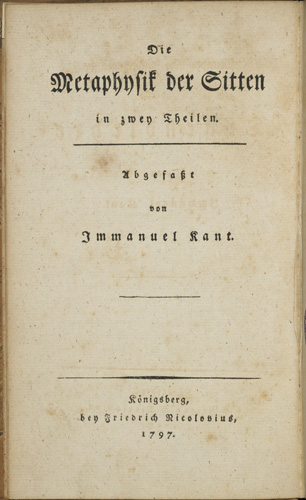
Metaphysics of Morals Published
Kant's comprehensive work on ethics divided into the 'Doctrine of Right' (political philosophy) and 'Doctrine of Virtue' (ethics proper). It systematically developed his moral theory. #ethics #politics
Metaphysics of Morals Published By Immanuel Kant - Scan of book cover, Public domain, https://commons.wikimedia.org/w/index.php?curid=76062498
1797 CE
Retires from Teaching
Kant gave his last lecture in 1796 and formally retired from the university in 1797. #academia #biography
1798 CE
Essay on the Contest of the Faculties
Kant defended the role of philosophy against the theology and law faculties, and discussed the French Revolution as a sign of moral progress. #philosophy #politics
1798 CE
Publishes 'Anthropology from a Pragmatic Point of View'
Kant compiled his lectures on anthropology, studying human nature from a practical perspective. The work examines cognition, feeling, and desire. #philosophy #psychology
Publishes 'Anthropology from a Pragmatic Point of View' By Immanuel Kant - https://archive.org/details/bub_gb_YK-WejWLAAEC/page/n7/mode/2up, Public domain, https://commons.wikimedia.org/w/index.php?curid=176344403
1800 CE
Logic (Jäsche Logic) Published
Kant's lecture notes on logic were published under his supervision, systematizing his views on formal logic and methodology. #philosophy #logic
1802 CE
Publishes 'Physical Geography' Based on Lectures
Kant's lecture notes on physical geography were published, reflecting his lifelong interest in empirical geography. #science #geography
1803 CE
Health Deteriorates
Kant's health declined rapidly in his last years; he became blind and weak, but continued to receive visitors. #biography
1803 CE
On Pedagogy Published
Kant's treatise on education emphasized the importance of discipline, cultivation, and moral training for developing rational beings. #education #philosophy )
Feb 12, 1804 CE
Death of Immanuel Kant
Kant died in Königsberg at age 79 after a period of declining health. His last words were reportedly 'Es ist gut' ('It is good'). #philosophy #biography
1804 CE
Opus Postumum Left Unfinished
Kant's unfinished manuscript, 'Opus Postumum,' attempted to bridge transcendental philosophy and empirical physics. It was published posthumously. #philosophy #science