Homological Algebra & Modules: Global Cross-Cultural Perspectives
Encyclopedia/1. The Cosmos & The Natural World/1. Mathematics & Formal Systems/02. Algebra & Symbolic Systems • Curated by Admin Timeline.sg
Homological algebra and module theory, emerging from abstract algebra in the early 20th century, have deep roots in diverse mathematical traditions. This timeline traces key developments from ancient modular ideas to modern derived categories, highlighting contributions from China, India, the Islamic world, Japan, Russia, and Europe.
Chronological Storyline (41 Milestones)
300 BCE
Chinese Remainder Theorem
The Chinese mathematician Sunzi demonstrates an early form of the Chinese remainder theorem for solving modular systems. This concept underpins modern module theory. #mathematics #history
Chinese Remainder Theorem By Cmglee - Own work, CC BY-SA 4.0, https://commons.wikimedia.org/w/index.php?curid=50938525
499 CE
Aryabhata's Modular Arithmetic
Indian mathematician Aryabhata develops algorithms for solving linear congruences, a precursor to module theory. #mathematics #india
Aryabhata's Modular Arithmetic By Cpjha13 - Own work, CC BY-SA 4.0, https://commons.wikimedia.org/w/index.php?curid=49883192
825 CE
Al-Khwarizmi's Algebra
Persian scholar Al-Khwarizmi writes 'The Compendious Book on Calculation by Completion and Balancing', laying foundations for algebraic thought. #algebra #islamicgoldenage
Al-Khwarizmi's Algebra By Zarateman - Own work, CC0, https://commons.wikimedia.org/w/index.php?curid=162213187
1545 CE
Cardano Solves Cubic
Gerolamo Cardano publishes 'Ars Magna', containing solutions to cubic and quartic equations, spurring development of group theory. #algebra #renaissance )
Oct 16, 1843 CE
Hamilton Discovers Quaternions
William Rowan Hamilton defines quaternions, the first non-commutative algebra, inspiring later module theory over rings. #algebra #history
Hamilton Discovers Quaternions By Cmglee - Own work, CC BY-SA 4.0, https://commons.wikimedia.org/w/index.php?curid=145997978
1844 CE
Grassmann's Linear Algebra
Hermann Grassmann publishes 'Die lineale Ausdehnungslehre', introducing concepts of vector spaces and linear independence. #linealgebra #mathematics
Grassmann's Linear Algebra By Unknown author - From the beginning of vol. 1 of Grassmann's collected works (1894), Public domain, https://commons.wikimedia.org/w/index.php?curid=174414110
1858 CE
Cayley Defines Matrix Multiplication
Arthur Cayley defines matrix multiplication and the Cayley–Hamilton theorem, fundamental for module theory. #matrices #algebra
Cayley Defines Matrix Multiplication By Herbert Beraud (1845–1896) - http://www-groups.dcs.st-and.ac.uk/~history/PictDisplay/Cayley.html, Public domain, https://commons.wikimedia.org/w/index.php?curid=904674
1870 CE
Kronecker on Abelian Groups
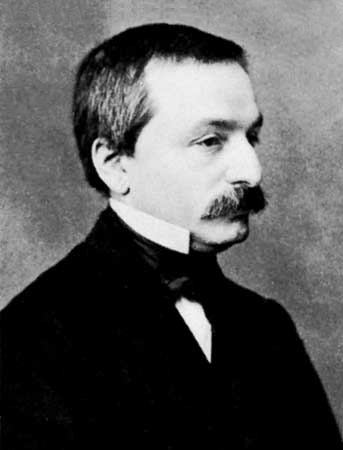
Leopold Kronecker classifies finite abelian groups, laying groundwork for module theory over PID. #grouptheory #algebra
Kronecker on Abelian Groups By Unknown author - http://www.britannica.com/EBchecked/media/28346/Kronecker-1865, Public domain, https://commons.wikimedia.org/w/index.php?curid=33753789
1880 CE
Dedekint Introduces Modules
Richard Dedekind introduces the concept of a module in number theory, studying ideals as modules over the ring of integers. #moduletheory #numbertheory
Dedekint Introduces Modules By Unknown (Mondadori Publishers) - https://www.gettyimages.co.uk/detail/news-photo/portrait-of-the-german-mathematician-richard-dedekind-1900s-news-photo/141551154, Public domain, https://commons.wikimedia.org/w/index.php?curid=41284791
1897 CE
Frobenius on Group Representations
Ferdinand Georg Frobenius develops representation theory of finite groups, intimately linked to modules over group algebras. #representationtheory #algebra
Frobenius on Group Representations By Furfur - (de): Oberwolfach Photo Collection, aus einem Fotoalbum der Mathematischen Gesellschaft (Hamburg)(en): Oberwolfach Photo Collection, from a photo album of the Mathematische Gesellschaft (Hamburg), CC BY-SA 3.0, https://commons.wikimedia.org/w/index.php?curid=59417515
1900 CE
Hilbert's Problems
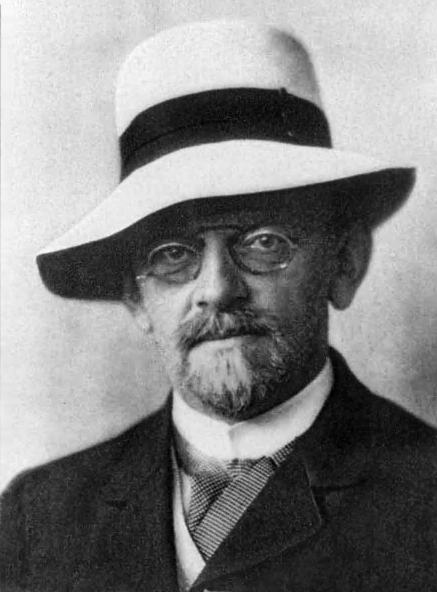
David Hilbert poses 23 problems, including the 23rd on calculus of variations, influencing abstract algebra and module theory. #mathematics #history
Hilbert's Problems By Unknown author - Possibly Reid, Constance (1970) Hilbert, Berlin, Heidelberg: Springer Berlin Heidelberg Imprint Springer, p. 230 ISBN: 978-3-662-27132-2., Public domain, https://commons.wikimedia.org/w/index.php?curid=36302
1904 CE
Wedderburn's Structure Theorem
Joseph Wedderburn proves the structure theorem for finite-dimensional simple algebras, crucial for module theory. #algebra #history
Wedderburn's Structure Theorem By Unknown author - http://www-history.mcs.st-andrews.ac.uk/Biographies/Wedderburn.html Made by Jean-Luc W, Public domain, https://commons.wikimedia.org/w/index.php?curid=1647394
1920 CE
Noether's Ideal Theory
Emmy Noether publishes groundbreaking work on ideals, later formulating the ascending chain condition. #algebra #womaninmath
Noether's Ideal Theory By Unknown authorUnknown author Publisher: Mathematical Association of America [3], Brooklyn Museum [4], Agnes Scott College [5], [6] - Emmy Noether (1882-1935), Archived, Public domain, https://commons.wikimedia.org/w/index.php?curid=158126186
1921 CE
Noether's Paper on Rings
Noether's paper 'Idealtheorie in Ringbereichen' formalizes abstract ring theory, the foundation for module categories. #ringtheory #algebra
1926 CE
Artin on Braid Groups
Emil Artin introduces braid groups, later connected to homological algebra through group cohomology. #grouptheory #topology
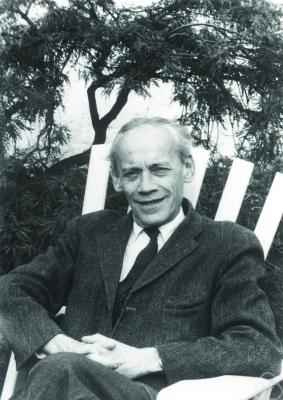
Artin on Braid Groups By Konrad Jacobs, Erlangen - Mathematisches Forschungsinstitut Oberwolfach, https://opc.mfo.de/detail?photoID=116, CC BY-SA 2.0 de, https://commons.wikimedia.org/w/index.php?curid=3898471
1932 CE
Van der Waerden's Moderne Algebra
Bartel Leendert van der Waerden publishes 'Moderne Algebra', systematizing abstract algebra and module theory. #textbook #algebra
Van der Waerden's Moderne Algebra By Bartel Leendert van der Waerden - https://archive.org/details/modernalgebra02waer/page/n5/mode/2up, Public domain, https://commons.wikimedia.org/w/index.php?curid=151846892
1940 CE
Mac Lane and Eilenberg on Categories
Saunders Mac Lane and Samuel Eilenberg introduce category theory, providing the language for homological algebra. #categorytheory #mathematics
Mac Lane and Eilenberg on Categories By User:Cepheus - Own work, based on en:Image:MorphismComposition-01.png, Public domain, https://commons.wikimedia.org/w/index.php?curid=1425613
1945 CE
Eilenberg-Steenrod Axioms
Samuel Eilenberg and Norman Steenrod axiomatize homology theory, a precursor to relative homological algebra. #topology #homology
1953 CE
Eilenberg-Moore Cohomology of Groups
Eilenberg and John Moore develop cohomology of groups using homological algebra, linking algebra and topology. #algebraictopology #grouptheory
1956 CE
Cartan-Eilenberg Homological Algebra
Henri Cartan and Samuel Eilenberg publish 'Homological Algebra', the foundational treatise on the subject. #homologicalalgebra #textbook )
1957 CE
Grothendieck's Tohoku Paper
Alexander Grothendieck publishes 'Sur quelques points d'algèbre homologique', introducing abelian categories and derived functors. #abeliancategories #derivedfunctors
1963 CE
Verdier's Derived Categories
Jean-Louis Verdier develops derived categories and triangulated categories in his PhD thesis. #derivedcategory #homologicalalgebra
1964 CE
Quillen's Model Categories
Daniel Quillen introduces model categories, connecting homotopy theory and homological algebra. #modelcategories #homotopytheory
Kunihiko Kodaira proves the vanishing theorem for sheaf cohomology, essential in algebraic geometry. #algebraicgeometry #sheaf
1970 CE
Gabriel-Zisman Calculus of Fractions
Pierre Gabriel and Michel Zisman develop categories of fractions, key for derived categories. #categorytheory #homologicalalgebra
1971 CE
Buchsbaum and Eisenbud: Koszul Complex
David Buchsbaum and David Eisenbud investigate the Koszul complex, a fundamental tool in module theory. #commutativealgebra #homologicalalgebra
1974 CE
Auslander-Buchsbaum Theorem
Maurice Auslander and David Buchsbaum prove the Auslander-Buchsbaum theorem on projective dimension. #moduletheory #commutativealgebra
1975 CE
Hochschild Cohomology
Gerhard Hochschild develops cohomology of associative algebras, central to deformation theory. #cohomology #algebra
1980 CE
Gelfand-Manin Homological Algebra
Sergei Gelfand and Yuri Manin publish 'Methods of Homological Algebra', a modern textbook. #homologicalalgebra #textbook
1982 CE
Beilinson-Bernstein-Deligne: Perverse Sheaves
Alexander Beilinson, Joseph Bernstein, and Pierre Deligne construct perverse sheaves, using derived categories. #algebraicgeometry #representationtheory
1983 CE
Kazhdan-Lusztig Conjecture
David Kazhdan and George Lusztig formulate the Kazhdan-Lusztig conjecture, relating modules to geometry. #representationtheory #moduletheory
1986 CE
Brouder-Kuroda-Kondō: Modular Tensor Categories
Work by Japanese mathematicians on modular tensor categories emerges from homological algebra and quantum groups. #categorytheory #quantum
Joseph Bernstein, Sergei Gelfand, and Israel Gelfand introduce the BGG resolution for modules over Lie algebras. #representationtheory #homologicalalgebra
1996 CE
Ringel-Hall Algebras
Claus Michael Ringel constructs Hall algebras, linking representation theory of quivers to homological algebra. #quivers #representationtheory
2000 CE
Lurie's Higher Topos Theory
Jacob Lurie develops higher topos theory, providing a framework for derived algebraic geometry. #highercategorytheory #algebraicgeometry
Kontsevich's Homological Mirror Symmetry By The original uploader was Lunch at English Wikipedia. - Transferred from en.wikipedia to Commons by Lunch. This diagram was created with Mathematica by n., CC BY-SA 2.5, https://commons.wikimedia.org/w/index.php?curid=3466278
2005 CE
Bridgeland Stability Conditions
Tom Bridgeland defines stability conditions on triangulated categories, impacting enumerative geometry. #triangulatedcategories #algebraicgeometry
2010 CE
Scholze's Perfectoid Spaces
Peter Scholze uses homological methods to introduce perfectoid spaces, linking arithmetic geometry and topology. #arithmeticgeometry #homologicalalgebra
2015 CE
MIP*=RE via Quantum Modules
Zhengfeng Ji, Anand Natarajan, Thomas Vidick, John Wright, and Henry Yuen use module theory in quantum complexity. #quantumcomputing #moduletheory