History of Science Fiction & Speculative Literature
Encyclopedia/4. Arts & Literature/1. Literature, Mythology & Folklore/01. Classical & Ancient Literature • Curated by Admin Timeline.sg
Science fiction and speculative literature have evolved from early visionary works by Jules Verne and H.G. Wells to the Golden Age masters like Isaac Asimov and Arthur C. Clarke, then through cyberpunk with William Gibson, and into modern global masterpieces by Ted Chiang and Liu Cixin, reflecting humanity's hopes, fears, and technological anxieties.
Chronological Storyline (49 Milestones)
Jan 1, 1818 CE
Mary Shelley Publishes Frankenstein
Often considered the first true science fiction novel, Frankenstein explores themes of creation, ambition, and monstrosity through a scientist who brings a creature to life. It established many tropes of the genre, including the dangers of unchecked scientific progress. #scifi #literature #gothic
Mary Shelley Publishes Frankenstein By Mary Shelley - Cropped and slightly rotated from https://www.christies.com/lot/lot-6332204, Public domain, https://commons.wikimedia.org/w/index.php?curid=160685660
Jan 1, 1865 CE
Jules Verne Publishes From the Earth to the Moon
Verne's novel about a post-Civil War gun club launching a projectile to the moon is a landmark of early hard science fiction. It predicted many aspects of space travel, including the use of Florida as a launch site and the need for a multi-stage rocket. #scifi #verne #space
Jules Verne Publishes From the Earth to the Moon By Unknown author, Public domain, https://commons.wikimedia.org/w/index.php?curid=1522641
Jan 1, 1870 CE
Jules Verne Publishes Twenty Thousand Leagues Under the Sea
This novel introduces Captain Nemo and the submarine Nautilus, blending adventure with detailed scientific speculation about the ocean depths. It remains a classic of speculative fiction, inspiring generations of marine exploration and submarine technology. #scifi #verne #adventure
Jules Verne Publishes Twenty Thousand Leagues Under the Sea By Edouard Riou (1833-1900), Alphonse Marie de Neuville (1835-1885), Jules Verne (author) - Houghton Library, Public domain, https://commons.wikimedia.org/w/index.php?curid=37326342
Jan 1, 1895 CE
H.G. Wells Publishes The Time Machine
Wells' novella popularized the concept of time travel via a mechanical device and introduced the social commentary of a future divided into Eloi and Morlocks. It is a foundational work of science fiction, exploring themes of class struggle and entropy. #scifi #wells #timetravel
H.G. Wells Publishes The Time Machine By Unknown author - https://en.wikipedia.org/wiki/File:Timemachinebook.JPG, Public domain, https://commons.wikimedia.org/w/index.php?curid=161926483
Jan 1, 1897 CE
H.G. Wells Publishes The Invisible Man
This novel tells the story of a scientist who discovers the secret of invisibility but descends into madness and crime. It examines the psychological and ethical implications of scientific power, a recurring theme in Wells' work. #scifi #wells #invisibility
H.G. Wells Publishes The Invisible Man By Unknown author - https://www.abebooks.co.uk/servlet/BookDetailsPL?bi=30289720550, Public domain, https://commons.wikimedia.org/w/index.php?curid=73629082
Jan 1, 1898 CE
H.G. Wells Publishes The War of the Worlds
Wells' tale of a Martian invasion of Earth is a seminal work of alien invasion fiction, using the narrative to critique colonialism and human hubris. Its realistic style and vivid descriptions influenced countless later works in science fiction. #scifi #wells #aliens
H.G. Wells Publishes The War of the Worlds By H. G. Wells - drzeus.best.vhw.net, Public domain, https://commons.wikimedia.org/w/index.php?curid=5893115
Jan 1, 1920 CE
Karel Čapek's R.U.R. Introduces the Word 'Robot'
Čapek's play R.U.R. (Rossum's Universal Robots) coined the term 'robot' and explored themes of artificial life, labor, and rebellion. It is a landmark in science fiction drama and robotics literature. #scifi #robots #theatre
Karel Čapek's R.U.R. Introduces the Word 'Robot' By Unknown author - Karel Čapek: R.U.R.: Rosumovi Univerzální Roboti. Vydalo Aventinum, Prague 1920.via answcdn.com, Public domain, https://commons.wikimedia.org/w/index.php?curid=41704686
Apr 1, 1926 CE
Amazing Stories Magazine Launches
Founded by Hugo Gernsback, Amazing Stories was the first magazine dedicated solely to science fiction, giving the genre its name and a platform for new writers. It sparked the pulp era and the rise of fandom. #scifi #pulp #magazine
Amazing Stories Magazine Launches By Unknown author - see above, Public domain, https://commons.wikimedia.org/w/index.php?curid=10503159
Jan 1, 1930 CE
Olaf Stapledon Publishes Last and First Men
This ambitious novel spans billions of years and multiple human species, exploring the future evolution of humanity. It influenced later writers like Arthur C. Clarke and remains a masterpiece of cosmic science fiction. #scifi #philosophy #future
Olaf Stapledon Publishes Last and First Men By Unknown author - lwcurrey, Public domain, https://commons.wikimedia.org/w/index.php?curid=191036317
Oct 30, 1938 CE
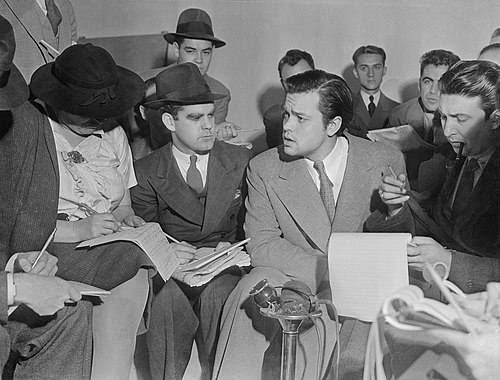
Orson Welles' War of the Worlds Radio Broadcast
Welles' radio adaptation of H.G. Wells' novel caused widespread panic among listeners who believed the Martian invasion was real. This event demonstrated the power of media and the public's susceptibility to mass hysteria. #scifi #radio #hoax
Orson Welles' War of the Worlds Radio Broadcast By Acme News Photos - eBay (archive link) front (archive link) back (archive link), Public domain, https://commons.wikimedia.org/w/index.php?curid=37849780
Jan 1, 1941 CE
Isaac Asimov Publishes 'Nightfall'
Asimov's short story about a planet in a multiple-star system that experiences darkness once every 2,049 years is considered one of the greatest science fiction stories ever written. It explores the psychological impact of cosmic revelation. #scifi #asimov #shortstory
Jan 1, 1942 CE
Isaac Asimov's Foundation Series Begins
Asimov's Foundation series, starting with the short story 'Foundation', introduced psychohistory, a mathematical method to predict the future of large populations. It became a cornerstone of science fiction, winning the Hugo Award for Best All-Time Series. #scifi #asimov #foundation
Jan 1, 1950 CE
Ray Bradbury Publishes The Martian Chronicles
A collection of interconnected stories about human colonization of Mars, blending nostalgia, social commentary, and poetic prose. It established Bradbury as a major voice in science fiction and literary fiction. #scifi #bradbury #mars
Ray Bradbury Publishes The Martian Chronicles By Jacket designer uncredited (published by Doubleday Science Fiction) Author's photograph by Morris Dollens - front cover HA.com dust jacket HA.com, Public domain, https://commons.wikimedia.org/w/index.php?curid=169597992
Jan 1, 1951 CE
Isaac Asimov Publishes Foundation (Novel)
The first full-length novel in the Foundation series, collecting earlier stories, it solidified Asimov's reputation and won a special Hugo Award for Best All-Time Series. It remains a touchstone for epic, idea-driven science fiction. #scifi #asimov #foundation
Jan 1, 1952 CE
John Wyndham Publishes The Day of the Triffids
This post-apocalyptic novel about a world blinded by a meteor shower and threatened by mobile, carnivorous plants is a classic of British science fiction. It explores themes of survival, society, and human nature. #scifi #apocalypse #plants
Jan 1, 1953 CE
Arthur C. Clarke Publishes Childhood's End
Clarke's novel about a peaceful alien invasion that leads to humanity's transcendence is a landmark of optimistic science fiction. It explores themes of evolution, utopia, and the limits of human understanding. #scifi #clarke #aliens
Jan 1, 1953 CE
Ray Bradbury Publishes Fahrenheit 451
A dystopian novel about a fireman who burns books in a future where reading is outlawed. It critiques censorship, conformity, and the role of media, becoming a staple of both science fiction and literary canons. #scifi #dystopia #censorship
Jan 1, 1956 CE
Robert A. Heinlein Publishes The Door into Summer
A time travel romance and adventure novel that showcases Heinlein's characteristic blend of engineering detail and social commentary. It remains a beloved classic of the Golden Age. #scifi #heinlein #timetravel
Robert A. Heinlein Publishes The Door into Summer By Jacket design by Mel Hunter - Front cover HA.com Dust jacket HA.com, Public domain, https://commons.wikimedia.org/w/index.php?curid=169124266
Jan 1, 1959 CE
Philip K. Dick Publishes Time Out of Joint
This novel about a man who discovers his reality is a constructed illusion is an early exploration of Dick's themes of simulated reality and identity. It foreshadows his later masterpieces like The Man in the High Castle. #scifi #dick #reality
Philip K. Dick Publishes Time Out of Joint By Arthur Hawkins - ha.com, Public domain, https://commons.wikimedia.org/w/index.php?curid=83687820
Jan 1, 1961 CE
Stanisław Lem Publishes Solaris
Lem's novel about a sentient ocean planet that manifests human memories and desires is a profound meditation on communication, consciousness, and the limits of human understanding. It is a cornerstone of philosophical science fiction. #scifi #lem #philosophy
Jan 1, 1962 CE
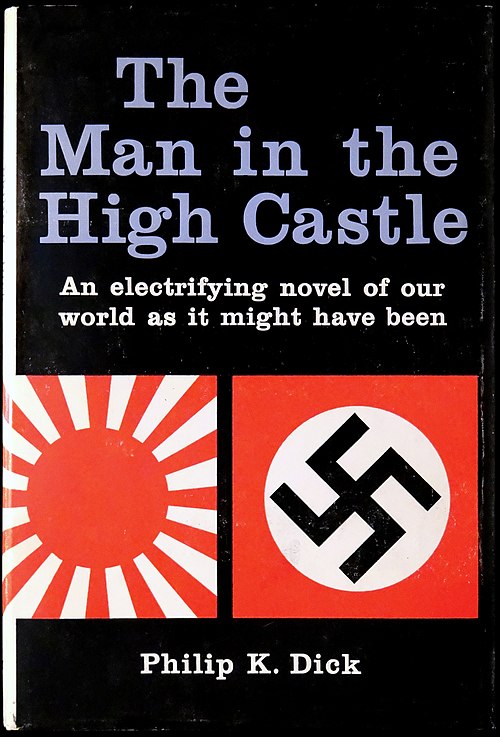
Philip K. Dick Publishes The Man in the High Castle
An alternate history novel where the Axis powers won World War II, it won the Hugo Award for Best Novel. Dick explores themes of reality, identity, and resistance within a fascist world. #scifi #dick #alternatehistory
Philip K. Dick Publishes The Man in the High Castle By Robert Galster - flickr, Public domain, https://commons.wikimedia.org/w/index.php?curid=83679962
Jan 1, 1965 CE
Frank Herbert Publishes Dune
Herbert's epic novel of politics, ecology, and religion on the desert planet Arrakis won both the Hugo and Nebula Awards. It is one of the best-selling science fiction novels of all time, known for its deep world-building and complex themes. #scifi #dune #epic
Frank Herbert Publishes Dune By John Schoenherr - https://historical.ha.com/itm/books/science-fiction-and-fantasy/frank-herbert-dune-philadelphia-and-new-york-chilton-books-1965-first-edition-signed-on-the/a/6155-45097.s, Public domain, https://commons.wikimedia.org/w/index.php?curid=192719933
Sep 8, 1966 CE
Star Trek Premieres on Television
Gene Roddenberry's original series introduced a optimistic vision of humanity's future, exploring social issues through allegory. It spawned a massive franchise and inspired generations of scientists and engineers. #scifi #startrek #tv
Apr 6, 1968 CE
Arthur C. Clarke and Stanley Kubrick Release 2001: A Space Odyssey
The film and novel, developed concurrently, revolutionized science fiction cinema with its realistic depiction of space travel and enigmatic monolith. It remains a landmark in both literature and film, exploring human evolution and artificial intelligence. #scifi #clarke #kubrick
Jul 20, 1969 CE
Apollo 11 Moon Landing
The first human moon landing realized the dreams of science fiction writers like Verne and Wells, inspiring a new wave of space-oriented stories. It marked a pinnacle of technological achievement and fueled public interest in space exploration. #space #apollo #moon
Apollo 11 Moon Landing By Neil A. Armstrong - https://tothemoon.im-ldi.com/gallery/Apollo/11/7#AS11-40-5903, Public domain, https://commons.wikimedia.org/w/index.php?curid=170640780
Jan 1, 1970 CE
Ursula K. Le Guin Publishes The Left Hand of Darkness
Le Guin's novel about a genderless alien society won both Hugo and Nebula Awards, challenging conventional notions of gender and identity. It is a seminal work of feminist science fiction and anthropological speculation. #scifi #leguin #gender
Jan 1, 1973 CE
Arthur C. Clarke Publishes Rendezvous with Rama
This novel about a mysterious cylindrical alien spacecraft entering the solar system won all major science fiction awards. It exemplifies Clarke's 'hard' science fiction style, focusing on exploration and discovery. #scifi #clarke #space
May 25, 1977 CE
Star Wars: A New Hope Released
George Lucas's space opera revitalized science fiction cinema with its mythic storytelling and groundbreaking special effects. It spawned a massive franchise and influenced countless works in the genre. #scifi #starwars #spaceopera
Jan 1, 1979 CE
Douglas Adams Publishes The Hitchhiker's Guide to the Galaxy
Adams' comedic science fiction series began as a radio drama and became a bestselling novel, blending absurdist humor with satirical commentary on human existence. It introduced iconic concepts like the number 42 and the Babel fish. #scifi #comedy #adams
Jun 25, 1982 CE
Blade Runner Released
Ridley Scott's film adaptation of Philip K. Dick's Do Androids Dream of Electric Sheep? defined the cyberpunk aesthetic with its noir, dystopian vision of Los Angeles. It raised philosophical questions about humanity and artificial life. #scifi #cyberpunk #dick
Jul 1, 1984 CE
William Gibson Publishes Neuromancer
Gibson's debut novel coined the term 'cyberspace' and launched the cyberpunk movement, blending high tech with low life. It won the Hugo, Nebula, and Philip K. Dick Awards, and its vision of a networked future proved prophetic. #scifi #cyberpunk #gibson
Jan 1, 1985 CE
Orson Scott Card Publishes Ender's Game
This novel about a child prodigy trained in military strategy to fight an alien threat won both Hugo and Nebula Awards. It explores themes of empathy, morality, and the ethics of warfare, becoming a modern classic. #scifi #card #war
Jan 1, 1985 CE
Margaret Atwood Publishes The Handmaid's Tale
Atwood's dystopian novel about a totalitarian theocracy that subjugates women is a powerful work of speculative fiction. It has become a cultural touchstone for feminist resistance and remains widely read and adapted. #scifi #dystopia #feminism
Jan 1, 1990 CE
Dan Simmons Publishes Hyperion
Simmons' novel, structured like Chaucer's Canterbury Tales, follows pilgrims on a journey to the Time Tombs on the planet Hyperion. It won the Hugo Award and is praised for its rich world-building and literary ambition. #scifi #simmons #spaceopera
Jan 1, 1992 CE
Neal Stephenson Publishes Snow Crash
Stephenson's novel blends cyberpunk, Sumerian mythology, and satire in a fast-paced story about a hacker in a near-future America. It popularized concepts like the metaverse and influenced the development of virtual reality. #scifi #cyberpunk #stephenson
Mar 31, 1999 CE
The Matrix Released
The Wachowskis' film about a simulated reality and a hacker's awakening became a cultural phenomenon, blending philosophy, action, and cyberpunk aesthetics. It popularized concepts like the simulation hypothesis and bullet time. #scifi #cyberpunk #matrix
Jan 1, 2002 CE
China Miéville Publishes Perdido Street Station
Miéville's novel is a cornerstone of the 'New Weird' movement, blending science fiction, fantasy, and horror in the city of Bas-Lag. It is known for its inventive world-building and political themes. #scifi #newweird #mievile
Jan 1, 2003 CE
Ted Chiang Publishes 'Stories of Your Life'
This novella, later adapted into the film Arrival, explores linguistic relativity and the nature of time through a linguist who learns an alien language. It won the Nebula Award and is celebrated for its intellectual depth and emotional resonance. #scifi #chiang #linguistics
Ted Chiang Publishes 'Stories of Your Life' By Hidenori Watanave from Japan - Ted Chiang's "Story of your life" Uploaded by PDTillman, CC BY 2.0, https://commons.wikimedia.org/w/index.php?curid=15949562
Jan 1, 2004 CE
Ted Chiang Publishes 'The Merchant and the Alchemist's Gate'
This time travel story set in medieval Baghdad blends Arabian Nights-style storytelling with scientific speculation. It won the Nebula Award and demonstrates Chiang's ability to merge genre with literary fiction. #scifi #chiang #timetravel
Jan 1, 2008 CE
Liu Cixin Publishes The Three-Body Problem
The first novel in Liu's Remembrance of Earth's Past trilogy introduces a chaotic alien civilization and a secret human response. It won the Hugo Award for Best Novel, bringing Chinese science fiction to global prominence. #scifi #liu #china
Jan 1, 2010 CE
Liu Cixin Publishes The Dark Forest
The second book in the trilogy expands on the 'dark forest' theory of cosmic sociology, exploring the terrifying implications of a universe filled with hidden civilizations. It deepens the series' philosophical and scientific themes. #scifi #liu #cosmology
Jan 1, 2011 CE
Ernest Cline Publishes Ready Player One
This novel about a virtual reality treasure hunt in a dystopian future became a bestseller and was adapted into a film by Steven Spielberg. It celebrates 1980s pop culture and explores themes of escapism and reality. #scifi #virtualreality #80s
Jan 1, 2014 CE
Ann Leckie Publishes Ancillary Justice
Leckie's debut novel, featuring a starship AI in a human body, won the Hugo, Nebula, and Arthur C. Clarke Awards. It challenges gender norms and explores identity, empire, and consciousness. #scifi #leckie #ai
Jan 1, 2015 CE
N.K. Jemisin Publishes The Fifth Season
The first book in Jemisin's Broken Earth trilogy, set on a world plagued by catastrophic climate change, won the Hugo Award for Best Novel three years in a row. It is praised for its innovative narrative structure and social commentary. #scifi #jemisin #fantasy
Jan 1, 2016 CE
Liu Cixin Publishes Death's End
The concluding volume of the Three-Body Problem trilogy spans millions of years and explores the ultimate fate of the universe. It completes the series' epic narrative and solidifies Liu's place as a major science fiction author. #scifi #liu #cosmology
Nov 11, 2016 CE
Arrival Film Released
Denis Villeneuve's adaptation of Ted Chiang's 'Story of Your Life' was acclaimed for its thoughtful exploration of language, time, and communication. It received multiple Oscar nominations and brought Chiang's work to a wider audience. #scifi #chiang #film
Jan 1, 2019 CE
Ted Chiang Publishes Exhalation: Stories
This collection of nine stories, including the title piece about a universe powered by air pressure, won the Locus Award and was widely praised. Chiang continues to produce intellectually stimulating and emotionally resonant speculative fiction. #scifi #chiang #shortstories
Jan 1, 2020 CE
Andy Weir Publishes Project Hail Mary
Weir's follow-up to The Martian is a hard science fiction novel about an astronaut on a mission to save Earth from a cosmic threat. It became a bestseller and is praised for its scientific accuracy and humor. #scifi #weir #space
Sep 24, 2021 CE
Foundation TV Series Premieres on Apple TV+
David S. Goyer's adaptation of Asimov's Foundation series brings the epic saga to screen with a diverse cast and updated storytelling. It introduces a new generation to the classic work, though with significant changes from the source material. #scifi #asimov #tv