Encyclopedia/5. Human Thought & Philosophy/3. Education & Knowledge Systems/01. Universities & Knowledge Institutions • Curated by Admin Timeline.sg
Historical evolution of scientific paradigms · Sociology of knowledge
Chronological Storyline (27 Milestones)
300 BCE
Mohist Canon formulates logic and empiricism
The Mohist Canon (Mo Jing) in China developed sophisticated logical doctrines, including criteria for valid inference and empirical standards for knowledge, representing an early indigenous Chinese tradition of analytic philosophy. Source — Wikipedia:
Birth places of notable Chinese philosophers of the Hundred Schools of Thoughts in the Zhou dynasty. By SY - Own work, CC BY-SA 4.0, https://commons.wikimedia.org/w/index.php?curid=65898454
300 BCE
Aristotle develops formal logic
Aristotle's Prior Analytics introduced the syllogism, establishing the first formal system of deductive logic that dominated scientific reasoning for over two millennia. · Wikipedia: https://en.wikipedia.org/wiki/Prior_Analytics
Biblioteca Medicea Laurenziana manuscripts By Sailko - Own work, CC BY 3.0, https://commons.wikimedia.org/w/index.php?curid=52174314
200 BCE
Nyaya school systematizes epistemology
The Nyaya school of Indian philosophy, founded by Gautama Aksapada, articulated rigorous epistemological frameworks defining valid means of knowledge (pramanas) including perception, inference, and testimony, forming a cornerstone of Indian logic. Source — Wikipedia:
150 CE
Ptolemy's geocentric model established
Claudius Ptolemy's Almagest presented a comprehensive mathematical model of the universe with Earth at its center, establishing a dominant scientific paradigm that persisted for nearly 1,400 years. · Wikipedia: https://en.wikipedia.org/wiki/Almagest
Almagest, a great and noble work containing all the motions of the heavens. May it go into the light under auspicious stars. By Ptolemy - http://www.univie.ac.at/hwastro/rare/1515_ptolemae.htm, Public domain, https://commons.wikimedia.org/w/index.php?curid=29985717
830 CE
Al-Khwarizmi founds algebra
Muhammad ibn Musa al-Khwarizmi's work on algebra introduced systematic methods for solving linear and quadratic equations, establishing algebra as an independent discipline and giving the field its name. · Wikipedia: https://en.wikipedia.org/wiki/Al-Khwarizmi
Monumento a Muhammad al-Juarismi en la Ciudad Universitaria de Madrid By Zarateman - Own work, CC0, https://commons.wikimedia.org/w/index.php?curid=162213187
830 CE
House of Wisdom translation movement
Under Caliph al-Ma'mun, Baghdad's House of Wisdom systematically translated Greek, Persian, and Indian scientific and philosophical texts into Arabic, synthesizing diverse intellectual traditions and preserving ancient knowledge. · Wikipedia: https://en.wikipedia.org/wiki/House_of_Wisdom
Manuscript with depiction by Yahya ibn Vaseti found in the Maqama of Hariri located at the Bibliotheque Nationale de France. Image depicts a library with pupils in it. By Zereshk - Own work, Public domain, https://commons.wikimedia.org/w/index.php?curid=2809505
1000 CE
Al-Biruni pioneers comparative methodology
Al-Biruni developed rigorous comparative and empirical methods in his studies of India, applying systematic observation, measurement, and cross-cultural analysis that anticipated modern anthropological and scientific methodology. Source — Wikipedia:
USSR stamp, Abū Rayhān al-Bīrūnī, 6 copecks, 1973. By The original uploader was Romanm at Slovenian Wikipedia. - Originally from sl.wikipedia; description page is/was here., Public domain, https://commons.wikimedia.org/w/index.php?curid=2590841
1021 CE
Ibn al-Haytham's experimental method
Ibn al-Haytham's Book of Optics insisted on systematic experimentation and empirical verification, combining controlled experiments with mathematical reasoning to establish a foundational methodology for modern science. · Wikipedia: https://en.wikipedia.org/wiki/Book_of_Optics
This picture is of the cover page of Ibn al-Haytham's "Book of Optics", 1572. By Ibn al-Haytham, Vitello, Friedrich Risner - University of Oklahoma History of Science Collections et BnF Gallica : http://gallica.bnf.fr/ark:/12148/bpt6k312873d.r=Haytham?rk=407727;2, Public domain, https://commons.wikimedia.org/w/index.php?curid=48189707
1025 CE
Ibn Sina's Canon of Medicine
Ibn Sina (Avicenna) compiled the Canon of Medicine, a systematic medical encyclopedia that codified Galenic and Islamic medical knowledge and structured diagnosis around rational principles for centuries. · Wikipedia: https://en.wikipedia.org/wiki/The_Canon_of_Medicine
The Persian manuscript copy of The Canon of Medicine in Museum and Mausoleum of Avicenna, Hamedan, Iran. By Coffeetalkh - Own work, CC BY-SA 3.0, https://commons.wikimedia.org/w/index.php?curid=11906621
1170 CE
Ibn Rushd reconciles reason and revelation
Ibn Rushd (Averroes) argued in his commentaries on Aristotle that philosophical rational inquiry and religious revelation are compatible, profoundly influencing medieval European scholasticism and the later development of secular epistemology. · Wikipedia: https://en.wikipedia.org/wiki/Averroes
Cappellone degli Spagnoli - Triumph of St. Thomas Aquinas By Sailko - Own work, CC BY 3.0, https://commons.wikimedia.org/w/index.php?curid=39974830
1265 CE
Roger Bacon advocates experimental science
Roger Bacon's Opus Majus argued forcefully for the empirical method, emphasizing that knowledge of nature must be grounded in observation and mathematical reasoning rather than authority alone. · Wikipedia: https://en.wikipedia.org/wiki/Opus_Majus
Fratris Rogeri Bacon ... Opus majus ad Clementem 4. pontificem maximum. Primum a Samuele Jebb M.D. Londini editum 1733. Nunc vero diligenter recusum. Accedit Prologus Galeatus in reliqua opera ejusdem autoris. - Venetiis : apud Franciscum Pitteri, 1750. - XL, 367, [1] p., 2 c. di tav. ripiegate, [1] c. di tav. ripiegata : ill. ; 4°. - Segn.: a-e4 A-Z8 . By Bacon, Roger - Available in the BEIC digital library and uploaded in partnership with BEIC Foundation., Public domain, https://commons.wikimedia.org/w/index.php?curid=40009328
1377 CE
Ibn Khaldun founds sociology and historiography
In the Muqaddimah, Ibn Khaldun introduced a systematic science of human society, analyzing historical causation, social cohesion (asabiyya), and the cyclical rise and fall of civilizations, founding modern historiography and sociology. · Wikipedia: https://en.wikipedia.org/wiki/Muqaddimah
The Muqaddimah of Ibn Khaldun By Riad Salih - Own work, CC BY 4.0, https://commons.wikimedia.org/w/index.php?curid=154963244
1620 CE
Bacon's Novum Organum introduces induction
Francis Bacon's Novum Organum proposed a new system of inductive reasoning based on systematic observation and experimentation, directly challenging Aristotelian deduction and laying the philosophical foundations of the scientific revolution. · Wikipedia: https://en.wikipedia.org/wiki/Novum_Organum
Title page for Novum organum scientiarum, 1645, by Francis Bacon (1561-1626). *EC.B1328.620ib, Houghton Library, Harvard University: Francis Bacon of Verulam / High Chancellor of England / New Organon (Beneath the galleon) “Many will travel and knowledge will be increased.” Leiden, Holland: at the shop of Wyngaerden and Moiardum, 1645. By Francis Bacon - Houghton Library, Public domain, https://commons.wikimedia.org/w/index.php?curid=34947014
1637 CE
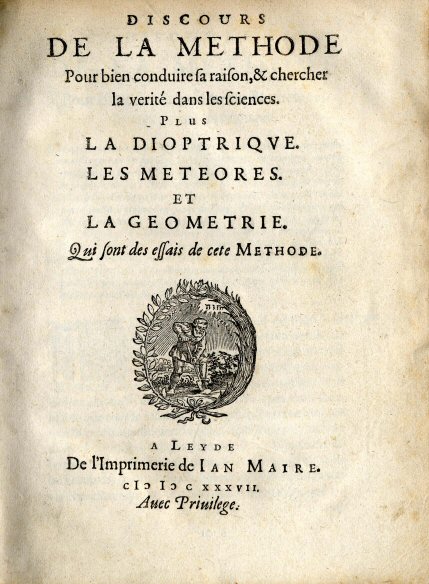
Descartes' method of systematic doubt
René Descartes' Discourse on the Method introduced methodological skepticism and rationalist deduction, establishing a new epistemological framework that sought certain knowledge through radical doubt and the principle of cogito ergo sum. · Wikipedia: https://en.wikipedia.org/wiki/Discourse_on_the_Method
Title page of the first edition of René Descartes' Discourse on Method By Ian Maire - Leeds University Library, Public domain, https://commons.wikimedia.org/w/index.php?curid=1472528COGITO ERGO SUM & METHOD OF DOUBT simple explanation ✅ | Rene Descartes
Isaac Newton's Philosophiæ Naturalis Principia Mathematica unified celestial and terrestrial mechanics under universal laws, establishing a deterministic, mechanistic paradigm that defined scientific methodology for over two centuries. · Wikipedia: https://en.wikipedia.org/wiki/Philosophi%C3%A6_Naturalis_Principia_Mathematica
Title page of the 1687 first edition of Philosophiae Naturalis Principia Mathematica, by Isaac Newton. PHILOSOPHIÆ NATURALIS PRINCIPIA MATHEMATICA. Autore IS. NEWTON, Trin. Coll. Cantab. Soc. Matheseos Professore Lucasiano, & Societatis Regalis Sodali. IMPRIMATUR. S. PEPYS, Reg. Soc. PRÆSES. Julii 5. 1686. LONDINI, Jussu Societatis Regiæ ac Typis Josephi Streater. Prostat apud plures Bibliopolas. Anno MDCLXXXVII. By The original uploader was Zhaladshar at English Wikisource. - Transferred from en.wikisource to Commons. (previous image from another copy) Internet Archive (current image from the Bern Dibner copy), Public domain, https://commons.wikimedia.org/w/index.php?curid=2681838
1739 CE
Hume's problem of induction
David Hume's A Treatise of Human Nature identified the problem of induction, questioning the logical justification for inferring universal laws from finite observations and fundamentally challenging the epistemological basis of empirical science. · Wikipedia: https://en.wikipedia.org/wiki/A_Treatise_of_Human_Nature
A TREATISE OF HUMAN NATURE: BEING AN ATTEMPT TO INTRODUCE THE EXPERIMENTAL METHOD OF REASONING INTO MORAL SUBJECTS. FOR JOHN NOON, 1739 By David Hume - http://www.sothebys.com/en/auctions/ecatalogue/2012/english-literature-history-l12408/lot.75.lotnum.html, Public domain, https://commons.wikimedia.org/w/index.php?curid=23502175David Hume's Problem of Induction (Simply Explained) 🔎
1833 CE
Whewell coins the term 'scientist'
William Whewell coined the word 'scientist' and wrote extensively on the philosophy of induction, arguing that scientific progress involves the creative integration of facts through unifying theoretical concepts he termed 'colligating concepts.' · Wikipedia: https://en.wikipedia.org/wiki/William_Whewell
- Iconographic Collections By Unknown author - https://wellcomeimages.org/indexplus/obf_images/a5/02/27077d587356a560e4d77fdaf300.jpg Gallery: https://wellcomeimages.org/indexplus/image/L0014766.html Wellcome Collection gallery (2018-04-01): https://wellcomecollection.org/works/m4vcqgcv CC-BY-4.0, CC BY 4.0, https://commons.wikimedia.org/w/index.php?curid=35971492
1890 CE
Durkheim founds sociology of knowledge
Émile Durkheim's The Rules of Sociological Method argued that social facts exist independently of individuals and must be studied empirically, establishing sociology as a rigorous science and laying groundwork for the sociology of knowledge. Source — Wikipedia:
Cover of the French edition of w:The Rules of the Sociological Method (Les règles de la méthode sociologique) By Unknown author - https://archive.org/details/lesrglesdelam00durkuoft, Public domain, https://commons.wikimedia.org/w/index.php?curid=14626239
1929 CE
Mannheim's sociology of knowledge
Karl Mannheim's Ideology and Utopia argued that knowledge is socially situated, proposing that even scientific and political thought is shaped by the social positions and historical contexts of its producers. Source — Wikipedia:
Ideology and Utopia (1923) By Karl Mannheim - https://archive.org/details/in.ernet.dli.2015.149633/page/n1/mode/2up, Public domain, https://commons.wikimedia.org/w/index.php?curid=174898666
1934 CE
Popper proposes falsifiability criterion
Karl Popper's The Logic of Scientific Discovery argued that scientific theories must be falsifiable, proposing that science advances not by verifying hypotheses but by attempting to refute them, fundamentally reshaping philosophy of science. Source — Wikipedia:
Karl Popper's Falsification
1936 CE
Merton formulates science norms
Robert K. Merton described the normative structure of science, identifying communalism, universalism, disinterestedness, and organized skepticism (CUDOS) as the institutional values governing scientific knowledge production. · Wikipedia: https://en.wikipedia.org/wiki/Mertonian_norms
1962 CE
Kuhn introduces paradigm shifts
Thomas Kuhn's The Structure of Scientific Revolutions argued that science does not progress linearly but through revolutionary paradigm shifts, transforming understanding of how scientific communities produce and change knowledge. Source — Wikipedia:
What is Paradigm Shift? (Thomas Kuhn & Postmodernism)
1975 CE
Feyerabend's epistemological anarchism
Paul Feyerabend's Against Method argued that there is no single valid scientific method, advocating epistemological anarchism and claiming that scientific progress historically relied on violating established methodological rules. Source — Wikipedia:
Against Method Front cover By Unknown author - Scan of book cover, Public domain, https://commons.wikimedia.org/w/index.php?curid=131375271
1979 CE
Latour's laboratory studies of science
Bruno Latour and Steve Woolgar's Laboratory Life applied anthropological methods to study scientists at work, arguing that scientific facts are socially constructed through laboratory practices, debates, and networks. · Wikipedia: https://en.wikipedia.org/wiki/Laboratory_Life
1985 CE
Latour develops actor-network theory
Bruno Latour and Michel Callon developed actor-network theory, which treats both human and non-human entities as actors in knowledge production, profoundly influencing science and technology studies by dissolving the nature-society divide. · Wikipedia: https://en.wikipedia.org/wiki/Actor-network_theory
1991 CE
Collins' sociology of scientific knowledge
Harry Collins' Changing Order argued that scientific knowledge is deeply shaped by social processes within expert communities, demonstrating through case studies how experimental replication depends on tacit knowledge and social negotiation. Source — Wikipedia:
A hands-on activity at the 2014 Cambridge Science Festival. By Cmglee - Own work, CC BY-SA 3.0, https://commons.wikimedia.org/w/index.php?curid=39163120
2024 CE
AI challenges epistemology of science
The rise of large language models and AI-driven scientific discovery tools has raised fundamental epistemological questions about reproducibility, algorithmic bias, and whether machine-generated knowledge constitutes genuine scientific understanding. · Wikipedia: https://en.wikipedia.org/wiki/Artificial_intelligence_in_science


![Fratris Rogeri Bacon ... Opus majus ad Clementem 4. pontificem maximum. Primum a Samuele Jebb M.D. Londini editum 1733. Nunc vero diligenter recusum. Accedit Prologus Galeatus in reliqua opera ejusdem autoris. - Venetiis : apud Franciscum Pitteri, 1750. - XL, 367, [1] p., 2 c. di tav. ripiegate, [1] c. di tav. ripiegata : ill. ; 4°. - Segn.: a-e4 A-Z8 .](https://upload.wikimedia.org/wikipedia/commons/thumb/d/d4/Bacon_-_Opus_maius%2C_1750_-_4325246.tif/lossy-page1-500px-Bacon_-_Opus_maius%2C_1750_-_4325246.tif.jpg)